LANGUAGE
 中文简体
 русский
 Français
 Español
 Português
 عربى

Content
- 1 Introduction
- 2 Understanding XLPE and PE Cable Extrusion
- 3 Core Structure of the Extrusion Machine
- 4 Key Advantages of the XLPE PE Cable Extruder
- 5 Comparison with Conventional Cable Extrusion Approaches
- 6 Manufacturing Strengths and Engineering Capabilities
- 7 How the Machine Supports a Complete Cable Production Line
- 8 Operational Benefits for Cable Manufacturers
- 9 Recommended Production Workflow
- 10 Application Fields
- 11 Factors to Consider Before Purchase
- 12 Why Choose an Integrated Supplier
- 13 Safety and Environmental Considerations
- 14 Frequently Asked Questions
- 14.1 What materials can this cable extruder process?
- 14.2 What is the purpose of the cooling water tank?
- 14.3 Can the machine produce different cable sizes?
- 14.4 How does the machine help improve insulation quality?
- 14.5 Is the extruder suitable for continuous production?
- 14.6 Can the equipment be integrated into an existing cable line?
- 14.7 What information should be supplied when requesting a quotation?
- 14.8 How often does the machine require maintenance?
- 14.9 Can the supplier assist with commissioning?
- 14.10 What standards can the finished cable comply with?
- 15 Conclusion
- 16 References
- 17 Product: XLPE PE Cable Extruder with Cooling Water Tank
Introduction
Insulation quality is one of the most important factors in the performance, safety, and service life of electrical and communication cables. Even when the conductor is manufactured correctly, an unstable insulation layer can lead to electrical leakage, poor mechanical protection, premature aging, and failure during installation or operation. For this reason, cable manufacturers require extrusion equipment that can maintain consistent material flow, precise temperature control, stable line speed, and efficient cooling throughout the production process.
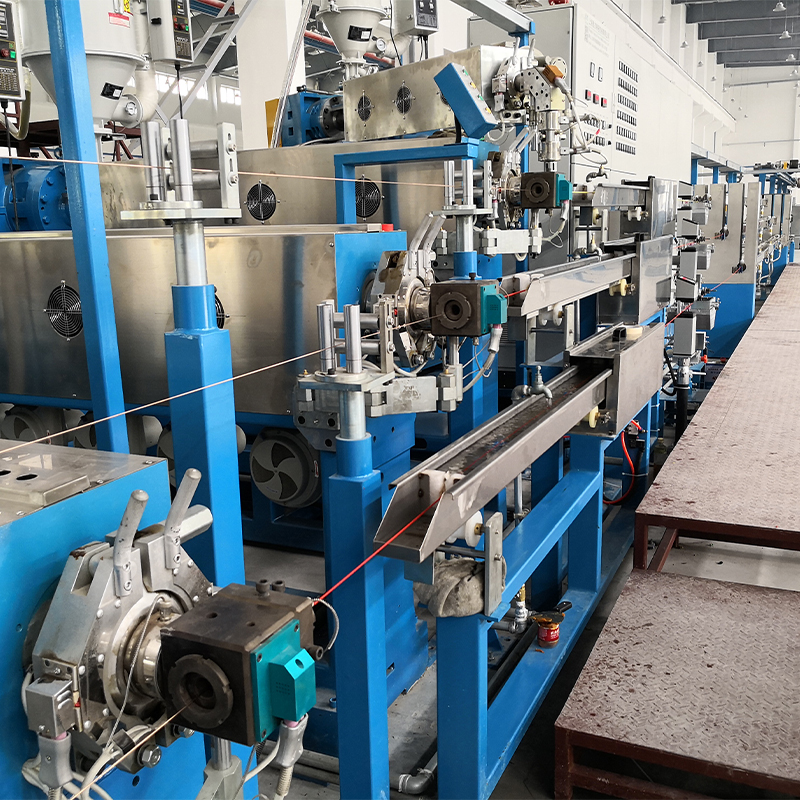
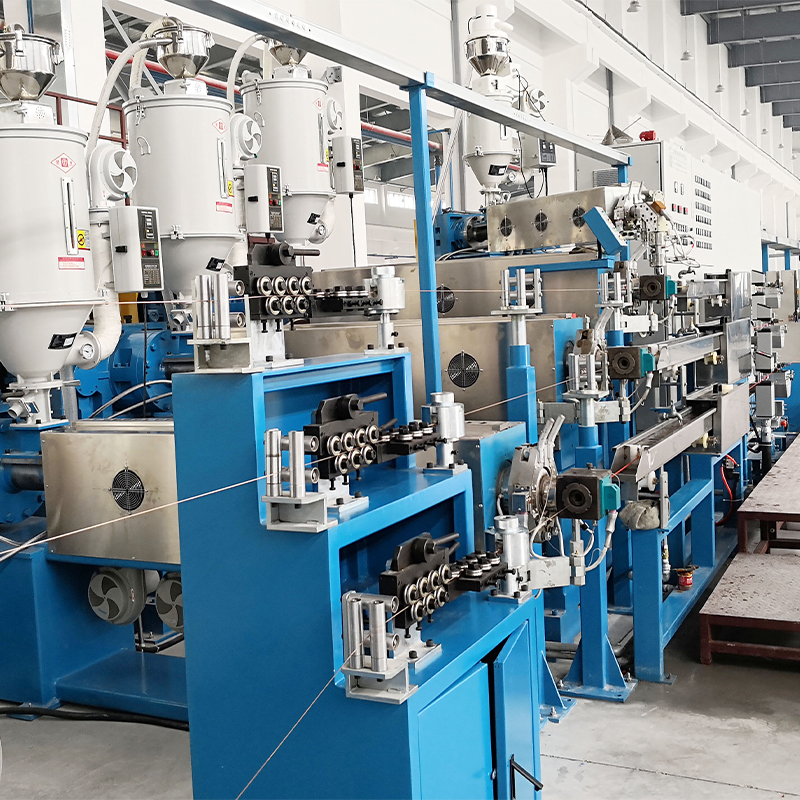
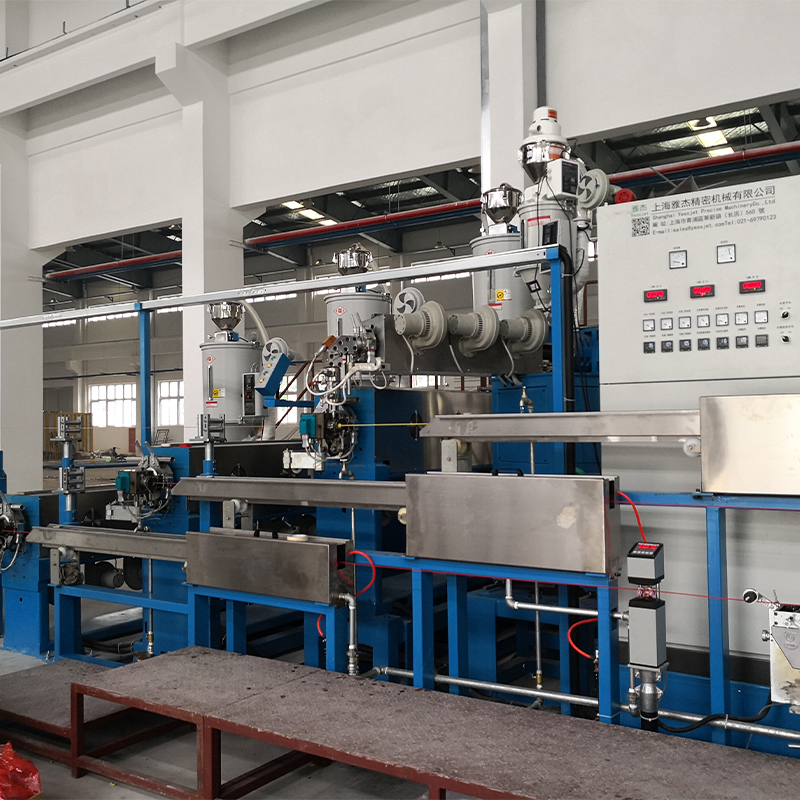
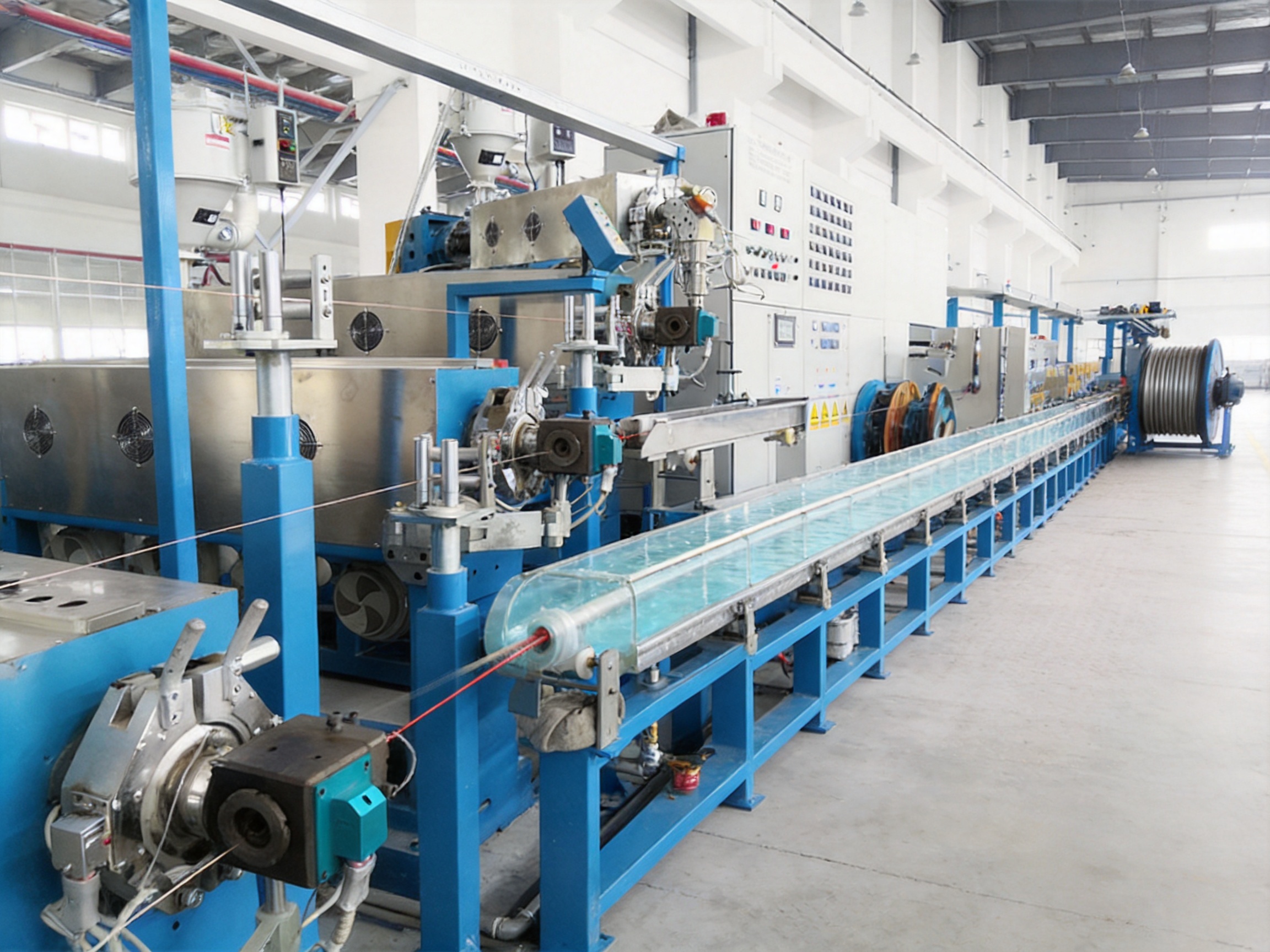
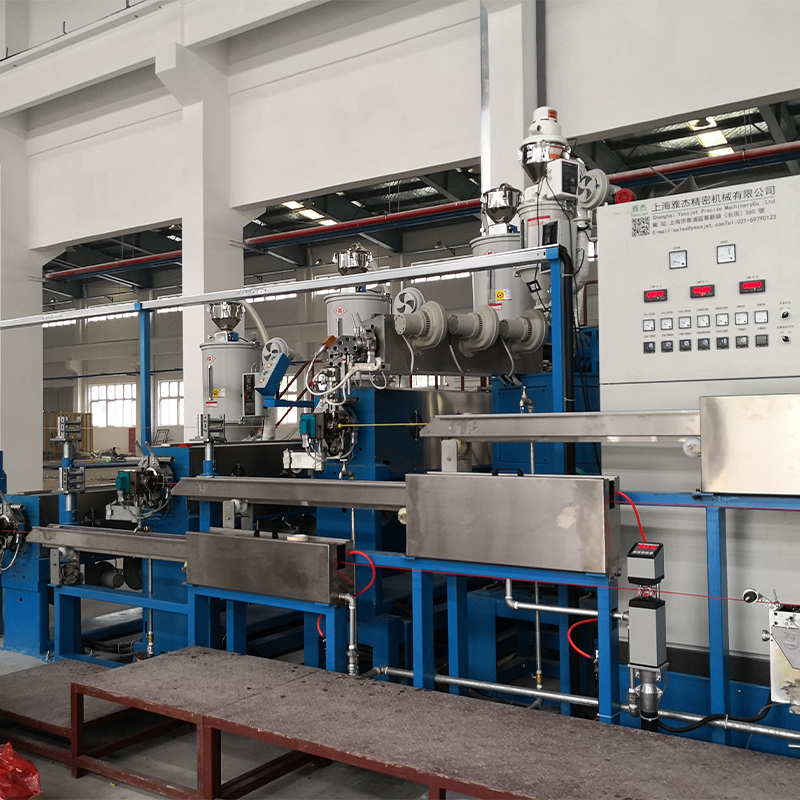
The XLPE PE Cable Extruder with Cooling Water Tank is designed to address these requirements in a single, coordinated processing system. It combines a high-precision single-screw extruder, an electrically heated temperature-control system, and a multi-section cooling water tank. Together, these assemblies support the continuous extrusion of XLPE and PE insulation around wires and cables while helping manufacturers achieve stable insulation thickness, reliable surface quality, and dependable production efficiency.
This type of equipment is suitable for power cables, communication wires, automotive cables, control cables, and other insulated conductors. It is also well suited to cable production lines that require repeatable operation across extended production shifts. By integrating extrusion and cooling into a carefully controlled process, the machine helps reduce the production problems commonly associated with uneven insulation, inadequate cooling, excessive scrap, and unstable electrical performance.
Shanghai Yessjet Precise Machinery Co., Ltd. develops wire and cable machinery for manufacturers seeking practical, reliable, and configurable production solutions. Its manufacturing approach combines mechanical processing, electrical integration, temperature-control technology, line commissioning, and application-oriented engineering. This enables the equipment to function not as an isolated extruder, but as an important part of a complete cable production system.
XLPE PE Cable Extruder with Cooling Water Tank
Understanding XLPE and PE Cable Extrusion
XLPE and PE are widely used insulation materials in the cable industry because they offer a useful balance of electrical insulation, mechanical strength, chemical resistance, and processing performance. Polyethylene-based materials can be adapted to different cable applications, conductor sizes, insulation thicknesses, and environmental requirements.
PE insulation is commonly selected for cables that require good dielectric properties, moisture resistance, and a relatively low material density. It is used in various communication, signal, data, control, and power-related cable applications. The material can be processed through extrusion when the screw, barrel, heating system, die, and cooling stages are correctly matched to the material specification.
XLPE, or cross-linked polyethylene, is used when the cable requires improved thermal performance, mechanical stability, and resistance to deformation under operating conditions. The specific processing method depends on the cable design and material formulation. In all cases, accurate extrusion control is essential because the insulation layer must maintain the designed dimensions around the conductor.
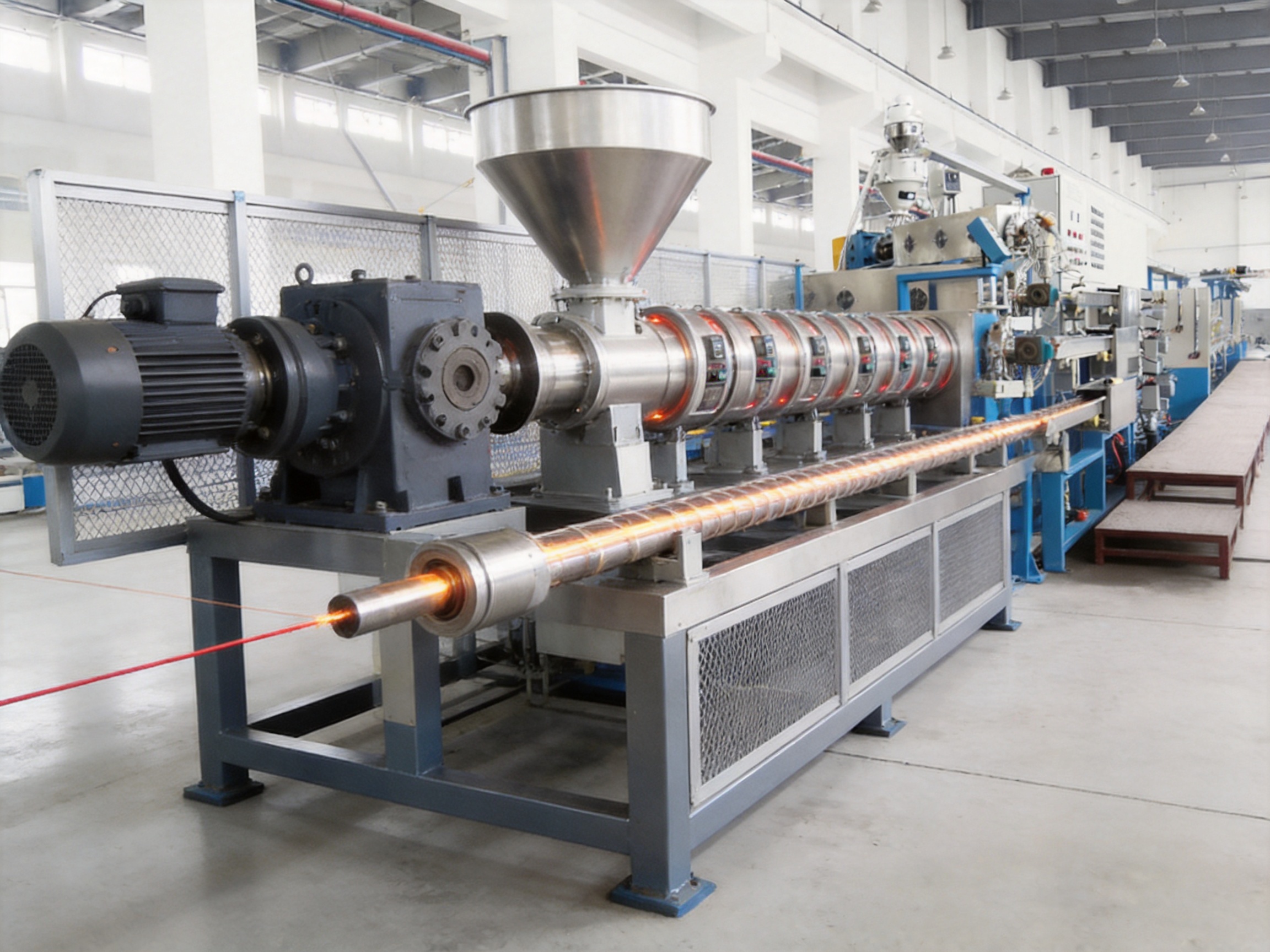
During extrusion, polymer granules or compound are fed into the extruder and transported along the heated barrel by the rotating screw. The material is gradually softened and homogenized before reaching the die head. The die then forms the molten insulation around the conductor. Immediately after leaving the die, the insulated cable passes through a cooling water tank. The cooling process stabilizes the insulation layer and allows the cable to maintain its required shape and dimensions.
If the extrusion temperature is too low, the material may not melt or mix uniformly. If the temperature is too high, the material may degrade, discolor, or produce unstable insulation. Similarly, if the cooling stage is too short or uneven, the insulation may deform before it fully stabilizes. The equipment must therefore control the entire process rather than focusing on the extruder alone.
Core Structure of the Extrusion Machine
High-Precision Single-Screw Extruder
The single-screw extruder is the central processing unit of the system. Its screw transports, melts, mixes, and pressurizes the insulation material before it enters the die head. A well-designed screw and barrel combination supports stable output, consistent melt quality, and smooth operation over long production cycles.
The screw geometry can be selected according to the material type, cable size, production speed, and required output. Screw design influences conveying efficiency, melting behavior, material residence time, and pressure stability. For XLPE and PE cable applications, the extruder must provide a controlled material flow that minimizes pulsation and supports uniform coating around the conductor.
Stable pressure is particularly important in cable insulation extrusion. Pressure fluctuations can cause variations in insulation diameter or eccentricity. The machine is therefore designed to support a balanced relationship between screw speed, material feed, melt temperature, die condition, and line speed. When these parameters are correctly matched, the production line can maintain a more consistent insulation layer throughout the cable length.
Temperature-Controlled Electrical Heating System
The electrical heating system provides controlled heat to the extruder barrel and other relevant processing zones. Instead of relying on a single general heat setting, the barrel can be divided into multiple temperature zones. Each zone can be adjusted to support the gradual heating and melting of the material as it moves toward the die.
Multi-zone heating offers several advantages. It helps prevent sudden thermal changes, supports more uniform melting, and allows the operator to adapt the process to different insulation compounds. The temperature-control system also helps reduce the risk of localized overheating, which can negatively affect material quality and cable appearance.
Accurate thermal control is essential for production repeatability. Once a suitable process recipe has been established, operators can use the same temperature settings, screw speed, and line speed as a starting point for future production runs. This shortens setup time and helps maintain consistent results between batches.
Die Head and Insulation Forming
The die head forms the molten XLPE or PE material around the conductor. Its internal flow path must be designed to distribute material evenly around the wire. Poor flow balance can create eccentric insulation, surface defects, or variations in wall thickness.
In practical operation, die selection depends on conductor diameter, insulation thickness, material characteristics, and production speed. Proper die and tip alignment is necessary to ensure that the conductor passes through the center of the insulation layer. Operators can also make adjustments during setup to optimize concentricity and surface quality.
A well-maintained die head contributes to smoother production. Regular cleaning, inspection, and dimensional verification help prevent material buildup and flow disturbances. The manufacturing and assembly quality of the die-head system also influences how easily the line can be adjusted for different cable specifications.
Multi-Section Cooling Water Tank
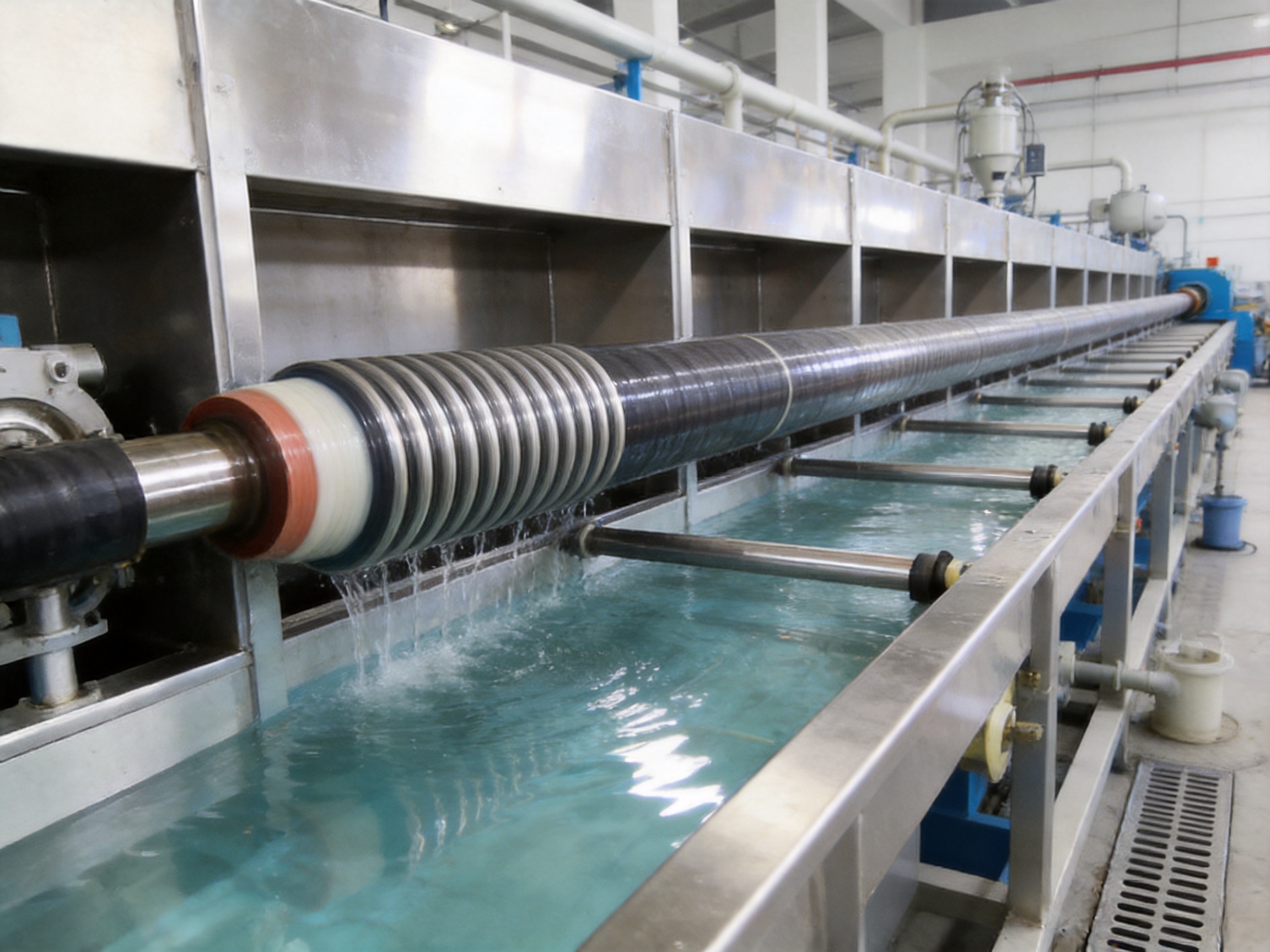
The cooling water tank stabilizes the freshly extruded insulation. The cable passes through a controlled water-cooling path after leaving the die. The use of multiple tank sections allows the cooling process to take place progressively rather than as one uncontrolled step.
Progressive cooling can help reduce thermal shock and improve dimensional stability. The first cooling section can begin reducing the temperature of the insulation, while subsequent sections continue the cooling process until the cable reaches a stable condition suitable for downstream handling, measuring, coiling, or take-up.
The length and configuration of the water tank can be adapted to the cable size, material, extrusion speed, and cooling requirements. Water circulation, water level, and tank cleanliness are important operating considerations. Stable water conditions support uniform cooling and help prevent localized deformation of the insulation surface.
Compared with a short or poorly controlled cooling arrangement, a multi-section tank provides more time and space for heat removal. This is especially valuable in continuous production, where the cable must maintain its shape at higher line speeds without excessive cooling-related defects.
Key Advantages of the XLPE PE Cable Extruder
More Consistent Insulation Thickness
One of the primary advantages of this machine is its ability to support uniform insulation thickness. Stable screw output, controlled melt temperature, accurate die forming, and consistent conductor movement work together to reduce variations in the insulation layer.
Uniform insulation is important for both electrical and mechanical reasons. Electrically, it helps maintain predictable dielectric performance. Mechanically, it ensures that the cable has a balanced protective layer around the conductor. This can improve flexibility, handling behavior, and resistance to damage during installation.
Manufacturers can further improve consistency by combining the extruder with suitable diameter measurement, spark testing, capstan, take-up, and control equipment. The extruder is therefore compatible with a broader quality-control strategy rather than being limited to manual inspection.
Improved Cooling Efficiency
The integrated water tank helps remove heat from the insulation in a controlled and continuous manner. Efficient cooling reduces the time required for the cable to become stable and supports higher line productivity when the process parameters are properly configured.
Improved cooling can also reduce deformation, surface waviness, and dimensional changes after the cable leaves the die. This is particularly important for cables with relatively thick insulation or for materials that require careful thermal management.
Stable Electrical Performance
Inconsistent insulation thickness, voids, surface damage, and material degradation can reduce electrical reliability. By supporting a controlled extrusion environment, the machine helps manufacturers produce insulation with more stable physical structure and predictable dielectric behavior.
The equipment is intended for applications that require attention to cable quality and compliance with recognized industry requirements. Depending on the cable design and production process, manufacturers can use appropriate testing equipment to verify conductor resistance, insulation resistance, spark performance, dimensional accuracy, and other relevant properties.
Adaptability to Different Cable Applications
The machine can be configured for a range of XLPE and PE insulated cable applications. Production variables may include conductor size, insulation diameter, material formulation, line speed, and target output. The flexibility of the screw, heating zones, die tooling, cooling tank, and line controls allows the equipment to support different production requirements.
This adaptability is useful for manufacturers that produce multiple cable types rather than operating a single high-volume product line. A properly planned extrusion system can reduce the need for separate machines for every cable specification, while still allowing the operator to use dedicated tooling and process settings where necessary.
Lower Production Waste
Scrap can result from startup instability, incorrect temperature settings, uneven material flow, poor cooling, or frequent line interruptions. The machine’s coordinated design helps reduce these causes by giving operators better control over the extrusion process.
Lower waste provides direct cost benefits through reduced material consumption. It also improves production sustainability by lowering the amount of rejected cable that must be recycled or discarded. Stable startup procedures and repeatable process recipes can further improve material utilization over time.
Suitable for Continuous Production
Cable manufacturing is generally a continuous process. Interruptions can create material waste, reduce equipment utilization, and make it more difficult to maintain consistent product quality. The XLPE PE Cable Extruder is designed for continuous operation when properly installed, maintained, and operated within its rated specifications.
The combination of a stable extruder, reliable heating, controlled water cooling, and compatible downstream equipment supports uninterrupted cable movement. This makes the system suitable for production environments where operating efficiency and repeatability are important.
Comparison with Conventional Cable Extrusion Approaches
Traditional or lower-cost extrusion arrangements may rely on simplified heating systems, limited cooling space, manual adjustment, or loosely integrated components. Such arrangements can be suitable for basic applications, but they may create difficulties when manufacturers need higher dimensional accuracy, greater output, or more consistent production quality.
| Evaluation Area | Basic Extrusion Arrangement | XLPE PE Extruder with Cooling Water Tank |
|---|---|---|
| Material melting | May depend on limited heating zones and less precise adjustment | Multi-zone electrical heating supports gradual and controlled melting |
| Insulation thickness | More sensitive to pressure and temperature fluctuations | Stable screw output and controlled forming help improve consistency |
| Cooling performance | May use a short or basic cooling section | Multi-section water tank supports progressive and efficient cooling |
| Production flexibility | May require extensive manual changes between products | Adjustable process parameters and tooling support multiple cable types |
| Startup waste | Can be higher because of slower stabilization | Controlled temperature and cooling can shorten stabilization time |
| Continuous operation | May be affected by unstable thermal or mechanical conditions | Integrated systems support longer and more consistent production runs |
| Process repeatability | Often depends heavily on operator experience | Defined recipes and coordinated controls improve repeatability |
The main competitive advantage of the equipment is not simply the presence of an extruder or a water tank. It is the coordination of the complete process. Melting, pressure generation, die forming, cable movement, and cooling must operate as a unified system. When these stages are properly matched, manufacturers can achieve a more predictable production result than with separate, loosely coordinated machines.
Manufacturing Strengths and Engineering Capabilities
Application-Oriented Equipment Design
Shanghai Yessjet Precise Machinery Co., Ltd. focuses on wire and cable machinery, including extrusion lines, coiling equipment, take-up and pay-off machinery, stacking systems, and related accessories. This product specialization provides valuable knowledge of the complete cable production environment.
An extrusion machine should not be selected only according to extruder output. It must also match the conductor pay-off, traction or capstan system, measuring equipment, spark tester, take-up unit, and final packaging requirements. A manufacturer with experience across these areas can better evaluate the interaction between individual machines and recommend a more balanced line configuration.
Mechanical Manufacturing and Assembly
The quality of an extrusion machine depends on the accuracy and stability of its mechanical structure. The frame, barrel assembly, screw drive, die support, water tank, cable guide, and adjustment mechanisms must be assembled with attention to alignment and rigidity.
Mechanical stability helps reduce vibration and unwanted movement during production. Proper alignment also supports smoother cable travel through the die and cooling path. These details can directly affect insulation concentricity, surface appearance, and the service life of moving components.
Manufacturing processes may include component preparation, machining, welding, surface treatment, assembly, inspection, and functional testing. Each stage contributes to the final performance of the machine. Attention to fit, tolerance, fastener security, and accessibility for maintenance helps create equipment that is practical for daily industrial use.
Electrical Integration and Control
The electrical system connects the heating zones, temperature sensors, drive motor, control panel, water circulation components, and safety functions. Proper electrical integration makes the machine easier to operate and helps the operator understand the current production condition.
A well-organized control system can display key operating values such as zone temperatures, screw speed, running status, alarm conditions, and other available parameters. This information supports faster troubleshooting and more consistent production adjustments.
Electrical integration is also important for safety. Emergency-stop functions, overload protection, temperature alarms, and appropriate interlocks can help reduce operational risks. The exact control architecture depends on the machine configuration and the customer’s requirements, but the guiding principle is consistent: the machine should provide clear feedback and predictable responses.
Process Commissioning
Equipment commissioning is an important part of cable extrusion machinery supply. Installation alone does not guarantee product quality. The screw speed, temperature profile, die dimensions, conductor tension, line speed, water flow, and take-up speed must be coordinated during initial operation.
Commissioning helps identify the correct production window for each material and cable size. It also gives operators practical experience with startup, shutdown, material changes, die adjustment, cooling control, and routine inspection.
For export customers, the supplier’s ability to provide clear technical documentation and remote or on-site support can be particularly valuable. Good commissioning reduces the learning curve and helps manufacturers reach stable production more efficiently.
How the Machine Supports a Complete Cable Production Line
The XLPE PE Cable Extruder with Cooling Water Tank normally operates as part of a larger production line. The conductor may first be unwound from a motorized pay-off unit. It then enters the extrusion section, where the insulation material is applied. After cooling, the cable can pass through diameter measurement, spark testing, capstan traction, marking, take-up, coiling, or packaging equipment.
The pay-off unit must provide smooth and stable conductor delivery. Excessive tension can stretch or damage the conductor, while insufficient tension can cause unstable movement through the die. A motorized pay-off system can help maintain better control over conductor feeding, especially for longer production runs.
At the downstream end, the take-up or coiling equipment must collect the insulated cable without creating excessive tension, bending, or surface damage. The speed of the take-up system must remain synchronized with the extrusion line. A mismatch can cause cable accumulation, stretching, or production interruptions.
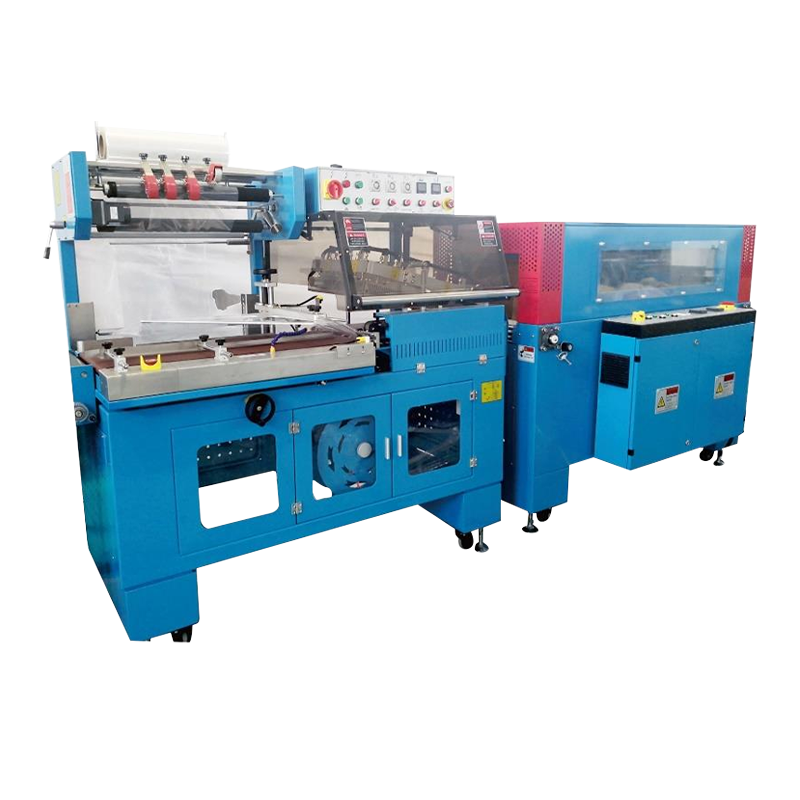
For customers requiring a complete solution, the extrusion machine can be integrated with related cable production equipment. This approach can simplify project coordination because the supplier can consider the relationship between extrusion, cooling, traction, take-up, coiling, and packaging from the beginning of the project.
Operational Benefits for Cable Manufacturers
Faster Production Stabilization
When heating zones, screw speed, and cooling sections are properly coordinated, the machine can reach a stable process condition more efficiently. This is beneficial during startup, product changes, and restart after planned maintenance.
Faster stabilization reduces the length of off-specification cable produced before normal conditions are reached. It also allows operators to spend less time making repeated manual adjustments.
Repeatable Production Recipes
Different cable specifications require different combinations of temperature, speed, tooling, and cooling settings. Recording successful production parameters allows operators to create repeatable process recipes.
Recipe-based operation helps reduce dependence on individual operator experience. Skilled operators remain important, but documented settings provide a reliable foundation for training, shift changes, and repeat orders.
Improved Maintenance Planning
Like any industrial machine, the extruder requires regular maintenance. Important areas include the screw and barrel, die head, heating elements, temperature sensors, drive system, water tank, pumps, filters, guides, and electrical cabinet.
A planned maintenance program can reduce unexpected downtime. Operators should inspect for material leakage, unusual vibration, abnormal noise, temperature instability, water contamination, and wear on cable-contact surfaces. Early attention to these signs can prevent more serious failures.
Support for Quality Management
Stable equipment is an important foundation for an effective quality-management system. When production parameters are controlled and recorded, manufacturers can more easily investigate deviations, compare batches, and establish corrective actions.
Quality checks may include conductor diameter, insulation diameter, eccentricity, insulation resistance, spark-test performance, tensile properties, elongation, visual appearance, and other requirements defined by the product specification. The extruder does not replace testing, but it helps create more consistent material for testing and final approval.
Recommended Production Workflow
1. Material Preparation
Operators should confirm that the XLPE or PE material is suitable for the selected cable application and extrusion system. Material should be stored according to the supplier’s recommendations and protected from contamination and moisture where applicable.
2. Tooling Selection
The die and tip should match the conductor size and target insulation thickness. Tooling must be clean, correctly assembled, and aligned before production begins.
3. Heating and Preheating
The barrel and die zones should be heated gradually to the selected operating temperatures. The machine should not be forced to process material before the thermal system has reached a stable condition.
4. Conductor Threading
The conductor should be threaded through the pay-off, guide system, die, cooling tank, traction section, and take-up unit. Alignment should be checked carefully to prevent rubbing, bending, or eccentric movement.
5. Initial Extrusion
Material feed and screw speed should be increased in a controlled manner. The operator should observe melt pressure, surface condition, insulation diameter, and the position of the conductor within the insulation.
6. Cooling Adjustment
Water flow, water level, and cooling-section conditions should be adjusted according to cable size and line speed. The goal is to cool the insulation sufficiently without causing unnecessary thermal shock or deformation.
7. Quality Verification
Once the line is stable, the operator should verify key dimensions and electrical properties. If adjustments are required, they should be made systematically rather than changing several variables at the same time.
8. Continuous Operation
During production, operators should monitor temperature, screw speed, line speed, water conditions, cable appearance, and take-up performance. Consistent monitoring helps identify deviations before they result in extensive scrap.
Application Fields
The XLPE PE Cable Extruder with Cooling Water Tank can be used in several cable manufacturing sectors. In power cable production, it supports the application of insulation around conductors used for electrical distribution and equipment connection. In communication cable production, PE insulation can help provide stable dielectric performance and moisture resistance.
Automotive wire manufacturers can use suitable extrusion configurations for wires that require consistent dimensions, reliable insulation, and continuous production capability. Control and instrumentation cables can also benefit from accurate insulation forming, particularly where multiple conductors and strict identification requirements are involved.
The machine may also be suitable for specialized wire products, depending on the material formulation, conductor design, insulation thickness, tooling, and required operating range. A technical review should be completed before ordering to confirm the correct screw diameter, output, die range, cooling length, line speed, and downstream configuration.
Factors to Consider Before Purchase
Manufacturers should define the target cable range before selecting an extrusion machine. Important information includes conductor material, conductor diameter, insulation material, insulation thickness, finished cable diameter, required line speed, expected output, production volume, and applicable standards.
Material behavior should also be considered. Different XLPE and PE compounds may have different melting ranges, processing temperatures, flow characteristics, and cooling requirements. The machine should be configured around the actual material to be used rather than relying only on a general equipment category.
Factory layout is another important factor. The equipment requires adequate space for pay-off, extrusion, cooling, traction, testing, take-up, maintenance access, and operator movement. Utilities such as electrical power, cooling water, ventilation, and compressed air should be evaluated in advance.
Customers should also consider future expansion. If the product range may grow, it can be beneficial to select a line with suitable adjustment range, interchangeable tooling, accessible controls, and compatible downstream interfaces.
Why Choose an Integrated Supplier
An integrated machinery supplier can provide advantages beyond the delivery of an individual extruder. The supplier can review the complete production flow, coordinate machine interfaces, recommend compatible auxiliary equipment, and help reduce integration problems during installation.
Shanghai Yessjet Precise Machinery Co., Ltd. offers a range of wire and cable machinery, including cable extrusion equipment, coiling machines, motorized pay-off units, motorized take-up units, accessory equipment, and intelligent stacking solutions. This broader product capability supports customers that require a complete or partially integrated cable production line.
Manufacturing strength is also reflected in the supplier’s ability to customize equipment according to production objectives. Customization may involve line arrangement, cooling configuration, tooling range, control functions, cable size, production speed, take-up method, or packaging interface. The exact scope should be confirmed through technical discussion and a formal specification.
For cable manufacturers, the value of a machine is determined by its performance over time. Reliable engineering, accessible maintenance, practical controls, suitable components, and responsive technical support all contribute to the total cost of ownership. A machine that produces consistent cable with limited downtime can provide greater long-term value than equipment selected only on the basis of initial purchase price.
Safety and Environmental Considerations
Operators should be trained before using the extrusion line. The barrel, die, and heated components can reach high temperatures, while the rotating screw and moving cable line create mechanical hazards. Guards, emergency stops, warning labels, and safe operating procedures should be used consistently.
Water management is also important. The cooling tank should be kept clean, and water quality should be monitored to reduce deposits, blockage, corrosion, or contamination. Proper drainage and housekeeping help maintain a safe working environment.
Energy efficiency can be improved through suitable insulation of heated zones, optimized temperature settings, regular maintenance, and stable production scheduling. Reducing startup waste and rejected cable also supports more responsible use of raw materials.
Frequently Asked Questions
What materials can this cable extruder process?
The machine is designed for XLPE and PE cable insulation applications. The exact process window depends on the selected compound, conductor size, insulation thickness, screw configuration, die tooling, and operating parameters. Material compatibility should be confirmed before production.
What is the purpose of the cooling water tank?
The cooling water tank removes heat from the freshly extruded insulation and helps the cable maintain its designed dimensions. A multi-section tank supports progressive cooling, which can improve dimensional stability and reduce deformation during continuous production.
Can the machine produce different cable sizes?
Yes, the production range can be adjusted through suitable screw specifications, die and tip combinations, line-speed settings, and cooling conditions. The actual diameter range depends on the machine model and configuration selected for the customer.
How does the machine help improve insulation quality?
It combines controlled material feeding, stable screw output, multi-zone heating, accurate die forming, and progressive water cooling. These functions help reduce uneven insulation thickness, surface instability, and dimensional variation.
Is the extruder suitable for continuous production?
Yes. It is designed for continuous cable extrusion when operated within its rated capacity and supported by suitable pay-off, traction, testing, and take-up equipment. Correct maintenance and process monitoring are essential for reliable long-term operation.
Can the equipment be integrated into an existing cable line?
Integration may be possible depending on the existing line speed, cable path, control system, pay-off, take-up, and available installation space. A technical assessment should be completed to verify mechanical, electrical, and process compatibility.
What information should be supplied when requesting a quotation?
Customers should provide the cable type, conductor diameter, insulation material, insulation thickness, finished diameter, desired line speed, expected output, power requirements, applicable standards, and preferred take-up or coiling method. Product samples or technical drawings may also help improve configuration accuracy.
How often does the machine require maintenance?
Maintenance frequency depends on operating hours, material type, production conditions, and the machine configuration. Daily inspection, regular cleaning, lubrication where applicable, electrical checks, water-tank maintenance, and periodic inspection of screw, barrel, die, and sensors are recommended.
Can the supplier assist with commissioning?
Technical commissioning and operating guidance can be arranged according to the project requirements. Commissioning typically includes machine inspection, parameter setup, material trial, cable threading, cooling adjustment, product verification, and operator instruction.
What standards can the finished cable comply with?
The machine is intended to support cable production for applications governed by recognized standards such as IEC, GB, and ANSI requirements. Final compliance depends on the cable design, raw materials, tooling, process settings, testing procedures, and the manufacturer’s quality system.
Conclusion
The XLPE PE Cable Extruder with Cooling Water Tank provides a practical solution for manufacturers that require stable insulation extrusion, efficient cooling, and repeatable cable quality. Its high-precision single-screw extruder supports controlled material processing, while the electrically heated multi-zone system helps maintain a stable thermal profile. The multi-section water tank then cools and stabilizes the insulation before the cable moves to downstream testing, take-up, coiling, or packaging equipment.
Compared with basic extrusion arrangements, the integrated design offers advantages in insulation consistency, cooling efficiency, production flexibility, startup control, and continuous operation. These benefits can help manufacturers reduce waste, improve electrical reliability, and maintain more predictable production results.
The strength of the equipment is further supported by the engineering and manufacturing capabilities of Shanghai Yessjet Precise Machinery Co., Ltd. Its experience with extrusion machinery, pay-off systems, take-up equipment, coiling machines, accessories, and intelligent cable-line solutions allows it to approach equipment supply from a complete production perspective.
For manufacturers evaluating a new cable extrusion line, the most important step is to match the machine configuration with the intended cable range, material characteristics, production speed, quality requirements, and future expansion plans. With proper technical planning, commissioning, and maintenance, the XLPE PE Cable Extruder with Cooling Water Tank can become a dependable foundation for modern wire and cable manufacturing.
References
International Electrotechnical Commission. Cable insulation, testing, and performance requirements applicable to electrical and communication cable products.
American National Standards Institute. General guidance for wire, cable, insulation, and electrical product performance requirements.
General Administration of Quality Supervision, Inspection and Quarantine of the People’s Republic of China. National standards and technical requirements for wire and cable manufacturing.
Plastics extrusion engineering references covering single-screw extruder design, polymer melting, die flow, temperature control, and cooling processes.
Industrial cable manufacturing references covering conductor preparation, insulation extrusion, dimensional control, spark testing, take-up, coiling, and packaging.
Manufacturer technical documentation for XLPE and PE insulation compounds, including recommended processing temperatures, cooling conditions, and material-handling procedures.