LANGUAGE
 中文简体
 русский
 Français
 Español
 Português
 عربى
Content
- 1 The Role of Automatic Coiling in LAN Cable Production
- 2 Designed for Mainstream LAN Cable Categories
- 3 Net-Type Coiling for Better Organization
- 4 Coils With or Without a Center Hole
- 5 Technical Specifications
- 6 Advantages Over Manual and Less Flexible Winding Methods
- 7 Manufacturing and Engineering Strengths
- 8 Production Workflow Using the Cross Winder
- 9 Quality, Safety, and Maintenance Considerations
- 10 Benefits for Cable Manufacturers and Packaging Operations
- 11 Why the Cross Winder Is a Practical Competitive Choice
- 12 Purchasing and Application Recommendations
- 13 Frequently Asked Questions
- 13.1 What types of cable can the Cross Winder process?
- 13.2 Can the machine make a coil without a center hole?
- 13.3 Can the center-hole size be changed?
- 13.4 What is the maximum listed speed?
- 13.5 What is the difference between DCW-2540 and DCW-2540P?
- 13.6 What are the listed coil dimensions?
- 13.7 Is the machine suitable for a factory that produces several cable types?
- 13.8 How does net-type winding benefit the finished cable?
- 13.9 Can the machine be integrated into a larger cable production line?
- 13.10 What should be checked before selecting a model?
- 13.11 How can manufacturers maintain consistent winding quality?
- 13.12 Who supplies this equipment?
- 14 Conclusion
- 15 References
- 16 Product: Cross Winder For LAN Cable
In modern data communication infrastructure, LAN cable manufacturers must deliver products that are not only electrically reliable but also neatly packaged, easy to transport, and ready for efficient installation. A cable may meet all performance requirements, yet poor winding quality can still create problems during storage, shipping, and field deployment. Tangled coils, uneven layers, excessive tension, and packaging that does not match the cable shape can increase handling time and reduce the overall value of the finished product.
The Cross Winder for LAN Cable is designed to address these practical challenges. It automatically coils LAN cables into a neat net-type structure, helping manufacturers improve packaging consistency while reducing dependence on manual labor. The machine is suitable for mainstream twisted-pair cable categories such as Cat5, Cat5e, and Cat6. It can also be used with coaxial cable, providing additional flexibility for cable production facilities that handle more than one product family.
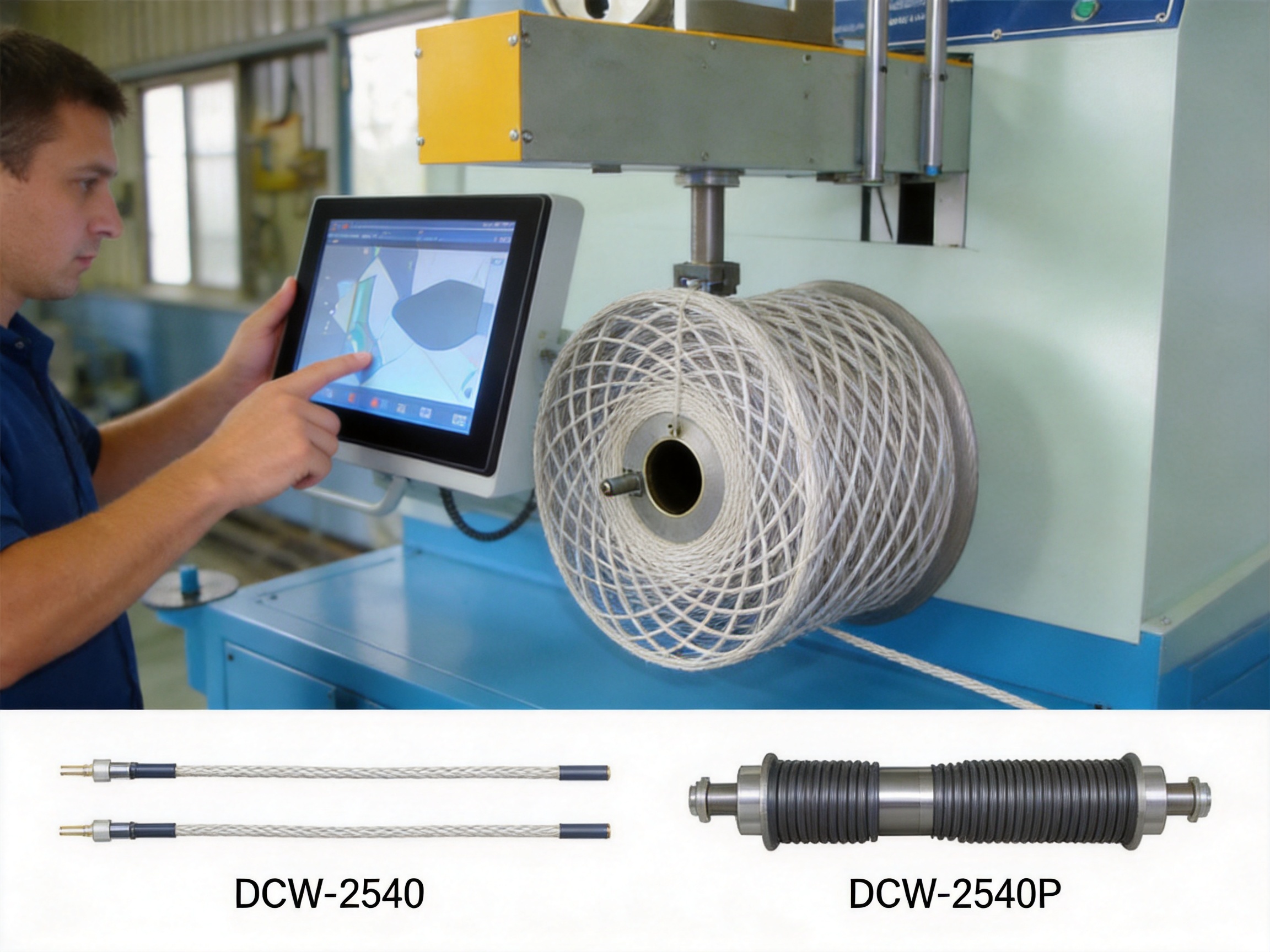
One of the most important features of this equipment is its ability to produce coils with or without a center hole. The hole size can be adjusted through a touch-screen control interface, allowing the finished coil to match different packaging box dimensions. This provides a practical advantage for manufacturers serving customers with varied packaging specifications, cable lengths, and installation requirements.
Supplied by Shanghai Yessjet Precise Machinery Co., Ltd., the Cross Winder for LAN Cable forms part of a broader range of wire and cable production, coiling, pay-off, take-up, packaging, and automation equipment. Its design reflects the needs of industrial cable manufacturers that require repeatable production, adaptable settings, and smooth integration with upstream and downstream processes.
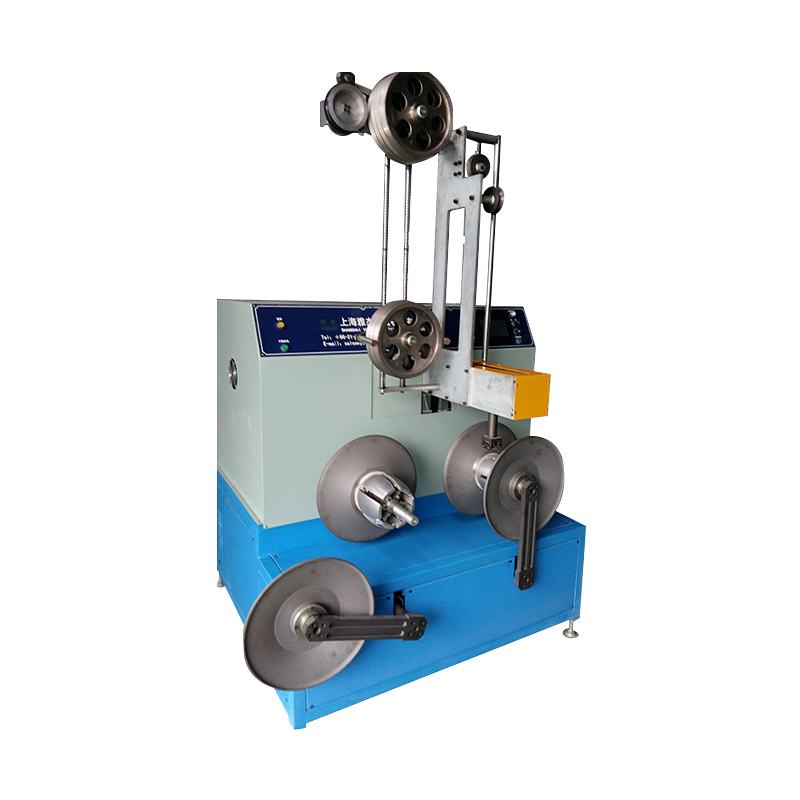
Cross Winder For LAN Cable
The Role of Automatic Coiling in LAN Cable Production
LAN cable production involves many stages, including conductor preparation, insulation, twisting, jacketing, testing, measuring, winding, and packaging. The final coiling stage is sometimes treated as a simple packaging operation, but it has a direct effect on product presentation and usability. A cable that is coiled unevenly may be difficult to remove from the package, while a coil with excessive tension can cause deformation or make installation inconvenient.
Manual coiling is also difficult to standardize. Different operators may use different winding speeds, winding patterns, and handling methods. Over time, this can lead to inconsistent coil diameters, irregular edges, variable center openings, and differences in cable tension. Manual processes may also require substantial labor, particularly when production volumes are high or when cable products are supplied in multiple lengths and package formats.
Automatic coiling provides a more controlled alternative. The machine guides the cable through a defined winding process and forms a consistent coil according to the selected operating parameters. The cross-winding arrangement helps organize the cable into a net-type coil rather than a loose or randomly accumulated bundle. This structure can improve visual quality and make the coil easier to place into a packaging box.
For LAN cable manufacturers, consistent coiling is valuable in several ways. It can help reduce the time required for final packing, simplify quality inspection, improve the appearance of the finished product, and reduce the possibility of tangling during storage. It also creates a more repeatable production method, which is especially important for manufacturers supplying distributors, network installation contractors, and retail packaging channels.
Designed for Mainstream LAN Cable Categories
The Cross Winder for LAN Cable is engineered for Cat5, Cat5e, and Cat6 cable applications. These cable categories are widely used in local area networks, structured cabling systems, office communication networks, security systems, data centers, and residential installations. Although the external appearance of these cables may be similar, their diameters, construction details, and packaging requirements can vary.
A coiling machine used for different LAN cable types must therefore provide adequate operating flexibility. The listed equipment supports cable diameters from 0.8 to 6 millimeters on the DCW-2540 model and from 1 to 12 millimeters on the DCW-2540P model. This range allows the equipment to serve standard LAN cable products as well as selected cable designs with larger external diameters.
The broader cable compatibility of the machine can help manufacturers make better use of their production equipment. Instead of dedicating separate manual stations to each cable type, a facility may be able to process several products with one adaptable coiling platform, subject to the specific cable construction and production requirements. This can support more efficient floor-space planning and simplify equipment management.
The machine is also applicable to coaxial cable. Coaxial cable has different structural characteristics from twisted-pair LAN cable, but it still benefits from controlled winding and organized packaging. A manufacturer that produces both LAN and coaxial cable can therefore consider the Cross Winder as a more versatile solution than equipment limited to only one cable family.
Cat5, Cat5e, and Cat6 Compatibility
Cat5, Cat5e, and Cat6 cables are commonly supplied in different lengths and packaging formats. Some customers may prefer compact coils for retail distribution, while others may require longer coils for installation projects. The machine’s adjustable winding configuration supports this type of production diversity by allowing operators to adapt the coil structure to the intended package.
Compatibility should always be evaluated together with the cable’s actual diameter, stiffness, surface material, and required winding speed. The listed technical data provide a useful operating range, while production trials can help determine the most appropriate settings for a specific cable construction. This approach enables manufacturers to balance speed, coil appearance, and cable handling quality.
Coaxial Cable Application
The ability to handle coaxial cable expands the potential application range of the equipment. Coaxial products are used in communication, video transmission, security, broadcasting, and signal distribution systems. These cables may require careful handling to protect their geometry and prevent unnecessary deformation.
By using a controlled automatic winding process, manufacturers can organize coaxial cable into a stable coil while reducing the irregularity associated with manual winding. The exact settings should be selected according to the cable diameter and mechanical characteristics, but the machine’s stated applicability provides a useful production option for facilities that manufacture more than one kind of communication cable.
Net-Type Coiling for Better Organization
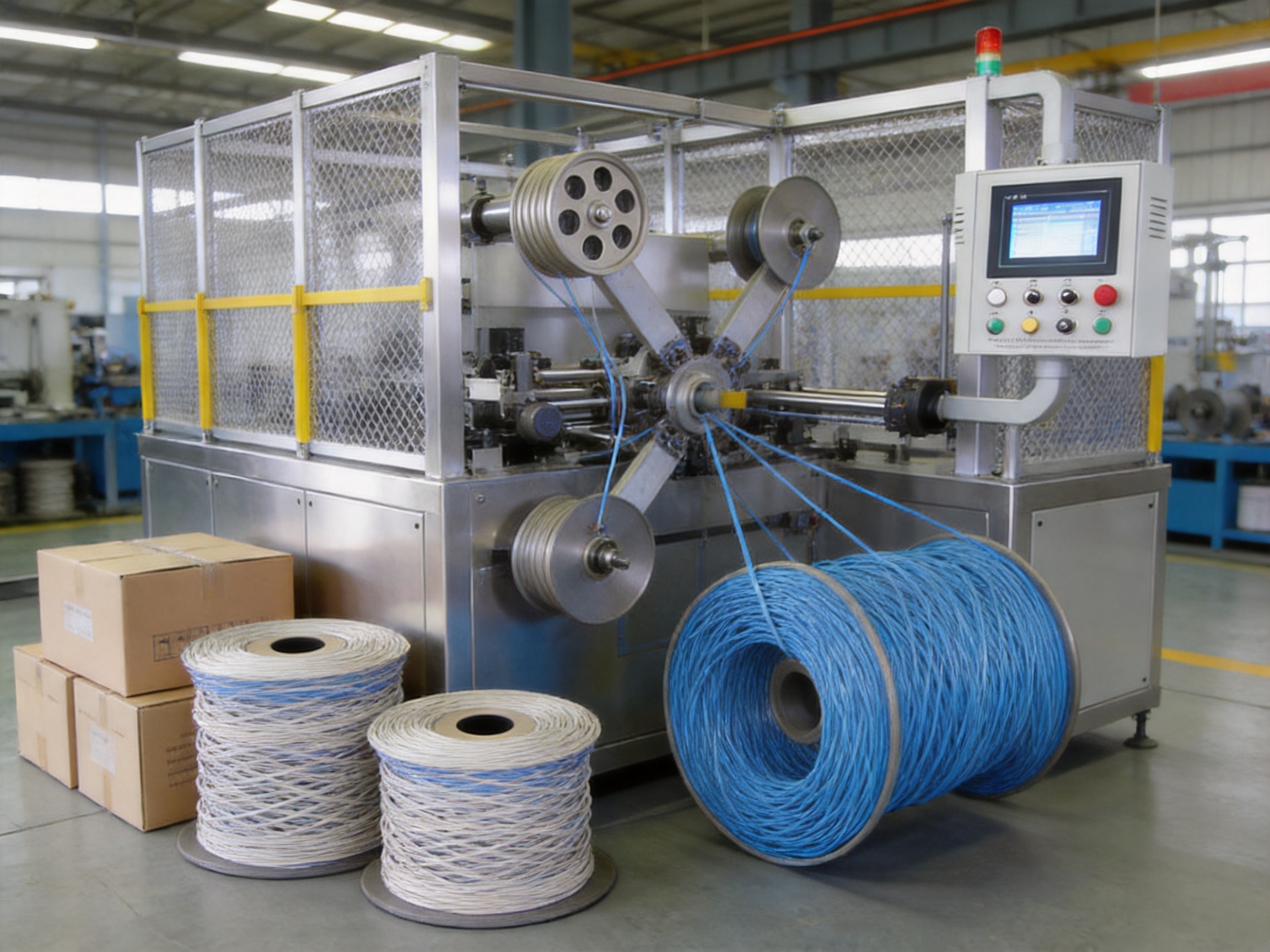
The Cross Winder forms cable into a net-type coil. This winding style is one of the defining characteristics of the machine and provides a practical alternative to simple circular accumulation. A net-type coil distributes the cable in an organized pattern, helping maintain a clean appearance and supporting easier handling.
When cable is wound into an irregular bundle, individual loops may cross unpredictably or become trapped under adjacent layers. This can make the cable difficult to unwind and may increase the risk of tangling during use. A net-type structure provides a more orderly arrangement, helping the user identify and remove the cable from the package in a controlled manner.
The organized appearance of the coil can also enhance product presentation. For manufacturers selling cable under their own packaging, neat winding communicates process discipline and product quality. For contract manufacturers, consistent coil appearance can help meet the packaging expectations of different customers and distributors.
Net-type coiling is particularly useful when the finished product must be placed inside a box. The coil can be formed to a defined outside diameter and adjusted for the available packaging space. This may reduce empty space inside the box and improve the stability of the product during transportation.
Reduced Risk of Tangling
Tangling is a common handling problem with loosely wound cable. It can increase unpacking time, cause frustration for installers, and sometimes lead to unnecessary pulling or bending. A more organized coil helps reduce the likelihood of loops catching on one another before and during installation.
The machine does not replace the need for proper packaging design, cable testing, or careful transport procedures. However, controlled coiling provides an important first step in creating a stable finished package. When combined with a suitable box, label, and protective material, the net-type coil can contribute to a more reliable distribution process.
Improved Finished-Product Consistency
Consistency is difficult to achieve when coiling depends entirely on individual operator technique. Automatic equipment can repeat the same general motion and winding pattern across production batches. This improves the uniformity of coil shape and supports more predictable packaging operations.
Consistent coils are also easier to inspect. Operators can quickly identify unusual gaps, excessive overlap, damaged surfaces, or abnormal coil dimensions. A repeatable appearance makes it easier to establish practical quality-control standards for the final packaging stage.
Coils With or Without a Center Hole
A major advantage of the Cross Winder is its ability to produce coils with or without a center hole. This gives manufacturers more freedom when designing packages and responding to customer preferences. Some boxes are designed around a solid coil, while others require a central opening to accommodate a box feature, a dispensing structure, or a particular internal dimension.
The center-hole function is not limited to one fixed size. According to the product information, the hole size can be adjusted through the touch screen. This makes the machine more adaptable than a winding unit that can only produce one standard opening. Operators can set the required hole dimension to match different packaging box sizes and product specifications.
Adjustable hole dimensions can be especially helpful for manufacturers with a broad product portfolio. A facility may supply short patch cables, longer installation cable, special-purpose coaxial cable, or products packed for different markets. Instead of using a separate winding fixture for each package design, the operator can change the setting through the control interface, subject to the machine’s operating range and the product’s physical requirements.
The option to eliminate the center hole is equally important. A solid coil may make better use of the available package volume or suit a customer who wants a compact, continuous cable bundle. The operator can select the winding mode that best fits the product and packaging design.
Touch-Screen Adjustment
A touch-screen interface provides a direct way to manage the winding configuration. Rather than relying only on mechanical changes, operators can use the control panel to adjust the required hole size and select the appropriate winding mode. This can simplify changeovers and make the equipment easier to operate in a production environment.
A clear control interface also supports communication between production and packaging teams. Once a product specification has been established, the relevant settings can be recorded as part of the production procedure. This helps reduce the possibility of setting errors when operators switch between cable types or package sizes.
Manufacturers should still establish operating instructions, verification procedures, and safety practices for the machine. Touch-screen control improves convenience, but reliable production depends on proper training, accurate cable measurement, suitable parameter selection, and routine equipment inspection.
Technical Specifications
The Cross Winder is offered in two listed configurations: DCW-2540 and DCW-2540P. Both models have a stated height of 250 millimeters, an outside diameter of 400 millimeters, and an inside diameter of 180 millimeters. Their main differences are cable diameter range and pneumatic configuration.
| Model | Height | Outside Diameter | Inside Diameter | Cable Diameter | Speed | Pneumatic System |
|---|---|---|---|---|---|---|
| DCW-2540 | 250 mm | 400 mm | 180 mm | 0.8–6 mm | 250 RPM | No |
| DCW-2540P | 250 mm | 400 mm | 180 mm | 1–12 mm | 250 RPM | Yes |
The DCW-2540 model is suitable for cable diameters from 0.8 to 6 millimeters. This range covers many conventional LAN cable applications and other smaller communication cable products. Its non-pneumatic configuration may be appropriate for manufacturers seeking a straightforward automatic coiling solution for standard cable sizes.
The DCW-2540P model expands the listed cable diameter range to 1–12 millimeters and includes a pneumatic system. This configuration may be more suitable for thicker cables or applications requiring pneumatic assistance during the winding process. The broader range can provide additional flexibility for facilities that process both standard LAN cables and larger communication cable products.
Both models are listed with a speed of 250 RPM. Actual production output will depend on cable length, cable diameter, winding pattern, acceleration and deceleration settings, operator handling, packaging requirements, and the time required for loading and unloading. The stated speed should therefore be understood as an equipment specification rather than a guaranteed finished-package output rate for every product.
How to Select Between the Two Models
Model selection should begin with the actual cable diameter range. If the facility primarily processes cable from 0.8 to 6 millimeters, the DCW-2540 may provide an appropriate configuration. If the production program includes cable from 1 to 12 millimeters or requires pneumatic functionality, the DCW-2540P may be the better option.
Manufacturers should also consider cable stiffness, jacket material, coil weight, required hole diameter, packaging dimensions, and the desired level of automation. A production trial is recommended when a cable is near the upper or lower limit of the listed range. Trial winding allows the manufacturer to confirm coil quality, tension, packaging fit, and changeover requirements before finalizing the equipment configuration.
Advantages Over Manual and Less Flexible Winding Methods
The Cross Winder offers several practical advantages compared with manual coiling or basic winding equipment that cannot adapt to different package designs.
Lower Dependence on Manual Labor
Manual winding requires an operator to guide, position, and organize the cable throughout the process. This can be physically repetitive and time-consuming. Automatic coiling transfers much of this work to the machine, allowing personnel to focus on loading, monitoring, inspection, and packaging.
Reducing manual labor does not necessarily mean eliminating people from the process. Instead, it can improve labor allocation. One operator may be able to supervise a more productive workflow, while other personnel handle quality checks, material preparation, labeling, or box assembly. This can be particularly beneficial when production volume is high or labor availability is limited.
More Repeatable Coil Quality
Automatic operation helps reduce differences between operators and production shifts. A defined winding pattern creates a more consistent finished product, making it easier to maintain packaging standards. This repeatability is valuable for companies that supply large distributors or customers with strict product presentation requirements.
Greater Packaging Flexibility
The adjustable center-hole function is a significant advantage over fixed-format winding systems. Manufacturers can select coils with or without a hole and adapt the hole size through the touch screen. This allows one machine to support multiple packaging formats rather than requiring a different dedicated setup for every box design.
Broader Cable Application
Support for Cat5, Cat5e, Cat6, and coaxial cable gives the equipment a wider application range than a unit intended for one narrow product category. This versatility can increase equipment utilization and help manufacturers respond to changing customer orders.
Suitable for Production Integration
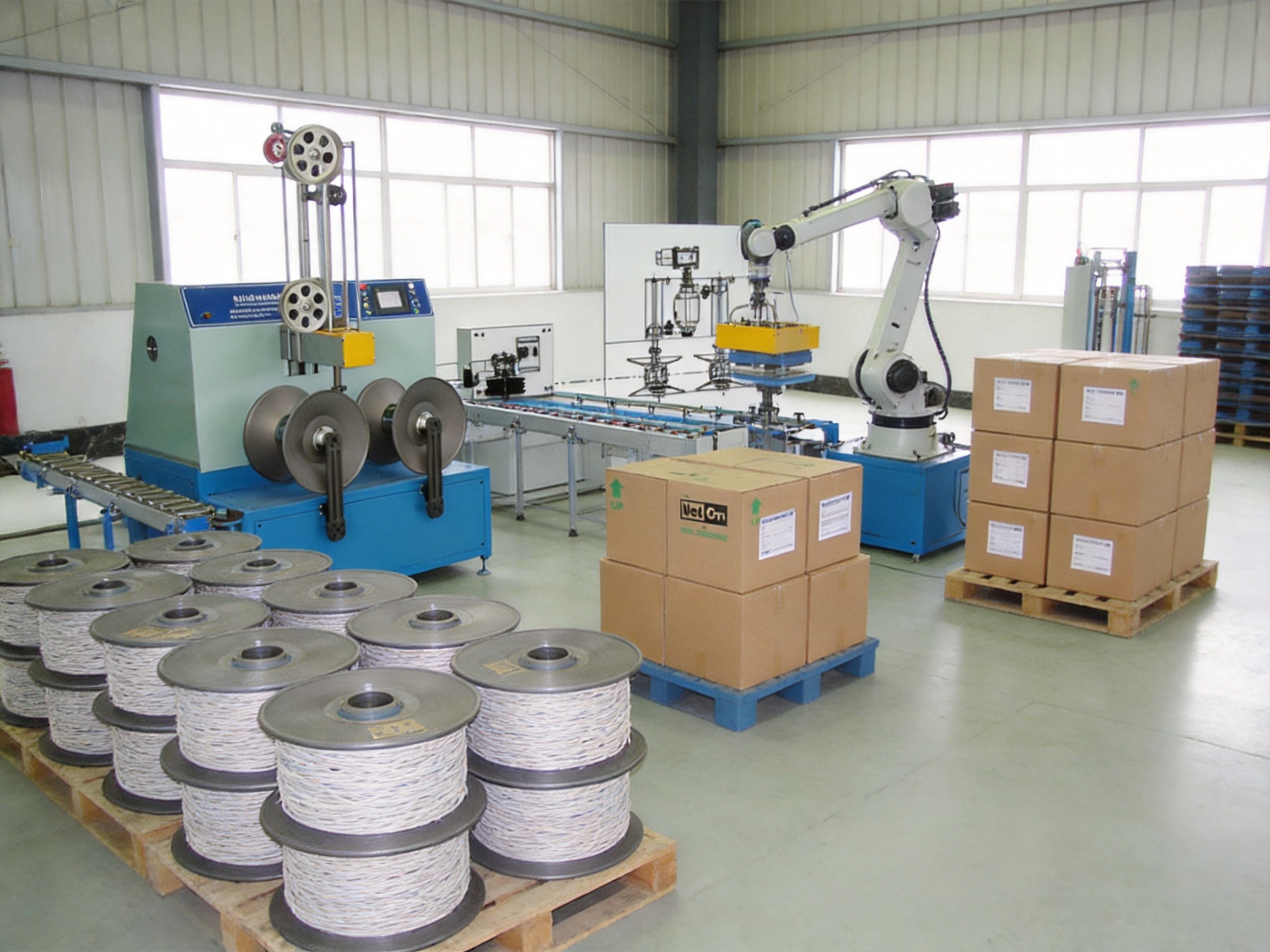
The Cross Winder can be positioned as part of a wider cable production and packaging workflow. It may receive cable from upstream pay-off or take-up equipment and pass the finished coil to a packaging or labeling station. This makes it relevant not only as a standalone machine but also as a component within a broader wire and cable manufacturing line.
Manufacturing and Engineering Strengths
The value of a coiling machine depends not only on its visible functions but also on the engineering quality behind those functions. A reliable machine must coordinate mechanical structure, cable guidance, winding motion, control logic, operator interaction, and maintenance access. The Cross Winder is developed by a company specializing in wire and cable machinery, including extrusion lines, automatic coiling and packaging equipment, intelligent robot stackers, pay-off systems, take-up systems, accessory equipment, and cable extrusion machines.
This product range indicates an understanding of the complete cable production environment. A supplier that works across extrusion, winding, take-up, pay-off, and packaging applications can evaluate a coiler in relation to the entire production process rather than viewing it as an isolated machine. That broader perspective can help when determining equipment layout, cable flow, production compatibility, and automation requirements.
Application-Oriented Engineering
The Cross Winder is designed around real cable production needs: different cable categories, variable cable diameters, diverse box sizes, and the need for repeatable packaging. Its ability to form net-type coils and adjust the center opening demonstrates an application-oriented approach. The equipment is not limited to a single fixed output shape.
Application-oriented engineering is especially important for cable manufacturers because cable products are rarely identical across every order. Jacket materials, conductor constructions, outer diameters, lengths, and packaging requirements may change frequently. A machine that can accommodate these variations is more useful than a highly specialized system that performs only one operation.
Integration of Mechanical and Digital Controls
The machine combines mechanical winding action with touch-screen adjustment. This combination allows the winding process to remain physically stable while giving operators a convenient method for selecting key parameters. Digital control also provides a foundation for clearer operating procedures and more consistent changeovers.
For production managers, this type of control can make it easier to standardize machine operation. Settings can be associated with product types or package sizes, and operators can follow documented procedures rather than relying entirely on personal experience.
Equipment Portfolio and System Thinking
Shanghai Yessjet Precise Machinery Co., Ltd. supplies equipment for several stages of wire and cable manufacturing. Its product categories include wire and cable extrusion lines, fully automatic coiling packaging equipment, intelligent robot stackers, coiling machines, motorized pay-off equipment, motorized take-up equipment, accessory equipment, and cable extrusion machines.
This portfolio supports a system-based approach to production planning. A customer may require only a cross winder, or may be developing a larger cable production project that includes extrusion, winding, take-up, packaging, and automated stacking. Working with a supplier familiar with these connected processes can simplify technical discussions and help identify practical equipment combinations.
Production Workflow Using the Cross Winder
A typical workflow begins with the prepared LAN or coaxial cable being delivered from an upstream process. Depending on the production line, the cable may come from a take-up system, a measuring and cutting station, or another controlled delivery unit. The operator confirms the cable type, diameter, required coil mode, center-hole size, and package dimensions.
The cable is then guided into the winding area. The machine creates the selected net-type coil at the designated operating speed. During operation, the operator monitors cable travel, coil formation, and machine status. If the production specification requires a center opening, the selected hole size guides the final coil structure. If a solid coil is required, the no-hole setting can be used.
After winding is completed, the coil can be removed for inspection and packaging. The operator checks the outside dimensions, appearance, winding order, cable surface condition, and fit within the intended box. The finished coil may then proceed to labeling, sealing, boxing, or an automated stacking process.
Recommended Process Checks
Before production begins, the cable diameter should be verified against the selected model’s operating range. The packaging box should also be measured to confirm that the target outside diameter and center-hole size are suitable. Cable length and weight should be considered because these factors can influence coil density and handling.
During production, the operator should look for irregular winding, excessive overlap, loose loops, surface marks, unexpected cable tension, or changes in coil shape. If any abnormal condition appears, the machine should be stopped and inspected according to the facility’s safety procedure.
After production, a sample coil can be unwound to verify that the cable releases smoothly. This check is useful because a visually attractive coil must also be functional for the installer or end user. The coil should maintain order without creating unnecessary resistance or tangling during removal.
Quality, Safety, and Maintenance Considerations
Automatic equipment improves process consistency, but proper maintenance remains essential. Cable dust, jacket particles, packaging debris, and general production contamination can affect moving components and cable-guiding surfaces. Regular cleaning helps preserve winding quality and reduces the possibility of material buildup.
Operators should inspect cable-contact surfaces for sharp edges, damage, or abnormal wear. Any surface that comes into contact with the cable should remain suitable for the product being processed. Damaged guides or worn components may leave marks on the cable jacket or influence the winding pattern.
Mechanical fasteners, drive components, sensors, and pneumatic elements on the DCW-2540P model should be checked according to the manufacturer’s maintenance recommendations. Pneumatic systems require appropriate attention to air quality, pressure stability, tubing condition, and connection integrity.
Safety procedures should include operator training, emergency-stop awareness, safe access to the winding area, and lockout procedures for maintenance. The exact safety requirements depend on the installation and local regulations. A well-organized production environment should combine machine safeguards with clear work instructions and routine inspections.
Protecting Cable Quality
LAN cable performance can be affected by mechanical damage, excessive bending, compression, and deformation. The coiling process should therefore be selected and adjusted with the cable construction in mind. The purpose of automatic winding is not simply to make a compact package; it is also to handle the cable in a controlled manner.
Manufacturers should validate the finished coil through visual inspection and, where appropriate, electrical or mechanical testing. Testing may include continuity, transmission performance, insulation condition, jacket appearance, and other requirements defined by the cable specification. Coiling is one stage in the quality chain, and its results should be evaluated together with the complete product standard.
Benefits for Cable Manufacturers and Packaging Operations
The Cross Winder can create value at several levels of a cable manufacturing business. At the production level, it reduces manual coiling work and supports repeatable winding. At the packaging level, it helps create coils that fit boxes more consistently. At the logistics level, orderly coils can be easier to store, label, count, and transport.
Improved organization can also support inventory management. Uniform coils make it easier for warehouse personnel to stack or position products. Clearly defined package dimensions can simplify pallet planning and reduce unnecessary movement inside the warehouse.
For sales and marketing teams, professional cable presentation can strengthen the perceived quality of the product. A neat coil with consistent packaging is easier to display and more convenient for distributors to handle. While appearance is not a substitute for electrical performance, it contributes to the overall customer experience.
The adjustable hole function provides another commercial advantage. Different customers may request different box formats, and export markets may use packaging styles that vary by region. The ability to adapt the coil configuration can help manufacturers serve these requirements without making major changes to the winding equipment.
Supporting High-Mix Production
Many cable factories produce a mixture of product types rather than one standardized item. A single production schedule may include Cat5e cable in one package length, Cat6 cable in another, and coaxial cable for a separate customer. Equipment that can accommodate these product changes may reduce the need for multiple dedicated winding stations.
High-mix production requires disciplined changeover procedures. Operators should record settings, verify cable diameters, confirm box dimensions, and inspect the first completed coil after each change. The Cross Winder’s touch-screen adjustment can support this process by providing a direct method for changing the hole configuration and winding mode.
Supporting Scalable Automation
The machine can also serve as a foundation for further automation. Once cable winding is standardized, additional operations such as automatic measuring, box loading, labeling, sealing, and robotic stacking may be integrated around it. The supplier’s wider range of automatic coiling packaging equipment and intelligent robot stackers is relevant for manufacturers planning a gradual transition from manual to automated production.
A phased automation strategy allows a company to prioritize the most labor-intensive or inconsistent operations first. Automatic coiling may be installed initially, followed by packaging and stacking automation as production volume increases. This approach can help manufacturers manage investment while building toward a more connected cable production system.
Why the Cross Winder Is a Practical Competitive Choice
Compared with a basic fixed-format coiler, the Cross Winder offers more flexibility through multiple cable applications, net-type winding, adjustable center-hole dimensions, and two model configurations. Compared with fully manual coiling, it provides a more repeatable process and can reduce labor requirements. Compared with equipment designed for only one cable family, its applicability to both LAN and coaxial cable can improve utilization.
Its competitive value comes from the combination of features rather than from one isolated specification. The 250 RPM operating speed provides a productive winding capability, while the 400-millimeter outside diameter and 180-millimeter inside diameter define a practical coil format. The two cable diameter ranges give manufacturers a choice between a standard non-pneumatic model and a broader pneumatic model.
The machine also addresses an important packaging issue that many simple winding systems overlook: the relationship between the coil and the box. By allowing hole-size adjustment through the touch screen, it helps the manufacturer design a coil that fits the intended package. This can reduce the need to redesign boxes around a fixed winding format.
For customers evaluating competing machines, the most important comparison should include operating flexibility, compatibility with actual cable products, ease of changeover, finished-coil consistency, maintenance requirements, and supplier support. A machine with a lower initial price may not provide the same value if it requires more manual labor, cannot handle multiple cable types, or produces coils that are difficult to package.
Purchasing and Application Recommendations
Before ordering the Cross Winder, a manufacturer should prepare detailed information about the intended cable products. This should include cable category, outer diameter, jacket material, stiffness, minimum bending requirements, total cable length per coil, target coil dimensions, center-hole requirements, and packaging-box measurements.
The customer should also identify the desired production arrangement. The machine may be used as a standalone coiler, connected to an upstream take-up system, or included in an automatic packaging line. The required layout, cable entry direction, operator position, and downstream handling method should be reviewed during project planning.
Sample-cable testing is recommended. A production trial can confirm whether the selected model produces the desired net-type coil, whether the cable surface remains undamaged, whether the center hole matches the box, and whether the operating speed is suitable for the product. Testing is particularly important when the cable is near the diameter limit or has unusual mechanical characteristics.
Customers should also discuss installation, commissioning, training, spare parts, documentation, and service arrangements with the equipment supplier. A successful machine project depends on more than the equipment itself. Clear communication about product samples, production targets, packaging design, and factory conditions can improve the final result.
Frequently Asked Questions
What types of cable can the Cross Winder process?
The machine is designed for LAN cable types including Cat5, Cat5e, and Cat6. It is also applicable to coaxial cable. The actual suitability of a specific cable should be confirmed through its diameter, construction, stiffness, and required winding conditions.
Can the machine make a coil without a center hole?
Yes. The machine allows the operator to select winding with or without a hole. This gives manufacturers flexibility when using different packaging designs or serving customers with different coil requirements.
Can the center-hole size be changed?
Yes. The center-hole size is adjustable through the touch-screen interface. This helps manufacturers match the coil to different packaging box dimensions.
What is the maximum listed speed?
Both the DCW-2540 and DCW-2540P models are listed at 250 RPM. Actual production output depends on cable length, cable diameter, winding settings, loading time, unloading time, and packaging requirements.
What is the difference between DCW-2540 and DCW-2540P?
The DCW-2540 supports a listed cable diameter range of 0.8–6 millimeters and does not include a pneumatic system. The DCW-2540P supports a listed range of 1–12 millimeters and includes pneumatic functionality.
What are the listed coil dimensions?
Both models have a listed height of 250 millimeters, outside diameter of 400 millimeters, and inside diameter of 180 millimeters. Final coil characteristics may also depend on the cable and selected winding configuration.
Is the machine suitable for a factory that produces several cable types?
It can be a suitable option for a facility producing multiple compatible cable types because it supports several LAN categories and coaxial cable. The manufacturer should verify each product through application testing and establish appropriate settings for every cable and package format.
How does net-type winding benefit the finished cable?
Net-type winding creates a more orderly coil structure. It can help reduce tangling, improve visual consistency, simplify packaging, and make the cable easier to store and handle.
Can the machine be integrated into a larger cable production line?
Yes. The Cross Winder can be considered as part of a broader production and packaging workflow. It may work with upstream pay-off or take-up equipment and downstream packaging or stacking systems, subject to the final line design.
What should be checked before selecting a model?
Manufacturers should check cable diameter, cable construction, required coil size, center-hole dimensions, box size, production volume, desired automation level, and whether pneumatic operation is needed. Sample testing is recommended before final selection.
How can manufacturers maintain consistent winding quality?
They should use documented settings, verify cable diameter, inspect the first coil after each changeover, maintain cable guides and moving components, monitor the winding process, and perform regular cleaning and maintenance. Operator training is also important.
Who supplies this equipment?
The Cross Winder for LAN Cable is supplied by Shanghai Yessjet Precise Machinery Co., Ltd., a manufacturer and supplier of wire and cable machinery and related production equipment.
Conclusion
The Cross Winder for LAN Cable is a practical solution for manufacturers seeking more consistent, flexible, and efficient cable packaging. Its compatibility with Cat5, Cat5e, Cat6, and coaxial cable allows it to serve a broad range of communication-cable applications. Its net-type winding method supports neat organization, while the option to produce coils with or without a hole gives manufacturers greater packaging freedom.
The adjustable center-hole size, controlled touch-screen operation, 250 RPM listed speed, and two model configurations make the equipment suitable for different production requirements. The DCW-2540 serves a listed cable diameter range of 0.8–6 millimeters, while the pneumatic DCW-2540P expands the range to 1–12 millimeters.
More importantly, the machine is supported by a supplier with experience across wire and cable extrusion, pay-off, take-up, coiling, packaging, and robotic stacking equipment. This broader manufacturing capability can help customers evaluate the coiler as part of a complete production strategy rather than as an isolated device.
For cable factories facing rising labor costs, increasing packaging diversity, and higher expectations for finished-product consistency, automatic cross winding can deliver meaningful operational benefits. With appropriate model selection, sample testing, operator training, and maintenance, the Cross Winder can help transform LAN cable coiling from a labor-intensive finishing task into a controlled and repeatable production process.
References
1. Product technical information for the DCW-2540 and DCW-2540P Cross Winder models, supplied in the manufacturer’s equipment documentation.
2. Manufacturer product information concerning LAN cable coiling, coaxial cable application, net-type winding, and adjustable center-hole operation.
3. General principles of wire and cable manufacturing, including extrusion, pay-off, take-up, winding, packaging, and material handling.
4. General production-engineering practices for cable handling, coil formation, packaging consistency, equipment maintenance, and operator safety.
5. General packaging and logistics principles for communication cables, including organized winding, box compatibility, storage efficiency, and transport protection.