LANGUAGE
 中文简体
中文简体 русский
 Français
 Español
 Português
 عربى
عربى
Content
- 1 Understanding the Role of a Cable Conveyor Belt System
- 2 Applications in Wire and Cable Manufacturing
- 3 Two Flexible Transmission Platforms
- 4 Advantages Over Conventional Manual Handling
- 5 Advantages Compared with Less Flexible Conveyor Solutions
- 6 Integration with Cable Production Equipment
- 7 Manufacturing Strengths and Engineering Approach
- 8 Manufacturing Process for a Reliable Conveyor System
- 9 Key Design Considerations for Buyers
- 10 Operation and Maintenance Recommendations
- 11 Why This System Supports Cost-Effective Production
- 12 Quality, Safety, and Process Reliability
- 13 Suitable Industries and Production Environments
- 14 Purchasing from an Experienced Cable Machinery Manufacturer
- 15 Frequently Asked Questions
- 15.1 What is a cable conveyor belt system used for?
- 15.2 What are the two transmission methods?
- 15.3 Can automatic and manual transmission be used together?
- 15.4 Can the conveyor connect with coiling and packaging equipment?
- 15.5 Is the system suitable for small-batch production?
- 15.6 Can it be used with an intelligent robot stacker?
- 15.7 How does the system reduce labor costs?
- 15.8 How does it help save energy?
- 15.9 What information should be provided when requesting a solution?
- 15.10 Can the system be expanded later?
- 15.11 What maintenance does the conveyor require?
- 15.12 Why choose a cable machinery manufacturer for this accessory?
- 16 Conclusion
- 17 References
- 18 Product: Cable Conveyor Belt Systems
In modern wire and cable manufacturing, production efficiency depends on more than extrusion, cooling, take-up, and coiling equipment. The movement of finished packages between production areas and handling stations also has a direct effect on labor utilization, floor organization, energy consumption, and overall operating cost. A well-designed cable conveyor belt system provides a practical connection between these stages by transporting packaged goods in a stable, orderly, and economical manner.
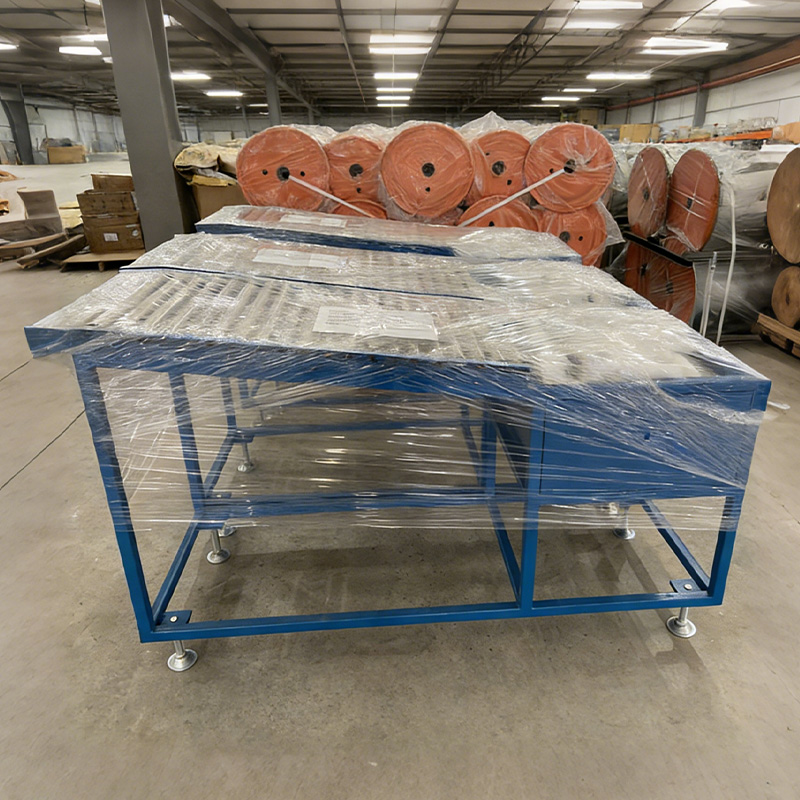
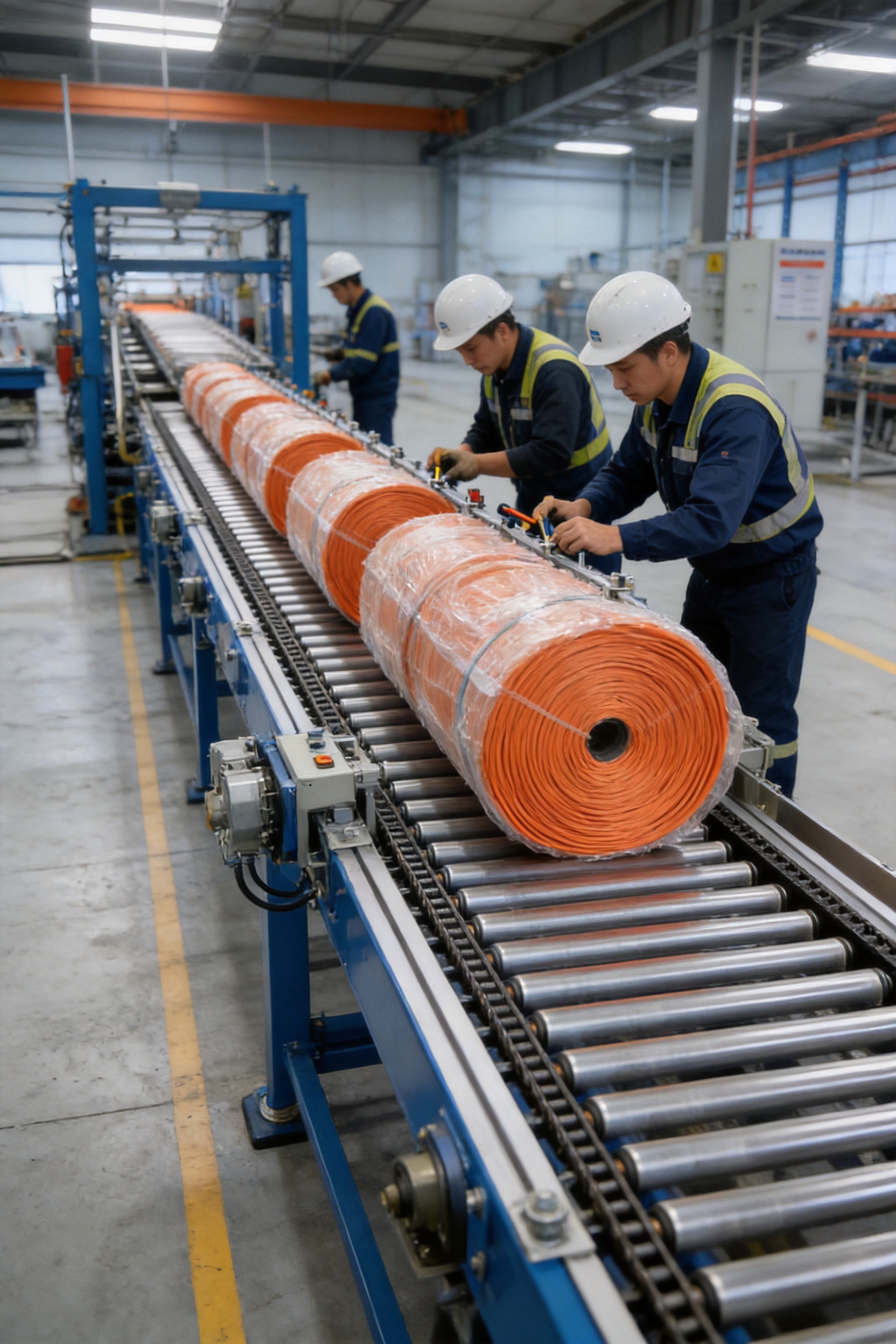
Cable Conveyor Belt Systems are material handling solutions developed for packaged goods transfer. They can be configured with two complementary transmission methods: automatic track transmission and manual roller transmission. Automatic track transmission supports consistent, high-efficiency conveying, while manual roller transmission provides flexible operation for small-batch handling, inspection, sorting, and changing production requirements.
By moving packages from the production location to a designated manual handling station, the system reduces unnecessary carrying and improves the flow of materials through the workshop. It can be used as an accessory system alongside wire and cable extrusion lines, fully automatic coiling and packaging equipment, intelligent robot stackers, coiling machines, motorized pay-off equipment, and motorized take-up equipment.
The result is a more coordinated production environment in which finished cable packages are transferred through a defined route instead of being moved repeatedly by operators. This approach helps reduce labor intensity, avoid inefficient handling procedures, and support a cleaner, more organized factory layout.
Cable Conveyor Belt Systems
Understanding the Role of a Cable Conveyor Belt System
A cable conveyor belt system is a dedicated transport platform for transferring packaged products within a manufacturing facility. In wire and cable production, packages may leave a coiling machine, packaging station, extrusion line, or other finishing area before they are inspected, labeled, stored, palletized, or prepared for shipment. If these products must be carried manually over long distances, the production process becomes dependent on additional labor and repeated physical movement.
The conveyor system creates a planned connection between the point where goods are produced and the point where they are handled next. Instead of requiring workers to lift or push packages through the workshop, the system provides a controlled conveying route. The route may be automatic, manual, or a combination of both, depending on the needs of the production line.
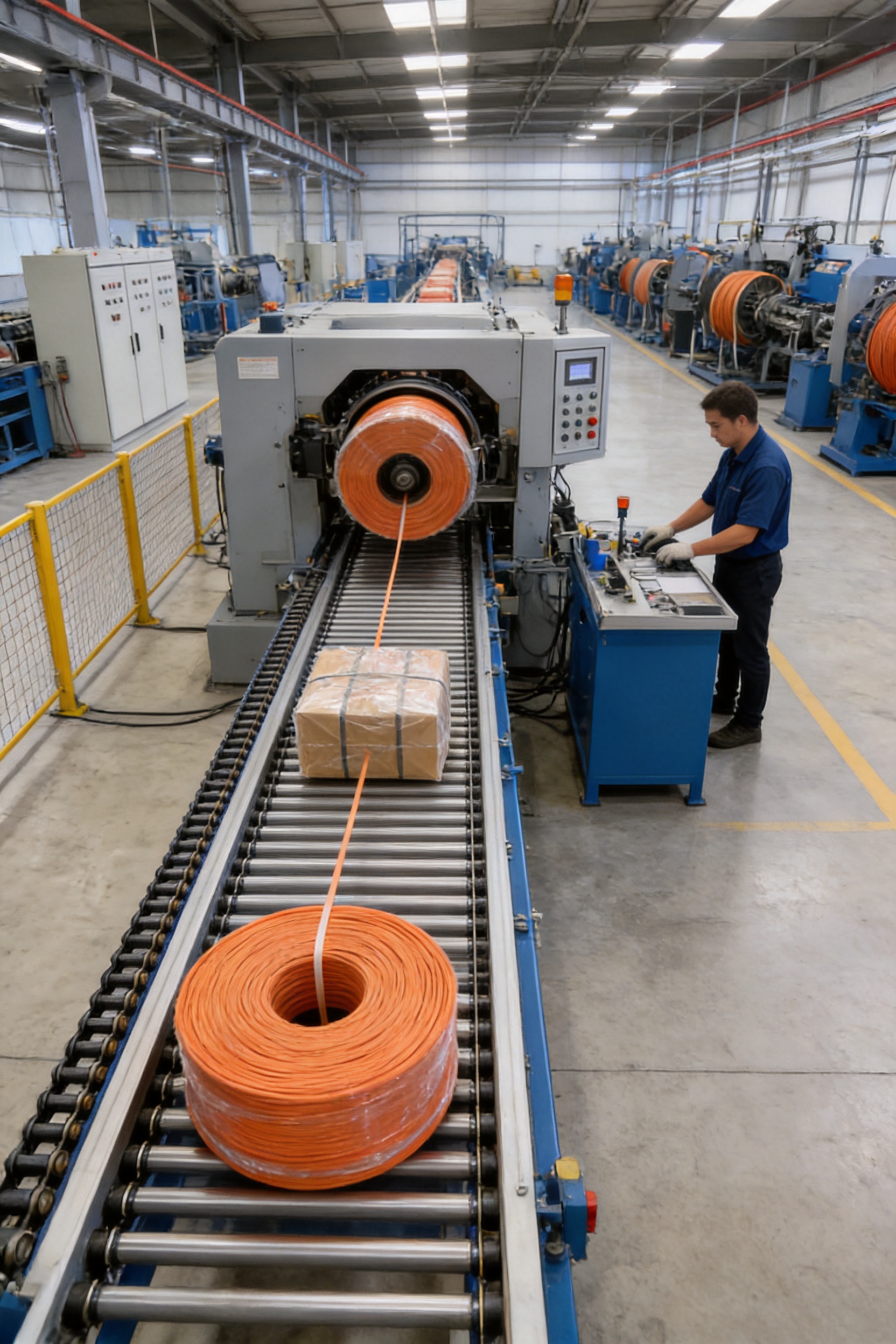
Automatic track transmission is suitable for continuous or regularly scheduled movement. It provides a repeatable path and supports a steady transfer rate. This makes it particularly useful when packaged goods leave a production machine at a consistent rhythm. Manual roller transmission is appropriate when operators need to stop, inspect, reposition, sort, or redirect products. It is also useful in small-batch production environments where a fully automated conveyor may not be necessary.
The two transmission methods can work together rather than compete with one another. A production area may use automatic track transmission for the main movement path and manual roller transmission near the final handling location. This arrangement combines the efficiency of automation with the flexibility of operator-controlled handling.
Applications in Wire and Cable Manufacturing
Wire and cable production includes multiple stages that may generate finished or semi-finished packages. A cable conveyor belt system can be positioned after coiling, packaging, bundling, labeling, or inspection operations. It can also serve as a connection between individual machines in a larger production line.
For example, a packaged cable coil may be discharged from a coiling and packaging machine. The package can then enter an automatic track transmission section and travel toward an inspection or manual handling station. At the end of the route, a manual roller section can allow workers to check the package, apply labels, sort different specifications, or prepare the product for stacking.
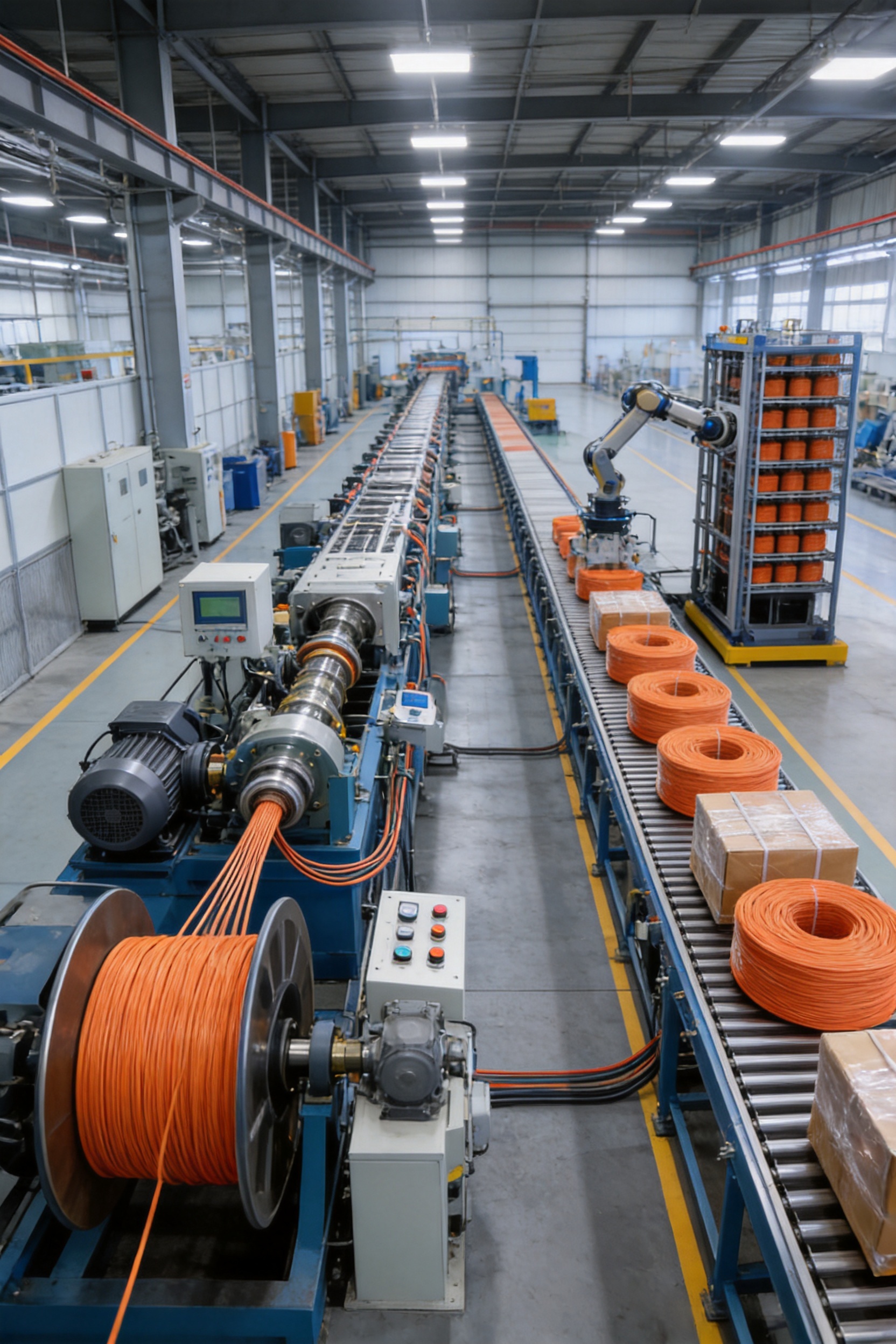
When combined with an intelligent robot stacker, the conveyor system can form part of a coordinated finished-product handling process. Packages may be transported to a defined position where a robot or operator performs the next handling step. The conveyor therefore acts as an important link between production equipment and downstream logistics.
It can also be integrated into lines that include motorized pay-off and motorized take-up equipment. Although pay-off and take-up systems primarily control the movement of cable during processing, the conveyor system supports the movement of finished packages after production. Together, these systems help create a continuous equipment arrangement from raw-material feeding to finished-product handling.
For extrusion operations, the conveyor is especially useful after cable cooling, measuring, take-up, coiling, and packaging. Extrusion lines may operate continuously, and finished packages must be removed without creating congestion around the main machine. A dedicated transmission platform helps maintain separation between production and manual handling activities.
Two Flexible Transmission Platforms
Automatic Track Transmission
Automatic track transmission is designed for stable and repeatable movement. It can transfer packaged goods along a predetermined route with limited manual intervention. This is advantageous when the production output is regular and packages must be delivered to a specific downstream location.
The automatic track arrangement helps reduce interruptions caused by manual carrying. Operators do not need to leave their workstations repeatedly to transport packages. Instead, the transmission platform performs the routine movement, allowing personnel to concentrate on inspection, quality control, packaging management, equipment supervision, and other higher-value tasks.
A defined track also improves the organization of the workshop. When products follow a fixed route, the movement of goods is easier to understand and manage. This can reduce random placement, improve access around machines, and make the relationship between production areas and handling stations clearer.
Automatic transmission is particularly beneficial in production environments with medium or high throughput. It supports efficient movement while reducing the physical workload associated with repeatedly lifting, pushing, or carrying packaged cable products.
Manual Roller Transmission
Manual roller transmission provides a simple and flexible method for moving packaged goods. Operators can push or guide items along the rollers according to the immediate requirements of the production process. This method is useful for small-batch orders, product changes, inspection points, temporary storage, and areas where the flow of goods is not constant.
Manual roller transmission may also be positioned at the end of an automatic route. Once packages reach the manual section, workers can perform final checks, sorting, labeling, packing adjustments, or transfer to pallets and storage locations. The roller surface supports easier movement than carrying products directly, while still giving operators direct control.
This flexibility is an important advantage for manufacturers that produce multiple cable types, sizes, and package formats. A fully automatic line may be efficient under stable conditions, but a manual roller section can accommodate variations without requiring a complex changeover procedure.
Combining Automatic and Manual Operation
The combination of automatic track transmission and manual roller transmission creates a balanced material handling system. Automatic movement can be used where the route and output are predictable, while manual movement can be retained where judgment, inspection, or product variation is important.
This hybrid structure can be adapted to different factory layouts. For example, the automatic section may extend from the coiling machine to the packaging output, while the manual roller section may lead to a quality inspection table or palletizing area. In another arrangement, manual rollers may be used between several small production machines, with automatic tracks installed only on the main transport route.
The appropriate arrangement depends on package weight, dimensions, production volume, transfer distance, available floor space, and the preferred level of automation. A flexible system allows the manufacturer to invest in automation where it produces the greatest benefit without making every part of the material flow unnecessarily complex.
Advantages Over Conventional Manual Handling
Reduced Labor Intensity
Manual carrying of cable packages requires repeated lifting, walking, pushing, and positioning. These actions consume time and place physical demands on operators. A conveyor system takes over much of the routine transport work, helping employees avoid unnecessary movement between production machines and handling stations.
Reducing labor intensity does not mean removing the importance of skilled personnel. Instead, it allows workers to focus on activities that require judgment, such as checking package condition, confirming product information, monitoring production quality, and managing exceptions.
Improved Material Flow
Without a defined transfer route, packaged goods can accumulate near machines or be moved through irregular paths. This may create congestion and make it difficult to determine which products have been completed, inspected, or prepared for shipment. A conveyor system establishes a visible material flow path and supports more orderly production management.
Stable movement also helps reduce waiting time between production and handling. When products can be transferred promptly, downstream personnel can receive them more consistently. This supports better coordination between manufacturing, inspection, packing, and storage operations.
Lower Handling Costs
Repeated manual transport adds labor cost without directly increasing product value. A conveyor belt system reduces the amount of time spent on routine movement and can help lower long-term handling expenses. The system also reduces the need for additional carts or temporary transport tools in areas where a fixed route is appropriate.
Because automatic track transmission supports continuous movement, it can be especially useful when production operates for extended periods. Manual roller transmission then provides economical flexibility where the product flow is intermittent or changes frequently.
Better Workshop Organization
A well-planned conveyor route contributes to a more organized factory. Finished packages move through designated areas rather than being placed randomly around machines. Clear movement paths can support easier cleaning, inspection, maintenance access, and production supervision.
Better organization also helps operators identify bottlenecks. If packages accumulate at a particular station, management can investigate the cause and adjust the process. The conveyor system therefore provides not only physical transport but also a clearer view of how materials move through the production environment.
Energy-Conscious Operation
The system is designed to optimize material flow and reduce unnecessary handling. When packaged goods move along a planned route, fewer additional transport actions are required. This can help reduce the energy and labor associated with repeated carrying and repositioning.
Energy efficiency is influenced by many factors, including conveyor length, package weight, operating frequency, motor selection, control strategy, and maintenance. A properly planned system can avoid excessive movement and provide practical energy-saving benefits without compromising production continuity.
Advantages Compared with Less Flexible Conveyor Solutions
Some conveyor systems are designed only for continuous automatic operation. While such systems may be effective in highly standardized factories, they can be less convenient when manufacturers handle multiple products or frequent order changes. Cable production often involves different conductor structures, insulation materials, package sizes, and production quantities. The ability to combine automatic and manual transmission is therefore a significant practical advantage.
Compared with a purely manual handling arrangement, the automatic track section improves consistency and reduces physical labor. Compared with a fully automatic arrangement, the manual roller section makes product inspection and small-batch handling easier. This balance can provide a better return on investment for manufacturers whose production requirements vary.
The system also offers an advantage over temporary handling methods such as floor carts or unplanned pallet movement. A permanent conveyor route provides a more predictable flow and reduces the need to repeatedly organize transport paths. It can be designed around existing machines and adjusted to the actual layout of the workshop.
Another advantage is scalability. A manufacturer can begin with a basic transmission platform and later connect additional sections, handling stations, coiling equipment, packaging equipment, or stacking equipment as production requirements grow. This makes the conveyor system suitable for both current operating needs and future line development.
Integration with Cable Production Equipment
Connection with Coiling Machines
Coiling machines prepare cable into manageable finished packages. After coiling, the package may require wrapping, labeling, inspection, or transfer to a storage location. A conveyor system can receive the package from the coiling area and move it toward the next operation.
The connection between the coiling machine and conveyor should consider package dimensions, discharge height, movement direction, and the required transfer rate. A smooth connection helps prevent packages from being dropped, stacked incorrectly, or left in the operating area of the coiler.
Connection with Fully Automatic Coiling and Packaging Equipment
Fully automatic coiling and packaging equipment can produce packaged cable products with limited manual involvement. However, even an automated packaging operation needs a downstream route for finished goods. A conveyor system extends the automation concept beyond the packaging machine by transferring products to manual handling, inspection, palletizing, or storage.
This creates a more complete workflow. The packaging equipment performs the product preparation, the conveyor manages movement, and the designated handling station completes inspection or logistics preparation. Each part of the system has a clear role.
Connection with Intelligent Robot Stackers
An intelligent robot stacker requires products to arrive at a predictable position and orientation. A conveyor system can provide a consistent transfer route to the stacking area. This supports the coordination between product movement and robotic handling.
Where manual handling remains necessary, the conveyor can also deliver products to a station where operators prepare them for robotic stacking. The final arrangement depends on product dimensions, package stability, stacking pattern, and the factory’s automation strategy.
Connection with Extrusion Lines
Wire and cable extrusion lines may include pay-off equipment, extrusion units, cooling systems, measuring devices, take-up equipment, and coiling or packaging stations. The conveyor belt system is normally used on the finished-product side of this process, where packaged goods must be moved away from the production area.
Its role is important because extrusion equipment often occupies a long and carefully arranged production path. Finished cable packages should not obstruct access to the line or interfere with the movement of operators and raw materials. A dedicated transmission route helps separate production operations from finished-product logistics.
Manufacturing Strengths and Engineering Approach
Shanghai Yessjet Precise Machinery Co., Ltd. provides wire and cable machinery and turnkey cable production solutions. Its product range includes wire and cable extrusion lines, fully automatic coiling and packaging equipment, intelligent robot stackers, coiling machines, motorized pay-off equipment, motorized take-up equipment, accessory equipment, and cable extrusion machines.
This product range is relevant to the development of integrated production systems. A conveyor belt system is not an isolated item when it is installed as part of a complete cable manufacturing line. Its value depends on how well it connects with upstream and downstream equipment. A manufacturer with experience across several categories of cable machinery can evaluate the broader process instead of considering the conveyor as a standalone platform.
Application-Oriented Equipment Design
An effective manufacturing process begins with understanding the customer’s production requirements. Package weight, product dimensions, production volume, transfer distance, layout restrictions, operating method, and downstream handling requirements all influence the design of a conveyor system.
For this reason, the equipment should be developed around the actual application rather than selected only by general dimensions. The automatic track section must match the desired movement path, while the manual roller section must provide sufficient working space for operators. The combination should support the complete workflow from product discharge to final handling.
Modular Production Concept
A modular equipment concept makes it easier to combine different transmission sections and connect the conveyor with other cable machinery. Standardized structural elements can be arranged according to the workshop layout, while application-specific sections can be added where necessary.
Modularity is also beneficial during future expansion. If production volume increases or a new packaging machine is introduced, additional conveyor sections may be considered without redesigning the entire material handling process. This approach can help manufacturers protect their original equipment investment.
Precision-Oriented Fabrication
The company name reflects a focus on precise machinery, and precision is important in conveyor manufacturing. Structural alignment, roller positioning, transmission continuity, connection accuracy, and the relationship between equipment heights all affect the smooth movement of packaged products.
Precision-oriented fabrication includes careful preparation of structural components, controlled assembly, and inspection of the completed platform. The objective is to create a stable transmission route that can operate reliably in the working environment. Good fabrication practice also supports easier installation and adjustment at the customer’s site.
Complete Equipment Coordination
Because cable production lines contain multiple machines, equipment coordination is a major manufacturing strength. The conveyor must not obstruct the operation of coilers, packaging machines, robot stackers, or manual workstations. It should fit into the intended process sequence and maintain reasonable access for operators and maintenance personnel.
A coordinated design considers transfer points, product direction, operating height, control requirements, and safety clearance. These considerations help avoid problems that may occur when individual machines are purchased without considering the complete production route.
Turnkey Solution Capability
A turnkey cable production solution can include equipment selection, line arrangement, accessory matching, and process coordination. The conveyor system becomes one part of a broader manufacturing plan. This is valuable for customers who want to improve an existing line or establish a new cable production facility.
By offering several categories of wire and cable machinery, the manufacturer can support different stages of production. This may simplify project communication and help create a more consistent equipment arrangement. It also allows the customer to discuss production objectives with a supplier familiar with extrusion, coiling, take-up, packaging, and finished-product handling.
Manufacturing Process for a Reliable Conveyor System
Requirement Review
The manufacturing process begins with a review of the intended application. Important information includes the type of packaged goods, package dimensions, approximate weight, required conveying distance, production frequency, manual handling requirements, and available workshop space.
The supplier should also review the equipment that will be connected to the conveyor. The output height of the coiling or packaging machine, the location of the manual station, and the position of the storage or stacking area all affect the final configuration.
Layout and Flow Planning
After the requirements are understood, the material flow path can be planned. The objective is to create a route that moves products efficiently while maintaining access to production equipment and work areas. The route should avoid unnecessary turns, congestion points, and crossings with other material flows whenever possible.
The planning stage also determines where automatic track transmission is most useful and where manual roller transmission provides greater value. A mixed configuration is often suitable when the main route is regular but the final handling process requires operator flexibility.
Structural Fabrication
The conveyor frame, supports, roller sections, track components, and connection structures must be fabricated according to the selected configuration. Dimensional consistency is important because variations in height or alignment can affect package movement.
Structural fabrication should provide adequate stability for the intended package load and operating conditions. The design should also support practical access for cleaning, inspection, adjustment, and maintenance. These features contribute to dependable operation throughout the equipment’s service life.
Assembly and Alignment
During assembly, the transmission sections are installed and aligned so that products can pass smoothly from one section to another. Automatic track components must be coordinated with the drive and control arrangement, while manual roller sections must maintain a consistent working surface.
Connection points require particular attention. A package should not encounter an abrupt height difference, excessive gap, or obstruction when moving between sections. Proper alignment improves transmission stability and helps protect packaged cable products from unnecessary impact.
Operational Testing
Testing should verify the movement of representative packages through the complete route. The test process can assess starting and stopping behavior, transmission continuity, transfer points, operator access, and the interaction between automatic and manual sections.
Where the conveyor is integrated with other machinery, testing should consider the full process sequence. The system should receive products from the upstream equipment and deliver them to the intended handling point without creating accumulation or interference.
Installation and Commissioning Support
Installation and commissioning are important because the final workshop conditions may differ from the original design assumptions. The conveyor must be positioned correctly, connected to related equipment, and adjusted for the actual floor and production layout.
Commissioning provides an opportunity to confirm that the transfer route operates as intended. Operators can learn how to use the manual roller section, monitor automatic movement, identify abnormal conditions, and perform basic daily checks.
Key Design Considerations for Buyers
Product Characteristics
Buyers should provide accurate information about package size, shape, weight, surface condition, and stability. Cable packages may differ substantially depending on the cable type and packaging method. The transmission platform should be selected to support the actual product range rather than a single sample package.
Production Volume
Production volume influences the balance between automatic and manual operation. A high-volume line with regular output may benefit from a longer automatic track section. A small-batch or highly variable operation may require more manual roller space and fewer automatic sections.
Factory Layout
The available floor area, column positions, machine locations, aisle requirements, and storage zones should be considered before finalizing the conveyor route. A suitable layout improves material flow without reducing access to equipment.
Handling Destination
The destination may be a manual inspection station, packaging area, warehouse, palletizing zone, or intelligent robot stacker. Each destination creates different requirements for transfer height, product positioning, operator access, and possible accumulation control.
Future Expansion
Manufacturers should consider whether the production line may be expanded. A conveyor arrangement with modular connection points can make it easier to add new machines or extend the transport route later. Planning for future requirements may reduce modification costs and production disruption.
Maintenance Access
The system should be accessible for cleaning, inspection, adjustment, and replacement of wear components. A conveyor that is difficult to access may create unnecessary downtime. Practical maintenance design is therefore an important part of equipment reliability.
Operation and Maintenance Recommendations
Daily operation should begin with a visual check of the transmission route. Operators can confirm that the rollers, tracks, supports, and transfer points are free from foreign objects. They should also verify that the receiving and discharge areas are clear.
Packages should be placed on the conveyor in a stable position. Overloading, uneven placement, or the introduction of products outside the intended size range may affect transmission performance. Operators should follow the operating method established during commissioning.
Automatic sections should be observed for unusual noise, irregular movement, unexpected stopping, or package accumulation. Manual roller sections should be checked for smooth rotation and obstruction. Any abnormal condition should be addressed before it develops into a larger equipment problem.
Routine maintenance may include cleaning, fastening checks, alignment inspection, and examination of moving components. The specific maintenance interval depends on operating frequency, environmental conditions, package characteristics, and system configuration.
Good housekeeping around the conveyor is also important. Loose packaging materials, cable fragments, dust, and other debris should not be allowed to collect around moving sections. A clean working area supports safer and more reliable operation.
Why This System Supports Cost-Effective Production
The economic value of a conveyor system comes from the combined effect of several improvements. It reduces routine carrying work, shortens unnecessary movement paths, improves production organization, and supports more consistent transfer between equipment. These benefits can accumulate over the operating life of the production line.
The system also helps manufacturers use labor more effectively. Employees can spend less time moving finished packages and more time on quality-related and production-management tasks. This is especially valuable when labor resources are limited or when the production process requires close supervision.
A hybrid automatic and manual system can also control investment. Automation is applied to repetitive movement where it provides clear productivity benefits, while flexible manual transmission is retained for variable operations. This avoids the expense and complexity of automating every handling step regardless of actual need.
Improved material flow can reduce delays between machines. When finished packages are removed from the production area promptly, equipment is less likely to wait for manual clearance. This may support better utilization of coiling, packaging, and stacking equipment.
In addition, a more organized handling route can reduce the risk of product damage caused by uncontrolled movement or repeated repositioning. Protecting package condition helps preserve product quality and reduces avoidable handling losses.
Quality, Safety, and Process Reliability
A cable conveyor belt system should be evaluated not only by its transport function but also by its contribution to overall process reliability. Stable transmission helps maintain a predictable relationship between production output and downstream handling. This makes it easier to coordinate personnel, machines, and storage activities.
Safety considerations should be included in the design, installation, and operation of the equipment. Moving areas should be clearly understood by operators, and access should be managed according to the equipment arrangement. Manual handling stations should provide adequate working space and avoid unnecessary crossing of transport paths.
Product protection is another important consideration. Cable packages should move without excessive impact, unstable positioning, or uncontrolled stopping. Correct alignment between conveyor sections and appropriate operating procedures help reduce the possibility of package deformation or damage.
Process reliability also depends on equipment compatibility. A conveyor that is too fast, too slow, too low, too high, or poorly positioned relative to an upstream machine may create instability in the production sequence. Careful coordination during design and commissioning helps prevent these problems.
Suitable Industries and Production Environments
The system is primarily suited to wire and cable manufacturing environments where packaged goods must be transferred after production or packaging. It can support factories producing power cables, control cables, communication cables, specialty wires, and other cable products, provided the package characteristics are compatible with the selected configuration.
It is suitable for both established factories seeking to improve material flow and new production facilities planning a more integrated line. Existing operations may use the conveyor to replace inefficient manual carrying, while new facilities can include it from the beginning as part of a complete cable production solution.
The system can also be adapted to different operating scales. Small and medium-sized producers may benefit from a manual roller section combined with a limited automatic route. Larger manufacturers may require a longer automatic track connected to packaging machines, inspection stations, robotic stackers, and warehouse transfer areas.
Purchasing from an Experienced Cable Machinery Manufacturer
When purchasing a conveyor system, choosing a supplier with broader wire and cable machinery experience can provide practical advantages. The supplier should understand how the conveyor interacts with extrusion, take-up, coiling, packaging, and stacking equipment.
Shanghai Yessjet Precise Machinery Co., Ltd. focuses on wire and cable machinery and provides equipment for multiple stages of cable production. Its range covers both primary production machinery and accessory equipment, allowing customers to discuss material handling as part of a wider production plan.
This broader product knowledge can support better equipment matching. Instead of treating the conveyor as an independent product, the supplier can consider the production sequence, package output, transfer destination, and future automation requirements. Such coordination is valuable when customers are developing turnkey cable production solutions.
The company’s manufacturing strength is also related to its ability to provide application-oriented machinery. Cable production requirements vary from one factory to another, so a practical solution must be adapted to the customer’s process. A combination of automatic track transmission and manual roller transmission provides a foundation for that adaptability.
Customers can use the system as a standalone accessory or as part of a larger equipment package. The most suitable choice depends on the existing machinery, production volume, available space, and desired level of automation.
Frequently Asked Questions
What is a cable conveyor belt system used for?
It is used to transfer packaged wire and cable products from a production location to a designated manual handling, inspection, stacking, storage, or shipping area. The system reduces the need for repeated manual carrying.
What are the two transmission methods?
The system includes automatic track transmission and manual roller transmission. Automatic track transmission provides consistent movement along a defined route, while manual roller transmission allows operators to move products flexibly in small-batch or inspection applications.
Can automatic and manual transmission be used together?
Yes. A common arrangement uses automatic track transmission for the main transport route and manual roller transmission near the final handling station. This combines efficient movement with operator flexibility.
Can the conveyor connect with coiling and packaging equipment?
Yes. It can be arranged to receive packaged goods from coiling machines or fully automatic coiling and packaging equipment and transfer them to inspection, manual handling, stacking, or storage areas.
Is the system suitable for small-batch production?
Yes. The manual roller transmission section is particularly suitable for small-batch production, frequent product changes, inspection operations, and situations where continuous automatic movement is not required.
Can it be used with an intelligent robot stacker?
It can support a robot stacking process by transferring packages to a defined loading or positioning area. The final configuration depends on package dimensions, stacking requirements, and the layout of the production line.
How does the system reduce labor costs?
It takes over routine movement between production and handling stations. Operators spend less time walking, lifting, and carrying packages and can focus on inspection, process supervision, and other production tasks.
How does it help save energy?
By optimizing material flow paths, the system reduces unnecessary carrying and repeated repositioning. Actual energy performance depends on the system configuration, operating frequency, package weight, and equipment settings.
What information should be provided when requesting a solution?
Useful information includes package dimensions, package weight, product type, production volume, conveying distance, machine discharge height, destination location, factory layout, and the preferred balance between automatic and manual operation.
Can the system be expanded later?
A modular arrangement may allow additional conveyor sections or connected equipment to be introduced later. Expansion possibilities should be discussed during the initial planning stage.
What maintenance does the conveyor require?
Routine care may include cleaning, visual inspection, alignment checks, fastening checks, and examination of moving components. Operators should also keep the transmission path free from debris and monitor for abnormal noise or movement.
Why choose a cable machinery manufacturer for this accessory?
A cable machinery manufacturer understands the relationship between extrusion, take-up, coiling, packaging, stacking, and finished-product handling. This broader process knowledge can improve equipment matching and support a more coordinated production line.
Conclusion
Cable Conveyor Belt Systems provide a practical way to improve the movement of packaged goods in wire and cable production facilities. By combining automatic track transmission with manual roller transmission, the system offers both stable high-efficiency conveyance and flexible operator-controlled handling.
Its main benefits include reduced labor intensity, improved material flow, lower handling costs, better workshop organization, and more efficient coordination between production and downstream operations. The system can connect with coiling machines, fully automatic coiling and packaging equipment, intelligent robot stackers, extrusion lines, and other cable machinery.
The strongest results are achieved when the conveyor is designed as part of the complete manufacturing process. Package characteristics, machine layout, production volume, handling destination, and future expansion requirements should all be considered before equipment configuration is finalized.
With experience in wire and cable extrusion lines, coiling and packaging equipment, pay-off and take-up systems, robot stackers, and accessory machinery, Shanghai Yessjet Precise Machinery Co., Ltd. can support customers seeking coordinated cable production turnkey solutions. The combination of application-oriented design, modular equipment planning, precision-focused fabrication, and complete line coordination makes the cable conveyor belt system a valuable investment for manufacturers working to streamline material handling and control operating costs.
References
1. Industrial Conveyor Systems: Principles of Material Flow and Equipment Selection.
2. Wire and Cable Manufacturing Processes: Extrusion, Take-Up, Coiling, and Packaging Operations.
3. Manufacturing Plant Layout Planning: Production Flow, Workplace Organization, and Material Handling.
4. Industrial Equipment Maintenance: Inspection, Alignment, Cleaning, and Operational Reliability.
5. Automation in Cable Production: Integration of Conveyors, Packaging Equipment, and Robotic Stacking.
6. Material Handling Engineering: Labor Reduction, Process Coordination, and Cost Optimization.