LANGUAGE
 中文简体
中文简体 русский
 Français
 Español
 Português
 عربى
عربى
Content
- 1 1. The Role of Wrapping in Wire and Cable Production
- 2 2. Product Overview
- 3 3. Main Advantages of the Equipment
- 4 4. Why It Is Particularly Suitable for Wires and Cables
- 5 5. Comparison with Manual and Less Flexible Wrapping Methods
- 6 6. Operating Principle and Workflow
- 7 7. Manufacturing and Engineering Strengths
- 8 8. Packaging Materials and Application Considerations
- 9 9. Installation, Setup, and Daily Operation
- 10 10. Maintenance and Reliability Practices
- 11 11. Improving Overall Factory Performance
- 12 12. Safety and Responsible Use
- 13 13. Selecting the Correct Model
- 14 14. Purchasing and Integration Questions
- 15 15. Questions and Answers
- 15.1 Q1: Is the machine fully automatic?
- 15.2 Q2: What products can be wrapped?
- 15.3 Q3: Which wrapping materials can be used?
- 15.4 Q4: How many wrapping programs can be stored?
- 15.5 Q5: How does the machine help reduce labor requirements?
- 15.6 Q6: What happens when the machine detects a fault?
- 15.7 Q7: Which model is suitable for a 100-kilogram coil?
- 15.8 Q8: Can one machine package different coil sizes?
- 15.9 Q9: Is a product trial recommended?
- 15.10 Q10: Can the machine be used in a larger cable production line?
- 15.11 Q11: What are the main advantages over manual wrapping?
- 15.12 Q12: What information should a buyer provide before selecting a machine?
- 16 16. Conclusion
- 17 References
- 18 Product: Auto-Wrapping Machine For Circular Object
Efficient packaging is an essential part of modern wire and cable production. After extrusion, cooling, testing, measuring, and coiling, the finished cable must be protected, organized, and prepared for storage or shipment. A poorly wrapped coil can loosen during handling, collect dust, suffer surface damage, or become difficult for customers to install. Manual wrapping may appear simple, but it often produces inconsistent tension, uneven coverage, variable appearance, and high labor costs. For manufacturers producing large quantities of circular wire and cable coils, an automatic wrapping solution can improve both productivity and packaging quality.
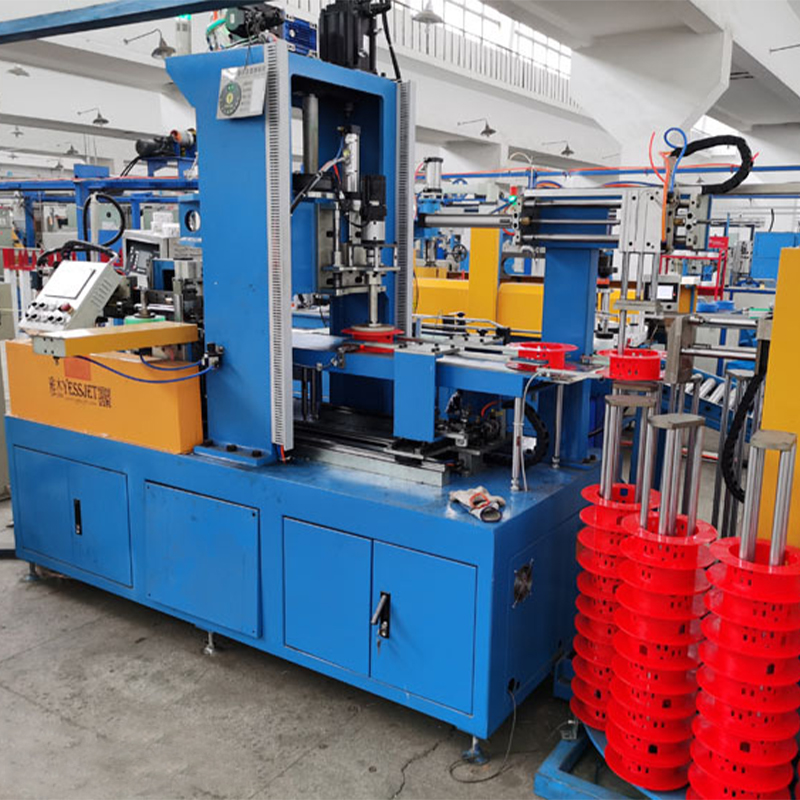
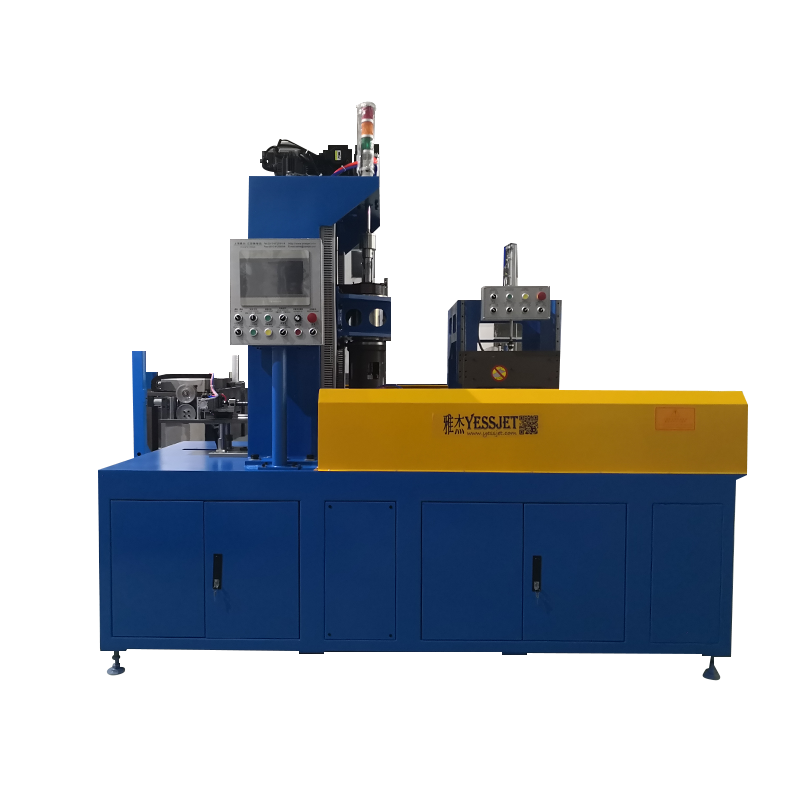
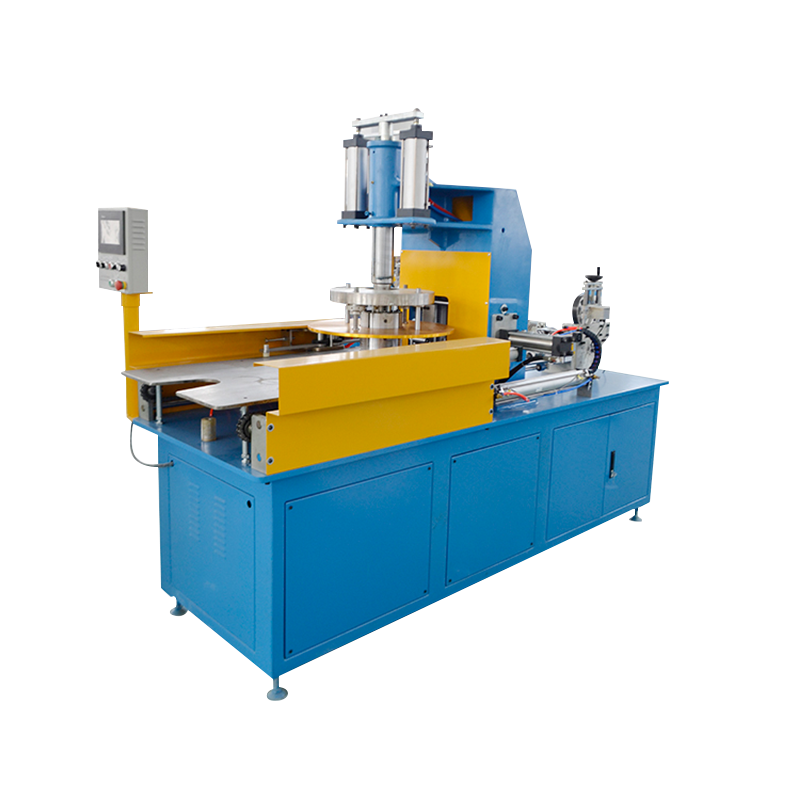
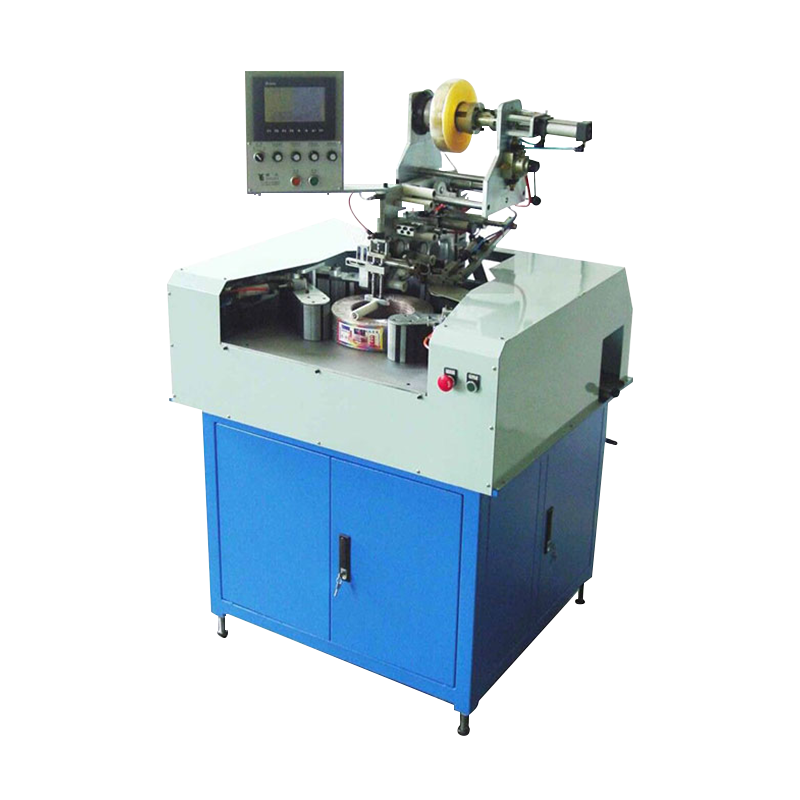
The Auto-Wrapping Machine for Circular Object is designed for this specific requirement. It is a semi-automatic packaging machine that automatically wraps circular objects after an operator places the object onto the machine’s handle plate. The equipment is particularly suitable for coils of BV, BVR, RVV, UL electronic wires, flower wires, and other circular wire products. It can use PVC tape, PE film, PP woven band, paper, and other compatible packaging materials according to the selected production requirement.
With a motor-driven four-arm carrier, touch-screen operation, programmable wrapping data, and automatic error detection, the machine combines practical automation with flexible control. Its design allows manufacturers to increase wrapping speed while maintaining a stable and professional package appearance. Compared with basic manual wrapping equipment or less adaptable automatic packers, it offers a more controlled process, greater repeatability, and easier changeover between different coil sizes.
Auto-Wrapping Machine For Circular Object
1. The Role of Wrapping in Wire and Cable Production
Wire and cable manufacturing does not end when the product leaves the extrusion line. Packaging is part of the production process because it protects the cable and affects how efficiently the finished product can be moved, stored, identified, and sold. A coil must retain its shape, remain compact, and withstand normal transportation conditions. The wrapping material should be applied evenly without damaging the insulation or leaving loose sections.
For electrical wires and flexible cables, packaging is especially important. Products such as BV, BVR, RVV, and UL electronic wires may have smooth insulation surfaces that can be scratched, compressed, or contaminated if they are handled without suitable protection. A consistent outer wrap helps keep the coil together and provides a barrier against dust and minor abrasion. It can also improve visual presentation, which is valuable when the product is delivered directly to distributors, contractors, or retail customers.
Manual wrapping creates several common difficulties. Operators must hold the coil, rotate it, feed the material, maintain tension, and stop at the correct point. These actions require coordination and concentration. As production volume increases, fatigue may lead to variations in overlap, wrapping density, and material usage. Different operators may also package the same product in different ways. Such differences make quality inspection more difficult and can create additional rework.
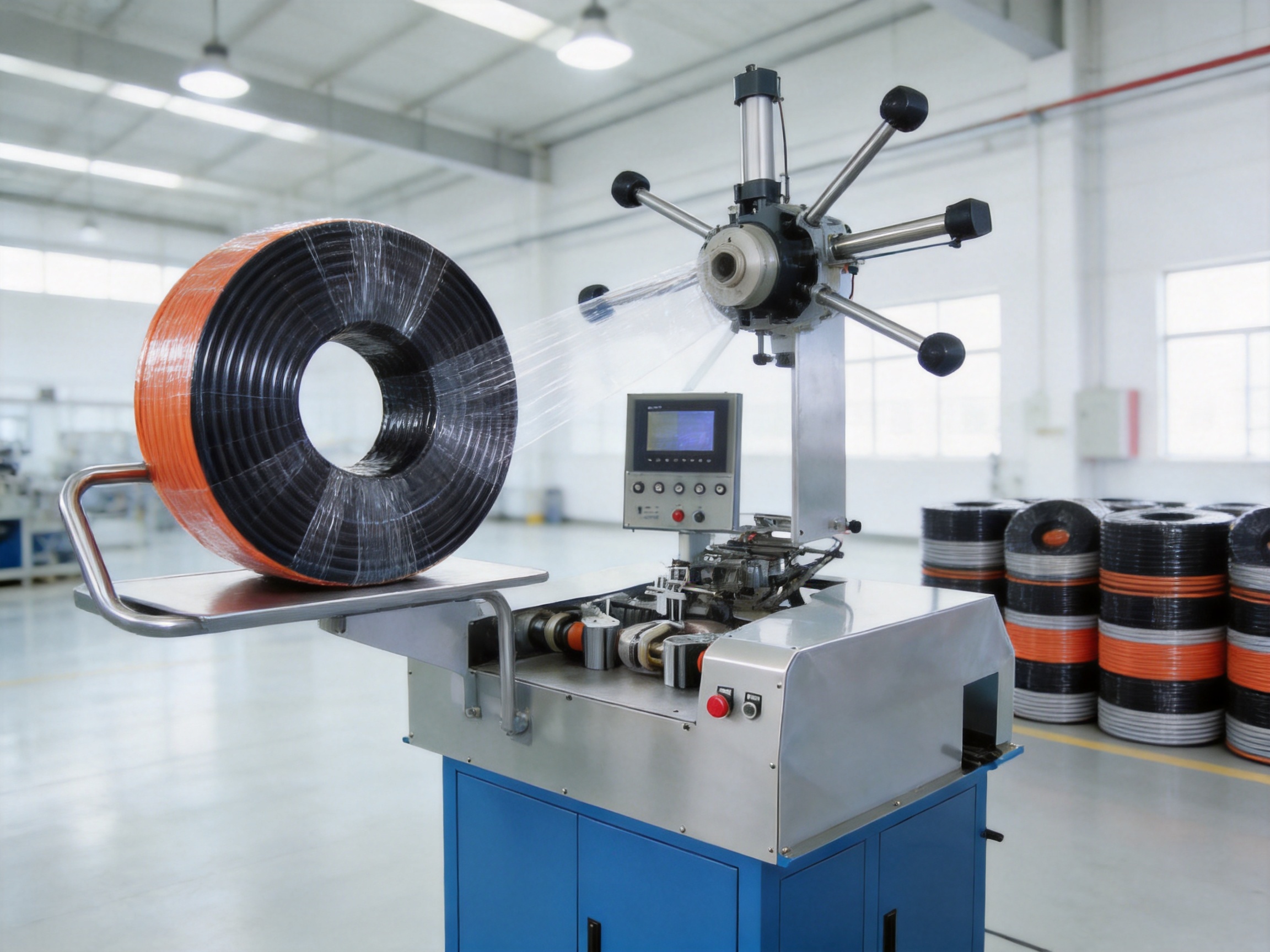
The circular-object wrapping machine addresses these issues by using a motorized carrier to rotate the coil smoothly while the wrapping material is applied. The operator still loads the coil manually, which keeps the machine practical and cost-effective for a broad range of applications, but the repetitive wrapping movement is automated. This division of work reduces physical effort and makes the key packaging operation more consistent.
2. Product Overview
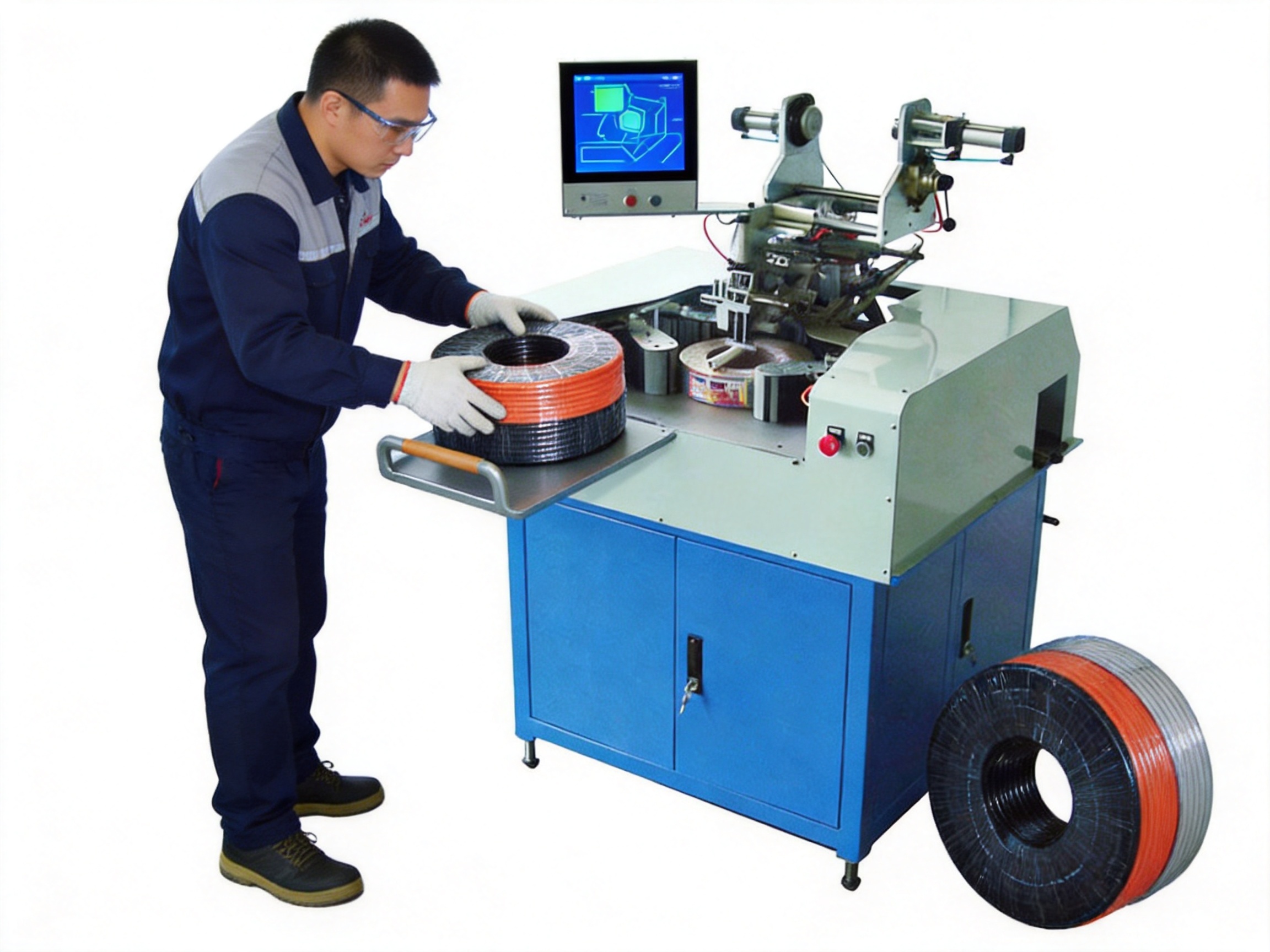
The machine is intended for wrapping circular coils with a controlled, repeatable process. The operator places the coil on the handle plate, selects or confirms the appropriate wrapping program, and starts the cycle. The motor-driven four-arm carrier turns the coil smoothly as the packaging material is applied around the circular object. Once the programmed wrapping process is completed, the operator can remove the finished coil and load the next one.
The equipment is classified as semi-automatic because loading and unloading are performed manually. This configuration is useful for manufacturers that require automation in the wrapping process but do not necessarily need a fully robotic loading and conveying system. It provides a balance between investment, flexibility, operator involvement, and production efficiency.
The available models are designed for different coil heights, outside diameters, inside diameters, and weights. This range enables users to select a machine that matches their wire and cable product portfolio. Smaller models can handle compact coils, while larger versions support heavier products and greater outside diameters.
| Model | Coil Height (mm) | Outside Diameter (mm) | Inside Diameter (mm) | Maximum Coil Weight | Wrapping Material | Material Width (mm) | Material Thickness (mm) |
|---|---|---|---|---|---|---|---|
| P100 | 50–100 | 180–460 | 120 | 35 kg | PVC, PE film | 40 | 0.04–0.07 |
| P120 | 70–120 | 220–600 | 140 | 40 kg | PVC, PE film | 45 | 0.04–0.07 |
| P140 | 70–140 | 300–600 | 180 | 60 kg | PVC, PE film | 50 | 0.04–0.07 |
| P180 | 90–180 | 320–600 | 180 | 80 kg | PVC, PE film | 60 | 0.04–0.07 |
| P210 | 100–210 | 400–800 | 250 | 100 kg | PVC, PE film | 80 | 0.04–0.07 |
The table shows that the P100 through P210 models cover a broad range of circular products. The maximum supported coil weight increases from 35 kilograms on the P100 to 100 kilograms on the P210. The largest model also accommodates coils up to 800 millimeters in outside diameter, making it suitable for higher-capacity wire and cable packaging applications.
Actual operating performance depends on the coil’s shape, material, winding condition, wrapping pattern, and selected packaging material. Before final model selection, manufacturers should confirm the dimensions and weight of their typical products as well as any special requirements for overlap, appearance, or transport protection.
3. Main Advantages of the Equipment
3.1 Consistent Wrapping Quality
One of the most important advantages of the machine is its ability to produce more consistent wrapping than manual operation. The coil is rotated by a motorized carrier, allowing the wrapping material to be applied in a controlled manner. Consistent rotation helps reduce loose sections, excessive overlap, and uneven distribution of material.
Stable wrapping quality is valuable for both protection and appearance. When the outer layer is even, the coil is easier to stack and handle. A uniform package also supports more reliable inspection because operators can quickly identify damaged or incomplete wrapping. In contrast, manual wrapping quality may vary according to operator technique, fatigue, and production speed.
3.2 High-Speed Coil Wrapping
The machine is designed for high-speed coil wrapping with PVC, PE film, PP woven band, or paper. Automating the repetitive rotation and wrapping action enables the operator to focus on loading, unloading, and basic process supervision. This can reduce the time required for each package and help increase the output of the packaging section.
Higher wrapping speed is particularly useful when the upstream extrusion line produces cable continuously. If packaging is too slow, finished coils may accumulate between production stages. By increasing the capacity of the wrapping operation, the machine can help maintain a smoother production flow and reduce bottlenecks after coiling.
3.3 Flexible Packaging Material Options
The equipment can work with several types of wrapping material. PVC and PE film are commonly selected for their practical protection and neat appearance. PP woven band and paper may be considered when a different package structure, branding method, or material preference is required. The correct material depends on the cable type, storage environment, transportation conditions, and customer requirements.
Material flexibility gives the machine an advantage over packaging systems designed for only one consumable. A wire and cable manufacturer may produce several product families, each requiring a different outer wrap. Supporting multiple material choices allows the same equipment platform to serve more products and reduces the need to install separate dedicated machines.
3.4 Touch-Screen Graphic Operation
The screen touch Graphic Operation Terminal provides a direct interface for machine control. Operators can select operating parameters, monitor the wrapping cycle, and respond to alarms through a graphical screen. Compared with a control panel based only on switches and indicator lights, a touch-screen interface can present more information in a clearer format.
A visual operating terminal also supports faster training. New operators can follow displayed instructions and use stored programs rather than manually setting every parameter from the beginning. This is especially helpful in factories with multiple cable specifications or frequent production changes.
3.5 Storage of up to 99 Wrapping Programs
The PLC memory can store up to 99 types of coil wrapping data. This feature allows users to create dedicated programs for different coil sizes, product categories, wrapping materials, or packaging patterns. Once a program has been tested and approved, it can be recalled for future production.
Program storage improves repeatability. Instead of relying on an operator’s memory, the factory can establish standard parameters for each product. This reduces setup variation and simplifies the transition between orders. It also supports quality management because the same product can be wrapped using the same approved settings from one production batch to the next.
3.6 Automatic Error Detection
The machine includes automatic error detection. When an equipment fault occurs, the system can detect the error and send an alarm to remind the operator. Early notification helps prevent extended downtime and allows maintenance personnel to investigate the problem before it affects a larger quantity of product.
Automatic alarms also improve operational safety and process awareness. Instead of requiring the operator to identify every abnormal condition through visual observation, the control system provides a direct warning. The specific response depends on the fault, but the general purpose is to support timely intervention and maintain normal equipment operation.
3.7 Reduced Labor Intensity
Manual wrapping requires repetitive physical movement and continuous attention. The operator must rotate the coil or manipulate the wrapping material while maintaining the desired package quality. The motor-driven carrier performs the most repetitive portion of this task, reducing operator fatigue.
Because the machine remains semi-automatic, it does not eliminate all labor. An operator is still required to place the circular object on the handle plate and remove it after wrapping. However, the operator’s role changes from physically performing every wrapping movement to loading, monitoring, and managing the process. This can improve labor utilization and make the packaging station more sustainable during long production shifts.
4. Why It Is Particularly Suitable for Wires and Cables
Wire and cable coils are not always identical. Their diameter, height, weight, flexibility, and surface characteristics can vary significantly according to conductor size, insulation material, construction, and application. A packaging machine for this industry must therefore be more flexible than a simple fixed-size wrapping unit.
The available P-series models provide different working ranges for coil height, outside diameter, inside diameter, and weight. This makes it possible to match the machine to compact electronic wire coils as well as larger and heavier cable products. The model selection can be based on the largest and most frequently produced coil, while the stored programs help manage different product dimensions within the selected machine’s operating range.
The machine is suitable for circular wire products including BV, BVR, RVV, UL electronic wires, flower wires, and other wire coils. These products may be used in construction, electrical installation, consumer electronics, appliance manufacturing, lighting, industrial equipment, and other applications. The ability to wrap different types of circular products gives manufacturers greater production flexibility.
For flexible cables, a well-controlled wrapping process helps maintain the coil’s form without unnecessary handling. For smaller electronic wires, a clean and consistent package can improve presentation and simplify distribution. For heavier cable coils, the correct model provides a suitable load capacity and working envelope. In every case, the machine should be operated within its specified dimensions and weight limits.
5. Comparison with Manual and Less Flexible Wrapping Methods
5.1 Compared with Manual Wrapping
Manual wrapping has a low initial equipment cost and can be used for occasional packaging. However, its productivity is strongly dependent on the operator. The quality of the finished package may differ from one person to another, and fatigue becomes a serious factor in high-volume production.
The automatic wrapping machine offers a more repeatable rotation and wrapping process. It also provides stored programs, which manual methods cannot offer in the same way. For manufacturers with regular production volumes, these advantages can compensate for the investment by reducing rework, improving throughput, and lowering the labor intensity of packaging.
5.2 Compared with Single-Size Machines
Some packaging systems are built for one specific coil dimension. Such equipment may perform well when the product range is narrow, but it can become a limitation when a factory receives different orders. A single-size machine may require extensive adjustment or may be unable to package other products at all.
The P100 to P210 range and the PLC’s capacity for 99 stored wrapping data types provide greater flexibility. A manufacturer can choose the appropriate machine size and then organize production programs for multiple products. This is a practical advantage for factories serving different markets or producing both standard and customized cable coils.
5.3 Compared with Basic Non-Programmable Equipment
Basic wrapping equipment may provide rotation but lack a modern control interface, program memory, or automatic fault notification. Operators must rely on manual settings and personal experience. This can make training, changeover, and troubleshooting more difficult.
The touch-screen Graphic Operation Terminal and PLC-based data storage create a more organized control method. The operator can select established parameters, while the alarm function provides a clear indication when abnormal conditions occur. These features support a more standardized packaging operation.
5.4 Compared with Fully Automatic Robotic Cells
Fully automatic robotic packaging cells may include conveyors, automatic loading, robotic handling, labeling, and palletizing. They are appropriate for very high-volume lines with highly standardized products. However, they generally require greater investment, more floor space, and more complex integration.
The semi-automatic circular-object wrapping machine is a practical alternative for manufacturers that need automated wrapping but still prefer manual product handling. It can be integrated into an existing production environment without requiring a complete robotic packaging cell. This makes it attractive for small and medium-sized cable manufacturers, mixed-product factories, and plants that are gradually upgrading their automation level.
6. Operating Principle and Workflow
6.1 Loading the Circular Object
The process begins when the operator places the wire or cable coil on the machine’s handle plate. The coil should be positioned correctly so that it is stable and aligned with the carrier. Proper loading is important because an incorrectly positioned coil may rotate unevenly or affect the finished wrapping pattern.
Before starting, the operator should confirm that the coil is within the selected model’s height, diameter, inside-diameter, and weight range. The coil should also be wound securely. Loose or irregular coils may require correction before packaging to ensure that the wrapping process can be completed smoothly.
6.2 Selecting the Wrapping Program
The operator selects an existing program or enters the required operating data through the touch-screen terminal. Program parameters may correspond to the coil dimensions, packaging material, wrapping amount, and other approved production settings. Storing the data in the PLC memory reduces repeated manual adjustment.
For a new product, the production team can conduct a trial, inspect the package, and adjust the settings as necessary. Once the result is accepted, the data can be saved as one of the available wrapping programs. A clear naming or numbering system should be used so that operators can easily identify the correct program.
6.3 Motorized Rotation and Wrapping
After the cycle starts, the four-arm carrier driven by a motor turns the coil smoothly. The wrapping material is applied around the circular object as it rotates. The carrier arrangement supports stable movement and helps maintain a controlled wrapping path.
The machine is designed for high-speed wrapping, but the best operating speed depends on the coil’s mass, flexibility, dimensions, and packaging material. A suitable production setting should provide a balance between speed, wrapping quality, material tension, and equipment stability.
6.4 Completion and Unloading
When the wrapping cycle is complete, the machine stops according to the programmed process. The operator removes the packaged coil and places it in the designated storage, inspection, or dispatch area. The next coil can then be loaded.
At this stage, the operator should check the package for complete coverage, acceptable overlap, secure material placement, and any signs of damage. Regular visual inspection helps maintain quality and can identify conditions that require adjustment before they become repeated defects.
7. Manufacturing and Engineering Strengths
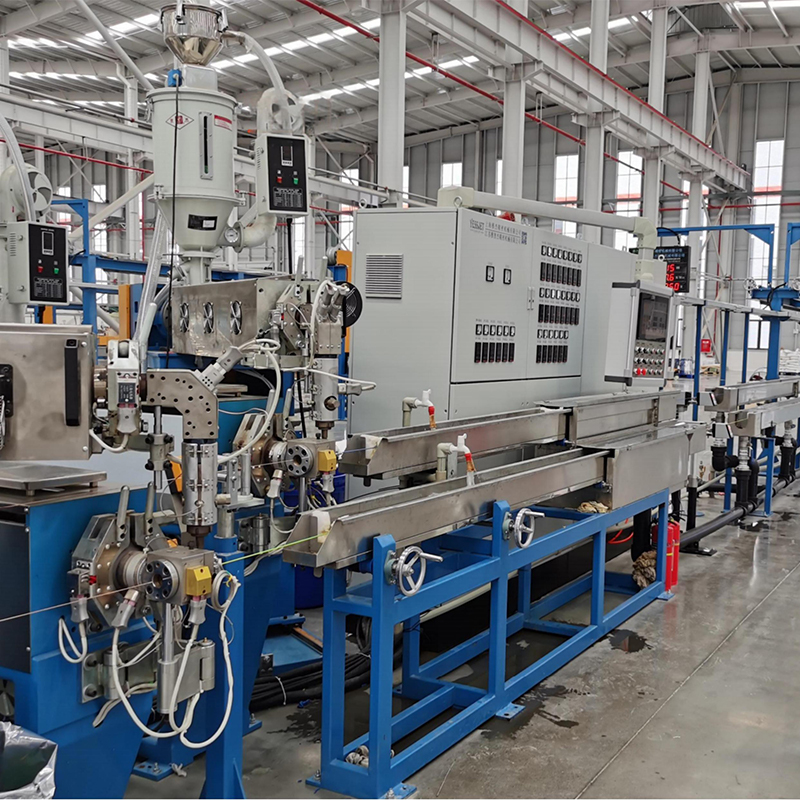
Shanghai Yessjet Precise Machinery Co., Ltd. supplies machinery for wire and cable production, including wire and cable extrusion lines, fully automatic coiling and packaging equipment, intelligent robot stackers, coiling machines, motorized pay-off equipment, motorized take-up equipment, accessory equipment, and cable extrusion machines. This product range gives the company experience across multiple stages of wire and cable manufacturing.
A supplier with knowledge of the complete production process can better understand how packaging equipment interacts with upstream and downstream machinery. The wrapping machine must receive coils with appropriate dimensions and winding conditions, while the finished packages may need to move toward stacking, storage, or shipping. Experience with pay-off, take-up, coiling, and stacking equipment supports a more coordinated approach to line planning.
The company’s focus on precise machinery is reflected in the use of motorized movement, PLC control, touch-screen operation, programmable data storage, and automatic error detection. These functions are not isolated features; together they create a packaging system that is easier to operate, standardize, and maintain.
7.1 Product-Oriented Engineering
Wire and cable products have different physical properties. A machine designed around actual product characteristics is more useful than a generic wrapping machine with limited adjustment. The P-series models are organized around practical dimensional and weight ranges, allowing users to select equipment based on their production needs.
The company’s broader product portfolio also supports product-oriented engineering. A customer may require only a wrapping machine, or may be planning an integrated line that includes extrusion, coiling, packaging, and stacking. The supplier’s knowledge of these related operations can help customers evaluate the packaging station as part of a larger production solution.
7.2 Programmable Process Control
The use of PLC memory for up to 99 wrapping data types supports repeatable manufacturing. Program-based operation is important when a factory produces different cable sizes or changes between orders frequently. It also creates a foundation for process documentation because production teams can associate each product specification with a corresponding machine program.
Programmable control can reduce dependence on individual operator experience. Skilled operators remain important, but the machine can preserve approved process settings and make them available to the wider production team. This is especially useful when factories operate multiple shifts or train new employees.
7.3 Practical Automation Rather Than Unnecessary Complexity
The machine’s semi-automatic structure demonstrates a practical automation philosophy. It automates the repetitive wrapping action without requiring the full complexity of automatic loading and unloading. This can reduce the initial investment and simplify installation while still delivering the most important benefits of automated wrapping.
For many wire and cable factories, the most suitable automation strategy is not necessarily the most complicated one. A machine should match the product mix, output level, available floor space, labor structure, and future expansion plans. The circular-object wrapping machine provides a scalable step toward higher automation.
7.4 Support for Production Efficiency
The combination of high-speed wrapping, stored programs, alarm notification, and motorized rotation helps reduce avoidable delays. Faster cycles improve output, program storage shortens changeovers, and error detection supports quicker troubleshooting. Together, these functions can improve the overall efficiency of the packaging section.
Production efficiency should be measured not only by nominal machine speed. It also includes material usage, setup time, operator workload, rework, downtime, and the consistency of finished packages. A controlled wrapping system can deliver benefits across each of these areas when properly installed and operated.
8. Packaging Materials and Application Considerations
8.1 PVC Film
PVC tape or film is commonly used when manufacturers want a neat, visible, and practical outer package. It can help hold a coil together and provide protection against dust and minor surface contact. The selected PVC material should be compatible with the cable’s insulation and the intended storage conditions.
8.2 PE Film
PE film is another suitable option for wrapping circular wire and cable coils. It can provide flexible coverage and may be selected for its handling characteristics, availability, and packaging appearance. The film thickness and width should match the machine’s operating specifications and the desired level of protection.
8.3 PP Woven Band
PP woven band can be used when a stronger band-style wrapping structure is required. It may be appropriate for certain products or transportation conditions where additional package restraint is desired. The wrapping pattern and tension should be evaluated carefully to avoid unnecessary pressure on the cable.
8.4 Paper
Paper wrapping may be selected for product presentation, material preference, or specific customer requirements. Its performance depends on paper quality, humidity, storage conditions, and the desired overlap. The production team should confirm that the selected paper works smoothly with the machine’s material-feeding arrangement.
8.5 Width and Thickness Selection
The listed models use wrapping-material widths from 40 to 80 millimeters and material thicknesses from 0.04 to 0.07 millimeters. These values provide a reference for choosing compatible consumables. The correct width affects coverage and appearance, while thickness influences strength, flexibility, and material consumption.
Manufacturers should conduct trials with the actual cable product and selected packaging material. The trial should examine wrapping tightness, overlap, edge condition, coil stability, material breakage, and package appearance. A material that works well on one cable type may require different settings on another because of differences in coil diameter, surface friction, and flexibility.
9. Installation, Setup, and Daily Operation
Before installation, the factory should prepare a level floor, sufficient operating space, suitable electrical service, and safe access for loading and unloading. The machine should be positioned so that the operator can work comfortably without obstructing nearby production equipment or emergency routes.
Initial setup should include mechanical inspection, electrical connection, control-system checks, and trial operation without a product. The carrier should rotate smoothly, the wrapping-material path should be correctly installed, and the touch-screen controls should respond as expected. Safety devices and alarm functions should also be verified before normal production begins.
Operators should receive training in loading, program selection, material replacement, alarm response, cleaning, and basic inspection. They should understand the difference between a normal stop, a material-related interruption, and an equipment fault. Clear operating procedures help reduce misuse and improve response time.
At the beginning of each shift, the operator should inspect the carrier, handle plate, material-feeding components, electrical controls, and visible fasteners. Any unusual noise, vibration, material tracking, or repeated alarm should be recorded and reported. Early attention to small abnormalities can help prevent more serious downtime.
During production, coils should be loaded within the appropriate model range. The operator should ensure that the coil is stable before starting the cycle. If the package shows uneven coverage or excessive looseness, the process should be paused and the relevant settings checked rather than allowing the problem to continue across multiple coils.
10. Maintenance and Reliability Practices
Routine maintenance is essential for maintaining stable wrapping performance. The machine should be kept clean, particularly around the material-feeding path and rotating carrier. Dust, film fragments, and paper particles can interfere with movement or affect the quality of the wrapping material.
Moving components should be inspected according to the manufacturer’s maintenance recommendations. Lubrication, where required, should use the correct product and quantity. Fasteners, guards, electrical connections, sensors, and emergency devices should be checked periodically.
The PLC and touch-screen system should be protected from unauthorized changes. Approved programs should be documented and backed up where possible. If a parameter is changed during troubleshooting, the change should be recorded so that the production team knows which settings are currently active.
Automatic error detection makes maintenance more efficient because the operator receives an alarm when the equipment identifies an abnormal condition. However, alarms should not simply be cleared without investigation. Repeated alarms may indicate material incompatibility, incorrect loading, sensor contamination, mechanical wear, or a control-system issue.
A preventive maintenance schedule should consider production intensity. A factory operating one shift may use a different inspection frequency from a plant running continuously. Maintenance records should include the date, observed condition, corrective action, replacement parts, and responsible person. This information helps identify recurring issues and supports long-term equipment management.
11. Improving Overall Factory Performance
The wrapping machine can create the greatest benefit when it is incorporated into a coordinated production workflow. The upstream coiling operation should produce coils with stable dimensions and a suitable winding condition. If the coil is irregular, the wrapping machine may not be able to compensate for the underlying problem.
After wrapping, the finished coil may be transferred to an intelligent robot stacker, pallet, storage rack, or dispatch area. A clear material-flow plan prevents congestion around the wrapping station. The operator should have defined locations for unwrapped coils, packaging materials, finished packages, rejected products, and maintenance tools.
Production planning should also consider program organization. Each cable product can be assigned a program number based on a documented naming system. For example, the factory may group programs by product family, nominal diameter, coil size, or customer packaging requirement. A consistent system reduces selection errors and makes shift handovers easier.
Quality indicators can be used to measure the effect of the machine. Useful indicators include average wrapping time, material consumption per coil, package rejection rate, alarm frequency, operator loading time, and daily output. Comparing these indicators before and after installation can help the manufacturer quantify the equipment’s contribution.
Manufacturers may also reduce waste by optimizing material overlap and selecting an appropriate thickness. Excessive overlap increases consumption without necessarily improving protection, while insufficient overlap may create an unstable package. Stored programs make it easier to test and standardize an efficient wrapping pattern for each product.
12. Safety and Responsible Use
Operators should follow the machine’s safety instructions and keep hands, clothing, and tools away from moving components during operation. The rotating carrier must be allowed to stop before the operator attempts to adjust the coil or packaging material. Guards and safety devices should remain in place and should never be bypassed during normal production.
Heavy coils should be handled with appropriate lifting equipment or safe manual-handling procedures. The P180 and P210 models can support coils weighing up to 80 and 100 kilograms respectively, so loading arrangements must be planned carefully. The machine’s maximum capacity does not remove the need for safe lifting practices.
Packaging materials should be stored in a clean, dry location and protected from damage. Film, tape, woven band, and paper can be affected by humidity, heat, dust, or improper stacking. Damaged material may break during wrapping or produce an inconsistent package.
When an alarm occurs, the operator should follow the approved troubleshooting procedure. If the fault cannot be safely corrected by the operator, qualified maintenance personnel should be called. Electrical cabinets and control components should only be serviced by trained personnel.
13. Selecting the Correct Model
Model selection should begin with the complete range of coils that the machine is expected to wrap. The manufacturer should list the minimum and maximum coil height, outside diameter, inside diameter, and weight. It is also useful to identify the percentage of production represented by each size, because the most frequently produced product may be more important than an occasional maximum-size coil.
The P100 model supports coil heights from 50 to 100 millimeters, outside diameters from 180 to 460 millimeters, and coil weights up to 35 kilograms. The P120 increases the height range to 70–120 millimeters and the outside-diameter range to 220–600 millimeters, with a 40-kilogram capacity.
The P140 supports heights from 70 to 140 millimeters, outside diameters from 300 to 600 millimeters, and coil weights up to 60 kilograms. The P180 accommodates 90–180-millimeter coil heights, 320–600-millimeter outside diameters, and loads up to 80 kilograms.
The P210 is the largest listed model. It supports coil heights from 100 to 210 millimeters, outside diameters from 400 to 800 millimeters, inside diameters of 250 millimeters, and coil weights up to 100 kilograms. This model is suited to larger and heavier circular cable coils.
Users should not select a model solely by outside diameter. A coil may fit within one dimension while exceeding the permitted height or weight. All relevant dimensions must be checked together. Product trials are recommended when the cable has unusual flexibility, an irregular coil shape, or a special wrapping requirement.
14. Purchasing and Integration Questions
When evaluating the machine, buyers should request clarification about the actual production cycle, compatible packaging materials, electrical requirements, machine footprint, replacement parts, installation assistance, and operator training. They should also discuss whether the equipment will be used as a standalone machine or integrated with a coiling, conveying, stacking, or labeling system.
Customers should provide representative product samples or detailed coil specifications during the technical evaluation. Testing with real coils can reveal practical factors that are not visible from a specification table, such as winding stability, surface friction, material tension, and package appearance.
It is also important to define acceptance criteria before commissioning. These may include wrapping completeness, allowable overlap variation, package tightness, cycle time, material consumption, alarm response, and the ability to store and recall product programs. Clear criteria help both the buyer and supplier confirm that the equipment meets the intended production purpose.
15. Questions and Answers
Q1: Is the machine fully automatic?
No. It is a semi-automatic machine. The operator must manually place the circular object on the handle plate and remove it after wrapping. The wrapping and rotation process is automated by the motor-driven carrier.
Q2: What products can be wrapped?
The machine is designed for circular objects, especially wire and cable coils. It is suitable for products such as BV, BVR, RVV, UL electronic wires, flower wires, and other circular wire coils, provided that their dimensions and weight fall within the selected model’s range.
Q3: Which wrapping materials can be used?
The equipment can use PVC, PE film, PP woven band, or paper, depending on the material-feeding configuration and the specific application. The material width and thickness should be selected according to the model specifications and production requirements.
Q4: How many wrapping programs can be stored?
Up to 99 types of coil wrapping data can be entered and retained in the PLC memory. This allows operators to recall approved settings for different cable products and coil sizes.
Q5: How does the machine help reduce labor requirements?
The motorized four-arm carrier performs the repetitive rotation and wrapping action. The operator remains responsible for loading, unloading, and supervision, but does not need to manually rotate the coil throughout the entire wrapping cycle.
Q6: What happens when the machine detects a fault?
The automatic error-detection function sends an alarm to remind the operator. The operator can then follow the troubleshooting procedure, inspect the material and coil position, or contact maintenance personnel if the problem requires technical service.
Q7: Which model is suitable for a 100-kilogram coil?
The P210 model is listed with a maximum coil weight of 100 kilograms. The coil must also meet the P210 dimensional ranges, including a height of 100–210 millimeters and an outside diameter of 400–800 millimeters.
Q8: Can one machine package different coil sizes?
Yes, within the operating range of the selected model. Different wrapping data can be stored in the PLC memory, allowing the operator to select the appropriate program for each product.
Q9: Is a product trial recommended?
Yes. A trial with actual coils and the intended packaging material is recommended, especially when the product has unusual dimensions, flexibility, winding characteristics, or appearance requirements.
Q10: Can the machine be used in a larger cable production line?
Yes. It can operate as a standalone packaging machine or be considered as part of a broader wire and cable production solution. Its suitability for integration depends on the layout, conveying method, upstream coiling equipment, downstream stacking requirements, and the customer’s automation plan.
Q11: What are the main advantages over manual wrapping?
The main advantages are more consistent wrapping, higher productivity, reduced operator fatigue, stored process data, and automatic fault notification. These features can help improve package quality and reduce variation between operators and production shifts.
Q12: What information should a buyer provide before selecting a machine?
The buyer should provide coil height, outside diameter, inside diameter, weight, product type, desired wrapping material, expected production volume, and any requirements for package appearance or transportation protection. Representative samples are useful for technical confirmation.
16. Conclusion
The Auto-Wrapping Machine for Circular Object provides a practical and flexible packaging solution for wire and cable manufacturers. Its semi-automatic format keeps loading and unloading straightforward while automating the repetitive wrapping operation. The motor-driven four-arm carrier supports smooth coil rotation, and the touch-screen Graphic Operation Terminal makes the equipment easier to operate.
Its ability to store up to 99 wrapping data types is a significant advantage for factories producing multiple cable sizes and product families. Automatic error detection helps operators respond to equipment abnormalities, while support for PVC, PE film, PP woven band, and paper provides flexibility in packaging material selection. The P100 to P210 model range covers different coil dimensions and weight capacities, including products up to 100 kilograms on the largest listed model.
Compared with manual wrapping, the machine offers greater consistency, improved productivity, and reduced physical labor. Compared with highly complex robotic cells, it provides a more accessible level of automation for manufacturers that still prefer manual product loading. This balance makes it appropriate for a wide variety of wire and cable production environments.
Shanghai Yessjet Precise Machinery Co., Ltd. strengthens this product offering through its wider experience in wire and cable machinery, including extrusion lines, coiling systems, pay-off and take-up equipment, accessory machinery, packaging equipment, and intelligent stacking solutions. By understanding the complete production chain, the company can support customers that need a standalone wrapping machine as well as those planning a broader cable production turnkey solution.
For manufacturers seeking a more reliable and standardized way to package circular wire and cable coils, the machine represents a practical step toward higher production efficiency, improved package quality, and more organized factory automation.
References
1. Product specification information for the Auto-Wrapping Machine for Circular Object, including P100, P120, P140, P180, and P210 model data.
2. General principles of wire and cable manufacturing, including extrusion, coiling, packaging, material handling, and finished-product protection.
3. Industrial packaging equipment practices for circular products and flexible cable coils.
4. Programmable logic controller applications in automated manufacturing and packaging systems.
5. General occupational safety principles for machinery involving rotating components, heavy coils, electrical controls, and packaging materials.
6. General maintenance practices for motor-driven industrial equipment, touch-screen control terminals, sensors, and material-feeding systems.
7. Technical application information for PVC film, PE film, PP woven band, and paper packaging materials used in industrial product protection.
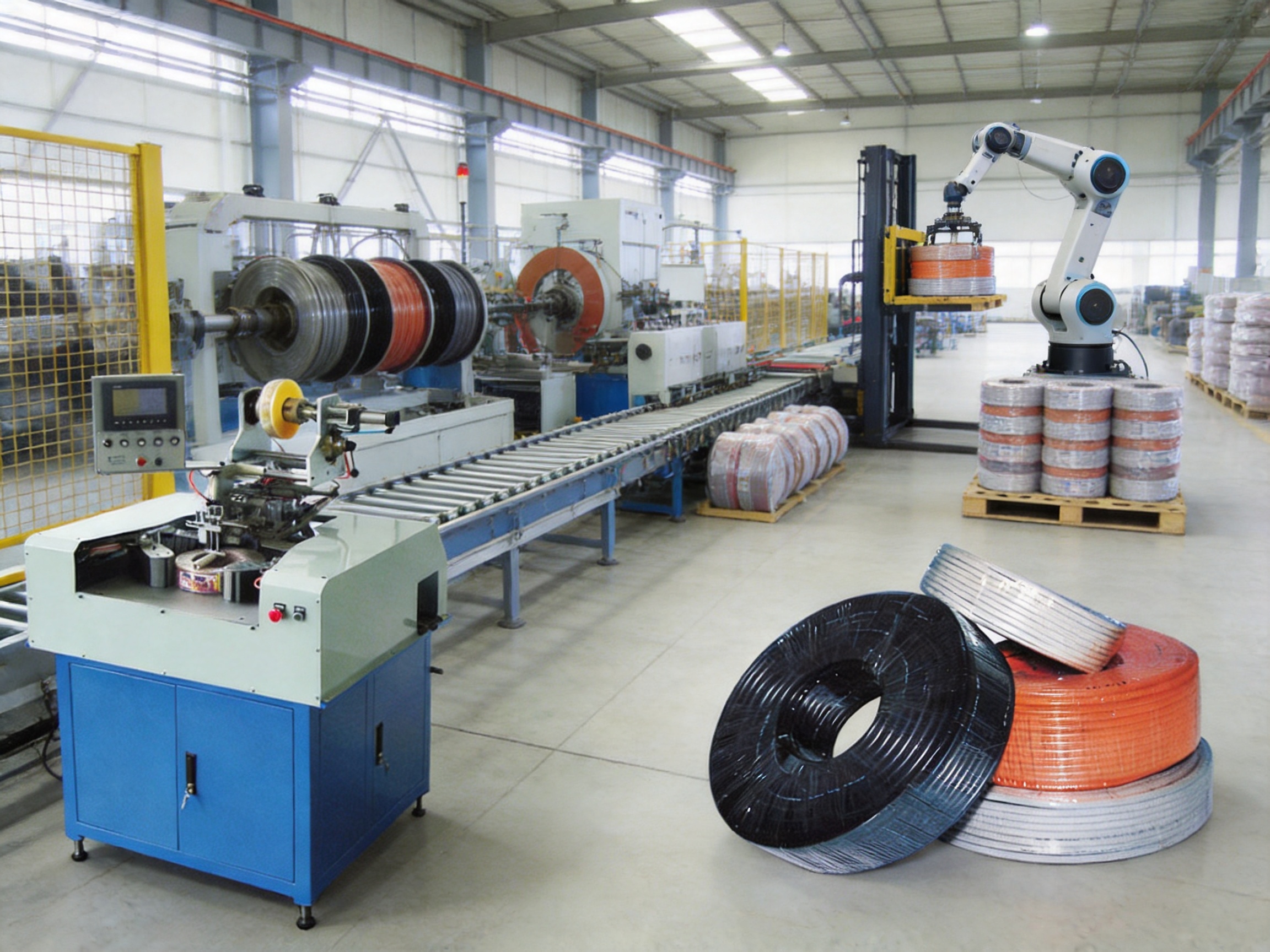
Shanghai Yessjet Precise Machinery Co., Ltd. specializes in wire and cable machinery and production equipment. Its product portfolio includes wire and cable extrusion lines, coiling and packaging systems, intelligent robot stackers, motorized pay-off and take-up equipment, accessory equipment, and cable extrusion machines.