LANGUAGE
 中文简体
中文简体 русский
 Français
 Español
 Português
 عربى
عربى
Content
- 1 Why Material Handling Matters in Cable Production
- 2 Product Overview
- 3 Core Advantages of the Dual Transmission Design
- 4 Comparison with Conventional Handling Methods
- 5 Advantages for Wire and Cable Manufacturers
- 6 Manufacturing Strengths and Engineering Approach
- 7 How the System Works in a Production Environment
- 8 Installation and Layout Considerations
- 9 Operational and Economic Benefits
- 10 Maintenance and Long-Term Usability
- 11 Quality, Safety, and Workflow Discipline
- 12 Application Areas
- 13 Why Choose a Specialized Machinery Manufacturer
- 14 Selection Guide for Buyers
- 15 Frequently Asked Questions
- 15.1 What are Cable Conveyor Belt Systems used for?
- 15.2 What is the difference between automatic track transmission and manual roller transmission?
- 15.3 Can both transmission methods be used in one system?
- 15.4 Are these systems suitable for small-batch production?
- 15.5 Can the system reduce labor costs?
- 15.6 Can the conveyor connect with cable packaging equipment?
- 15.7 Does the system improve energy efficiency?
- 15.8 What information is needed for a suitable configuration?
- 15.9 Is the system only suitable for cable factories?
- 15.10 How does a specialized supplier add value?
- 16 Conclusion
- 17 References
- 18 Product: Cable Conveyor Belt Systems
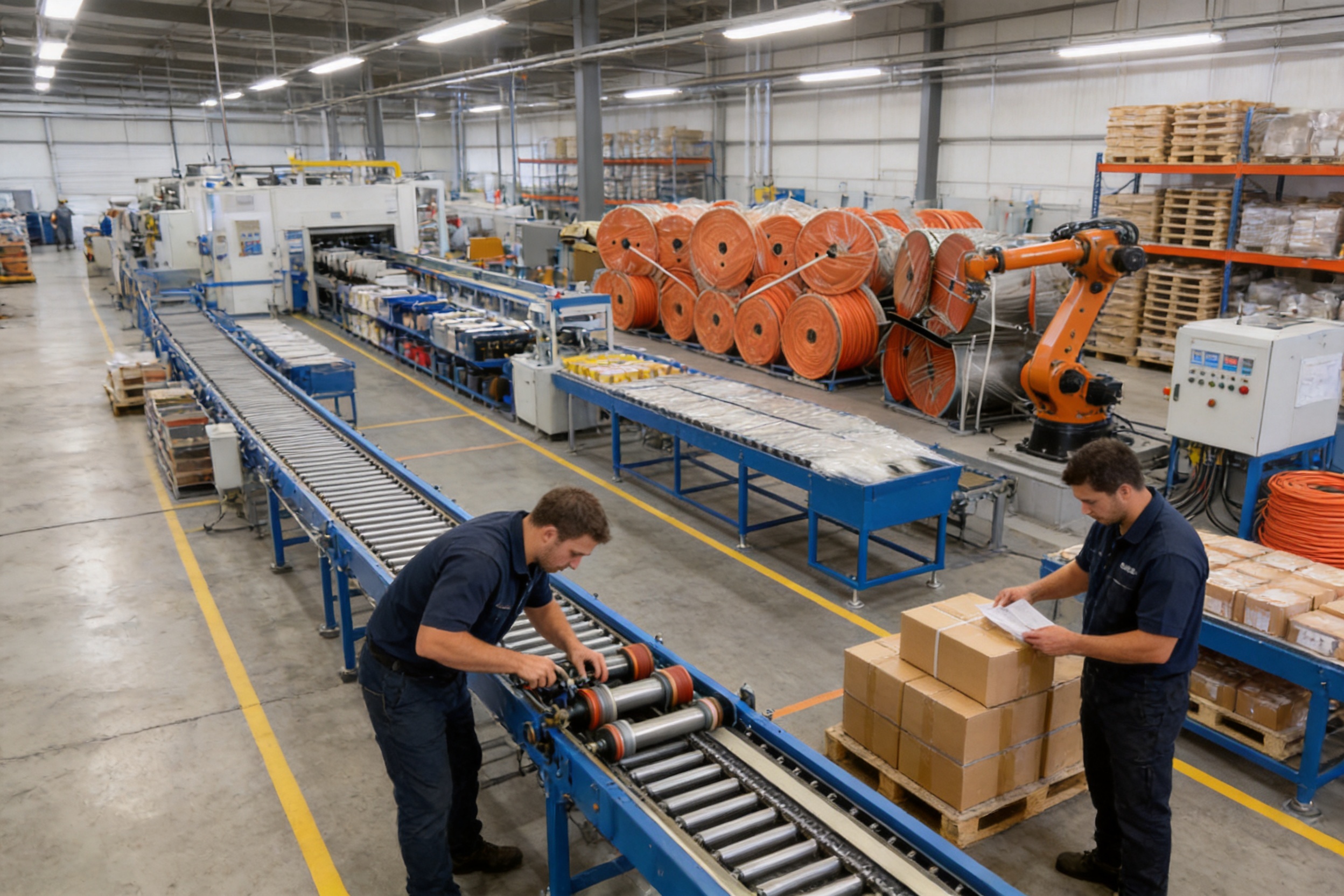
Cable manufacturing depends on more than extrusion, coiling, and packaging equipment. Once a cable product has been produced and packed, it must still move safely, consistently, and efficiently to the next handling point. This final movement stage can influence labor consumption, production continuity, workplace organization, and the overall cost of operating a cable production line. Cable Conveyor Belt Systems provide a practical solution for transferring packaged goods from production areas to designated manual handling stations.
Designed for cable and wire production environments, this material handling solution combines automatic track transmission with manual roller transmission. The two transmission methods allow manufacturers to select an appropriate handling mode according to production volume, package characteristics, layout requirements, and operator involvement. Automatic track transmission supports continuous and consistent movement, while manual roller transmission offers flexible operation for small-batch handling, temporary staging, and work areas where operators need direct control.
By reducing unnecessary carrying procedures, the system helps create a more organized connection between packaging equipment and downstream handling operations. It can move finished packages along a planned route, reduce repetitive manual lifting, and support a smoother flow of materials. In this way, the conveyor system is not simply a transport device. It is an important accessory for improving the efficiency of a complete wire and cable production solution.
Why Material Handling Matters in Cable Production
Wire and cable factories often focus their investment decisions on extrusion lines, take-up machines, coiling machines, packaging equipment, and testing systems. These machines directly create or package the product, so their importance is obvious. However, the handling stage between machines can also become a significant source of delay and expense.
Packaged cables may be heavy, bulky, flexible, or difficult to carry manually. Packages can include coils, reels, cartons, wrapped bundles, or other finished units. If these products must be moved by hand over long distances, operators may spend a considerable portion of each shift on non-value-added transportation. Manual carrying can also create bottlenecks whenever production speed increases or several packages reach the same station at the same time.
A properly planned conveyor system addresses these problems by establishing a defined material flow path. Finished packages leave the production location and travel toward a selected manual handling point or downstream area. The movement is more predictable, the work area is easier to organize, and operators can focus on inspection, sorting, labeling, palletizing, or other important activities instead of repeatedly transporting goods.
For cable manufacturers, efficient handling is especially valuable because production lines frequently involve several connected processes. A typical workflow may include conductor preparation, insulation extrusion, cooling, take-up, testing, coiling, wrapping, labeling, and final packing. If the finished package cannot move efficiently after packaging, the productivity of the earlier equipment may not be fully realized. The conveyor system helps close this operational gap.
Product Overview
Cable Conveyor Belt Systems are material handling systems developed for the transfer of packaged goods. They are suitable for production areas where finished or semi-finished packages need to travel from a machine outlet to a designated manual handling location.
The system is based on two complementary transmission platforms:
Automatic track transmission for steady, repeatable, and high-efficiency movement.
Manual roller transmission for flexible, operator-controlled handling in small-batch or variable-flow situations.
These platforms can be used independently or arranged as part of a broader handling route. The appropriate configuration depends on the factory layout, package size, required throughput, operator workflow, and the degree of automation desired by the customer.
The automatic track section is intended for consistent conveyance. It can support a regular production rhythm by moving packages along a predetermined path without requiring an operator to push each unit. This is particularly useful where packages leave a coiling or packaging machine at a repeated interval.
The manual roller section provides a different type of value. It allows operators to guide, reposition, or temporarily hold packages without relying on powered movement throughout the entire route. This can be useful for short distances, low-volume production, product changes, inspection points, and areas where workers need direct access to the goods.
Combining the two modes gives manufacturers more flexibility than relying exclusively on powered conveyors or manual transport. The result is a balanced handling approach that can support automation while retaining practical human control where it is most useful.
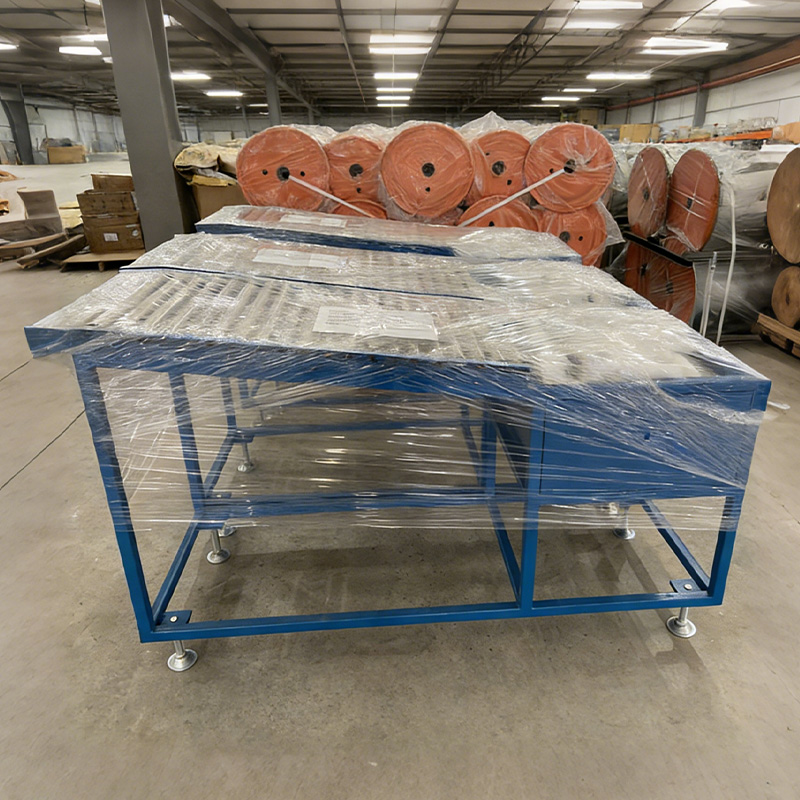
Cable Conveyor Belt Systems
Core Advantages of the Dual Transmission Design
Continuous Automatic Track Transmission
Automatic track transmission supports a stable material flow from the production area to the designated handling location. Because the route is defined in advance, the movement of packages can become more consistent than manual carrying. This helps reduce interruptions caused by operator availability, long walking distances, or temporary congestion between machines.
For production lines with a regular output, automatic transmission can help synchronize the packaging outlet with the downstream handling point. The system can be incorporated into a planned production layout so that packages follow an efficient path rather than being moved around obstacles or stored in unorganized temporary areas.
Consistent transmission also improves visibility. Operators can more easily identify where packages are located, which batches have reached the handling station, and whether the production route is operating normally. A clear material path can support better production coordination and simpler daily management.
Flexible Manual Roller Transmission
Manual roller transmission is valuable when production requirements are not fully uniform. Small-batch manufacturing, frequent product changes, customized orders, and inspection activities may not justify continuous powered movement in every section of the facility. In these situations, a manual roller platform allows workers to move packages with relatively little effort while keeping the arrangement simple.
The roller platform can also serve as a practical buffer area. Operators may temporarily hold packages, turn them, check packaging quality, separate different orders, or prepare them for the next operation. This flexibility is important in cable production because finished goods may vary in diameter, length, package shape, weight, and labeling requirements.
Reduced Repetitive Carrying
One of the main benefits of the system is the reduction of unnecessary carrying procedures. Repeatedly lifting or transporting packaged cables can consume labor time and contribute to operator fatigue. It may also increase the risk of package damage caused by dropping, dragging, or placing products in unsuitable locations.
With a defined conveyor route, operators can guide packages rather than carry them over long distances. This can improve the working environment and allow labor resources to be directed toward tasks that require judgment or technical attention.
Improved Material Flow
A conveyor system helps transform scattered product movement into an organized flow. Instead of allowing packages to accumulate near the production machine, the system moves them toward the next planned location. This can improve housekeeping, reduce congestion, and make better use of available floor space.
Improved flow is also helpful when several machines share a common packing or handling area. A planned transmission route makes it easier to separate products by process, production order, or destination. This can contribute to fewer mix-ups and better control of work-in-progress and finished goods.
Lower Labor Intensity
Material handling can be physically demanding when products are heavy, flexible, or difficult to grip. By supporting the movement of packages, the conveyor reduces the amount of manual effort required for each unit. Lower labor intensity can make work more sustainable over long shifts and can help factories maintain a more stable operating rhythm.
The benefit is not limited to fewer lifting actions. Workers may also spend less time walking between machines and handling stations. Shortening these nonproductive movements can improve the effective utilization of the workforce without requiring an increase in staffing.
Energy-Conscious Operation
The system is designed to optimize material flow paths and avoid unnecessary transport activity. When packages move along a direct and organized route, the factory can reduce the repeated movement associated with manual carrying, temporary storage, and rehandling.
Energy efficiency in a handling system should be considered together with labor efficiency. A suitable combination of automatic and manual transmission avoids the need to power every section continuously when some areas only require occasional movement. This balanced approach can help manufacturers match equipment operation to actual production demand.
Comparison with Conventional Handling Methods
Traditional package handling often depends on workers carrying or pushing products from one machine to another. This method may appear simple, but it can become inefficient as production volume increases. Walking distance, operator availability, package weight, and floor layout all affect the result.
Another common approach is to use a fully powered conveyor throughout the entire route. Full automation can provide high consistency, but it may be unnecessary for low-volume areas or sections that require frequent human intervention. A completely powered system can also reduce flexibility when product dimensions and production schedules change frequently.
The dual transmission design offers a middle path. It provides automatic movement where regular flow is important and manual roller movement where flexibility is more valuable. This makes the system adaptable to different production patterns without forcing every customer into one level of automation.
| Handling approach | Main strengths | Typical limitations | Best application |
|---|---|---|---|
| Manual carrying | Simple initial arrangement and direct operator control | High labor intensity, longer walking distances, and inconsistent flow | Very low-volume or temporary handling |
| Manual roller transmission | Flexible, easy to operate, and suitable for small batches | Requires operator involvement for movement | Variable production, inspection, and short-distance transfer |
| Fully powered conveying | Consistent movement and reduced direct handling | May be less flexible for irregular production or frequent changes | High-volume, repeatable production routes |
| Combined automatic track and manual roller system | Balances efficiency, flexibility, labor reduction, and practical control | Requires suitable planning of the transition between modes | Wire and cable packaging areas with mixed handling requirements |
Compared with conventional methods, the combined system provides a stronger balance between automation and usability. It is not limited to one production model. Manufacturers can use automatic transmission for stable high-output sections and manual roller transmission for product changes, quality checks, or smaller batches.
Advantages for Wire and Cable Manufacturers
Support for Multiple Package Types
Cable production does not produce only one type of finished package. Depending on the product and customer order, the output may consist of coils, reels, cartons, wrapped cable bundles, or other packaged forms. A handling system must therefore accommodate variation rather than assume that every unit is identical.
The use of automatic and manual sections allows operators to respond to package differences. Regular packages can follow the automatic route, while unusual or customized units can be guided manually through the roller section. This reduces the need to redesign the entire material handling route whenever the product mix changes.
Connection with Packaging Equipment
Once a cable has been coiled, wrapped, or otherwise packaged, the product must leave the packaging area without creating a queue. The conveyor system can be positioned after packaging equipment to provide a direct path to manual handling, inspection, sorting, or storage.
This connection helps ensure that packaging machines do not need to stop simply because the operator has not yet removed the previous package. A more continuous transfer arrangement can improve the utilization of upstream equipment and support a smoother production rhythm.
Better Use of Floor Space
Production workshops often contain extrusion lines, coiling machines, take-up systems, packaging units, testing equipment, and storage areas. Poorly organized movement routes may consume valuable floor space and create safety concerns. A conveyor system establishes a defined path, helping the factory arrange equipment and handling stations more systematically.
When planning the route, manufacturers can consider the distance between machines, the location of operator stations, access for maintenance, and the direction of finished-product movement. A well-organized layout can minimize unnecessary crossings and make the production area easier to manage.
Reduced Rehandling
Every additional movement creates an opportunity for delay, damage, or product mix-up. If a package is carried from the machine to a temporary floor location, then moved again to an inspection table and later transferred to storage, the handling process becomes longer and more complicated.
A conveyor route can reduce this rehandling by moving the package directly toward the planned manual handling location. Fewer intermediate movements can help protect packaging quality and reduce the time required to prepare products for dispatch.
Practical Support for Labor Management
Labor efficiency is not achieved merely by reducing the number of workers. It also involves using personnel where their skills create the greatest value. When a conveyor handles routine package movement, operators can spend more time on quality checks, order verification, labeling, product arrangement, and production monitoring.
This approach can be especially useful when a factory is expanding output but wants to control the increase in labor requirements. A suitable handling system can improve the productivity of existing personnel while maintaining a manageable and organized workflow.
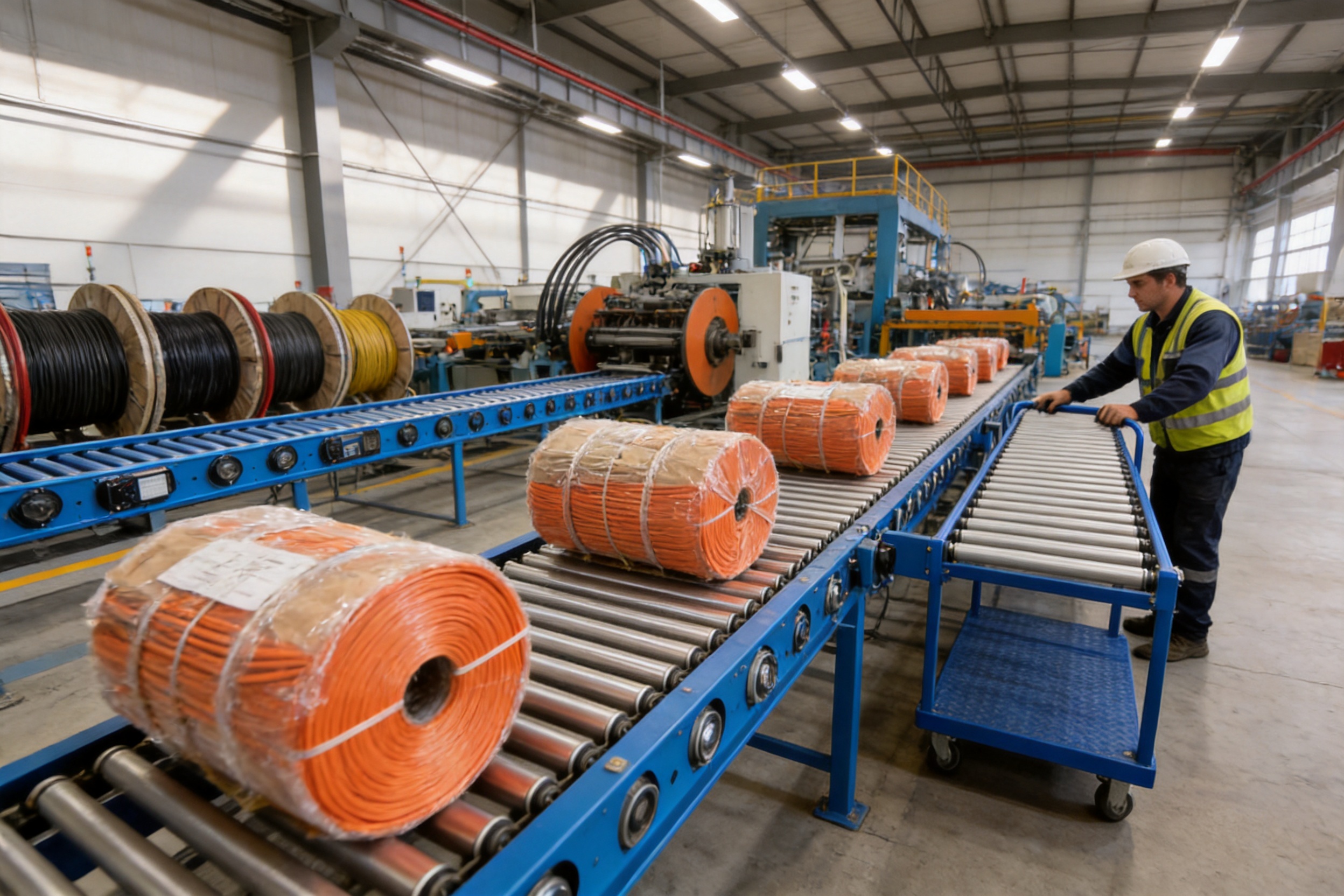
Manufacturing Strengths and Engineering Approach
The effectiveness of a conveyor system depends on more than its visible frame, rollers, or transmission track. Manufacturing quality, engineering coordination, process control, and application understanding all influence long-term performance. A supplier with experience in wire and cable machinery can approach the conveyor as part of a complete production solution rather than as an isolated accessory.
Industry-Oriented Product Development
Equipment used in wire and cable factories must operate within a demanding production environment. It may be positioned near extrusion lines, coiling equipment, packaging machinery, or other automated systems. The supplier therefore needs to understand how material handling interacts with cable production, not merely how to move a generic box.
A product development approach focused on wire and cable applications can take into account package flow, production rhythm, operator access, equipment connection, and downstream handling. This industry orientation helps the conveyor perform its intended function within the complete line.
Integrated Machinery Experience
The product category includes wire and cable extrusion lines, fully automatic coiling and packaging equipment, intelligent robot stackers, coiling machines, motorized pay-off equipment, motorized take-up equipment, accessory equipment, and cable extrusion machines. Experience across these categories provides a broader understanding of how individual machines connect with one another.
That broader perspective is important when designing a handling solution. The conveyor may need to receive packages from a coiling machine, work beside an automatic packaging station, or deliver products to a robotic stacking area. Understanding the upstream and downstream equipment helps create a more functional production route.
Application-Based Configuration
Different customers may have different requirements for package size, line speed, transport distance, operator access, and production volume. A responsible manufacturing process begins with understanding the application before selecting the transmission method or arranging the layout.
Important considerations may include the following:
The type and dimensions of packaged goods.
The approximate weight and stability of each package.
The required transfer distance.
The desired movement speed and production rhythm.
The number of packages handled during a normal shift.
The location of manual inspection or handling stations.
The available workshop space and access routes.
The amount of automation required by the customer.
Using these factors to guide configuration helps avoid a one-size-fits-all solution. It also allows automatic track transmission and manual roller transmission to be placed where each one offers the greatest operational value.
Controlled Fabrication and Assembly
Reliable performance begins with accurate fabrication. Structural components must be produced with suitable dimensional control so that the conveyor remains stable and aligned after installation. Roller sections require consistent spacing and smooth rotation, while automatic track sections require dependable movement along the planned route.
Assembly quality is equally important. Components must be correctly positioned, fastened, and checked before delivery. Careful assembly reduces the possibility of misalignment, uneven movement, or unnecessary adjustment during commissioning. A professional manufacturing process should include inspection of the structure, transmission components, connection points, and operating functions.
Attention to Operational Simplicity
Industrial equipment should be practical for the people who operate and maintain it. A system that is difficult to understand may create avoidable downtime, even if its basic mechanical design is sound. The conveyor is therefore developed around simple operation, clear material movement, and accessible handling points.
Manual roller transmission is inherently easy to understand because operators directly guide the packages. Automatic track transmission can be arranged to provide predictable movement without adding unnecessary complexity to the workflow. This combination supports users who need both automation and direct control.
Quality-Oriented Production Culture
As a machinery manufacturer serving wire and cable producers, Shanghai Yessjet Precise Machinery Co., Ltd. can provide equipment knowledge that extends beyond one accessory. Its product range covers major and supporting parts of cable production, allowing customers to discuss complete or partial production line requirements with a supplier familiar with the industry.
The strength of this approach lies in coordination. When extrusion, coiling, packaging, stacking, and conveying equipment are considered together, the customer can work toward a more coherent factory workflow. The conveyor becomes part of a production solution designed to improve output movement, reduce labor intensity, and support cost control.
How the System Works in a Production Environment
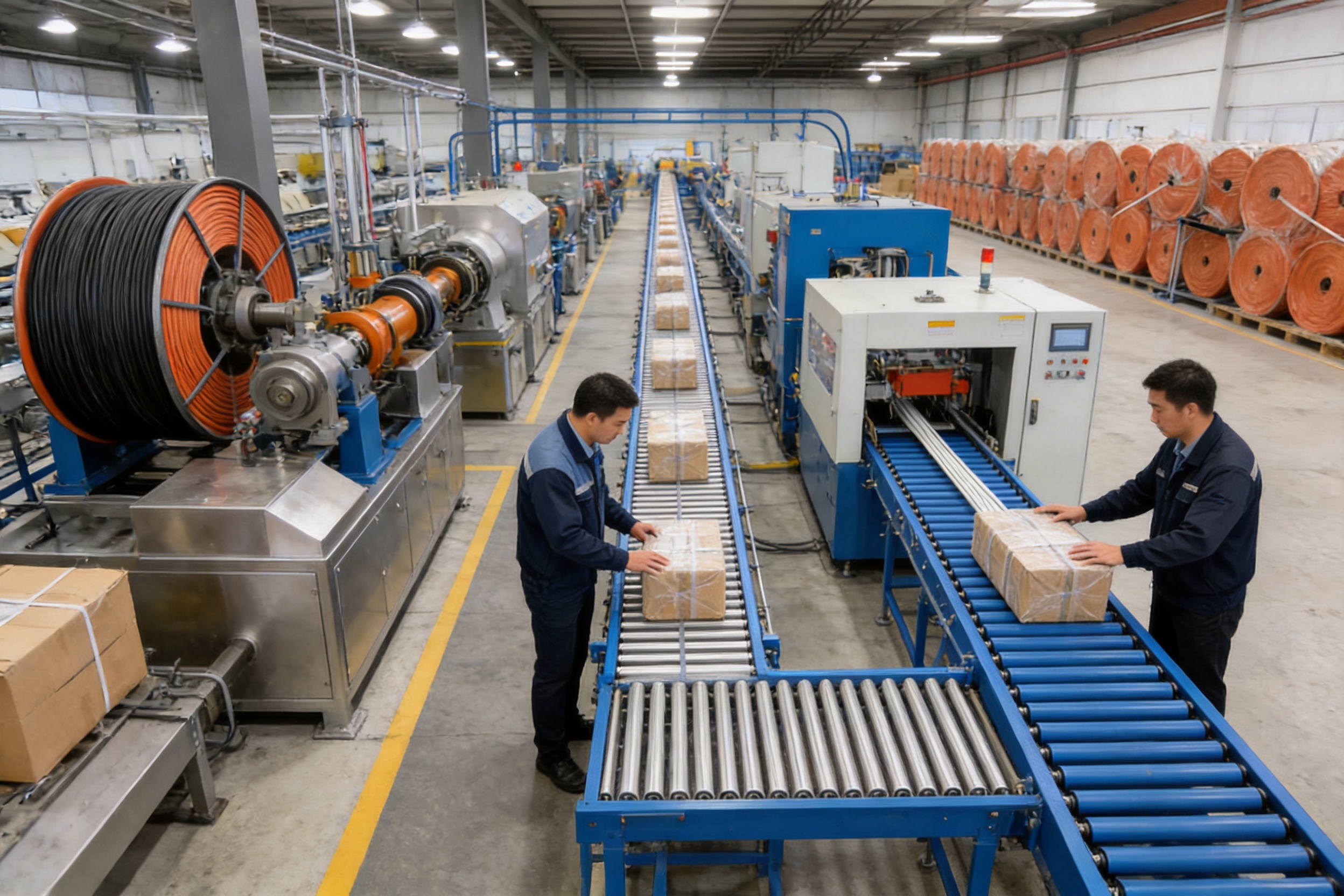
A typical application begins when a packaged cable product leaves the production or packaging location. Rather than being carried manually across the workshop, the package is placed onto the transmission platform. If the route is part of a regular, high-output process, the automatic track section moves the package toward the designated handling station.
When the package reaches a manual roller section, the operator can guide it to the exact position needed for inspection, sorting, labeling, or further handling. In a smaller production batch, the manual roller section may be used as the primary method of movement. The operator can push the package along the rollers and stop it at a convenient point.
This arrangement allows the system to support different levels of automation within the same factory. It can operate as a continuous route for standard production or as a flexible workstation for customized orders. The manufacturer can select the arrangement according to the customer’s actual production pattern.
The system may also help create a buffer between packaging equipment and manual handling. If operators are temporarily occupied with quality inspection or order preparation, packages can remain on the transmission platform in an organized manner rather than being placed randomly on the floor. This supports better control of the production area.
Installation and Layout Considerations
Route Planning
The first installation consideration is the movement route. The conveyor should connect the production location with the designated handling station using a practical path. The route should avoid unnecessary turns, obstructed passages, and interference with maintenance access.
A good layout also considers the direction in which operators approach the package. The manual handling end should provide enough space for inspection, sorting, stacking, or loading. The automatic track should connect smoothly with the outlet of the upstream machine or packaging station.
Package Stability
Packaged cables must remain stable during movement. Package dimensions, weight distribution, outer wrapping, and contact surfaces all influence how a product behaves on the transmission platform. The conveyor configuration should be selected with these characteristics in mind.
For products with different dimensions, the customer should identify the normal range rather than designing only for one sample package. This helps ensure that the system remains practical during product changes and future production expansion.
Operator Access
Operators need clear access to both the automatic and manual sections. They should be able to place packages onto the system, observe movement, remove products at the handling point, and intervene when necessary. The layout should also leave sufficient room for routine cleaning, adjustment, and maintenance.
Connection with Other Equipment
The conveyor may be installed after a coiling machine, packaging machine, or other cable production equipment. The connection point should be planned so that products can transfer without excessive lifting, sudden drops, or awkward manual intervention.
When the conveyor leads to a robot stacker or storage area, the transition should also be considered carefully. The final handling point must present packages in a condition suitable for the next operation. Coordinating the equipment layout at the planning stage can reduce later modifications.
Future Expansion
Manufacturers often increase output, add product types, or introduce more automation over time. A conveyor layout that allows future adjustment can provide better long-term value. During planning, customers may consider whether additional sections, handling stations, or automated equipment could later be added.
Flexible planning does not mean overbuilding the system. It means leaving reasonable options for expansion while selecting a configuration that meets current requirements. A balanced design helps control the initial investment while preserving future adaptability.
Operational and Economic Benefits
The economic value of Cable Conveyor Belt Systems comes from several connected improvements rather than one isolated feature. The system can reduce manual transport, improve production flow, lower rehandling requirements, and make better use of labor. These benefits can accumulate throughout the working day.
When workers no longer need to carry every package from the production line to a handling station, the time saved can be redirected toward productive activities. If the system also reduces waiting around packaging equipment, the output of the upstream line can be used more effectively.
Improved flow may reduce the need for temporary floor storage. This can make better use of workshop space and reduce the possibility that packages block walkways or interfere with other equipment. A more orderly production area can also make it easier to identify abnormal conditions and maintain consistent operating procedures.
The combination of automatic and manual transmission can help control investment. Customers do not necessarily need to install powered movement in every part of the route. Automatic sections can be concentrated where they provide the most benefit, while manual roller sections can be used in low-volume or operator-intensive areas.
This balance is one of the product’s important advantages over less flexible alternatives. A purely manual approach may require more labor, while a fully automated route may involve higher complexity than the application requires. The dual-platform system allows the factory to select a practical level of automation.
Maintenance and Long-Term Usability
Simple and regular maintenance is essential for keeping a material handling system reliable. Operators should routinely observe the movement of packages, check for unusual noise or resistance, and keep the transmission surfaces clean. Any material that could interfere with rollers or track movement should be removed promptly.
Manual roller sections should be checked for smooth rotation and proper alignment. If a roller becomes obstructed or damaged, it may affect the movement of packages and increase the effort required from operators. Automatic sections should be inspected according to the operating instructions provided for the specific configuration.
The surrounding production environment should also be considered. Cable manufacturing areas may contain packaging materials, labels, wrapping residues, and other items that can accumulate around equipment. A clean area supports better operation and makes maintenance issues easier to identify.
Preventive maintenance is generally more effective than waiting for a complete stoppage. Regular checks can help identify abnormal wear, loose connections, or changes in movement quality before they become larger problems. The maintenance schedule should be adapted to production volume and operating conditions.
Because the conveyor is part of a larger production line, maintenance planning should also consider adjacent equipment. The system should remain accessible without creating unnecessary disruption to extrusion, coiling, packaging, or stacking operations. Good layout and practical assembly contribute to easier long-term service.
Quality, Safety, and Workflow Discipline
Material handling equipment should be integrated into the factory’s normal operating procedures. Operators need to understand where packages enter the system, where they should be removed, how to respond to an obstruction, and which areas must remain clear.
Packages should be placed on the transmission platform in a stable position. Products should not be overloaded onto a section beyond its intended working conditions. Workers should also avoid placing loose materials on the route because they may interfere with movement or create a trip hazard.
The manual roller section should be used in a controlled manner. Operators can guide packages without applying sudden force or pushing products in a way that could cause them to leave the intended path. At the automatic section, workers should observe the route and use the appropriate operating procedure if a package stops or becomes misaligned.
Clear workflow discipline improves both safety and productivity. When the movement path is respected, packages are less likely to collide, become mixed with other orders, or obstruct nearby activities. The conveyor can then perform its main function: creating a stable connection between production and manual handling.
Application Areas
Coiled Cable Packaging
After cable is coiled and wrapped, the finished package may need to travel to an inspection or manual handling station. The conveyor provides a controlled route that reduces the need to carry the coil across the workshop.
Finished Product Sorting
Different cable specifications may need to be separated by order, size, color, or destination. A conveyor route can move packages toward a sorting point where operators identify and organize the products.
Small-Batch Production
Small-batch manufacturing often involves frequent product changes and variable output. Manual roller transmission offers a flexible solution for operators who need to move packages only when required.
High-Efficiency Packaging Lines
When packaging equipment operates at a regular pace, automatic track transmission can help maintain a consistent flow. This reduces the risk that packaged goods accumulate directly at the machine outlet.
Transfer to Stacking or Storage
The system can also support the movement of packaged goods toward a manual stacking area, warehouse transfer point, or another downstream handling station. Its role is to make the route between production and the next operation more efficient and organized.
Why Choose a Specialized Machinery Manufacturer
Purchasing a conveyor from a supplier familiar with wire and cable machinery offers advantages over selecting a general-purpose material handling product without considering the production line. A specialized manufacturer understands that the conveyor must work in coordination with extrusion, coiling, take-up, packaging, and stacking processes.
This understanding can improve technical communication. Customers can describe the complete production workflow rather than discussing the conveyor as an isolated component. The supplier can then evaluate where automatic movement is most valuable, where manual control is needed, and how the transfer point should connect to adjacent equipment.
A specialized manufacturer can also provide a broader equipment solution when the customer is planning a new line or upgrading an existing factory. The product range covering cable production and accessory equipment creates an opportunity to coordinate multiple stages of the production process.
Shanghai Yessjet Precise Machinery Co., Ltd. serves the wire and cable machinery field and provides equipment for cable production applications. Its strengths include a product portfolio that covers both primary production machines and supporting material handling equipment. This makes it possible to approach conveyor requirements as part of a complete manufacturing workflow.
For customers seeking a custom wire and cable production line, such coordination can be valuable. The final performance of a factory depends on how well machines, operators, materials, and handling routes work together. A conveyor system designed with this broader view can provide more practical value than a generic transport unit selected without reference to the production process.
Selection Guide for Buyers
Before purchasing a Cable Conveyor Belt System, manufacturers should prepare clear information about their application. This enables the supplier to recommend an appropriate transmission arrangement and avoid unnecessary modifications later.
Product Information
Provide the type of packaged goods, package dimensions, approximate weight, outer material, and expected variation between products. If several package types will share the same system, all relevant ranges should be identified.
Production Information
Explain the expected output, working hours, package frequency, product change frequency, and whether production is continuous or batch-based. This information helps determine where automatic track transmission is appropriate and where manual roller transmission may be sufficient.
Layout Information
Share the distance between the production outlet and the handling station, available floor space, access points, nearby equipment, and the desired direction of movement. A workshop drawing or basic layout can help the supplier evaluate the route.
Handling Information
Identify what happens at the end of the conveyor. The destination may be a manual inspection station, sorting area, storage location, palletizing point, or robotic stacking system. The receiving operation influences the height, position, and arrangement of the transmission platform.
Automation Expectations
Clarify whether the priority is maximum automation, balanced automation, flexible manual operation, labor reduction, or a combination of these objectives. The dual transmission design allows the system to be adapted to different priorities, but the supplier needs to understand the customer’s main goal.
Frequently Asked Questions
What are Cable Conveyor Belt Systems used for?
They are used to transfer packaged cable products from a production or packaging location to a designated manual handling station or downstream area. The system helps reduce unnecessary carrying and creates a more organized material flow.
What is the difference between automatic track transmission and manual roller transmission?
Automatic track transmission moves packages along a planned route with consistent, high-efficiency conveyance. Manual roller transmission allows operators to push and guide packages directly, making it suitable for small batches, variable production, inspection, or flexible handling areas.
Can both transmission methods be used in one system?
Yes. The two platforms can be arranged as complementary sections of the same handling route. Automatic transmission can be used where continuous movement is required, while manual roller transmission can be installed where operator control provides greater flexibility.
Are these systems suitable for small-batch production?
Yes. The manual roller transmission platform is especially suitable for small-batch scenarios and production environments with frequent product changes. It provides an easy way to move packages without requiring the entire route to be powered.
Can the system reduce labor costs?
It can help reduce labor requirements associated with repetitive carrying and long-distance walking. By handling routine package movement, the system allows workers to focus on inspection, sorting, labeling, stacking, and other tasks that require direct attention.
Can the conveyor connect with cable packaging equipment?
It is designed to support the transfer of packaged goods from production and packaging areas. The exact connection arrangement depends on the packaging machine, package dimensions, outlet height, production speed, and factory layout.
Does the system improve energy efficiency?
By optimizing the material flow path and reducing unnecessary movement and rehandling, the system can support lower energy and operating costs. The combination of automatic and manual sections also allows powered transmission to be used where it provides the greatest benefit.
What information is needed for a suitable configuration?
Important information includes package size, weight, product type, production volume, transfer distance, workshop layout, required automation level, and the location of the manual handling station. These details help determine the most practical arrangement.
Is the system only suitable for cable factories?
The product is tailored to packaged goods transfer in wire and cable production environments, but similar material handling requirements may exist in other manufacturing applications. Suitability should be evaluated according to package characteristics, production flow, and operating conditions.
How does a specialized supplier add value?
A specialized wire and cable machinery supplier understands how conveying interacts with extrusion, coiling, take-up, packaging, and stacking equipment. This broader knowledge can support better equipment coordination and a more efficient complete production workflow.
Conclusion
Cable Conveyor Belt Systems provide a practical way to improve the movement of packaged goods in wire and cable manufacturing plants. Their dual transmission design combines the consistency of automatic track transmission with the flexibility of manual roller transmission. This makes the system suitable for both stable high-output production and smaller, more variable handling tasks.
The main benefits include reduced repetitive carrying, lower labor intensity, improved material flow, better use of workshop space, fewer rehandling steps, and support for energy-conscious operation. By creating a defined path between packaging equipment and manual handling stations, the system helps manufacturers build a more orderly and efficient production environment.
Its value is further strengthened when it is supplied by a manufacturer with experience across wire and cable machinery. A supplier familiar with extrusion lines, coiling equipment, take-up systems, packaging machinery, robot stackers, and accessory equipment can understand the conveyor’s role within the complete production process.
For factories seeking to improve handling efficiency without sacrificing operational flexibility, the combination of automatic and manual transmission offers a balanced solution. It supports practical automation, reduces unnecessary labor, and helps cable manufacturers move finished products more smoothly from production to the next stage.
References
1. Industrial Material Handling Principles, manufacturing workflow and conveyor application guidance.
2. Wire and Cable Production Engineering, production line coordination and packaged product movement.
3. Factory Layout Planning and Lean Material Flow, methods for reducing unnecessary transport and rehandling.
4. Industrial Conveyor Equipment Maintenance Practices, inspection, cleaning, alignment, and preventive maintenance guidance.
5. Packaging Line Integration Fundamentals, coordination between packaging machinery and downstream handling systems.
6. Workplace Ergonomics in Manufacturing, approaches to reducing repetitive carrying and manual handling intensity.