LANGUAGE
 中文简体
 русский
 Français
 Español
 Português
 عربى

Content
- 1 Why Cable Packaging Quality Matters
- 2 Integrated Film Application and Heat Shrinking
- 3 Key Product Features
- 4 Available Models and Production Capacity
- 5 Advantages Compared with Conventional Packaging Methods
- 6 Advantages Compared with Less Integrated Automatic Equipment
- 7 Manufacturing Strengths and Engineering Approach
- 8 How the Machine Supports Different Cable Industries
- 9 Recommended Operating Workflow
- 10 Film Selection and Packaging Quality
- 11 Energy and Cost Efficiency
- 12 Quality Control in the Finished Package
- 13 Installation and Production Planning Considerations
- 14 Potential for Turnkey Cable Production Solutions
- 15 Why Choose a Specialized Machinery Manufacturer
- 16 Common Application Questions
- 16.1 Can the machine package different cable coil sizes?
- 16.2 What films can be used?
- 16.3 What is the operating temperature?
- 16.4 Does the machine package all sides of the coil?
- 16.5 How fast can it operate?
- 16.6 Is the machine difficult to operate?
- 16.7 What safety functions are provided?
- 16.8 Can the machine be integrated into a cable production line?
- 16.9 What information should be supplied before selecting a model?
- 16.10 How does heat shrink packaging reduce damage?
- 17 Conclusion
- 18 References
- 19 Product: Cable Heat Shrink Packaging Machine
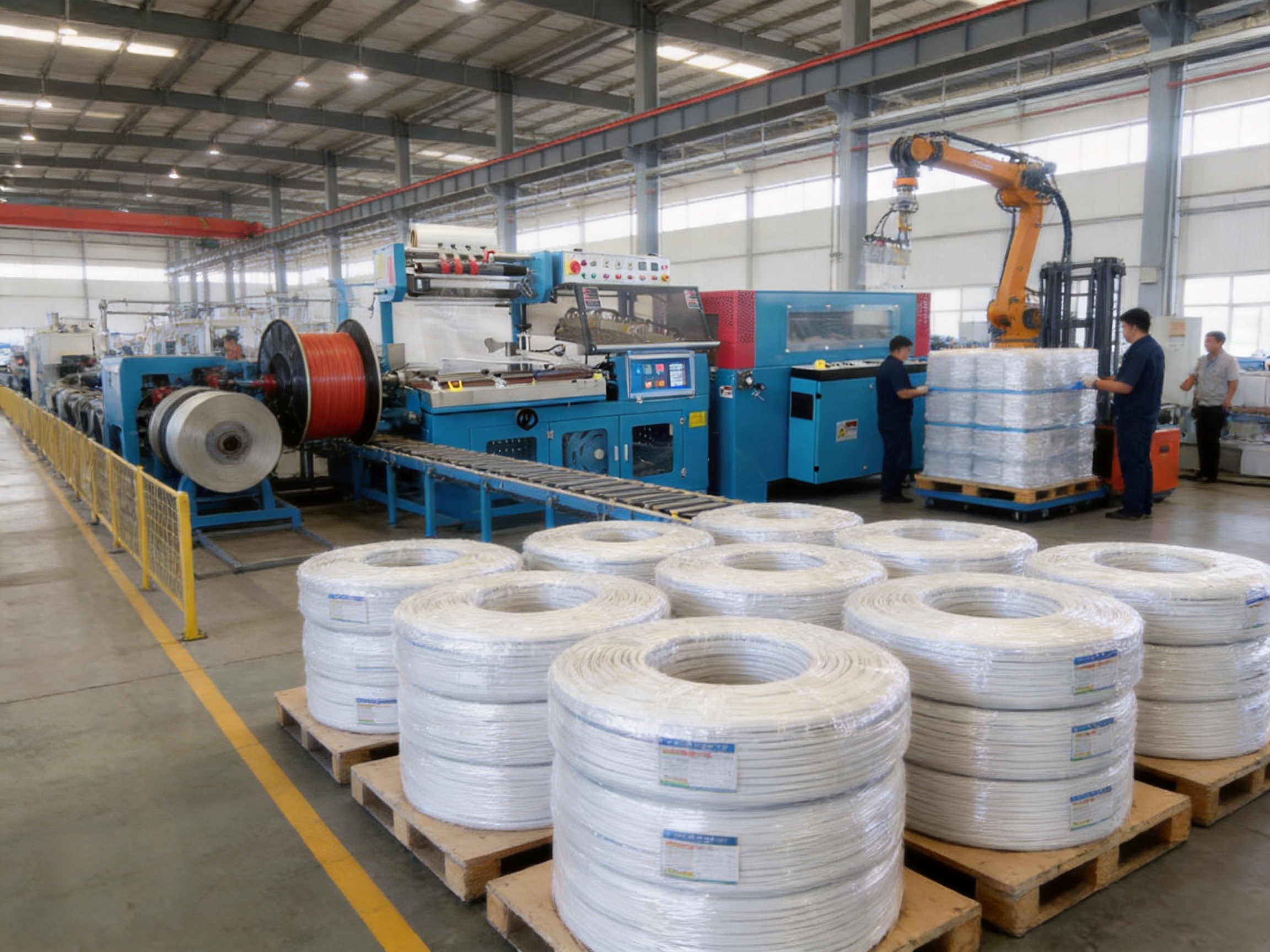
Packaging is the final stage in many wire and cable production processes, but it is also one of the most important. A cable may have been extruded, cooled, tested, measured, coiled, and labeled with great precision, yet poor packaging can still expose it to dust, moisture, abrasion, corrosion, and handling damage. For this reason, manufacturers increasingly require packaging equipment that can deliver consistent protection while maintaining production efficiency.
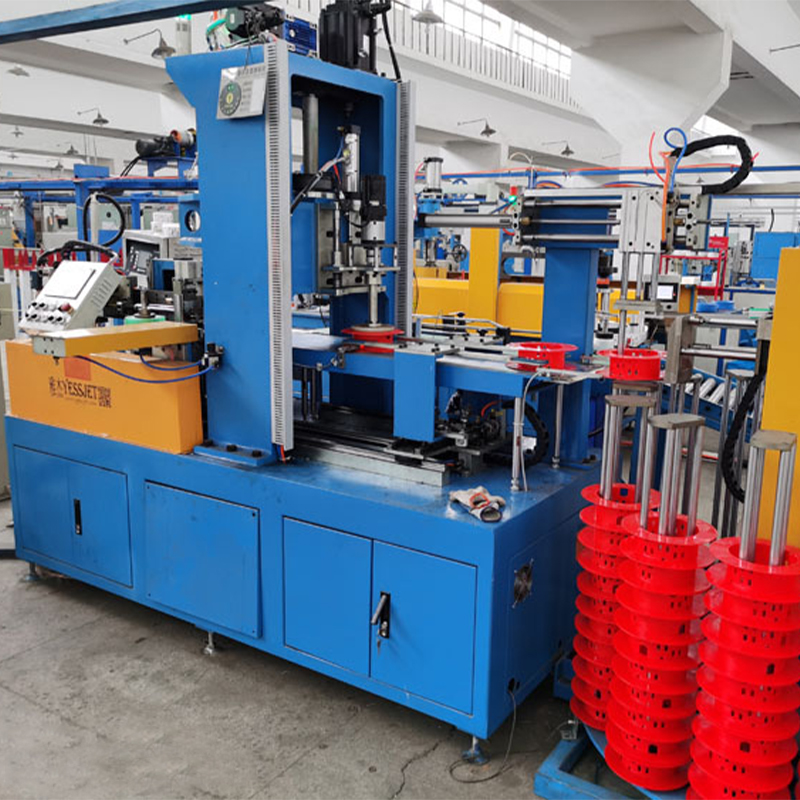
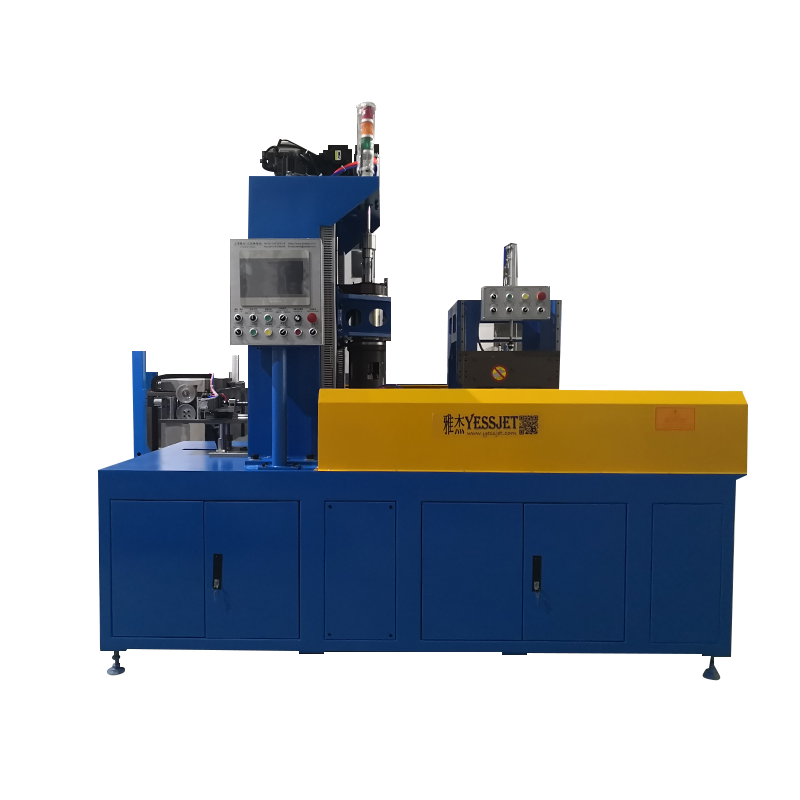
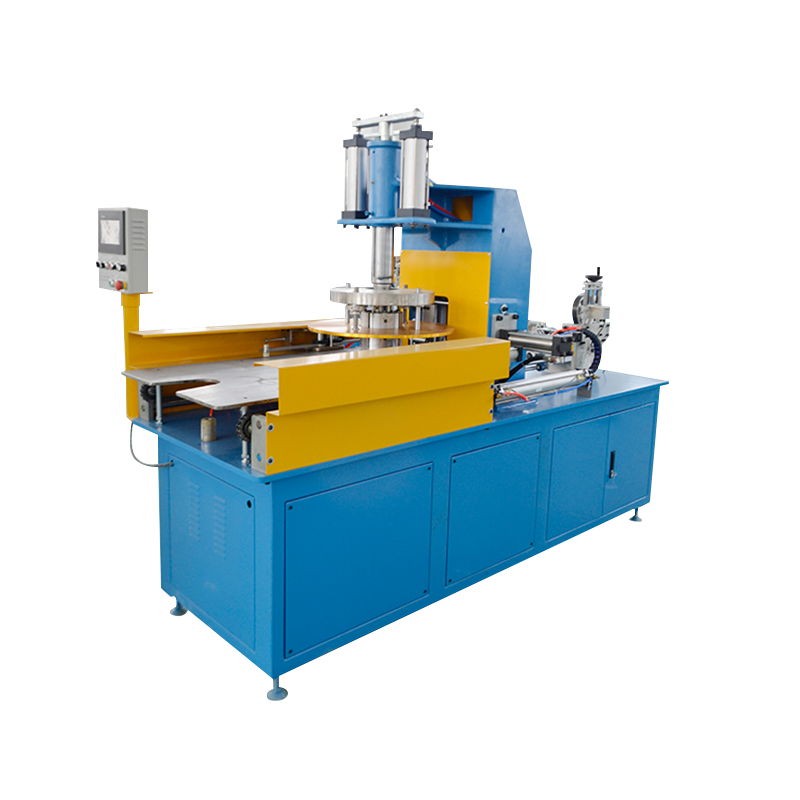
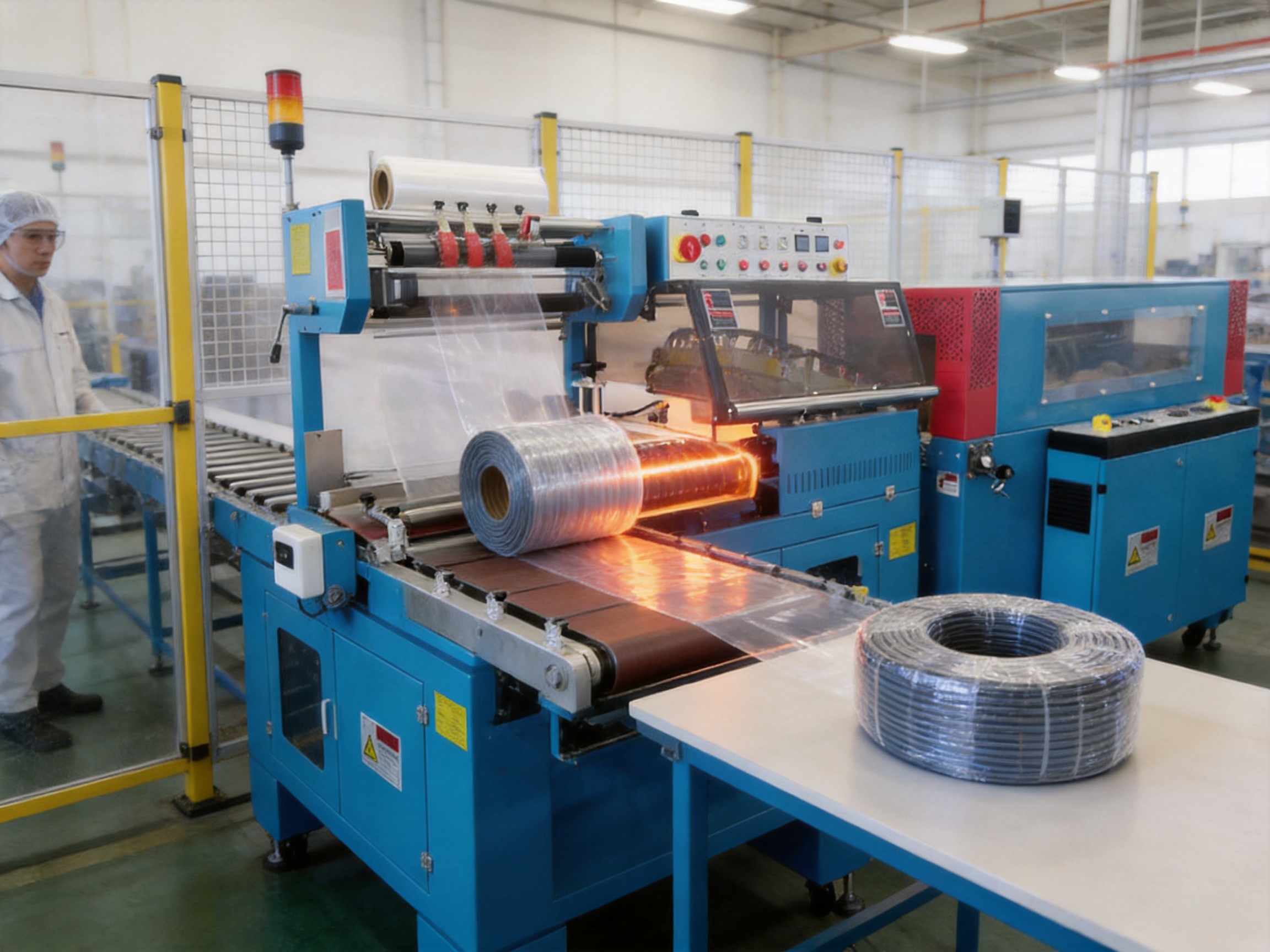
The Cable Heat Shrink Packaging Machine is designed to provide a practical and dependable solution for cable coils, wire coils, and related products. It combines film application, automatic sealing, controlled heat shrinking, and product transfer into one coordinated workflow. Instead of relying on manual wrapping or several disconnected machines, operators can use an integrated system to produce clean, tight, and repeatable packages.
Suitable for power cables, communication cables, industrial wires, and other coiled products, the machine is engineered around the essential requirements of modern cable packaging: stable operation, adjustable process parameters, efficient material use, safe operation, and convenient maintenance. Its compact and straightforward design also allows it to fit into a variety of production environments.
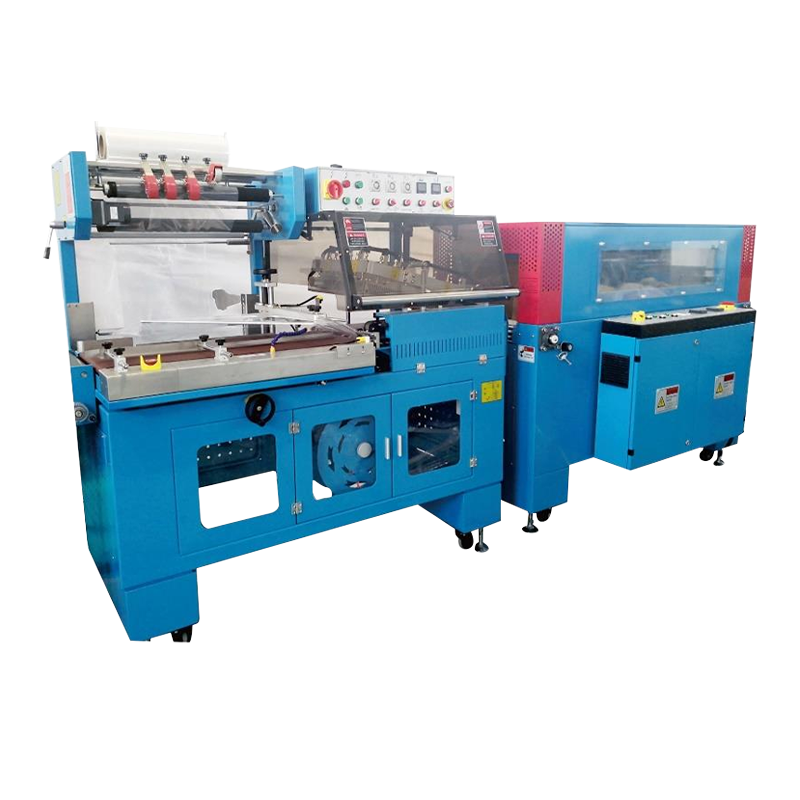
Cable Heat Shrink Packaging Machine
Why Cable Packaging Quality Matters
Cables are often stored for extended periods and transported through warehouses, distribution centers, construction sites, and outdoor work areas. During these stages, the product may encounter dust, humidity, condensation, oil particles, friction, pressure, or rough handling. An unprotected coil can quickly lose its visual quality and may suffer surface contamination or damage to labels and insulation.
Traditional packaging methods such as hand wrapping, loose plastic covering, or simple strapping may provide limited protection. These methods can also create inconsistent results. Some coils may receive too much film, while others may have exposed areas. Loose film can unfold during transportation, and excessive manual handling can increase labor costs and reduce productivity.
Heat shrink packaging creates a more complete and uniform protective layer. When the selected film is heated under controlled conditions, it contracts around the cable coil and follows the product’s shape. The resulting package is more compact, cleaner, and less likely to shift during storage or transportation.
The Cable Heat Shrink Packaging Machine is configured to package the coil’s front, back, right, and left sides. This full coverage is particularly useful where the product requires protection from airborne contamination and moisture during logistics. It also produces a more professional appearance for finished goods prepared for shipment or customer delivery.
Integrated Film Application and Heat Shrinking
The machine operates through a coordinated film application and heating process. First, the cable coil enters the packaging area, where PE or POF film is applied around the product. The film is then sealed, and the wrapped coil is transferred into a hot shrink tunnel. Controlled heat causes the film to contract tightly around the coil before the finished package is delivered to the working table.
This sequence reduces the need for manual intervention. Operators do not need to wrap, seal, heat, and move each coil as separate tasks. The integrated workflow improves consistency and allows production personnel to focus on loading, inspection, and downstream handling.
The packaging process can be summarized as follows:
1. The cable coil is positioned for packaging.
2. The selected PE, PVC, or POF film is applied around the coil.
3. The film is automatically sealed.
4. The wrapped coil is transferred to the hot shrink tunnel.
5. The heating system contracts the film around the product.
6. The finished package is discharged to the working table.
The result is a sealed and close-fitting package that supports cleaner handling, more efficient stacking, and improved protection during delivery.
Key Product Features
Automatic Sealing and Packing
The machine automatically performs the primary wrapping and sealing operations. This helps reduce the variation associated with hand packaging and supports more consistent film tension and sealing quality. Automatic operation is especially valuable when a factory handles a high number of coils or needs to maintain stable packaging standards across multiple shifts.
Support for Common Shrink Films
The equipment is designed for use with PE and POF film, while the product description also identifies PVC film as a suitable packaging material. This gives users flexibility when selecting materials according to product size, required appearance, packaging strength, and purchasing cost.
PE film is commonly selected when strength and practical protective performance are important. POF film can be preferred when a clear and neat appearance is required. The ability to work with different film options allows the packaging process to be adapted to different cable products and market expectations.
Full-Surface Coil Coverage
The PE film can fully package the coil, including the front, back, right, and left sides. This is an important advantage over simple top covering or loosely wrapped film. Full coverage helps reduce the chance that exposed sections will collect dust or be affected by moisture during handling.
Controlled Heating
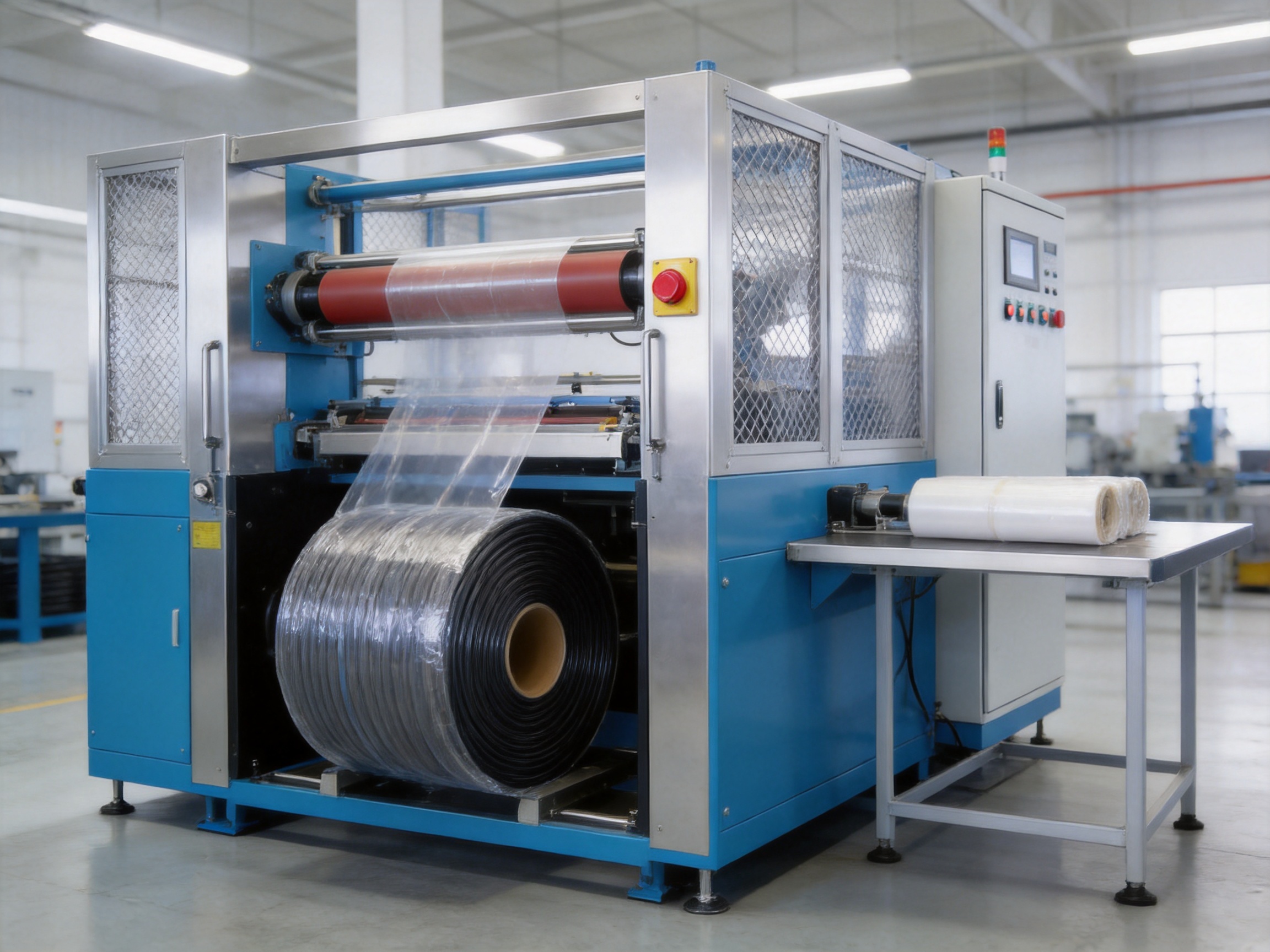
The heating system uses adjustable temperature settings in the range of approximately 150 to 200°C. This range enables operators to adapt the shrinking process to different films and product conditions. Correct temperature adjustment is essential because insufficient heat may leave loose film, while excessive heat may cause deformation, uneven shrinking, or unnecessary energy consumption.
PLC-Based Control
An intuitive PLC control system coordinates the machine’s principal operating actions. PLC control supports repeatable timing, controlled heating, and straightforward parameter adjustment. It also makes the machine easier to integrate into a standardized production process.
For operators, the value of PLC control is not limited to automation. It also provides a clearer operating method. Instead of depending entirely on individual operator experience, the machine can retain a defined process sequence and settings. This supports more consistent packaging results between shifts and between batches.
Hot Shrink Tunnel Transfer
After sealing, the coil is transferred to the hot shrink tunnel. This reduces manual movement between separate packaging stations and helps maintain a smooth production rhythm. The tunnel is designed to apply controlled heat around the package so that the film contracts evenly around the cable coil.
Safety-Oriented Design
Safety guards and emergency stop functions are included to support safer operation. Heat-shrink equipment naturally contains heated surfaces and moving components, so protective structures and accessible emergency controls are important features. Safe machine design also contributes to more reliable daily production by reducing avoidable operating risks.
Simple Maintenance Structure
The machine uses a relatively simple design intended to support easy operation and maintenance. A straightforward layout can reduce the time required for cleaning, film replacement, inspection, and routine adjustments. This is particularly helpful for cable manufacturers that need equipment to remain available during demanding production schedules.
Available Models and Production Capacity
The machine is available in three principal models. The selection is based primarily on the combined dimensions of the coil, represented by the outside diameter and height. Choosing the correct model is important because the available packaging space must accommodate the entire product without restricting film movement or tunnel operation.
| Model | Applicable Combined Dimension | Output Capacity |
|---|---|---|
| HP 430 | Outside diameter plus height up to 430 mm | Approximately 1–10 coils per minute |
| HP 600 | Outside diameter plus height up to 600 mm | Approximately 1–10 coils per minute |
| HP 800 | Outside diameter plus height up to 800 mm | Approximately 1–5 coils per minute |
The stated output range depends on the selected model, product dimensions, film characteristics, sealing conditions, heating requirements, and operator loading rhythm. Smaller or less complex coils may be processed at a higher rate, while larger coils may require slower movement to achieve complete and attractive shrinking.
The HP 430 model is appropriate for operations handling relatively compact coils. The HP 600 model provides additional dimensional capacity for larger products while maintaining a similar upper output range. The HP 800 model is designed for larger coil dimensions and emphasizes broader packaging capability, with a stated output range of approximately 1 to 5 coils per minute.
Before ordering, users should provide the actual cable coil outside diameter, height, weight, packaging material, desired throughput, and available factory space. These details help ensure that the selected machine matches the real production conditions rather than only the nominal product dimensions.
Advantages Compared with Conventional Packaging Methods
More Consistent Package Quality
Manual packaging depends heavily on operator technique. Differences in wrapping tension, film overlap, sealing position, and heating time can result in packages with varying appearance and protection. The automatic machine establishes a more repeatable process, helping each coil achieve a similar packaging standard.
Higher Labor Efficiency
Manual wrapping requires repeated actions such as pulling film, positioning the material, cutting, sealing, heating, and transferring the product. By combining these steps, the Cable Heat Shrink Packaging Machine reduces the amount of direct labor required for each coil. Operators can manage loading and inspection instead of performing every packaging motion manually.
Improved Film Utilization
A controlled packaging process can reduce unnecessary film consumption. Excess film may be caused by inconsistent manual wrapping, while insufficient film may leave exposed areas and require repackaging. Automatic film application and sealing support more predictable material use, helping reduce waste and operating costs.
Better Protection During Transportation
A close-fitting shrink package helps keep the cable coil together and provides a barrier against dust, moisture, and surface contamination. Compared with loose plastic covering, heat-shrunk film is less likely to open or move during handling. This supports cleaner delivery and reduces the chance of packaging-related complaints.
Cleaner and More Professional Appearance
Customers often evaluate finished cable products not only by technical performance but also by packaging quality. A neat, tight, and uniformly sealed package creates a more professional presentation. It can also make products easier to identify, stack, move, and display in warehouses or distribution facilities.
More Efficient Use of Floor Space
Loose wrapping and irregular packaging can make cable coils difficult to stack. Heat-shrunk film follows the product shape more closely, allowing finished coils to be arranged more systematically. Better organization can improve warehouse utilization and reduce unnecessary handling.
Greater Process Control
With adjustable heating and PLC-based operation, the machine gives users more control over packaging conditions than basic manual methods. Operators can establish standard settings for different product types and make controlled adjustments when film or coil dimensions change.
Advantages Compared with Less Integrated Automatic Equipment
Some automatic packaging systems require separate wrapping, sealing, shrinking, and transfer machines. Such arrangements may work well in large facilities, but they can also increase equipment complexity, installation requirements, and coordination demands. The Cable Heat Shrink Packaging Machine combines the essential stages into a more unified system.
An integrated design can reduce unnecessary transfer points between machines. Fewer transfer points may mean fewer opportunities for product misalignment, film damage, or operator intervention. It can also simplify training because personnel work with one coordinated packaging process rather than several independent control systems.
The machine’s simple structure is another practical advantage. Advanced automation does not have to mean unnecessarily complicated operation. By focusing on the core packaging sequence, the equipment can provide useful automation while remaining accessible to production and maintenance staff.
The three model sizes also give manufacturers a practical selection range. A company does not have to use the same packaging capacity for every application. It can choose a model according to the dimensions of its cable coils and expected output, which helps avoid both under-sizing and excessive investment in unnecessary capacity.
Manufacturing Strengths and Engineering Approach
Shanghai Yessjet Precise Machinery Co., Ltd. focuses on wire and cable machinery, cable production lines, coiling equipment, pay-off and take-up machines, accessory equipment, and automated packaging solutions. This product background is significant because packaging equipment performs best when its designers understand the physical characteristics and production requirements of cable products.
A general-purpose packaging supplier may not fully understand the differences between power cables, communication cables, industrial wires, and other coiled products. A company focused on wire and cable machinery is more familiar with coil geometry, cable surface protection, production continuity, material handling, and the need to connect packaging with upstream and downstream equipment.
Application-Based Equipment Design
Effective machinery design begins with the intended application. For cable packaging, this means considering product diameter, coil outside diameter, coil height, weight, film selection, required protection, and production speed. The available HP 430, HP 600, and HP 800 models reflect an approach based on practical product dimensions rather than a single universal configuration.
Application-based design helps the manufacturer provide more suitable recommendations. It also creates a foundation for future customization, such as adjustments to conveying, control logic, packaging size, or line arrangement when a customer’s product range requires a specialized configuration.
Mechanical Integration
The machine must coordinate film movement, sealing, product transfer, tunnel heating, and discharge. These functions depend on accurate mechanical alignment. If the film path, sealing area, and transfer structure are not properly coordinated, the package may wrinkle, tear, or become uneven.
Equipment manufacturers with experience in precision machinery understand the importance of stable frames, properly arranged transmission components, accessible adjustment points, and durable working surfaces. These design considerations support smoother operation and help maintain packaging quality over repeated cycles.
Electrical and Control Integration
PLC control is central to the machine’s operating sequence. The electrical system must coordinate the timing of sealing, conveying, heating, and discharge while allowing operators to adjust relevant parameters. This requires logical control design and a clear interface.
Good control integration also supports troubleshooting. When machine actions follow a defined sequence, maintenance personnel can more easily inspect sensors, heating components, drive systems, and control signals. This can shorten the time required to identify problems and return the equipment to service.
Temperature Management
Heat shrinking depends on stable and appropriate temperature management. The specified adjustment range of 150 to 200°C provides a practical operating window for different packaging requirements. Manufacturing quality is important in this area because inconsistent heating can cause uneven shrinkage or film damage.
A well-designed heating system should distribute heat in a controlled manner and allow operators to make adjustments according to film type and product size. Larger coils may require different heating conditions from smaller products, and film thickness may also affect the final result.
Safety and Maintainability
Machine safety should be incorporated into the design rather than added as an afterthought. Guards around moving or heated areas, emergency stop functions, and clearly arranged operating controls help protect personnel. At the same time, maintenance access should remain practical so that routine inspection does not require excessive disassembly.
The stated emphasis on simple operation and maintenance reflects a useful balance between automation and serviceability. Cable manufacturers need equipment that improves productivity without creating unnecessary maintenance burdens.
How the Machine Supports Different Cable Industries
Power Cable Manufacturing
Power cables may be produced in heavy coils that require strong external protection during warehousing and transportation. Shrink packaging can help keep these coils clean and reduce exposure to environmental contaminants. Depending on product dimensions, a larger machine model may be selected to accommodate the coil size.
Communication Cable Production
Communication cables often require clean handling and attractive packaging for distribution. A uniform shrink package can protect the cable surface and support organized logistics. The clear or neat appearance provided by suitable film may also help inspection and identification.
Industrial Wire and Cable Applications
Industrial wire products may be shipped in a wide range of coil sizes. The machine’s different model capacities and adjustable process settings make it suitable for manufacturers that handle multiple product specifications. Automated packaging can also help these companies reduce variation between product batches.
Component and Accessory Packaging
The equipment is primarily intended for cable coils and related products, but its packaging principles may also be applicable to other components with compatible dimensions. Before using the machine for a new product, the operator should confirm that the item can withstand the packaging temperature and that its shape is suitable for film shrinking.
Recommended Operating Workflow
Successful use begins with correct preparation. Operators should confirm that the selected film is compatible with the machine and that the coil dimensions fall within the capacity of the chosen model. The packaging area should be free from unnecessary obstacles, and the working table should be ready to receive finished coils.
The following workflow provides a practical operating reference:
1. Inspect the Equipment
Check the machine frame, film path, sealing area, tunnel entrance, discharge area, guards, and emergency stop functions. Verify that no foreign material is present in the conveying or heating zones.
2. Install the Film
Load the selected PE, PVC, or POF film according to the machine’s film-routing arrangement. Confirm that the film is aligned and can move smoothly without excessive tension, folding, or obstruction.
3. Confirm Product Dimensions
Measure or verify the outside diameter and height of the cable coil. The combined value should remain within the selected model’s applicable range. Oversized products may interfere with sealing or tunnel operation.
4. Set the Temperature
Choose an initial temperature within the 150–200°C adjustment range according to the film supplier’s recommendations and the product’s packaging requirements. A trial package is useful when introducing a new film or cable size.
5. Adjust the Operating Sequence
Use the PLC control interface to set the appropriate timing and operating parameters. The exact settings may depend on product size, film thickness, required output, and heat-shrink behavior.
6. Run a Trial Coil
Inspect the first packaged coil carefully. Check the seal, film coverage, wrinkles, shrink uniformity, exposed areas, and overall appearance. Make controlled adjustments rather than changing several parameters at the same time.
7. Begin Continuous Operation
Once the trial package is acceptable, continue production while monitoring film movement, temperature stability, product alignment, and discharge. Periodic inspection helps detect changes before they affect a large number of packages.
8. Perform Routine Cleaning and Inspection
At suitable intervals, remove film residue and dust, inspect sealing components, and confirm that safety functions remain effective. Preventive maintenance helps preserve packaging quality and reduce unexpected downtime.
Film Selection and Packaging Quality
Film selection has a direct effect on the finished package. PE, PVC, and POF films can differ in shrink behavior, strength, clarity, thickness, sealing characteristics, and recommended heating conditions. The best choice depends on the cable product, logistics environment, appearance requirements, and cost target.
Operators should avoid selecting film only by price. A low-cost film that shrinks poorly or tears during handling may create more waste and rework. The film should be tested under actual operating conditions, including the intended temperature range and packaging speed.
Film storage is also important. Materials should be kept in a clean and suitable environment to prevent contamination or deterioration. Damaged rolls, distorted cores, or contaminated film can cause irregular wrapping and sealing problems.
Good packaging quality is achieved through the combined effect of suitable film, correct temperature, stable machine operation, and proper product positioning. No single setting can compensate for an unsuitable film or an incorrectly sized coil.
Energy and Cost Efficiency
Packaging costs include film consumption, electricity, labor, maintenance, floor space, and the cost of damaged or repackaged products. The Cable Heat Shrink Packaging Machine is designed to support efficiency in several of these areas.
Automatic operation can reduce labor requirements and improve output consistency. Controlled film application can help limit unnecessary material use. Adjustable heating allows the operator to apply an appropriate process rather than relying on excessive temperature. The integrated workflow can also reduce manual transfer and associated handling time.
Energy efficiency should be considered together with packaging quality. Operating at an unnecessarily high temperature may increase energy consumption without improving the package. Conversely, insufficient heat can create loose film and lead to repackaging. Establishing the correct temperature and cycle time is therefore important for both quality and cost control.
Manufacturers can evaluate efficiency by recording film consumption per coil, average packaging time, energy usage, labor hours, and rework rates. These measurements help identify the practical return of automatic packaging equipment in a particular factory.
Quality Control in the Finished Package
A simple inspection routine can help maintain stable output. Operators should check whether the film fully covers the coil, whether the seal is complete, and whether the shrink pattern is even. They should also look for holes, tears, excessive wrinkles, loose sections, and signs of overheating.
The package should remain secure during normal movement from the working table to storage or shipping. If the cable coil shifts excessively inside the film or if the film opens at the seal, the operating parameters may need adjustment.
Visual inspection should be supported by periodic dimensional and functional checks. For example, production personnel can compare package appearance across different shifts and film batches. If a change is observed, possible causes include film variation, temperature fluctuation, product size changes, or mechanical alignment.
Installation and Production Planning Considerations
Before installation, users should review the machine footprint, material flow, power supply, ventilation, operator position, and downstream storage arrangement. There should be sufficient space for loading coils, replacing film, inspecting the package, and carrying out maintenance.
The machine should be positioned so that the packaged coils can move efficiently toward labeling, weighing, palletizing, or shipment. If the packaging machine is part of a larger cable production line, its speed should be considered together with the output of the coiling machine and the requirements of subsequent handling equipment.
Training should cover normal operation, film loading, temperature adjustment, emergency stop use, basic fault identification, and daily cleaning. Even a highly automated machine requires operators who understand the relationship between product dimensions, film behavior, and heating conditions.
Potential for Turnkey Cable Production Solutions
The Cable Heat Shrink Packaging Machine can be considered as part of a broader cable manufacturing solution. Shanghai Yessjet Precise Machinery Co., Ltd. also works with wire and cable extrusion lines, coiling machines, motorized pay-off equipment, motorized take-up equipment, accessory equipment, and intelligent robot stackers.
This wider product range can be valuable for manufacturers seeking coordinated equipment rather than isolated purchases. Upstream extrusion and take-up processes determine how the cable is formed and collected, while coiling and packaging prepare the finished product for storage and shipment. When these stages are planned together, the factory may achieve better material flow and more consistent production management.
An intelligent robot stacker can further support finished-product handling after packaging. Although the heat shrink packaging machine performs the wrapping and shrinking process, automated stacking can help reduce manual lifting and organize packaged coils for warehousing or dispatch.
A supplier with experience across these stages can better understand how equipment interfaces, product transfer, and production rhythm influence the complete line. This is one of the important strengths of working with a specialized wire and cable machinery manufacturer rather than a supplier focused only on general packaging.
Why Choose a Specialized Machinery Manufacturer
Specialization provides several practical benefits. First, the manufacturer is familiar with the cable industry’s product forms and production terminology. Second, it can evaluate the packaging machine in relation to extrusion, take-up, coiling, and stacking operations. Third, it can offer more application-focused suggestions when the product range is complex.
Shanghai Yessjet Precise Machinery Co., Ltd. positions its machinery activities around precise equipment for wire and cable production. Its product categories cover the major stages required by many cable factories, from material handling and extrusion to coiling, packaging, and stacking.
The company’s strength is therefore not limited to one machine specification. It includes the ability to understand the production chain, select suitable equipment configurations, and support the practical requirements of cable manufacturers. For customers planning a new line or upgrading an existing operation, this broader perspective can simplify technical communication and equipment coordination.
Common Application Questions
Can the machine package different cable coil sizes?
Yes. The available HP 430, HP 600, and HP 800 models address different combined outside-diameter and height requirements. The correct model should be selected after reviewing the largest and smallest coils to be processed.
What films can be used?
The machine is described for PE and POF film, and the product information also identifies PVC film as an applicable material. Film compatibility should be confirmed through testing and operating recommendations before continuous production.
What is the operating temperature?
The adjustable temperature range is approximately 150–200°C. The final setting depends on film type, film thickness, product size, and required shrink quality.
Does the machine package all sides of the coil?
Yes. The stated packaging method fully covers the coil, including the front, back, right, and left sides.
How fast can it operate?
The HP 430 and HP 600 models are listed at approximately 1–10 coils per minute, while the HP 800 model is listed at approximately 1–5 coils per minute. Actual output depends on product dimensions, film, settings, loading, and required packaging quality.
Is the machine difficult to operate?
The design emphasizes simple operation and uses PLC control. Operators still require training in film loading, temperature adjustment, product positioning, and routine inspection, but the integrated workflow reduces the number of manual packaging steps.
What safety functions are provided?
The machine includes safety guards and emergency stop functions. Operators should still follow site safety procedures and avoid contact with heated or moving areas during operation.
Can the machine be integrated into a cable production line?
It can be considered alongside coiling, take-up, stacking, and other cable production equipment. Integration details depend on the customer’s product dimensions, factory layout, handling method, and required production speed.
What information should be supplied before selecting a model?
Users should provide the cable type, coil outside diameter, coil height, coil weight, film type, expected output, packaging appearance requirements, available space, and any connection requirements for upstream or downstream equipment.
How does heat shrink packaging reduce damage?
The tightly contracted film provides a protective barrier against dust, moisture, and surface contamination. It also helps keep the coil together during handling and transportation. Packaging does not replace appropriate storage conditions, but it can significantly improve external protection.
Conclusion
The Cable Heat Shrink Packaging Machine provides an efficient and practical way to protect cable coils and wire products after production. By combining automatic film application, sealing, hot shrink tunnel processing, and discharge, it replaces several labor-intensive packaging steps with a more consistent workflow.
Its key advantages include full coil coverage, adjustable heating from approximately 150 to 200°C, PLC-based control, support for PE and POF film, compatibility with the stated PVC film application, safety guards, emergency stop functions, and a simple design for operation and maintenance. The HP 430, HP 600, and HP 800 models provide a useful range of packaging capacities for different coil dimensions.
Compared with manual wrapping and less integrated equipment, the machine can improve package consistency, reduce labor requirements, support better film utilization, and create a cleaner finished product. These benefits are especially valuable for power cable, communication cable, and industrial wire manufacturers that need reliable protection during storage and transportation.
The equipment also benefits from the broader experience of Shanghai Yessjet Precise Machinery Co., Ltd. in wire and cable extrusion lines, coiling machines, pay-off and take-up equipment, accessory machinery, and intelligent stacking systems. This specialized industry knowledge supports application-based design and makes the machine suitable for consideration within a complete cable production or packaging solution.
For manufacturers seeking a dependable balance of automation, protection, flexibility, and maintainability, the Cable Heat Shrink Packaging Machine is a strong option for modern cable packaging operations.
References
1. Product information for Cable Heat Shrink Packaging Machine, including model capacities, film application, heating range, PLC control, safety functions, and packaging workflow.
2. Technical information for HP 430, HP 600, and HP 800 cable coil packaging models.
3. General principles of polymer film packaging, sealing, and heat-shrink processing.
4. Industrial guidance on wire and cable handling, storage protection, and transportation packaging.
5. Machinery application principles for cable extrusion, coiling, take-up, packaging, and automated material handling.