LANGUAGE
 中文简体
中文简体 русский
 Français
 Español
 Português
 عربى
عربى
Content
- 1 Why the Cable Coiling Head Matters in Cable Manufacturing
- 2 Product Design and Functional Options
- 3 Advantages Compared with Generic Coiling Heads
- 4 Applications Across Cable Processing Equipment
- 5 Manufacturing Strengths and Engineering Approach
- 6 Material and Operating Considerations
- 7 Installation, Replacement, and Maintenance Guidance
- 8 How the Product Supports Manufacturing Efficiency
- 9 Selection Guide for Customers
- 10 Company Capabilities and Customer Value
- 11 Frequently Asked Questions
- 11.1 What is a Cable Coiling Head?
- 11.2 Can the Cable Coiling Head be customized?
- 11.3 What is the difference between positioning and non-positioning types?
- 11.4 Can the accessory be used on a machine from another supplier?
- 11.5 Why choose a replaceable coiling head instead of replacing the machine?
- 11.6 Is the positioning model suitable for automatic packaging?
- 11.7 When is the non-positioning model useful?
- 11.8 What information should be provided for a quotation?
- 11.9 How can maintenance staff identify a potential coiling-head problem?
- 11.10 Can one head handle several cable sizes?
- 12 Conclusion
- 13 References
- 14 Product: Cable Coiling Head
Modern cable production depends on more than extrusion speed. After insulation, sheathing, braiding, or other processing stages are completed, the cable must be collected, arranged, protected, and prepared for transportation or the next manufacturing operation. Coiling quality directly affects production efficiency, product appearance, storage convenience, and customer satisfaction. A well-designed cable coiling head is therefore an important component in the overall performance of a coiling system.
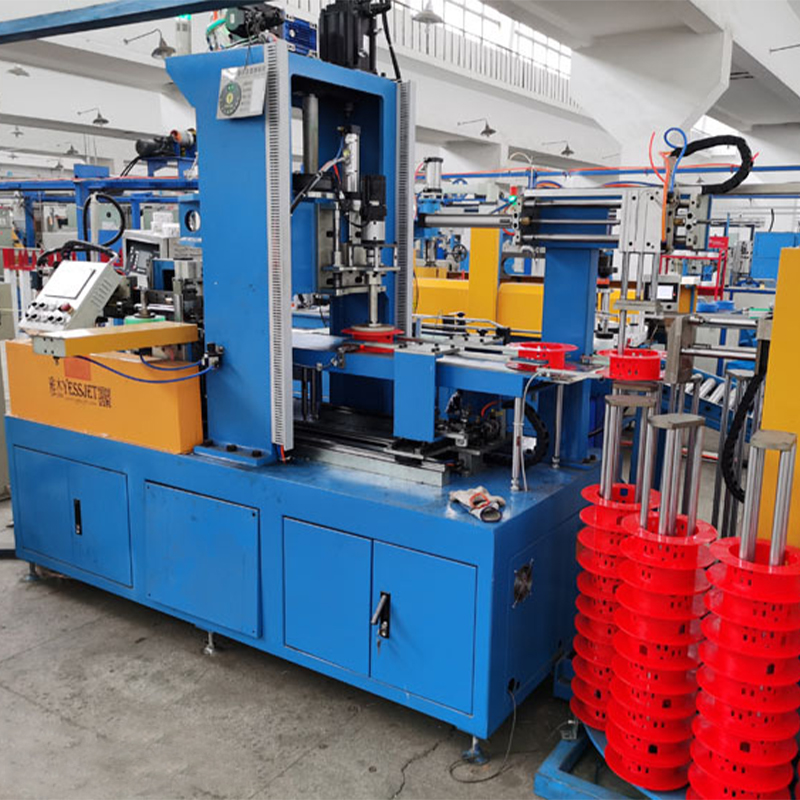
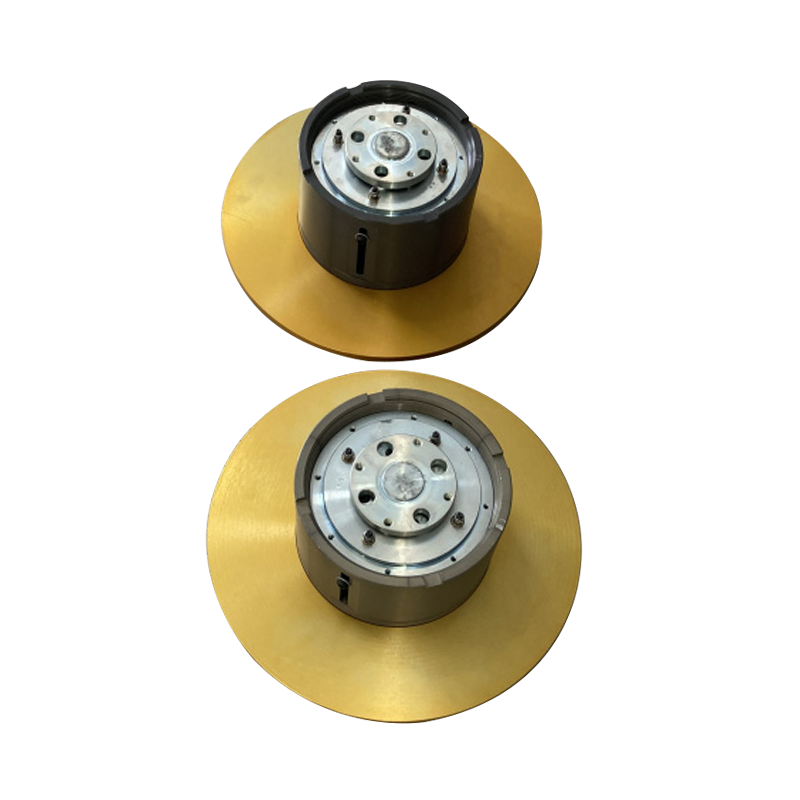
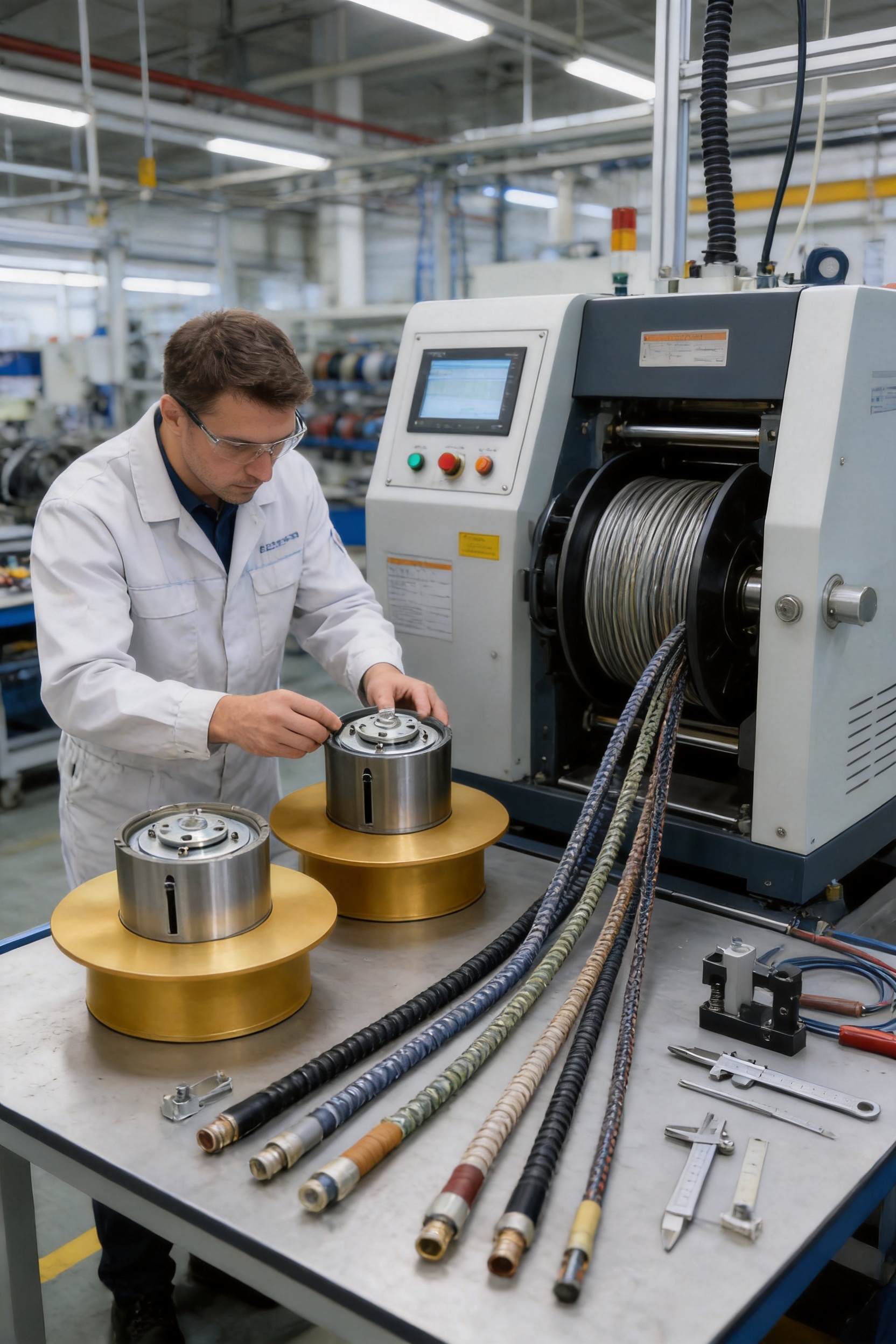
The Cable Coiling Head is a replaceable accessory developed for cable coiling machines, cable coiling and wrapping machines, and cable coiling and binding machines. It is designed to guide cable into an orderly coil while supporting the operating requirements of different cable sizes, production speeds, and equipment configurations. The component can be customized in size and is available in positioning and non-positioning versions, allowing users to choose a configuration that matches their production process.
Shanghai Yessjet Precise Machinery Co., Ltd. supplies cable-processing machinery and related accessories for wire and cable production applications. Its equipment portfolio includes wire and cable extrusion lines, fully automatic coiling and packaging equipment, intelligent robot stackers, coiling machines, motorized pay-off equipment, motorized take-up equipment, accessory equipment, and cable extrusion machines. Within this broader equipment system, the Cable Coiling Head provides a practical and replaceable solution for improving the final collection stage of cable manufacturing.
Compared with generic, fixed, or poorly matched coiling heads, this product offers greater adaptability. Its replaceable construction helps reduce the need to replace an entire machine when a working component requires renewal or when production requirements change. Its customizable dimensions make it easier to match different cable specifications and machine models. Meanwhile, the two functional options—positioning and non-positioning—allow manufacturers to select the appropriate level of guidance and control for each application.
Cable Coiling Head
Why the Cable Coiling Head Matters in Cable Manufacturing
Cable coiling is often considered a simple collection process, but it involves several technical requirements. The cable must enter the coil smoothly, maintain suitable tension, avoid excessive bending, and form a stable package. If the cable is guided unevenly, the finished coil may become loose, crossed, distorted, or difficult to bind. In some cases, poor coiling can affect production continuity and increase manual handling after the machine stops.
The coiling head is positioned at the point where the cable is directed into its circular or layered arrangement. It works together with the drive system, take-up mechanism, tension-control system, binding unit, wrapping unit, and machine control system. Its geometry and installation position influence how the cable travels during coiling. A suitable head helps the cable follow a repeatable path and supports more consistent coil formation.
Different cables require different handling conditions. Small control wires, flexible conductors, power cables, communication cables, jacketed cables, and other products may vary considerably in outer diameter, stiffness, surface friction, and allowable bending radius. A single universal component may not provide ideal results across every product range. This is why a size-customizable coiling head can be more useful than a standard component designed for only one operating condition.
The cable coiling head is also important when production lines change frequently. A manufacturer may produce several cable types on the same machine during one shift or across different orders. Replacing the head instead of changing a complete machine allows the production team to adapt the equipment with less disruption. This approach supports more flexible manufacturing and can help reduce the cost associated with maintaining multiple dedicated machines.
Connection Between Coiling Quality and Finished-Cable Value
A cable is not judged only by its electrical or mechanical properties. Buyers also consider packaging, appearance, ease of installation, and convenience during transportation. A neat coil communicates production discipline and makes the cable easier to handle. Consistent coil dimensions can also help downstream packaging, labeling, palletizing, and warehouse management.
When the coiling process is unstable, operators may need to correct the coil manually. This creates additional labor, slows the line, and introduces variation between production batches. In contrast, a well-matched coiling head helps create more repeatable results. Although the coiling head is a relatively compact component, its influence can extend across the complete finalization process.
Product Design and Functional Options
The Cable Coiling Head is designed as a core replaceable accessory rather than a permanently fixed component of one machine. This design philosophy gives users more control over maintenance, product changeovers, and equipment adaptation. When a head becomes worn, when the cable specification changes, or when a different coiling arrangement is needed, the accessory can be replaced without replacing the entire coiling machine.
Positioning Coiling Head
The positioning type is intended for applications that require more precise cable arrangement. It helps guide the cable into a defined path so that the coil can maintain a more consistent shape and size. This configuration is suitable for standard production where the cable must be distributed evenly and the finished coil needs a predictable appearance.
Positioning is especially useful when the finished coils are packaged automatically or transferred to another handling stage. Consistent dimensions can make it easier for wrapping equipment, binding equipment, conveyors, or robotic handling systems to perform their functions. It can also reduce the amount of adjustment required by operators during a production run.
In a high-volume production environment, repeatability is a major consideration. A positioning head supports a stable relationship between the cable path and the coiling mechanism. While the complete result still depends on machine speed, tension, cable properties, and control settings, the head provides an important mechanical foundation for orderly coiling.
Non-Positioning Coiling Head
The non-positioning type is intended for applications where greater flexibility is preferred over strict cable arrangement. It can be useful for irregular coiling scenarios, special cable products, or processes in which the operator or machine system requires a less constrained cable path.
Some cable products do not respond well to rigid guidance. They may have unusual dimensions, greater flexibility, special surface materials, or a production process that requires a different arrangement. In such cases, a non-positioning head can provide a more adaptable solution. It allows the coiling system to accommodate variations without forcing every product into the same guiding pattern.
The two options allow customers to select a component based on actual production needs rather than accepting a single fixed design. This is an important advantage over standard accessories that provide limited configuration choices. The positioning and non-positioning versions expand the range of applications that can be served by the same general equipment platform.
Customizable Dimensions
The Cable Coiling Head can be customized in size to match different cable specifications and machine models. Dimensional matching is important because the accessory must work correctly with the cable diameter, guide path, machine frame, mounting arrangement, and coiling mechanism.
Customization may be considered in relation to the cable’s working diameter, the required entry path, the available installation space, and the design of the existing equipment. Instead of treating the accessory as an isolated part, the manufacturer can evaluate how it fits into the complete coiling system. This reduces the risk of ordering a component that is technically similar but mechanically unsuitable.
Customers should provide accurate technical information during the inquiry stage. Useful information may include cable type, outside diameter range, material characteristics, coiling method, machine model, operating speed, desired coil dimensions, and whether positioning or non-positioning operation is required. Clear information helps the supplier recommend or manufacture a more appropriate configuration.
Advantages Compared with Generic Coiling Heads
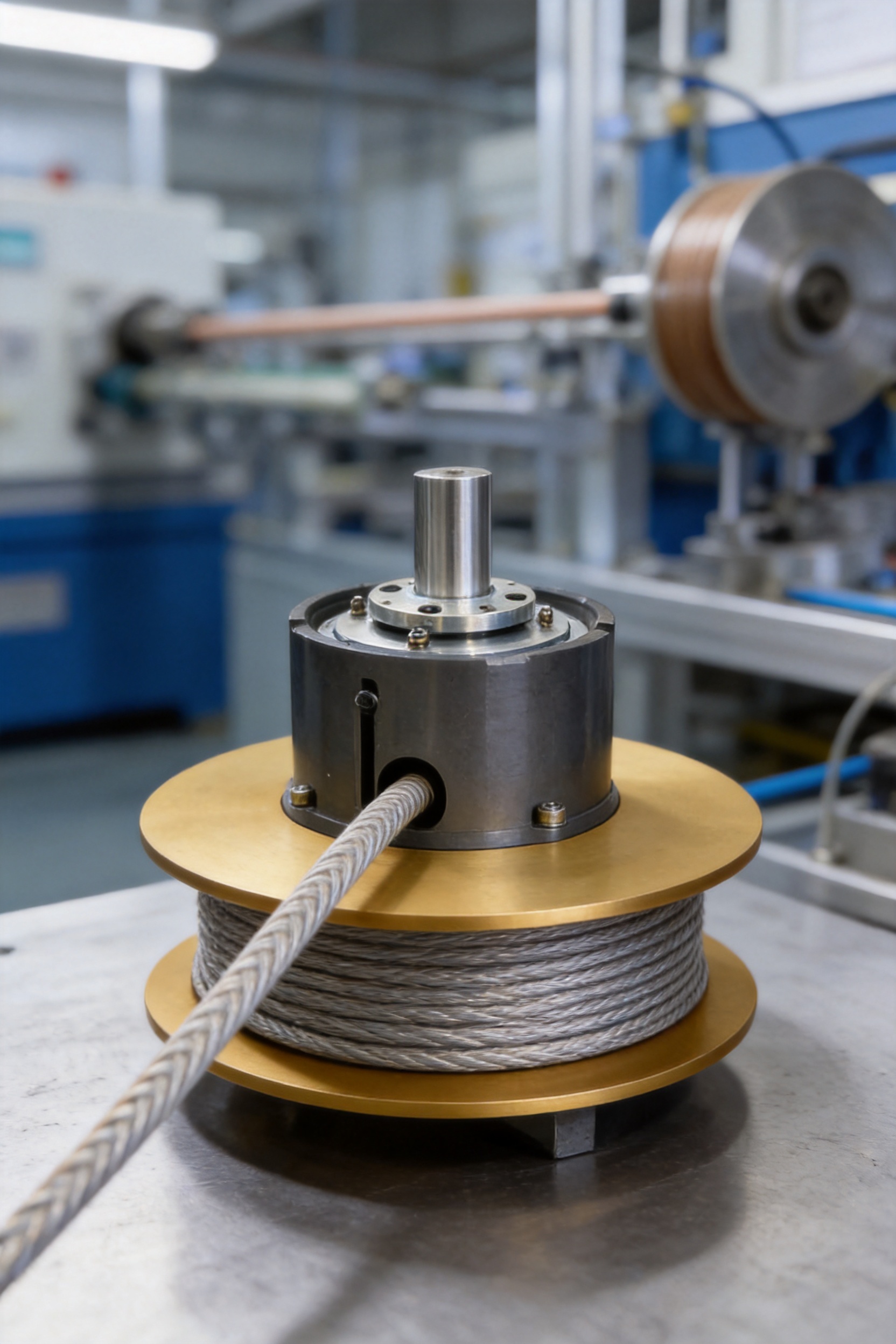
Generic coiling heads may be adequate for simple applications, but they often have limitations when a manufacturer needs flexibility, repeatability, and convenient maintenance. The Cable Coiling Head addresses these concerns through its replaceable structure, customization capability, and functional choices.
| Evaluation Area | Generic Fixed Coiling Head | Customizable Cable Coiling Head |
|---|---|---|
| Compatibility | Often designed for a narrow range of machines or cable sizes | Can be adapted to different cable specifications and equipment models |
| Replacement | May require extensive modification or replacement of a larger assembly | Designed as a replaceable core accessory |
| Operating Choice | Usually offers one guiding method | Available in positioning and non-positioning versions |
| Production Flexibility | Less suitable for frequent product changes | Supports changeovers and varied cable applications |
| Coil Consistency | Depends heavily on a standard, non-adjusted geometry | Can be matched more closely to the application and required arrangement |
| Maintenance Approach | Limited component-level replacement options | Allows a focused replacement of the relevant accessory |
| Application Range | Generally limited to common production conditions | Suitable for coiling, wrapping, and binding equipment across different scenarios |
Replaceability Reduces Equipment Disruption
One of the most practical advantages is the replaceable design. In production machinery, small components can be affected by continuous friction, repeated contact, dust, vibration, and long operating hours. If the component is integrated permanently into a larger assembly, maintenance may become more complicated and expensive.
A replaceable coiling head allows the maintenance team to focus on the affected accessory. This can shorten the service operation, simplify spare-parts management, and reduce unnecessary replacement of functional machine structures. It also gives the equipment owner a more practical way to prepare for future production changes.
Replaceability is particularly valuable for manufacturers with several coiling machines or multiple cable product lines. A common accessory platform, combined with different customized sizes, can help organize spare parts and support production planning. The exact replacement procedure depends on the machine design, but the principle remains the same: maintain the main equipment while renewing only the component that needs attention.
Adaptability Supports More Cable Products
Manufacturers increasingly need to produce different cable types in response to customer demand. A coiling accessory that is suitable for only one cable diameter can restrict the usefulness of a machine. The ability to customize the head makes the equipment more adaptable to production expansion.
Adaptability is not limited to physical size. The choice between positioning and non-positioning operation also allows users to adjust the guiding method to the behavior of the cable. A regular, dimensionally stable cable may benefit from positioning. A flexible or irregular product may be better served by a non-positioning configuration. This product choice can help manufacturers avoid forcing unsuitable operating conditions onto a cable.
Consistent Coiling Supports Automation
Automated wrapping, binding, stacking, and packaging systems depend on stable product presentation. If coils vary significantly in diameter, width, or shape, downstream equipment may require additional adjustments. The positioning version of the coiling head helps create a more predictable coil arrangement, supporting smoother integration with automated processes.
This does not mean that the head operates independently of the rest of the machine. Motor speed, take-up tension, control parameters, cable condition, and binding settings must all be coordinated. However, a suitable coiling head strengthens the mechanical part of this relationship and gives the complete line a better basis for repeatable operation.
Applications Across Cable Processing Equipment
Cable Coiling Machines
In a standard cable coiling machine, the head guides the cable as it is collected into a coil. The desired result may be a compact coil with a consistent outside diameter, a stable arrangement for manual removal, or a package ready for binding. The head can be selected according to the cable dimensions and the intended coil format.
For regular products, a positioning model can help guide the cable in a controlled pattern. For products requiring a looser or less restricted arrangement, the non-positioning model can offer additional flexibility. The replaceable nature of the accessory also supports routine maintenance and future production adjustments.
Cable Coiling and Wrapping Machines
Coiling and wrapping machines combine cable collection with protective packaging. The cable must be arranged into a coil before or during the wrapping process. If the coil is unstable, wrapping material may not be applied evenly, and the finished package may be difficult to transport.
A well-matched cable coiling head helps establish the shape of the coil before wrapping. The positioning option can be useful when the wrapping unit expects a consistent package outline. The non-positioning option may be appropriate when the product or package design requires a more flexible arrangement.
The accessory therefore supports not only the formation of the coil but also the performance of the following packaging stage. By improving the relationship between the cable and the wrapping equipment, it can contribute to more stable packaging results.
Cable Coiling and Binding Machines
Binding machines use straps, ties, or other materials to secure the completed coil. The binding operation is easier when the cable has a stable and manageable shape. A coil that is too loose, uneven, or irregular may require operator correction before binding.
The positioning coiling head can help produce a more consistent coil for automatic or semi-automatic binding. For special cable types, the non-positioning version can provide an alternative arrangement that better suits the product. The correct choice depends on the cable’s flexibility, desired coil dimensions, and binding method.
Integration with Complete Cable Production Lines
The Cable Coiling Head can be considered as part of a broader cable production solution. Shanghai Yessjet Precise Machinery Co., Ltd. also provides extrusion lines, pay-off equipment, take-up equipment, coiling systems, packaging equipment, and intelligent stacking solutions. This broader product scope allows customers to consider the coiling stage in relation to the complete manufacturing line.
A cable production line is most effective when each stage is compatible with the next. The extrusion process determines the cable’s dimensions and surface condition. The take-up system manages collection and tension. The coiling machine forms the final coil. Packaging and stacking equipment then prepare the product for handling and delivery. The coiling head is a small but meaningful connection within this chain.
Manufacturing Strengths and Engineering Approach
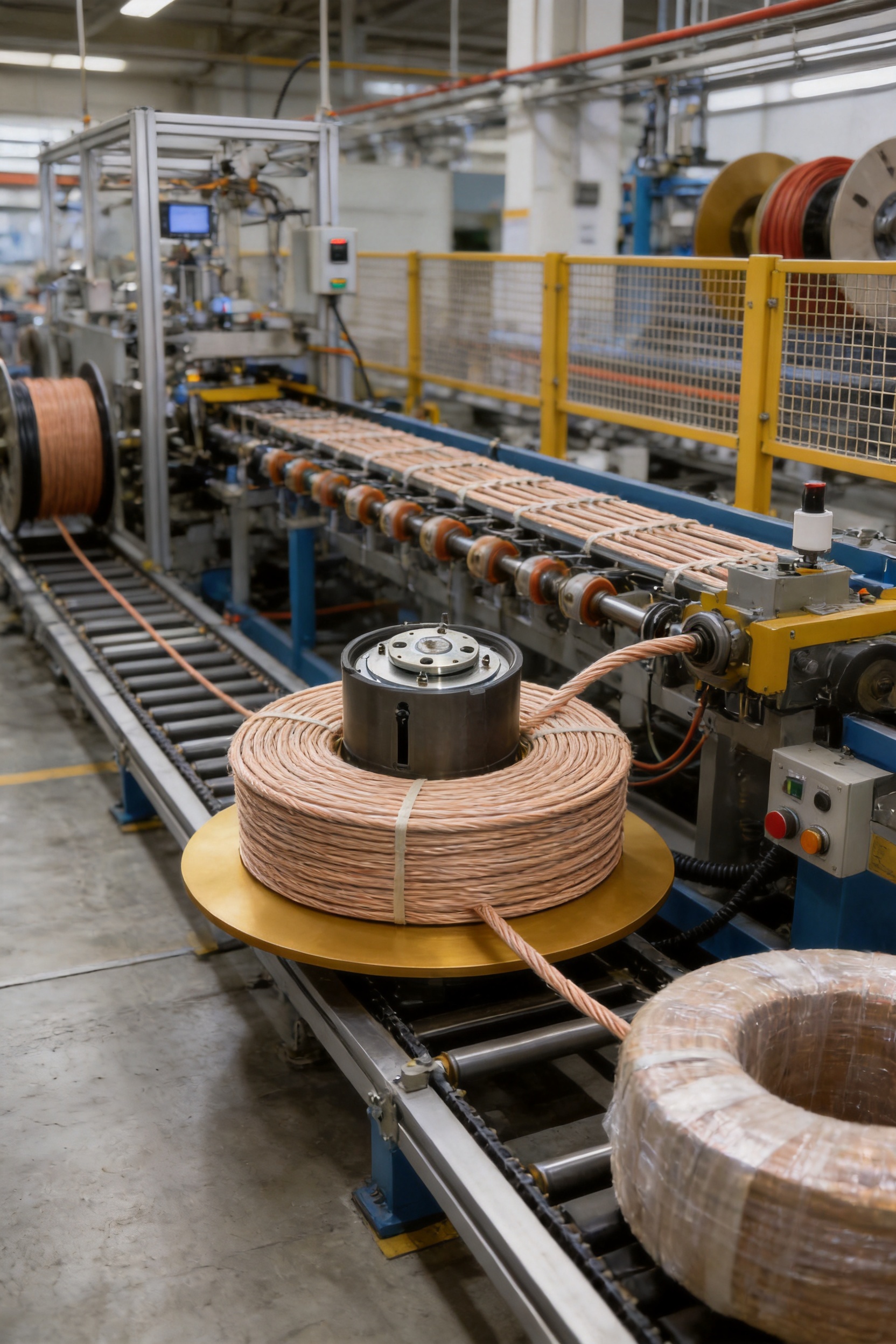
Producing a reliable coiling head requires more than copying an existing shape. The component must be matched to the cable, the machine, and the intended operating conditions. Shanghai Yessjet Precise Machinery Co., Ltd. approaches the product as an engineered accessory that can be adapted to different applications.
Application-Based Technical Review
The manufacturing process begins with understanding the customer’s production requirements. The supplier can review the cable dimensions, machine structure, coiling method, desired performance, and installation conditions before confirming the product configuration. This application-based approach is more reliable than selecting a component only by appearance or nominal size.
Technical review is particularly important when the customer uses an existing machine from another supplier. Different machines may have different mounting dimensions, guide positions, working clearances, and cable entry directions. A detailed review helps reduce compatibility risks and supports a more efficient customization process.
Precision Component Manufacturing
The coiling head must be manufactured with attention to dimensional accuracy and surface condition. Its working surfaces should support smooth cable movement and avoid creating unnecessary resistance or damage. Mounting features must align correctly with the machine so that installation does not introduce unwanted deviation.
Precision machining, controlled processing procedures, and careful dimensional verification are important parts of producing this type of accessory. The exact material and processing method can be selected according to the application, cable characteristics, and operating environment. The objective is to create a component that is practical, stable, and suitable for repeated industrial use.
For customized products, manufacturing discipline becomes even more important. A design that differs slightly from a standard model must still be documented, processed, checked, and delivered consistently. Proper production records help connect the customer’s technical requirements with the finished accessory.
Assembly and Trial Fitting
A coiling head should be evaluated not only as an individual component but also in relation to the equipment on which it will be installed. Assembly checks and trial fitting help confirm that the head can be positioned correctly and that the cable path is not obstructed.
Where practical, the manufacturer can assess the relationship between the head, cable guide, take-up structure, and coiling mechanism. This type of verification helps identify installation problems before shipment. It also provides useful information for customers preparing the machine for replacement or upgrade.
Inspection and Quality Control
Quality control for a coiling accessory can include dimensional inspection, visual inspection, mounting verification, surface checks, and functional evaluation according to the order requirements. The purpose is to confirm that the delivered part corresponds to the agreed design and can be installed as intended.
For positioning models, inspection should pay particular attention to the guiding geometry and the repeatability of the cable path. For non-positioning models, the relevant focus may be the smoothness of cable entry, clearances, and compatibility with the intended irregular coiling process.
Quality control is most effective when it is integrated into the full manufacturing process rather than performed only at the end. Engineering review, process planning, machining, assembly, and final inspection should support one another. This creates a more dependable workflow for both standard and customized accessories.
Support for Complete Equipment Solutions
A manufacturer that supplies both machinery and accessories can better understand how a coiling head interacts with the complete production line. Experience with extrusion machines, pay-off systems, take-up systems, coiling machines, packaging units, and robot stackers can support more practical recommendations.
This broader perspective is one of the strengths of Shanghai Yessjet Precise Machinery Co., Ltd. Customers can discuss not only the accessory itself but also the production objective surrounding it. The company can help customers consider whether the need relates to cable diameter, machine compatibility, coil shape, packaging, binding, or a broader line configuration.
Material and Operating Considerations
Cable Diameter
Cable diameter is one of the first factors to consider when selecting a coiling head. The head should provide a suitable path without creating excessive compression or unnecessary clearance. A mismatch can affect the stability of the coil and may influence the appearance of the finished product.
When multiple cable diameters will be processed, the customer should identify the complete working range rather than provide only one nominal size. The manufacturer can then evaluate whether one customized head is appropriate or whether several interchangeable heads would provide better results.
Cable Flexibility and Stiffness
Flexible cables may require a different guiding approach from rigid or heavily jacketed cables. A flexible cable can respond quickly to changes in tension and may form irregular shapes if guidance is insufficient. A stiff cable may require more room to follow the desired radius and may resist tight coiling.
The choice between positioning and non-positioning should take these properties into account. Positioning can support orderly arrangement for many standard products, while non-positioning can be useful when the cable needs a less constrained path. Neither option should be selected without considering the actual cable behavior.
Surface Characteristics
The outer surface of the cable can influence friction and movement through the coiling head. Smooth jackets, textured surfaces, soft materials, and special protective layers may behave differently during continuous contact. The working area of the head should therefore be suitable for the cable surface and production speed.
A smooth and properly finished contact area can help reduce unnecessary resistance. The equipment should also be operated within appropriate process parameters so that the cable does not experience excessive tension or abrupt changes in direction.
Coil Dimensions and Packaging Requirements
The required outside diameter, inside diameter, width, weight, and binding method of the finished coil can affect the selection of the coiling head. A coil intended for manual handling may have different requirements from a coil intended for automatic wrapping, robotic stacking, or palletized shipment.
Customers should communicate the expected finished package as early as possible. This allows the accessory and the surrounding machine configuration to be considered together. The goal is not simply to make a coil, but to make a coil that can be handled efficiently through the next stage.
Installation, Replacement, and Maintenance Guidance
Before installing a Cable Coiling Head, the machine should be stopped and isolated according to the equipment manufacturer’s safety procedures. Operators should confirm that moving parts have come to a complete stop and that the working area is safe. The replacement should be performed by trained personnel familiar with the machine.
The existing head should be removed carefully, with attention to mounting hardware, alignment references, and cable routing. The new head should be checked against the approved dimensions before installation. Fasteners should be tightened appropriately, and the accessory should be aligned with the cable path and coiling mechanism.
After installation, a low-speed trial is recommended. The operator can observe whether the cable enters smoothly, whether the head remains secure, and whether the coil develops the intended arrangement. If the machine includes tension or speed controls, these should be adjusted gradually rather than changed abruptly.
Routine maintenance should include cleaning the working area, checking for visible wear, verifying mounting security, and observing changes in cable movement. Dust, jacket residue, and other production debris should not be allowed to accumulate around the guiding area. Regular observation can help identify problems before they affect a large production batch.
Signs That Replacement May Be Necessary
Possible signs of a worn or unsuitable coiling head include unstable cable guidance, inconsistent coil dimensions, unusual friction, visible surface damage, recurring cable crossover, or difficulty maintaining the required coil shape. These symptoms may also be caused by tension settings, machine alignment, cable variation, or other components, so a complete inspection is advisable.
If the head is confirmed as the source of the problem, replacing the accessory can be more efficient than modifying the entire machine. The replacement should match the cable and equipment requirements. When the production specification has changed, a newly customized head may be more suitable than a direct replacement of the previous configuration.
How the Product Supports Manufacturing Efficiency
Efficiency is measured not only by machine speed. It also includes setup time, changeover time, maintenance convenience, product consistency, labor requirements, and the amount of material that meets specifications. The Cable Coiling Head contributes to these areas by supporting a more adaptable and controllable coiling process.
A replaceable accessory can reduce the scope of maintenance. Instead of treating a complete coiling machine as a single indivisible system, the operator can address the specific component that requires attention. This can simplify spare-parts planning and reduce the disruption associated with service work.
Customization can also reduce trial-and-error during installation. A head designed for the actual machine model and cable range is more likely to fit the intended application than a generic part selected without technical review. Better initial matching can help shorten commissioning and support faster production preparation.
The positioning option can support repeatable production for standard cable products. More consistent coils may reduce manual correction and support smoother packaging or binding. The non-positioning option can help manufacturers handle special products without purchasing a completely separate machine configuration.
These benefits are especially relevant to cable manufacturers serving multiple markets. Production flexibility allows the same equipment platform to support more order types. As market requirements change, the coiling system can be adapted through accessory selection and configuration rather than replaced entirely.
Selection Guide for Customers
Customers considering a Cable Coiling Head should first define the application. The correct product depends on the machine type, cable dimensions, coiling method, and desired finished package. A clear technical inquiry helps the manufacturer provide a more accurate recommendation.
| Information to Provide | Why It Matters |
|---|---|
| Machine type and model | Helps confirm mounting structure, working space, and equipment compatibility |
| Cable type | Indicates likely flexibility, stiffness, surface behavior, and handling requirements |
| Outer diameter range | Supports selection of a suitable guiding size and working clearance |
| Production speed | Helps evaluate the required stability and cable movement conditions |
| Desired coil size | Connects the accessory design with the final packaging requirement |
| Wrapping or binding method | Shows how consistent the finished coil must be for downstream operations |
| Positioning requirement | Determines whether a positioning or non-positioning version is more suitable |
| Installation dimensions | Helps reduce compatibility problems during replacement |
It is also useful to provide drawings, photographs, sample cables, or information about the existing accessory when available. These materials can help the engineering team understand the current installation and identify the most practical replacement approach.
Choosing Positioning or Non-Positioning
A positioning coiling head is generally appropriate when the manufacturer values orderly arrangement, repeatable coil dimensions, and compatibility with automated packaging or binding. It may be selected for regular production products where the cable follows a predictable path.
A non-positioning coiling head may be appropriate when flexibility is more important than strict arrangement. It can be considered for irregular coiling scenarios, special cable constructions, or applications in which the operator or control system needs greater freedom in how the cable is collected.
For users who process several product categories, maintaining both types as interchangeable accessories may be a practical option. The best choice should be based on production data rather than on a general assumption that one type is suitable for every cable.
Company Capabilities and Customer Value
Shanghai Yessjet Precise Machinery Co., Ltd. focuses on wire and cable machinery and provides equipment for different stages of cable production. Its product range covers complete production lines as well as individual machines and accessories. This enables the company to serve customers seeking a single component, a machine upgrade, or a broader cable production solution.
The company’s strength in supplying the Cable Coiling Head comes from combining accessory manufacturing with knowledge of cable-processing equipment. A coiling head must function within a machine, and the company’s wider equipment experience supports a more complete understanding of that relationship.
Its manufacturing approach emphasizes practical customization. Rather than offering only one standard accessory, the company supports different sizes and two operating configurations. This helps customers address the actual conditions of their production line and avoid unnecessary compromises.
The company also supports equipment users who need coordinated production solutions. A customer may begin with an accessory inquiry and later require coiling equipment, take-up equipment, packaging equipment, or intelligent stacking equipment. A supplier with a broader portfolio can help maintain greater consistency across the equipment planning process.
For international customers, clear communication of technical information is important. Cable-processing machinery often involves customized dimensions and application-specific requirements. Accurate documentation, careful inquiry review, and confirmation of the final configuration help create a more reliable purchasing process.
Frequently Asked Questions
What is a Cable Coiling Head?
A Cable Coiling Head is a replaceable accessory used to guide cable during the coiling process. It is designed for cable coiling machines, cable coiling and wrapping machines, and cable coiling and binding machines.
Can the Cable Coiling Head be customized?
Yes. The product can be customized in size to match different cable specifications and equipment models. Customers should provide cable dimensions, machine information, desired coil size, and installation details for evaluation.
What is the difference between positioning and non-positioning types?
The positioning type is designed to support precise cable arrangement and more consistent coil formation. The non-positioning type provides greater flexibility for irregular coiling scenarios or products that require a less restricted cable path.
Can the accessory be used on a machine from another supplier?
It may be possible, provided that the mounting structure, dimensions, working clearance, and cable path are compatible. The machine model and relevant technical drawings or photographs should be submitted for confirmation before ordering.
Why choose a replaceable coiling head instead of replacing the machine?
A replaceable head allows the operator to renew or adapt a core working accessory without replacing the entire coiling machine. This can simplify maintenance, reduce equipment disruption, and support changes in cable specifications.
Is the positioning model suitable for automatic packaging?
It can be suitable for applications where a more consistent coil arrangement is beneficial to wrapping, binding, handling, or stacking equipment. The final result also depends on machine settings, cable properties, tension control, and packaging requirements.
When is the non-positioning model useful?
The non-positioning model can be considered for irregular coiling scenarios, flexible products, special cable constructions, or applications where the cable needs a less constrained arrangement.
What information should be provided for a quotation?
Customers should provide the machine type and model, cable type, cable outside diameter, production speed, desired coil dimensions, binding or wrapping method, installation dimensions, and preferred positioning mode. Drawings or photographs can also be helpful.
How can maintenance staff identify a potential coiling-head problem?
Possible indicators include inconsistent coil size, unstable cable guidance, excessive friction, visible wear, cable crossover, or recurring difficulty in forming the required coil. These signs should be assessed together with machine alignment, cable tension, speed, and other operating conditions.
Can one head handle several cable sizes?
The answer depends on the design and the working diameter range. A customized head may support a defined range, but customers should provide the complete size range for technical review. Several interchangeable heads may be recommended when the range is broad.
Conclusion
The Cable Coiling Head is a compact but important accessory for cable-processing operations. Its function is closely connected with cable guidance, coil consistency, packaging quality, binding efficiency, and production flexibility. By offering replaceable construction, customizable dimensions, and positioning or non-positioning options, it provides a practical alternative to generic fixed accessories.
For manufacturers producing different cable types, the product can help simplify equipment adaptation and support more efficient changeovers. For users operating wrapping or binding equipment, the positioning version can contribute to a more stable coil arrangement. For special or irregular coiling applications, the non-positioning version offers greater flexibility.
Shanghai Yessjet Precise Machinery Co., Ltd. combines cable machinery experience with accessory customization and complete production-line capability. Its manufacturing approach includes application review, precision component production, assembly consideration, and quality inspection. These strengths allow the Cable Coiling Head to be considered not merely as a replacement part, but as an engineered component within a wider wire and cable production solution.
When selecting the product, customers should focus on the relationship between the cable, the machine, and the finished package. Accurate technical information and clear communication help ensure that the selected coiling head provides the desired compatibility, stability, and adaptability. With the right configuration, this accessory can support reliable cable coiling and help manufacturers pursue higher efficiency across their production operations.
References
1. General principles of wire and cable manufacturing, including extrusion, take-up, coiling, wrapping, binding, and packaging operations.
2. Industrial equipment maintenance practices for replaceable guiding and cable-handling components.
3. Mechanical design considerations for cable routing, bending radius, tension control, and product handling.
4. Production-line integration concepts for cable coiling, automatic packaging, and robotic stacking systems.
5. Product information supplied for the Cable Coiling Head, including positioning and non-positioning configurations and customizable dimensions.
6. Company product information for Shanghai Yessjet Precise Machinery Co., Ltd., covering wire and cable extrusion lines, coiling equipment, pay-off equipment, take-up equipment, packaging equipment, intelligent robot stackers, and accessory equipment.