LANGUAGE
 中文简体
中文简体 русский
 Français
 Español
 Português
 عربى
عربى
Content
- 1 Why Heat Shrink Packaging Matters in Cable Manufacturing
- 2 Integrated Film Application, Sealing, and Shrinking
- 3 Complete Coverage for Cable Coils
- 4 Suitable Film Options
- 5 PLC Control and Adjustable Temperature Management
- 6 Model Selection and Capacity Range
- 7 Advantages Over Manual and Conventional Packaging Methods
- 8 Manufacturing Strength and Engineering Approach
- 9 Energy Efficiency and Operating Cost Considerations
- 10 Simple Operation and Maintenance
- 11 Installation and Production Integration
- 12 Quality Control for Shrink-Wrapped Cable Coils
- 13 Applications Across Wire and Cable Industries
- 14 How to Select the Correct Configuration
- 15 Recommended Operating Practices
- 16 Q&A
- 16.1 What products can the Cable Heat Shrink Packaging Machine package?
- 16.2 Which film materials can be used?
- 16.3 What is the heating temperature range?
- 16.4 Does the machine cover the entire cable coil?
- 16.5 How are the models different?
- 16.6 Is the machine suitable for a complete cable production line?
- 16.7 Does automatic packaging eliminate all labor?
- 16.8 How can packaging quality be improved?
- 16.9 What information should be supplied before purchasing?
- 16.10 Why is a PLC control system useful?
- 16.11 Can the machine help reduce packaging costs?
- 17 Conclusion
- 18 References
- 19 Product: Cable Heat Shrink Packaging Machine
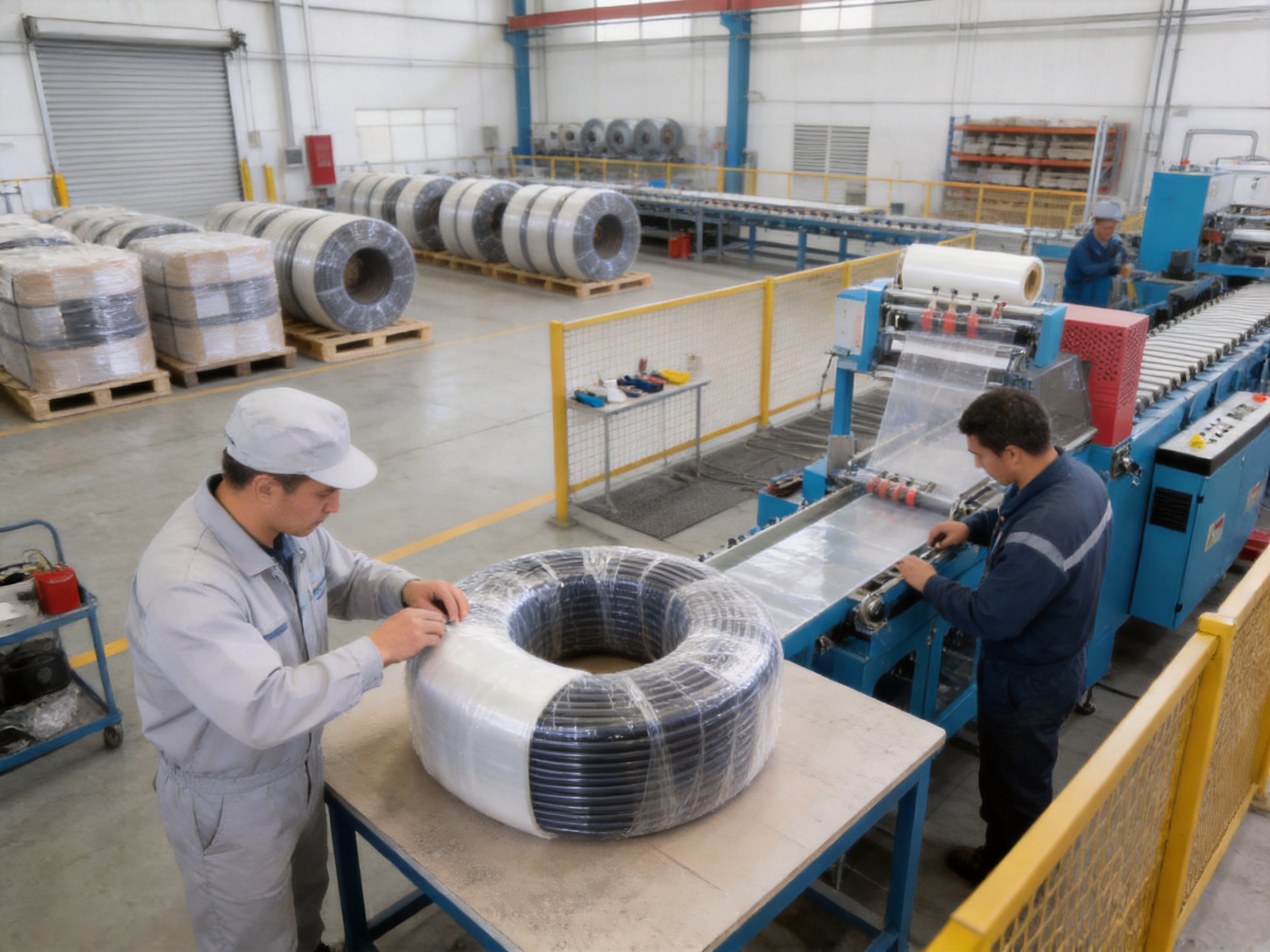
Efficient packaging is an essential part of modern wire and cable production. After extrusion, cooling, testing, coiling, and take-up, finished cables must be protected against dust, moisture, abrasion, corrosion, deformation, and handling damage. A well-designed packaging process does more than improve appearance. It helps preserve product quality, reduce transportation losses, simplify warehouse management, and present a consistent professional image to customers.
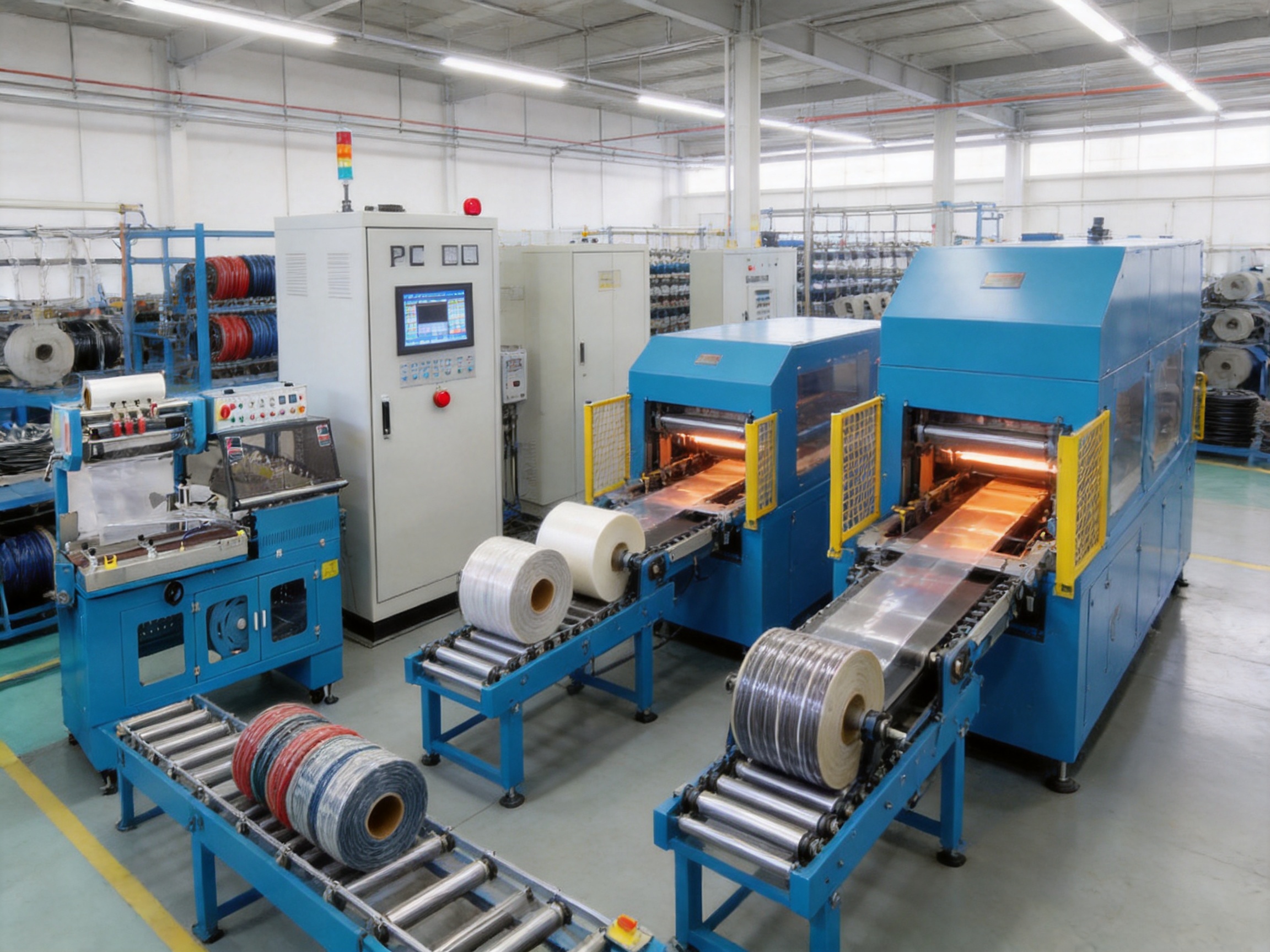
The Cable Heat Shrink Packaging Machine is designed for this stage of production. It combines automatic film application, sealing, heating, shrinking, and discharge in one coordinated system. The result is a tightly wrapped cable coil or related product with a continuous protective film layer covering the front, back, right, and left sides. The equipment is suitable for wire coils, cable coils, communication cables, power cables, industrial components, and other regularly shaped products that require clean and compact packaging.
Rather than relying on manual wrapping and separate heating equipment, this machine creates a controlled packaging workflow. The product is wrapped with suitable PE, PVC, or POF film, transferred into a hot shrink tunnel, heat-shrunk, and then sent to a working table or discharge position. The integrated arrangement reduces unnecessary handling and supports a more stable production rhythm.
Why Heat Shrink Packaging Matters in Cable Manufacturing
Cables often leave the production line with exposed surfaces that can be affected by the surrounding environment. Dust may settle on insulation surfaces, moisture may enter packaging gaps, and friction during transportation may cause scuffing. In coastal or humid regions, prolonged exposure can also increase the risk of corrosion on metallic components, terminals, or other unprotected parts.
Traditional packaging methods may include hand wrapping, adhesive tape, woven bags, cartons, or loose plastic covers. These methods can be useful for certain products, but they often have limitations. Manual wrapping depends heavily on operator skill. Loose covers may not protect the complete product. Tape can create an uneven appearance and may leave adhesive residue. Oversized cartons consume storage space and may require additional filling material.
Heat shrink packaging addresses these problems by forming a close-fitting film layer around the product. When the selected film is heated within the appropriate temperature range, it contracts and follows the contour of the cable coil. This helps keep the coil compact, reduces exposure to contaminants, and provides a visually uniform package.
For cable manufacturers, the packaging stage can also influence productivity. If packaging becomes a bottleneck, the extrusion line, coiling machine, and take-up equipment may have to wait for finished coils to be processed. An automated shrink packaging machine helps connect the upstream production process with downstream storage and shipment. It can therefore contribute to a more balanced cable production line.
Integrated Film Application, Sealing, and Shrinking
The core operating principle is a “film application-heating-shrinking” workflow. Each stage has a specific function, and the sequence is designed to reduce manual intervention.
Automatic Film Application
The machine applies film around the cable coil or other product in a controlled manner. Depending on the material selected, PE, PVC, or POF film can be used for different packaging requirements. The film is positioned so that the product is enclosed before it moves to the sealing and heating stages.
Automatic film application improves consistency compared with hand wrapping. The film can be applied with a repeatable overlap and alignment, helping reduce exposed areas and unnecessary material consumption. Consistent wrapping is especially valuable when products are shipped under the same model, size, and packaging specification.
Sealing and Cutting
After the film has been applied, the packaging process creates a sealed enclosure. The sealing function joins the film edges and separates the package from the remaining film supply. A clean seal helps prevent the package from opening during transfer or transportation.
The sealing area is an important part of packaging quality. Excessive heat may damage the film or create a weak, irregular seam, while insufficient heat may result in incomplete sealing. The equipment’s adjustable control system allows operators to set operating conditions according to the film type, product dimensions, and production requirements.
Transfer to the Hot Shrink Tunnel
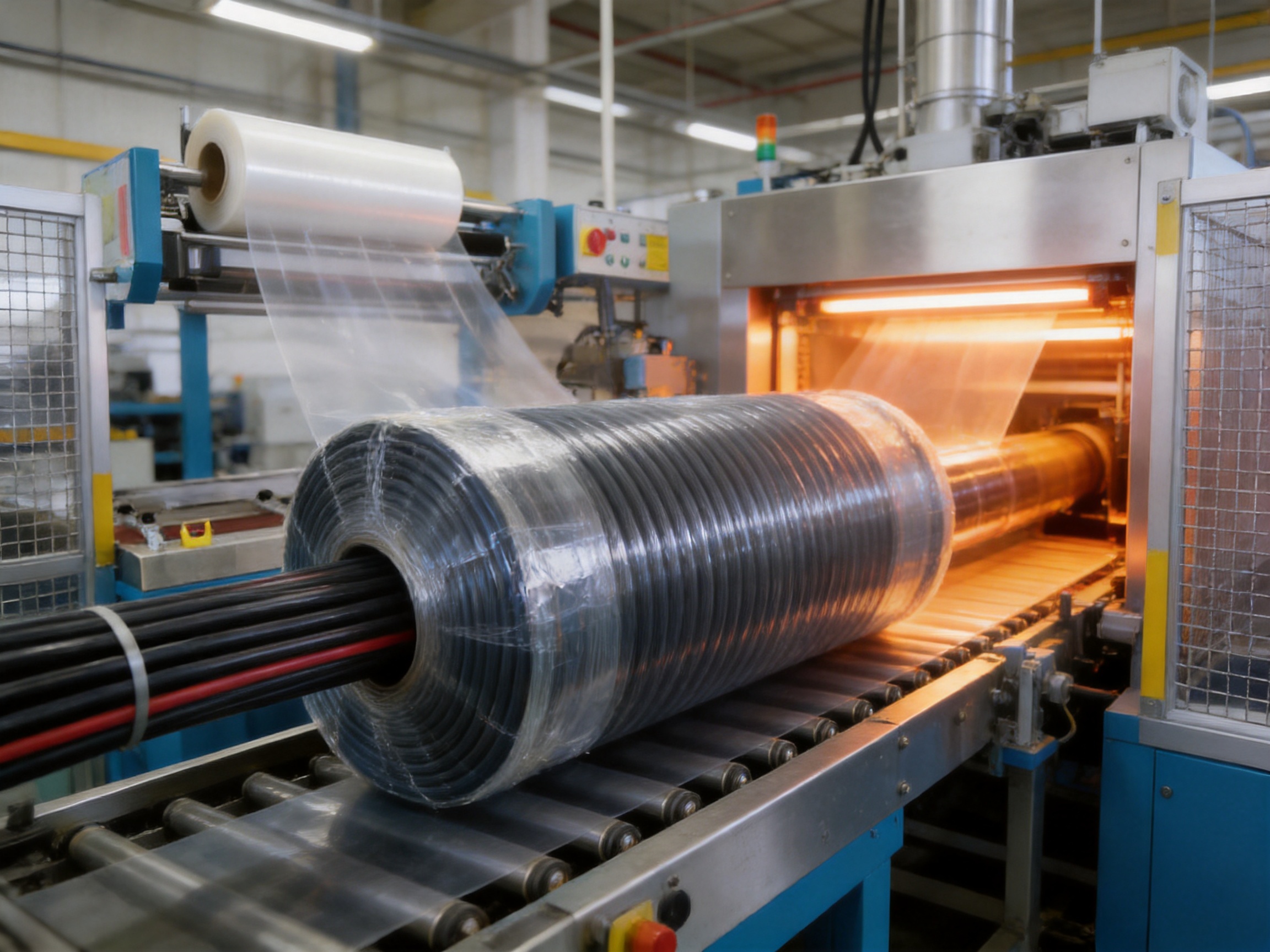
Following sealing, the wrapped coil is transferred into the hot shrink tunnel. Within the tunnel, controlled heat causes the film to contract around the product. The process is intended to create a tight, smooth, and stable outer layer without requiring additional manual adjustment.
Heat distribution and conveying stability are critical during this stage. Uneven heating can cause loose sections, wrinkles, or excessive shrinkage in one area. The machine is designed to provide a coordinated transfer and heating process so that each package follows a repeatable route through the tunnel.
Discharge to the Working Table
Once shrinking is completed, the packed coil is sent out to a working table. Operators can inspect the package, apply labels, arrange products for palletizing, or move the finished coil to a warehouse or shipping area. This discharge arrangement creates a practical transition between automatic packaging and final logistics operations.
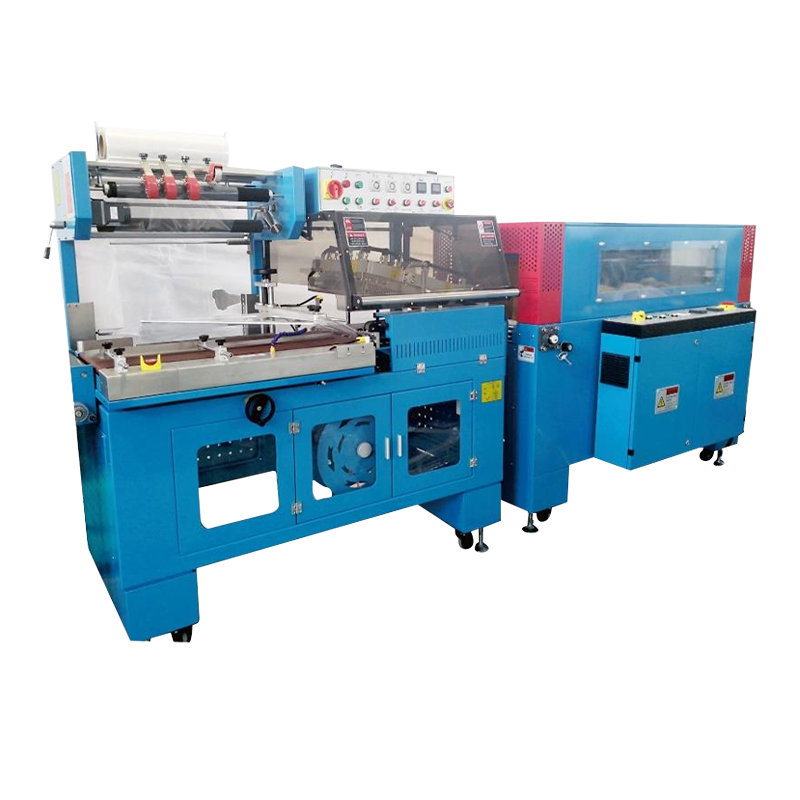
Cable Heat Shrink Packaging Machine
Complete Coverage for Cable Coils
One of the notable features of the Cable Heat Shrink Packaging Machine is its ability to fully package the coil. The PE film can cover the front, back, right, and left sides, providing more complete protection than a simple top cover or loose wrap.
Complete coverage offers several benefits. It reduces the number of open surfaces through which dust and moisture can enter. It also minimizes contact between the cable surface and external materials during handling. For products stored for extended periods, the sealed film layer can help maintain a cleaner appearance and reduce exposure to warehouse contaminants.
Full packaging is also useful for transportation. Cable coils may be moved by forklift, pallet truck, or manual handling. A close-fitting film layer helps keep the coil and its packaging together, reducing the likelihood of loose wrapping becoming caught, torn, or separated during movement.
The film does not replace all forms of shipping protection. Heavy coils may still require pallets, supports, corner protection, or external crates depending on their weight and destination. However, heat shrink packaging can serve as an effective inner protective layer within a broader logistics system.
Suitable Film Options
The machine supports PE, PVC, and POF film options. Each film type has different characteristics, and selection should be based on product requirements, environmental conditions, appearance expectations, and operating cost.
PE Film
PE film is widely used for practical industrial packaging. It offers useful toughness and flexibility and can be suitable for cable coils and products that need a durable protective layer. PE film is also commonly selected when packaging cost and resistance to handling are important considerations.
For cable packaging, PE film can provide a broad protective surface around the coil. The machine’s full-wrap configuration makes it possible to use the material for both protection and presentation without depending on several separate packaging components.
PVC Film
PVC film can be considered when a different level of clarity, stiffness, or shrink behavior is required. Its suitability depends on the product specification, local regulations, storage environment, and customer requirements. Before production, users should confirm film compatibility with the sealing temperature and shrink tunnel settings.
POF Film
POF film is often chosen when a neat appearance and smooth shrink finish are priorities. It can be suitable for products requiring visually clean packaging and consistent surface presentation. As with other films, the correct temperature and conveying conditions should be selected to avoid distortion or incomplete shrinking.
The availability of multiple film choices gives manufacturers greater flexibility than systems limited to one packaging material. It allows the packaging process to be adjusted for different cable types, coil sizes, customer preferences, and shipping conditions.
PLC Control and Adjustable Temperature Management
The machine is equipped with an intuitive PLC control system. PLC-based operation supports coordinated control of the film application, sealing, transfer, heating, and discharge actions. It also provides operators with a practical interface for adjusting and monitoring the machine.
Temperature settings can be adjusted within a stated range of 150 to 200°C. This range allows the machine to accommodate different film properties and packaging conditions. The correct setting depends on film thickness, film composition, product size, conveyor speed, and the desired shrink result.
Temperature control is important for both quality and efficiency. If the temperature is too low, the film may remain loose or uneven. If the temperature is too high, the film may become excessively thin, develop holes, or form unattractive shrink marks. Controlled heating helps operators establish a repeatable process rather than relying on trial-and-error manual heating.
The PLC system can also support the standardization of operating procedures. Once a suitable setting has been confirmed for a particular cable coil, operators can use the same process parameters for subsequent production. This is valuable for factories producing multiple cable specifications or working across several shifts.
In a well-managed production environment, the control system can be integrated into a broader quality program. Operators may record film type, temperature, conveying speed, product dimensions, and inspection results. Such records help identify changes in packaging quality and support continuous process improvement.
Model Selection and Capacity Range
The available models are identified as HP 430, HP 600, and HP 800. The selection is based mainly on the combined product dimension represented by OD plus H. In this notation, OD refers to the outside diameter of the coil, while H refers to its height. The combined dimension must remain within the applicable model limit.
| Model | Applicable OD + H Size | Stated Output Range | Typical Selection Consideration |
|---|---|---|---|
| HP 430 | OD + H ≤ 430 mm | 1–10 units per minute | Compact cable coils and products with smaller overall dimensions |
| HP 600 | OD + H ≤ 600 mm | 1–10 units per minute | Medium-sized cable coils and flexible production requirements |
| HP 800 | OD + H ≤ 800 mm | 1–5 units per minute | Larger coils requiring a wider packaging capacity |
The stated output is shown as 1 to 10 units per minute for the HP 430 and HP 600 models and 1 to 5 units per minute for the HP 800 model. Actual output may vary according to cable coil size, film specification, heating conditions, sealing time, operator workflow, and product handling requirements.
Model selection should not be based only on the largest product currently in production. Manufacturers should also consider future product development, variation in coil dimensions, available floor space, required production speed, and the desired level of automation. Selecting a model with appropriate capacity can prevent the need for premature equipment replacement as product sizes increase.
Before ordering, customers should provide accurate information about outside diameter, coil height, product weight, film type, packaging appearance, and expected throughput. A technical review can then confirm whether the selected model is suitable for the application.
Advantages Over Manual and Conventional Packaging Methods
Improved Packaging Consistency
Manual packaging often produces variation in film tension, overlap, seal position, and overall appearance. These differences may not affect every product, but they can become visible when large quantities are shipped to customers. Automated film application and controlled shrinking help create more uniform packages.
Consistency is particularly important for cable manufacturers supplying distributors, construction projects, utilities, and equipment manufacturers. A uniform package is easier to stack, identify, inspect, and present in a professional manner.
Reduced Labor Dependence
Manual wrapping requires operators to repeatedly position film, rotate or manipulate the coil, seal the film, and apply heat. This can be physically demanding, especially when coils are heavy or production volumes are high. The automated sequence reduces the amount of repetitive work required at the packaging station.
Labor is still needed for loading, inspection, labeling, and downstream handling, but the machine allows personnel to focus on supervision and quality control instead of performing every packaging movement manually.
More Complete Protection
Loose film, partial covers, and hand-applied wrapping may leave gaps or exposed surfaces. The machine is designed to cover the complete coil, including the front, back, right, and left sides. This creates a more continuous protective barrier against dust and moisture.
Lower Material Waste
Uncontrolled manual wrapping can consume excess film because operators may use additional layers to compensate for uneven coverage. The automatic process supports more predictable film use. The energy-efficient design also aims to reduce operating costs by controlling the heating and packaging process.
Material savings depend on product dimensions, film thickness, overlap requirements, and operating settings. Even small reductions in film consumption can become significant when a factory packages thousands of coils each month.
Better Production Flow
The machine’s integrated transfer, tunnel, and discharge arrangement helps reduce unnecessary movement between separate packaging stations. A continuous workflow can improve the connection between coiling equipment and finished-goods handling.
Compared with a process using multiple independent machines, an integrated design can simplify operator coordination and reduce the chance of packages waiting between stages. This is particularly useful in factories that are building a complete wire and cable production line.
Improved Workplace Safety
Heat shrink packaging involves heated surfaces and hot air. The machine includes safety guards and emergency stop functions to support safer operation. These features help separate operators from hazardous moving and heated areas while allowing rapid interruption of the process when necessary.
Safety functions should be used together with proper training, routine inspections, personal protective equipment where required, and clear operating procedures. Machine safety is most effective when it forms part of a complete factory safety culture.
Manufacturing Strength and Engineering Approach
The performance of a packaging machine depends not only on its visible frame and control panel but also on the quality of its engineering, assembly, testing, and after-sales support. Shanghai Yessjet Precise Machinery Co., Ltd. develops equipment for wire and cable production, including wire and cable extrusion lines, coiling and packaging equipment, intelligent robot stackers, coiling machines, motorized pay-off equipment, motorized take-up equipment, accessory equipment, and cable extrusion machines.
This broader product range is important because packaging performance is connected with upstream and downstream equipment. Cable coils supplied to the packaging station may be created by coiling machines or take-up systems with different speeds, dimensions, and handling requirements. A manufacturer familiar with the complete production process can better understand how packaging equipment should fit into a cable factory.
Application-Oriented Design
Industrial machinery should be designed around actual production conditions rather than isolated laboratory performance. Cable factories may operate continuously, handle multiple insulation materials, change coil dimensions, and package products for different markets. The machine’s adjustable controls and model range reflect the need for application flexibility.
An application-oriented approach also considers operator access, maintenance requirements, film replacement, product transfer, and floor-space limitations. A simple design can be an advantage when operators need to learn the equipment quickly or maintenance teams must perform routine service without complicated procedures.
Coordinated Mechanical and Electrical Systems
A heat shrink packaging machine requires coordination between mechanical movement, film handling, sealing, heating, conveying, and control logic. If one part operates out of sequence, the package may be incomplete or the product may not transfer correctly.
PLC control provides the foundation for synchronizing these functions. Mechanical components must also be aligned and adjusted properly so that the coil moves smoothly through the machine. Electrical components, sensors, heating elements, and emergency circuits should be installed and checked according to a structured manufacturing and testing process.
Structured Assembly and Inspection
Reliable machinery is supported by disciplined assembly. Important practices include checking frame alignment, verifying conveyor movement, inspecting sealing mechanisms, testing temperature response, confirming sensor operation, and examining the emergency stop circuit.
Before delivery, equipment should be evaluated under operating conditions that reflect the customer’s application as closely as possible. Film compatibility, product dimensions, sealing performance, tunnel heating, and discharge operation should be reviewed. This type of pre-delivery inspection can reduce commissioning time at the customer’s facility.
Turnkey Production Perspective
As a wire and cable machinery manufacturer, the company can support customers seeking more than a single packaging unit. A complete cable production project may include pay-off equipment, extrusion machinery, cooling and sizing systems, take-up equipment, coiling equipment, testing devices, packaging machinery, and robotic stacking or handling systems.
A turnkey perspective helps factories plan compatibility across the entire line. Line speed, cable diameter, coil dimensions, floor layout, control interfaces, and material flow can be considered together. This can be more efficient than purchasing unrelated equipment from multiple suppliers without a unified production plan.
Energy Efficiency and Operating Cost Considerations
Packaging costs include film, electricity, labor, maintenance, downtime, and rejected packages. A machine that uses less film but produces inconsistent results may not be economical, while a machine with higher initial investment may provide lower long-term operating costs through stable performance and reduced labor requirements.
The Cable Heat Shrink Packaging Machine is designed with energy efficiency in mind. Controlled heating helps direct energy toward the shrink tunnel and sealing process rather than relying on uncontrolled heat application. Appropriate temperature settings also prevent unnecessary overheating, which can waste electricity and shorten the service life of film and heating components.
Operators can improve efficiency by selecting the correct film thickness, setting only the required temperature, maintaining proper conveyor speed, avoiding idle heating when production is stopped, and keeping the tunnel and sealing areas clean. Regular maintenance of heating elements, sensors, fans, and moving parts can also help maintain efficient operation.
Film waste can be reduced by standardizing package dimensions and checking film alignment. When the film roll is correctly installed and the sealing position is stable, the machine can operate with more predictable material consumption. Production data should be reviewed periodically to compare planned and actual film usage.
Simple Operation and Maintenance
The equipment is described as having a simple design for easy operation and maintenance. This is a practical advantage in factories where equipment must be managed by operators with different levels of technical experience.
Daily operation generally involves checking the film supply, confirming the selected settings, positioning the product, starting the packaging cycle, and inspecting the finished package. Operators should verify that the film is correctly threaded and that the product is within the permitted model dimensions.
Routine maintenance may include cleaning film residue from the sealing area, checking conveyor surfaces, inspecting guards, verifying emergency stop functions, and examining electrical connections. Heating areas should be kept free of accumulated film or dust. Any abnormal noise, temperature fluctuation, incomplete sealing, or unstable transfer should be reported promptly.
Preventive maintenance is preferable to waiting for a breakdown. A maintenance schedule can include weekly, monthly, and periodic inspections of heating elements, temperature sensors, bearings, belts, rollers, pneumatic or electrical components, and control cabinet connections, depending on the machine configuration and operating environment.
Installation and Production Integration
Before installation, the factory should prepare a level floor, suitable electrical power, adequate ventilation, and enough working space around the machine. The layout should allow operators to load cable coils safely and move finished packages to the next station without obstructing other equipment.
The packaging machine may be installed after a coiling machine or take-up system. If the line is semi-automatic, an operator may transfer the coil to the packaging station. If the production line includes automated handling or a robot stacker, the discharge position can be considered as part of the overall material-flow design.
Integration planning should also address product orientation. The coil must enter the wrapping area in a repeatable position so the film can cover the required surfaces. Differences in coil diameter, height, weight, or shape may require adjustments to the loading and transfer procedure.
Commissioning should begin with a controlled test using the intended film and a representative product. The operator can then adjust sealing temperature, tunnel temperature, conveying speed, and other settings until the package is tight and visually acceptable. Test packages should be inspected after cooling because some film behavior becomes more apparent after the product leaves the tunnel.
Quality Control for Shrink-Wrapped Cable Coils
Packaging inspection should be included in the cable factory’s quality management system. A finished package can be evaluated according to several criteria.
Film coverage: The front, back, right, and left sides should be adequately protected.
Seal integrity: Sealed areas should be continuous and strong enough for normal handling.
Shrink uniformity: The film should fit the coil without excessive looseness, tearing, or severe wrinkles.
Surface condition: The package should be free from holes, burns, contamination, and unnecessary film buildup.
Product stability: The coil should remain compact and stable during transfer and storage.
Label visibility: Product identification labels should remain readable and correctly positioned.
When a problem occurs, operators should identify whether the cause is related to film type, film tension, sealing temperature, tunnel temperature, product positioning, or conveyor speed. Correct diagnosis prevents unnecessary changes to unrelated settings.
Applications Across Wire and Cable Industries
The machine is suitable for cables and wire coils used in power, communication, and industrial fields. Power cable coils may require strong protection during outdoor transportation or long-distance delivery. Communication cable coils may require clean packaging to preserve appearance and protect connectors or sensitive surfaces. Industrial cables may be produced in multiple dimensions and require flexible packaging settings.
The equipment can also be considered for related products such as harness assemblies, bundled wires, tubing, hoses, and regularly shaped industrial components, provided their dimensions and weight fall within the selected model’s operating range.
For distributors and export-oriented manufacturers, consistent heat shrink packaging can simplify warehouse storage. Packages with predictable dimensions are easier to stack and count. The sealed surface can also reduce exposure to dust while products wait for shipment.
How to Select the Correct Configuration
Customers should review several factors before selecting a machine model.
Product Dimensions
Measure the maximum outside diameter and height of the cable coil. The combined OD plus H value should remain within the selected model’s limit. Measurements should include any spool, flange, protrusion, or accessory that will enter the packaging area.
Product Weight
Weight affects loading, transfer, conveyor operation, and discharge. Heavy coils may require additional handling equipment or a specific loading arrangement. Weight information should be provided during technical discussions.
Film Type and Thickness
Different films shrink at different rates and temperatures. The customer should identify whether PE, PVC, POF, or another approved film will be used. Film thickness affects sealing behavior, heating time, material consumption, and package strength.
Required Throughput
The stated model output provides a general reference, but actual capacity depends on product size and process settings. Customers should calculate the required units per minute based on shift length, order volume, product changeovers, and planned downtime.
Automation Level
Some factories may require an operator to load each coil manually, while others may want the packaging machine connected to automated coiling, conveying, labeling, or robotic stacking equipment. The required automation level should be defined at the planning stage.
Packaging Appearance
Export customers, retail distributors, and high-visibility industrial brands may require a particularly smooth and clean package. Film choice, tunnel settings, and product orientation should be selected according to the desired appearance.
Recommended Operating Practices
Operators should use film that is compatible with the machine and the product. Film rolls should be stored in a dry, clean location and protected from excessive heat or direct sunlight. Damaged or deformed rolls can affect feeding and sealing performance.
The machine should be allowed to reach stable operating conditions before full production begins. Initial packages should be checked carefully, especially after changing film type, product dimensions, or production speed.
Operators should not bypass safety guards or emergency stop functions. Heated areas should be treated as hazardous during and shortly after operation. Maintenance should be performed only after the machine has been stopped and isolated according to the factory’s safety procedures.
At the end of a production run, film residue should be removed, the working area should be cleaned, and any unusual operating conditions should be recorded. These simple steps can improve the next start-up and support preventive maintenance.
Q&A
What products can the Cable Heat Shrink Packaging Machine package?
It is primarily intended for cables, wire coils, and related products used in power, communication, and industrial applications. Other regularly shaped components may also be suitable if their dimensions and weight are compatible with the machine.
Which film materials can be used?
The machine is designed to use PE, PVC, or POF film. The final choice depends on the required packaging strength, appearance, shrink behavior, storage conditions, and customer requirements.
What is the heating temperature range?
The adjustable temperature range is stated as 150 to 200°C. The correct setting should be determined according to the film type, thickness, product size, and conveying speed.
Does the machine cover the entire cable coil?
Yes. The stated feature is full packaging of the coil, including the front, back, right, and left sides. This provides more complete coverage than a partial plastic cover.
How are the models different?
The models differ mainly in their applicable OD plus H size range and output range. HP 430 supports OD plus H up to 430 mm, HP 600 supports up to 600 mm, and HP 800 supports up to 800 mm. The stated output ranges are 1–10 units per minute for HP 430 and HP 600, and 1–5 units per minute for HP 800.
Is the machine suitable for a complete cable production line?
It can be used as the packaging section of a broader wire and cable production system. The manufacturer also supplies extrusion, coiling, pay-off, take-up, accessory, and robot stacking equipment, allowing customers to consider a coordinated production solution.
Does automatic packaging eliminate all labor?
No. Operators may still be needed for product loading, film replacement, setting adjustments, inspection, labeling, palletizing, and maintenance. The machine reduces repetitive packaging work and improves process consistency rather than removing every human task.
How can packaging quality be improved?
Use compatible film, keep the product centered, set an appropriate sealing and tunnel temperature, control conveying speed, inspect initial packages, and maintain the heating and sealing areas. Consistent operating procedures are also important.
What information should be supplied before purchasing?
Customers should provide cable coil outside diameter, height, weight, product type, required film material, film thickness, target output, available factory space, electrical conditions, and the desired level of automation.
Why is a PLC control system useful?
A PLC system coordinates the packaging sequence and allows operators to adjust and monitor key process conditions. It supports repeatable operation when production changes between different cable sizes or film materials.
Can the machine help reduce packaging costs?
It can help reduce labor requirements, film waste, rework, and handling time. Actual savings depend on production volume, product dimensions, film consumption, energy settings, maintenance practices, and the comparison with the existing manual process.
Conclusion
The Cable Heat Shrink Packaging Machine provides a practical and integrated approach to protecting finished cable coils. Its automatic film application, sealing, hot shrink tunnel, and discharge workflow can improve packaging consistency while reducing repetitive labor and unnecessary material use.
The ability to work with PE, PVC, and POF film gives manufacturers flexibility. PLC control and adjustable temperatures from 150 to 200°C support adaptation to different film and product conditions. Safety guards, emergency stop functions, and a simple design further support reliable daily operation.
With HP 430, HP 600, and HP 800 models, the equipment covers a range of cable coil dimensions. The machine can operate as an independent packaging station or as part of a broader wire and cable production line involving extrusion, pay-off, take-up, coiling, conveying, and intelligent stacking equipment.
For manufacturers seeking a cleaner, faster, and more consistent alternative to manual wrapping, this machine offers a strong industrial packaging solution. Its greatest value comes from combining complete product coverage, controlled shrinking, adaptable film selection, straightforward operation, and the manufacturing experience of a company focused on wire and cable machinery.
References
1. Product technical information for Cable Heat Shrink Packaging Machine, including HP 430, HP 600, and HP 800 model data.
2. General principles of polymer film sealing and heat shrink packaging in industrial applications.
3. Industrial cable manufacturing process guidelines covering extrusion, coiling, take-up, packaging, and material handling.
4. General PLC automation and machine safety practices for packaging equipment.
5. Industrial packaging quality-control principles for moisture protection, product handling, storage, and transportation.