LANGUAGE
 中文简体
 русский
 Français
 Español
 Português
 عربى

Content
- 1 Understanding the Role of an XLPE and PE Cable Extruder
- 2 Core Construction of the Machine
- 3 How the Extrusion and Cooling Process Works
- 4 Advantages Compared with Conventional Extrusion Arrangements
- 5 Manufacturing Strengths and Engineering Approach
- 6 Technical Factors That Influence Extrusion Quality
- 7 Production Efficiency and Cost Control
- 8 Installation, Commissioning, and Operator Training
- 9 Quality Inspection During Cable Production
- 10 Safety Considerations
- 11 Why Choose a Specialized Cable Machinery Manufacturer
- 12 Recommended Application Areas
- 13 Maintenance Recommendations
- 14 Purchasing Considerations for Cable Manufacturers
- 15 Q&A About the XLPE PE Cable Extruder with Cooling Water Tank
- 15.1 What materials can this machine process?
- 15.2 Why is a cooling water tank necessary?
- 15.3 What is the advantage of a multi-section water tank?
- 15.4 Can the equipment produce different cable sizes?
- 15.5 Does the machine support complete cable production lines?
- 15.6 How does the machine help reduce uneven insulation thickness?
- 15.7 What should be checked during startup?
- 15.8 How can production waste be reduced?
- 15.9 What standards can the cable production line support?
- 15.10 Is operator training required?
- 15.11 What information should be provided when requesting a quotation?
- 16 Conclusion
- 17 References
- 18 Product: XLPE PE Cable Extruder with Cooling Water Tank
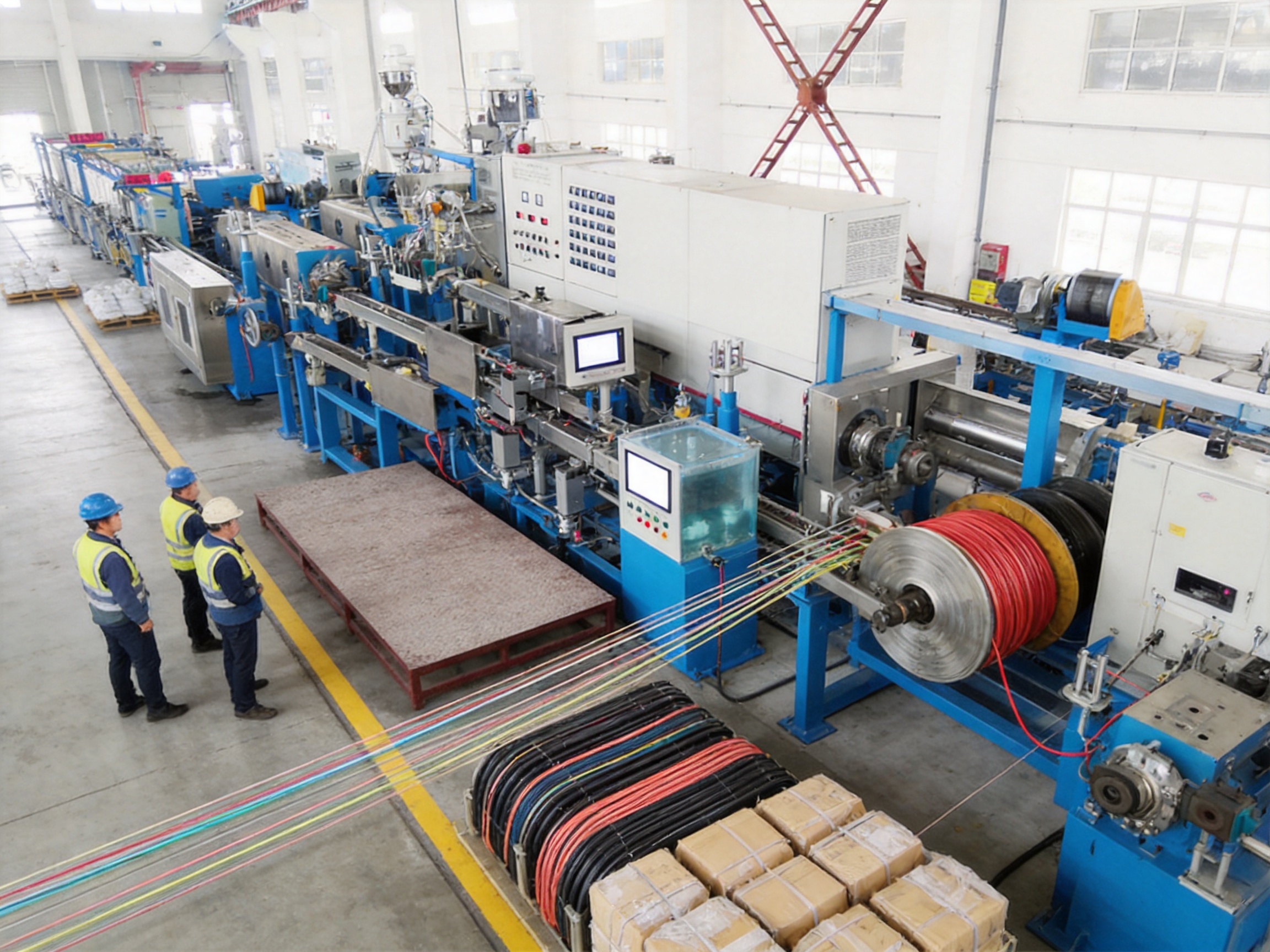
Modern wire and cable manufacturers require extrusion equipment that can deliver consistent insulation quality, stable production speeds, controlled cooling, and dependable long-term operation. The XLPE PE Cable Extruder with Cooling Water Tank is designed to meet these requirements in power cable, communication cable, automotive wire, and general insulated conductor applications. By combining a precision single-screw extruder, controlled electrical heating, and a multi-section cooling water tank, the machine provides a coordinated solution for producing insulated cables with uniform dimensions and reliable mechanical and electrical performance.
Cable insulation production is more demanding than simply applying a polymer layer around a conductor. The insulating material must be plasticized evenly, transported at a stable pressure, formed concentrically around the conductor, and cooled without distortion. Any instability in these stages can result in eccentric insulation, surface defects, inconsistent diameter, air entrapment, poor adhesion, or insufficient electrical protection. The XLPE PE Cable Extruder with Cooling Water Tank is engineered to address these production risks through integrated process control and a carefully organized machine structure.
Manufactured by Shanghai Yessjet Precise Machinery Co., Ltd., the equipment is suitable for production lines that need practical operation, repeatable results, and flexible processing capability. Its configuration supports the extrusion of polyethylene-based insulation and related cable insulation materials while allowing manufacturers to establish a controlled and continuous workflow from material feeding to cooling and downstream take-up.
Understanding the Role of an XLPE and PE Cable Extruder
An insulated cable extrusion line applies a controlled layer of polymer material over a metallic conductor. The conductor may be copper, aluminum, tinned copper, or another suitable conductive material. The polymer is introduced into the extruder, heated until it reaches the required processing condition, conveyed by the screw, and forced through a crosshead die. At the die, the molten polymer surrounds the moving conductor and forms the insulation layer.
Polyethylene is widely used because of its electrical insulation properties, moisture resistance, chemical stability, and relatively low dielectric loss. Cross-linked polyethylene, commonly known as XLPE, is used in applications that require enhanced thermal performance, electrical strength, and resistance to deformation under elevated operating temperatures. Although the exact processing conditions depend on the material formulation and production technology, both PE and XLPE-related applications require accurate temperature management and consistent material flow.
The extruder therefore acts as the central process unit. It must maintain a stable melt temperature, provide sufficient conveying and mixing action, and deliver a continuous output without excessive pressure fluctuation. The downstream cooling system is equally important because newly extruded insulation is soft and dimensionally sensitive. If cooling is too slow, the insulation may deform or become damaged during handling. If cooling is too sudden or uneven, internal stress and dimensional variation may occur.
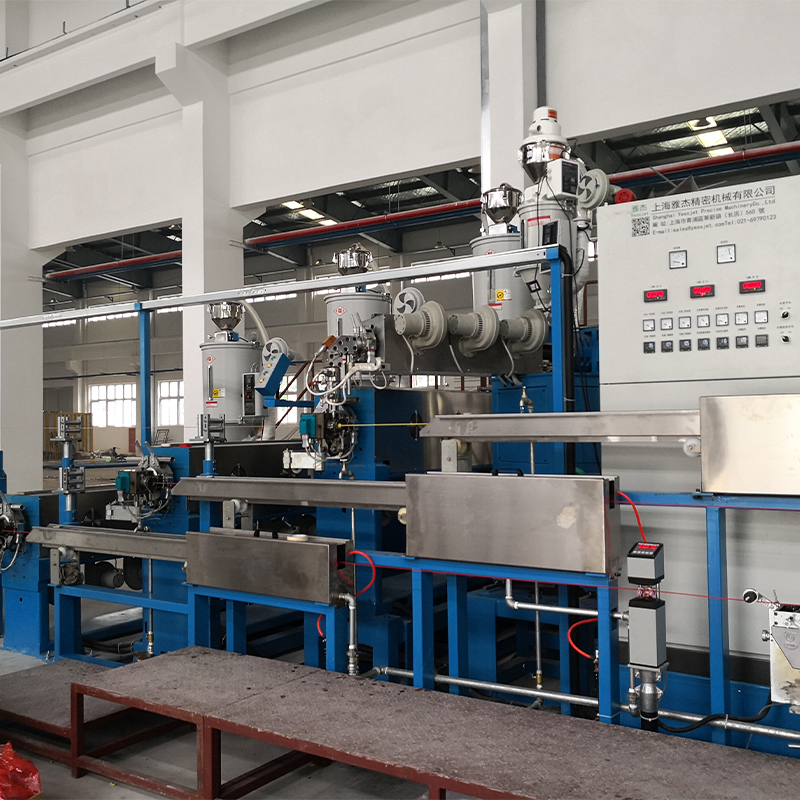
The integrated arrangement of the XLPE PE Cable Extruder and cooling water tank enables the extrusion and cooling stages to operate as one coordinated production process. This reduces the need for improvised equipment matching and helps manufacturers create a more stable line layout.
Core Construction of the Machine
Precision Single-Screw Extruder
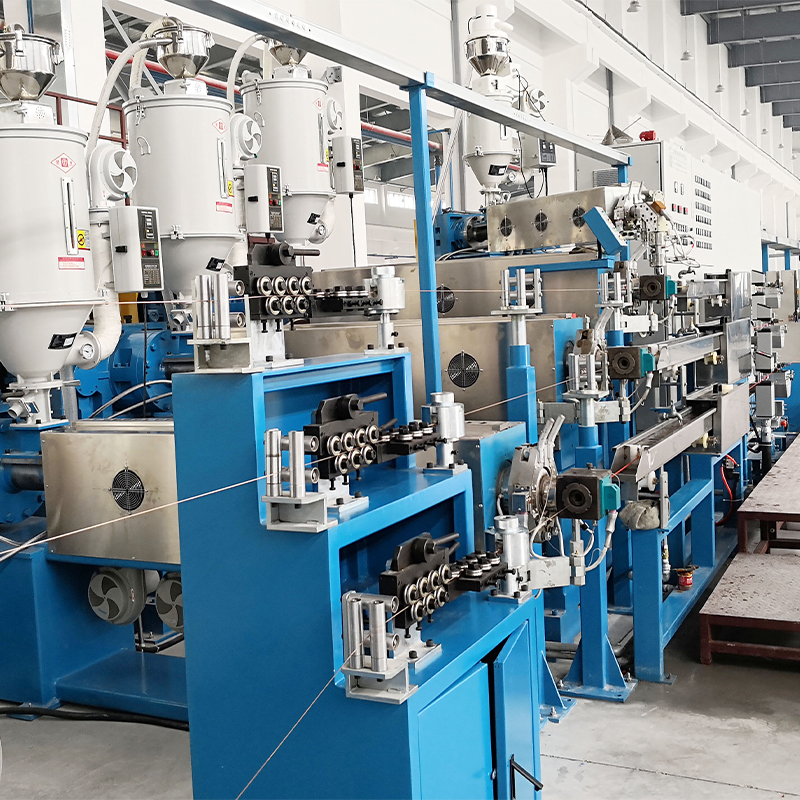
The single-screw extruder is designed to provide continuous polymer conveying and controlled plasticization. As the material enters the feed section, the rotating screw transports it through successive heating and compression zones. The polymer gradually changes from a solid or granular state into a homogeneous melt suitable for cable insulation extrusion.
A precision screw and barrel combination is important because the geometry directly affects throughput, pressure stability, residence time, and melt quality. An appropriately configured screw can reduce unplasticized particles, limit unnecessary shear, and support a consistent material flow toward the crosshead. Stable flow is especially valuable in cable production, where even small fluctuations can affect insulation diameter and concentricity over long production runs.
Compared with basic extrusion equipment that may rely on limited process feedback, a precision single-screw design gives the operator a better foundation for controlling material behavior. The machine can be configured according to material type, conductor size, insulation thickness, output requirement, and downstream line speed. This makes it suitable for manufacturers that produce several cable specifications rather than only one fixed product.
Temperature-Controlled Electrical Heating
The electrical heating system is divided into controlled zones so that the operator can establish a suitable temperature profile along the barrel and extrusion head. Different processing stages may require different temperatures. The feed section may need controlled preheating, the compression and metering sections may require higher and more stable temperatures, and the head area must be maintained at a condition that supports smooth coating and accurate dimensional control.
Zone-based heating helps avoid the disadvantages of uncontrolled or uneven heating. When the barrel temperature is inconsistent, the material may be insufficiently plasticized in some areas and overheated in others. This can lead to unstable pressure, surface imperfections, degraded material, or inconsistent insulation characteristics. Controlled electrical heating provides a more responsive method of maintaining the target process temperature during startup, steady operation, and changes in production speed.
Temperature control also supports repeatability between production batches. Once a suitable process recipe has been established, operators can use the same general heating profile for subsequent runs, while making adjustments for resin grade, conductor size, insulation thickness, and line speed. Better repeatability can reduce setup time and material waste.
Multi-Section Cooling Water Tank
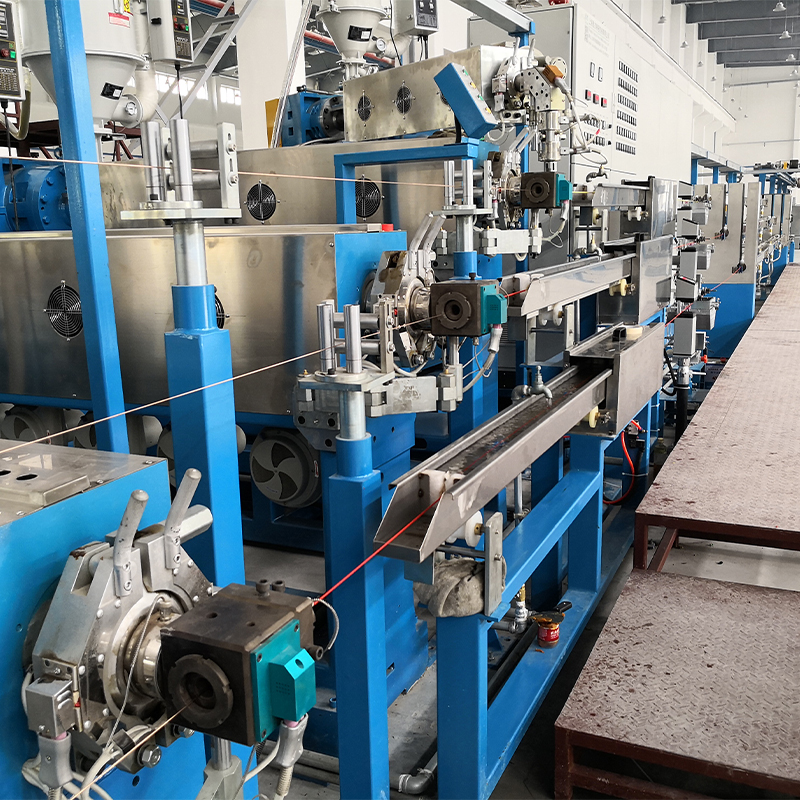
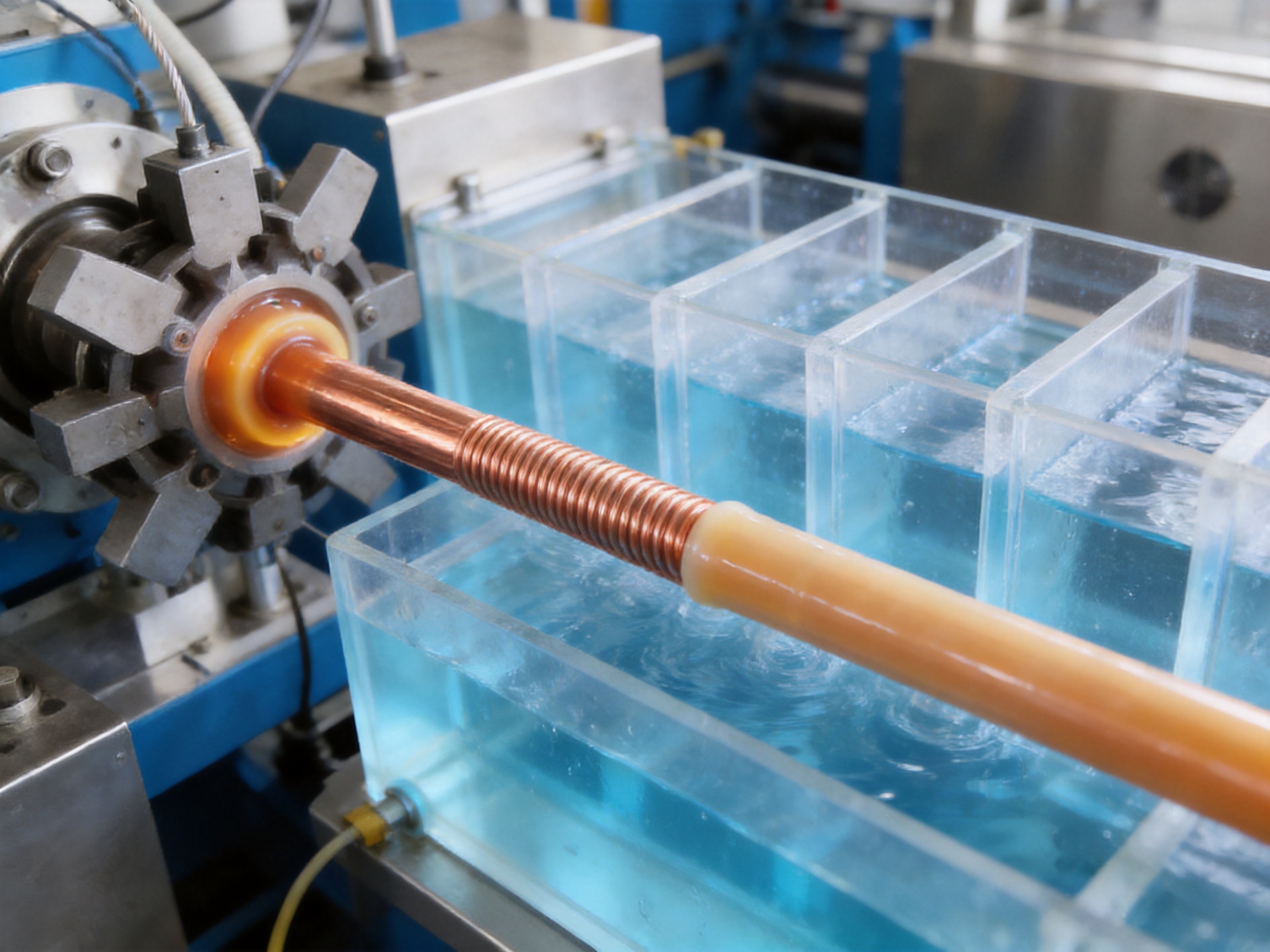
The cooling water tank receives the insulated cable immediately after it leaves the extrusion head. Its multi-section arrangement gives the production line a longer and more controlled cooling path than a short single-stage tank. The cable can gradually transfer heat to the water while retaining its intended roundness and insulation geometry.
A multi-section design offers several practical advantages. The first section can begin cooling the hot insulation without creating excessive thermal shock. Later sections can continue reducing the cable temperature until it is suitable for downstream capstan, measuring, coiling, or take-up equipment. The staged approach helps maintain dimensional stability over a longer section of the line.
Water circulation and temperature management are important to the performance of the cooling tank. Stable water conditions help prevent localized overheating and ensure that the cable is exposed to a more consistent cooling environment. The tank can also support easier inspection and maintenance because each section provides a defined part of the cooling process rather than an undifferentiated water path.
Traditional production arrangements may use a short cooling section that is not matched to the extruder output or cable size. Such an arrangement can result in insufficient cooling, cable deformation, or the need to reduce line speed. The integrated water tank of this machine is intended to solve these problems by providing a dedicated cooling length suitable for continuous insulation processing.
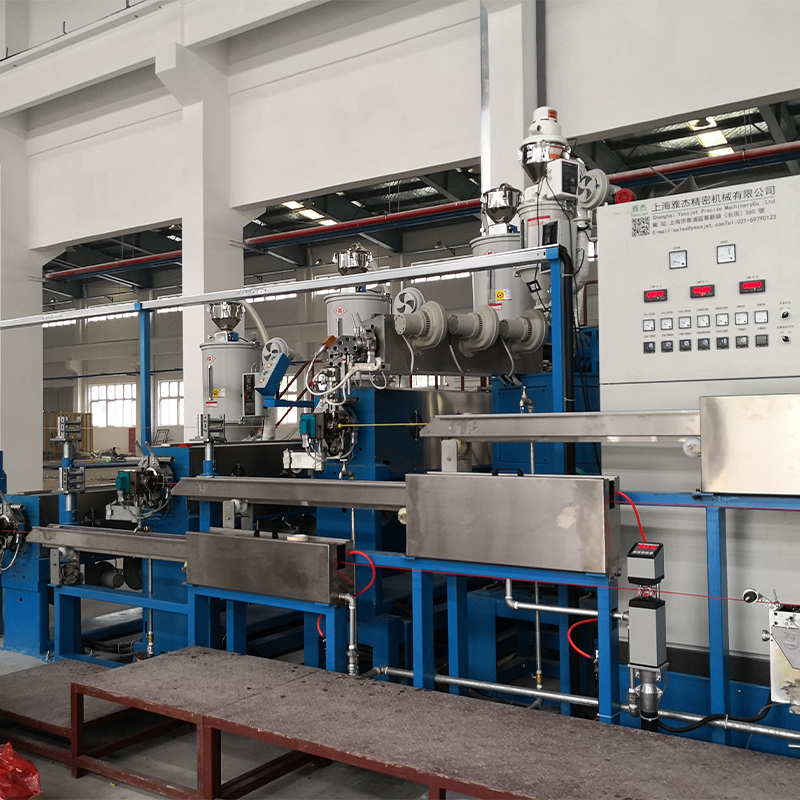
XLPE PE Cable Extruder with Cooling Water Tank
How the Extrusion and Cooling Process Works
Material Preparation and Feeding
Before production begins, the operator prepares the selected PE or XLPE-related insulation material according to the material supplier’s instructions. Resin condition, cleanliness, moisture control, and storage practices all influence extrusion quality. Contamination or poorly prepared material can create surface defects and compromise the consistency of the insulation layer.
The material is introduced into the extruder feed system and conveyed toward the heated barrel. The feed rate should be coordinated with screw speed and line speed. If material feeding is unstable, the extruder output may fluctuate, which can directly affect insulation thickness. For this reason, the production line should be operated with a stable material supply and a clearly defined process procedure.
Plasticization and Conveying
Inside the barrel, the screw transports the material through the heating zones. Mechanical energy from screw rotation combines with electrical heating to soften and plasticize the polymer. The screw design provides conveying, compression, and metering functions. At the metering stage, the objective is to deliver a steady melt flow to the extrusion head.
A stable melt flow is necessary for consistent coating around the conductor. Excessive pressure variation can cause periodic diameter changes, while incomplete melting may produce rough surfaces or weak points. The single-screw extruder is therefore operated within a process window that considers screw speed, heating temperature, material characteristics, and required output.
Insulation Application at the Crosshead
After plasticization, the melt moves to the extrusion crosshead. The conductor passes through the center of the crosshead while the molten polymer flows around it. The die and tooling determine the shape and initial dimensions of the insulation layer. Accurate tooling alignment is essential for producing concentric insulation.
Concentricity describes how evenly the insulation surrounds the conductor. If the conductor is positioned too close to one side of the die, one side of the insulation will be thinner than the other. This reduces the protective margin and may affect electrical performance. A properly adjusted extrusion head, combined with steady material pressure and controlled conductor movement, supports more uniform insulation distribution.
Cooling and Dimension Stabilization
Immediately after leaving the die, the polymer-coated conductor enters the cooling water tank. At this stage, the insulation is still warm and may be susceptible to deformation. The first cooling section begins removing heat, while subsequent sections continue the cooling process and stabilize the cable’s shape.
The cooling distance should be matched to the cable diameter, insulation material, production speed, and target outlet temperature. If the cable leaves the tank too hot, it may be difficult to handle without affecting the insulation. If the cooling system is overly aggressive or poorly distributed, the surface may solidify unevenly. A multi-section tank allows the process engineer to establish a more balanced thermal transition.
After cooling, the insulated cable can proceed to diameter measurement, spark testing, printing, capstan transport, take-up, or coiling equipment. The exact downstream arrangement depends on the cable product and the required production line configuration.
Advantages Compared with Conventional Extrusion Arrangements
Improved Insulation Uniformity
One of the main advantages of the machine is its focus on stable extrusion conditions. The combination of a precision single-screw extruder, controlled heating zones, and an accurately arranged extrusion head helps reduce the causes of uneven insulation thickness. Uniform insulation is important not only for appearance but also for electrical safety, dielectric strength, flexibility, and material consumption.
Inconsistent insulation can force manufacturers to increase the average insulation thickness to compensate for thin areas. That approach increases material usage and cable weight without necessarily solving the underlying process problem. By supporting more stable flow and better process adjustment, the equipment can help manufacturers work closer to the intended insulation specification.
More Effective Cooling
Compared with a simple short tank, the multi-section cooling water tank provides a longer and more organized route for heat removal. Better cooling helps prevent soft insulation from being marked, flattened, or distorted by downstream handling equipment. It also supports more consistent cable geometry when production speeds increase within the appropriate operating range.
Efficient cooling can contribute to improved line productivity because the cable becomes ready for downstream operations sooner. The actual achievable speed will depend on material formulation, conductor diameter, insulation thickness, die design, water temperature, and other line conditions. Nevertheless, a well-designed cooling system gives the manufacturer greater flexibility when optimizing production speed.
Stable Electrical and Mechanical Performance
The quality of the insulation layer affects the cable’s electrical resistance, dielectric behavior, environmental protection, and mechanical durability. A uniform and properly cooled layer is less likely to contain weak areas caused by inconsistent thickness or poor surface formation. For power and communication cables, this consistency is essential for reliable service in the field.
Mechanical performance is also affected by cooling. Uneven cooling can create internal stress and dimensional variation, while insufficient cooling may allow the insulation to deform during transport. The machine’s cooling arrangement is intended to help the finished cable retain a stable shape as it moves through the line.
Adaptability to Multiple Cable Applications
The equipment can support applications across several sectors, including power cable production, communication wire manufacturing, automotive wire processing, and general insulated conductor production. Its suitability for a particular product depends on the installed tooling, screw configuration, material specification, line speed, conductor size, and required insulation thickness.
This adaptability is valuable for cable manufacturers that operate several product families. Instead of purchasing completely different extrusion equipment for every type of insulated conductor, a properly configured machine can provide a common production platform for multiple product specifications.
Practical Process Integration
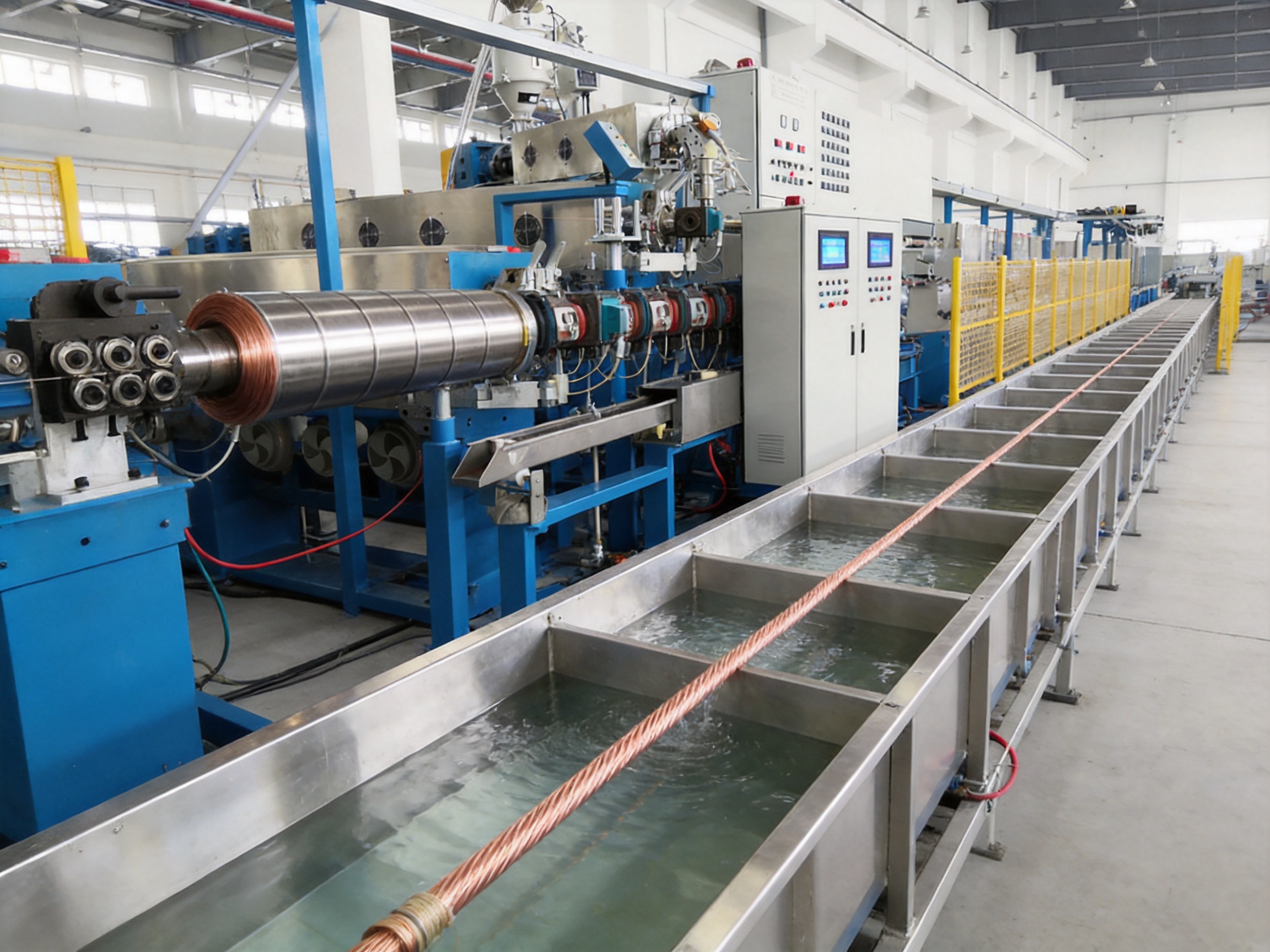
The extruder and cooling tank are designed as connected parts of an insulation production line. This integrated concept simplifies the relationship between polymer output, cable movement, and cooling length. It also makes it easier to plan the line layout and coordinate the machine with pay-off, conductor preheating, spark testing, diameter measurement, printing, capstan, and take-up equipment.
When individual machines are selected without considering the complete process, production bottlenecks may occur. For example, an extruder may produce more material than the cooling system can stabilize, or the take-up system may not match the line speed. An integrated equipment approach helps the manufacturer evaluate these relationships before installation.
Manufacturing Strengths and Engineering Approach
Application-Oriented Equipment Design
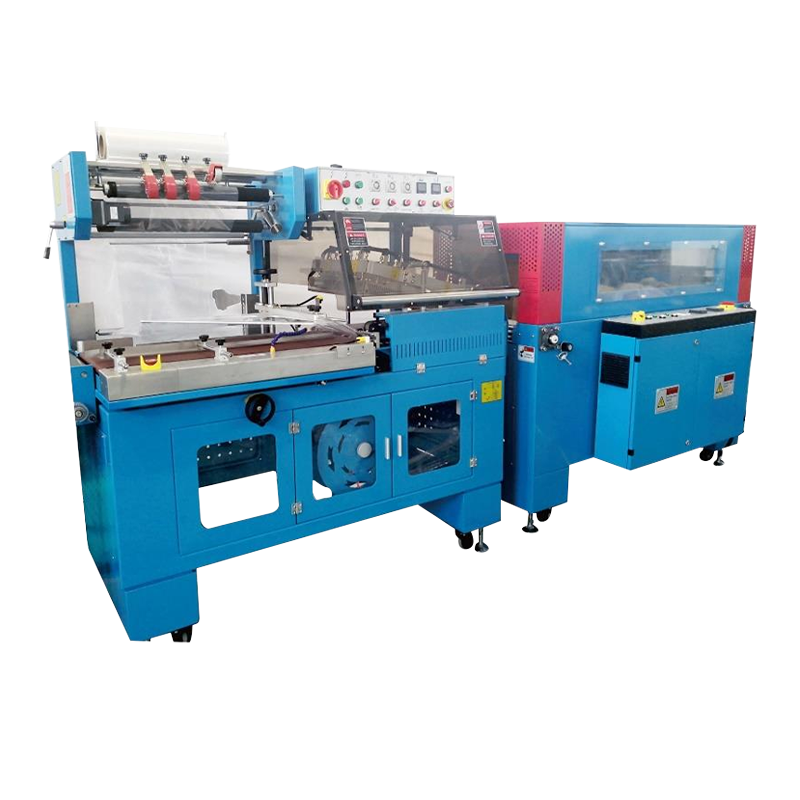
Shanghai Yessjet Precise Machinery Co., Ltd. focuses on wire and cable machinery, including cable extrusion lines, coiling and packaging equipment, intelligent robot stackers, coiling machines, motorized pay-off equipment, motorized take-up equipment, and accessory equipment. This broad product range gives the company a practical understanding of how an extrusion machine must operate within a complete cable production system.
Equipment design is more effective when it considers the entire manufacturing sequence rather than only the extruder barrel. Cable production involves conductor preparation, polymer processing, cooling, dimensional inspection, surface marking, tension control, winding, and packaging. Experience across these stages helps the manufacturer develop equipment that can be integrated into existing lines or used as part of a new turnkey solution.
Precision Manufacturing and Component Coordination
An extrusion line depends on the coordination of many components. The screw and barrel must work together, the heating zones must respond consistently, the extrusion head must remain aligned, the water tank must provide a suitable cooling path, and the downstream transport equipment must maintain stable cable tension. Manufacturing quality is therefore not limited to the appearance of individual machine parts.
Precision machining and careful assembly are important for maintaining alignment and minimizing vibration. Proper component coordination also supports easier commissioning and reduces the likelihood of repeated adjustments during normal production. A machine that is assembled with attention to mechanical relationships provides a better foundation for reliable operation.
Process-Based Quality Control
Quality control for cable extrusion equipment should cover both manufacturing and operating performance. Mechanical parts need to be inspected for dimensions, fit, finish, and alignment. Electrical systems require checks for wiring, heating response, control function, protection, and safety. Water tank components require attention to sealing, circulation, drainage, and accessibility for cleaning.
Factory testing and commissioning preparation are also important. Before shipment, the equipment should be reviewed against the agreed technical configuration. Operators and engineers need clear information about machine layout, utilities, temperature control, operating sequence, maintenance points, and recommended production settings.
These process-based practices help ensure that the delivered equipment corresponds to the intended application. They also make installation and operator training more efficient, especially when the machine is incorporated into a larger customized cable line.
Customized Cable Production Solutions
Different cable products require different combinations of conductor size, polymer type, insulation thickness, production speed, cooling length, and take-up method. A standardized machine may not provide the best result for every application. Yessjet’s experience with wire and cable machinery enables it to evaluate the customer’s product requirements and propose a suitable equipment configuration.
Customization may involve the extruder specification, screw and barrel arrangement, extrusion head, water tank dimensions, line height, pay-off, take-up, control system, measurement equipment, or integration with other machines. The goal is not simply to add optional components, but to create a production system in which each section supports the required output and quality level.
Technical Factors That Influence Extrusion Quality
Material Selection
PE and XLPE-related materials are not identical in processing behavior. Melt temperature, viscosity, thermal sensitivity, additives, color concentrates, and crosslinking requirements can vary. The machine should be operated according to the technical data provided for the selected compound. Using unsuitable temperatures or excessive residence time may degrade the material or cause unstable output.
Material storage is also important. Resin should be kept clean and protected from contamination. If the material formulation requires drying or conditioning, those steps should be completed before feeding. Consistent material preparation reduces variation at the extruder and improves the effectiveness of the machine’s process controls.
Conductor Condition
The conductor should enter the extrusion head with a stable position and suitable surface condition. Dust, oil, oxidation, moisture, or mechanical damage may affect insulation adhesion and surface appearance. The conductor pay-off and straightening arrangement should maintain smooth movement without unnecessary vibration or tension fluctuation.
For some products, preheating the conductor may be beneficial because it can improve polymer contact and reduce the thermal shock between the conductor and the insulation material. The correct approach depends on the conductor type, material formulation, and process specification.
Screw Speed and Output
Screw speed influences the material throughput, shear exposure, melt temperature, and pressure behavior. Increasing screw speed can raise output, but the cooling system, die, and downstream equipment must be capable of handling the higher production rate. A balanced process is more valuable than simply operating the screw at the highest possible speed.
Operators should observe pressure stability, motor load, melt appearance, insulation diameter, and surface quality when adjusting screw speed. Gradual changes are preferred because they allow the line to respond without creating sudden dimensional variation.
Heating Profile
The correct heating profile depends on the material and the machine configuration. The operator should allow the barrel and head to reach stable temperatures before beginning full production. Starting too quickly before the system is thermally stable can result in irregular flow and inconsistent insulation.
Temperature sensors should be checked periodically because inaccurate feedback can cause the controller to overheat or underheat a zone. Clean heater surfaces, secure sensor connections, and properly functioning control devices all contribute to stable operation.
Cooling Water Conditions
Water temperature, flow, cleanliness, and circulation affect cooling performance. The water should be maintained within a suitable operating range for the specific product. Contaminated water may reduce heat transfer, stain the cable surface, or create deposits in the tank and piping.
Regular cleaning helps preserve the cooling system’s effectiveness. Operators should inspect the water tank, drainage points, circulation equipment, and cable entry and exit areas. If the tank is divided into multiple sections, each section should be checked so that a local problem does not affect the entire cooling path.
Line Tension and Downstream Handling
After cooling, the cable must be transported without excessive pulling or compression. Incorrect tension can stretch the warm insulation, alter the cable diameter, or produce winding defects. The take-up or coiling equipment should be synchronized with the extrusion line and adjusted according to cable size and flexibility.
Yessjet’s product range includes motorized pay-off and take-up equipment, coiling machines, and packaging-related systems. This allows the extrusion machine to be considered together with the handling equipment, which is especially useful when the customer requires a complete cable production line rather than an isolated extruder.
Production Efficiency and Cost Control
Production efficiency involves more than maximum line speed. It includes material utilization, startup waste, changeover time, unplanned downtime, operator workload, maintenance requirements, and the percentage of cable that meets specification on the first pass.
Stable extrusion and cooling can reduce the amount of off-specification cable produced during startup and speed changes. When insulation dimensions remain consistent, less material may be discarded because of thin spots, excessive diameter, rough surfaces, or cooling-related deformation. More predictable operation also makes production planning easier.
The machine’s temperature-controlled zones support faster process stabilization after startup. The multi-section water tank helps the cable reach a suitable condition before downstream handling. Together, these features can contribute to a smoother transition from setup to continuous manufacturing.
Energy management is another consideration. Electrical heating should be controlled according to the actual process requirement, while the water circulation system should operate efficiently and be maintained to avoid unnecessary load. Proper insulation of heated areas, regular inspection of electrical components, and appropriate operating settings can help control energy consumption.
Maintenance planning protects production efficiency over the service life of the machine. Screw and barrel wear, heater performance, sensor accuracy, water quality, seals, bearings, electrical connections, and control components should be reviewed according to operating hours and production conditions. Preventive maintenance is usually less disruptive than emergency repair after a quality problem has already occurred.
Installation, Commissioning, and Operator Training
Site Preparation
Before installation, the factory should prepare sufficient floor space, electrical capacity, water supply, drainage, ventilation, material storage, and access for cable handling. The line should be installed on a stable foundation with enough room for maintenance and tooling changes.
The final layout should consider the movement of the conductor from pay-off to extrusion, cooling, testing, take-up, and packaging. Unnecessary changes in direction should be avoided because they can increase tension variation and make operation more difficult. Access to the water tank is especially important for cleaning and inspection.
Mechanical and Electrical Commissioning
Commissioning normally begins with mechanical inspection. The installation team checks machine leveling, alignment, fasteners, guards, cable path, tank position, and connections to auxiliary equipment. The extruder should be rotated and inspected according to the manufacturer’s procedures before material is introduced.
Electrical commissioning includes verification of power connections, motor rotation, heater operation, temperature sensors, control functions, emergency stops, alarms, and protective devices. Water circulation and drainage should be tested before production starts. Any abnormal vibration, leakage, heating response, or control behavior should be corrected before trial extrusion.
Trial Production
Trial production allows the team to establish initial settings for the selected material and cable specification. The line may begin at a conservative speed while operators observe melt pressure, output, insulation appearance, cooling behavior, cable diameter, and take-up tension.
Process adjustments should be made systematically. Changing several variables at once makes it difficult to determine which setting affected the result. A better method is to adjust one parameter, observe the cable, record the result, and then make the next controlled change. Over time, these records can become a useful process reference for future production.
Operator Training
Operators should understand the complete process rather than only the control panel. Training should cover material preparation, startup sequence, heating stabilization, screw operation, conductor threading, cooling tank operation, line synchronization, quality checks, emergency procedures, and shutdown.
Operators should also know how to identify early warning signs, such as unstable pressure, unusual motor noise, irregular heating, water leakage, cable surface changes, excessive vibration, or take-up tension variation. Early detection can prevent a minor issue from becoming a major production interruption.
Quality Inspection During Cable Production
Quality control should be performed at several points in the production process. Incoming material inspection confirms that the selected compound, color, packaging, and batch information match the production order. Conductor inspection checks diameter, surface quality, cleanliness, and continuity.
During extrusion, operators can monitor melt temperature, barrel temperatures, screw speed, motor load, line speed, cooling water condition, and cable diameter. Visual checks should look for roughness, bubbles, discoloration, scratches, die lines, and uneven coating.
Insulation thickness and eccentricity should be measured using suitable instruments. Spark testing may be used to detect pinholes or defects in the insulation, depending on the cable type and applicable production requirements. Tensile, elongation, aging, resistance, and dielectric tests may also be required by the customer specification or applicable standard.
Inspection results should be recorded together with material batch, tooling information, machine settings, date, and operator information. This creates traceability and helps engineers identify relationships between process settings and product quality.
The equipment is intended to support production aligned with demanding IEC, GB, and ANSI-related requirements. However, compliance with a specific standard depends on the complete cable design, material, tooling, testing procedures, and customer specification. The manufacturer and cable producer should confirm the applicable standard and acceptance criteria before production.
Safety Considerations
Cable extrusion equipment contains hot surfaces, rotating machinery, electrical systems, moving cable, and circulating water. Operators must follow the machine safety instructions and use suitable protective equipment. Guards should remain in place during operation, and access to the screw, coupling, capstan, and other moving components should be controlled.
Heated barrel and die surfaces can cause burns. Operators should allow sufficient cooling time before performing maintenance and use appropriate tools when handling hot components. Electrical cabinets should be opened only by qualified personnel, and the power supply must be isolated before electrical maintenance.
Water management also affects safety. Leaks near electrical equipment should be corrected immediately. Floors around the tank should be kept clean and dry where possible. Drainage should be designed to prevent standing water and reduce slip hazards.
Emergency stops should be tested according to the factory’s safety schedule. Operators should know how to stop the line safely during cable breakage, material blockage, abnormal temperature rise, electrical fault, water leakage, or other emergency situations.
Why Choose a Specialized Cable Machinery Manufacturer
A specialized wire and cable machinery manufacturer can provide more than a basic extrusion unit. The manufacturer understands the relationship between insulation quality, cooling performance, cable tension, take-up behavior, and final packaging. This knowledge is valuable when a customer is developing a new line or upgrading an existing plant.
Shanghai Yessjet Precise Machinery Co., Ltd. provides machinery for cable extrusion, coiling, packaging, pay-off, take-up, stacking, and related applications. Its broader equipment capability supports project coordination, especially when a customer requires several linked machines from one engineering source.
The company’s manufacturing strength is also reflected in its ability to provide customized wire and cable production line solutions. A customized approach may help address factory space limitations, product diversity, required automation level, labor conditions, and future capacity plans. Instead of selecting equipment solely by nominal output, the customer can evaluate the complete workflow and establish a configuration suited to actual production needs.
Technical communication is another important part of equipment supply. Before manufacturing, the customer and supplier should confirm cable specifications, material types, conductor dimensions, insulation thickness, target speed, line height, utilities, control preferences, testing requirements, and downstream equipment. Clear technical documentation reduces the risk of misunderstanding and helps ensure that the delivered machine is aligned with the intended production application.
Recommended Application Areas
Power Cable Manufacturing
Power cable producers require reliable insulation thickness, stable dielectric performance, and consistent dimensional control. The XLPE PE Cable Extruder with Cooling Water Tank can be incorporated into a line for suitable power cable insulation applications, subject to the selected material and cable design.
Communication Cable Production
Communication cables often require precise dimensions and stable electrical characteristics. Uniform insulation can help maintain the intended relationship between the conductor and surrounding layers. The machine’s controlled extrusion and cooling process provides a suitable foundation for communication wire production where the equipment configuration matches the cable specification.
Automotive Wire Production
Automotive wires may be exposed to vibration, temperature variation, oils, and limited installation space. Their insulation must be formed consistently and handled carefully during take-up. With suitable material and tooling selection, the extruder can support production environments that require repeatable dimensions and reliable surface quality.
General Insulated Conductors
The machine may also be used for a variety of general insulated wires and cables. Its flexibility is useful for plants that produce multiple conductor sizes or change between different insulation thicknesses. Tooling and process settings should be selected for each product to achieve the required result.
Maintenance Recommendations
Routine maintenance should begin with daily visual inspection. Operators can check for material leakage, loose fasteners, abnormal noise, heater problems, sensor alarms, water leaks, and unusual cable marks. The cable path and water tank should be kept clean to prevent contamination and production defects.
Regular checks should be made on the screw and barrel condition, heater bands, temperature sensors, motor and gearbox, extrusion head, water circulation components, seals, electrical cabinet, and control system. The inspection frequency should be adjusted according to operating hours, material type, output level, and factory conditions.
Material changes require careful cleaning and purging procedures. Residual material in the barrel or head can contaminate the next production batch or cause color and surface defects. Operators should use a cleaning method compatible with the machine and material system.
The cooling tank should be drained and cleaned at appropriate intervals. Sediment, polymer residue, and deposits can affect water flow and heat transfer. Water quality should be monitored, and circulation components should be maintained according to the equipment instructions.
Preventive maintenance records should include inspection dates, replaced components, observed conditions, process abnormalities, and corrective actions. These records help the production team plan service intervals and identify repeated issues before they create extended downtime.
Purchasing Considerations for Cable Manufacturers
Before purchasing an XLPE PE Cable Extruder with Cooling Water Tank, the buyer should prepare a clear product specification. Important information includes conductor material, conductor diameter range, insulation material, insulation thickness, cable outside diameter, expected output, target line speed, production voltage, factory power supply, and downstream handling requirements.
The buyer should also clarify whether the machine will operate independently or be integrated into a complete production line. If the line includes pay-off, conductor preheating, spark testing, diameter measurement, printing, capstan, take-up, coiling, or packaging equipment, all sections should be reviewed together.
Questions about tooling changes, color changes, material changes, control interfaces, spare parts, operator training, installation support, and maintenance documentation should be discussed before the order is finalized. A detailed technical agreement provides a useful basis for production, inspection, commissioning, and acceptance.
It is also important to evaluate the supplier’s experience with similar cable applications. A manufacturer that understands cable extrusion can provide more relevant guidance on cooling length, line coordination, temperature control, tooling, and downstream tension than a general-purpose plastics machinery supplier.
Q&A About the XLPE PE Cable Extruder with Cooling Water Tank
What materials can this machine process?
The machine is designed for XLPE and PE insulation-related cable extrusion applications. The exact material range depends on the compound formulation, screw and barrel configuration, extrusion head, temperature profile, and customer product requirements. Material suppliers’ processing recommendations should always be followed.
Why is a cooling water tank necessary?
Freshly extruded insulation remains hot and soft after leaving the die. The cooling water tank removes heat and stabilizes the cable’s dimensions before downstream handling. Without adequate cooling, the insulation may deform, become marked, or fail to maintain the intended geometry.
What is the advantage of a multi-section water tank?
A multi-section tank provides a longer and more controlled cooling path. It allows the cable to cool progressively rather than passing through a very short or poorly distributed cooling area. This can improve dimensional stability and provide greater flexibility when adjusting line speed and product size.
Can the equipment produce different cable sizes?
It can be configured for a range of cable sizes, but the actual range depends on the extruder specification, screw design, crosshead, dies, conductor dimensions, insulation thickness, and line speed. Customers should provide their product range so the supplier can recommend suitable tooling and machine parameters.
Does the machine support complete cable production lines?
Yes. The extruder can be integrated with pay-off equipment, take-up equipment, capstan systems, spark testers, diameter measurement devices, coiling machines, packaging equipment, and other accessories. Shanghai Yessjet Precise Machinery Co., Ltd. also supplies various wire and cable production machines for line integration.
How does the machine help reduce uneven insulation thickness?
Uniform insulation depends on several factors, including conductor alignment, die condition, melt pressure, screw stability, temperature control, line tension, and cooling. The machine supports these requirements through a precision single-screw extruder, controlled heating zones, and an integrated cooling path. Correct tooling setup and process operation remain essential.
What should be checked during startup?
Operators should check material preparation, conductor condition, tooling installation, machine alignment, heating temperatures, sensor readings, water circulation, emergency stops, cable threading, and take-up readiness. The line should normally begin at a controlled speed while the operator verifies pressure, diameter, surface quality, and cooling performance.
How can production waste be reduced?
Waste reduction depends on stable material feeding, accurate tooling, controlled startup, consistent heating, suitable cooling, and synchronized downstream equipment. Recording successful process settings for each cable specification can reduce repeated trial-and-error during future production runs.
What standards can the cable production line support?
The equipment is intended for high-standard cable production aligned with IEC, GB, and ANSI-related requirements. The applicable standard depends on the final cable type and customer specification. The complete product, including material, construction, testing, and process controls, must be evaluated against the relevant standard.
Is operator training required?
Yes. Operators should be trained in extrusion principles, heating control, material handling, conductor threading, water tank operation, line synchronization, quality inspection, safety, and maintenance. Proper training improves both product consistency and equipment service life.
What information should be provided when requesting a quotation?
The customer should provide cable type, conductor material and size, insulation material, insulation thickness, production speed, required output, cable diameter, voltage and utility conditions, factory layout, desired automation level, and downstream equipment requirements. These details help the supplier prepare a more accurate technical proposal.
Conclusion
The XLPE PE Cable Extruder with Cooling Water Tank provides a practical and coordinated solution for producing insulated wires and cables. Its precision single-screw extruder supports stable material conveying and plasticization. Its temperature-controlled electrical heating system helps maintain the process conditions required for consistent polymer flow. Its multi-section cooling water tank provides a longer and more controlled route for heat removal, helping the finished cable retain its intended shape and insulation quality.
Compared with conventional extrusion arrangements that may suffer from uneven heating, unstable output, insufficient cooling, or poor line coordination, this machine is designed around the complete insulation process. It supports better production consistency, more reliable electrical and mechanical performance, greater application flexibility, and improved integration with downstream cable equipment.
Shanghai Yessjet Precise Machinery Co., Ltd. combines cable machinery manufacturing experience with the ability to supply related pay-off, take-up, coiling, packaging, stacking, and accessory equipment. This broader capability is valuable for manufacturers seeking a customized wire and cable production line rather than a standalone machine. Through careful specification, professional installation, controlled commissioning, and regular maintenance, the XLPE PE Cable Extruder with Cooling Water Tank can provide dependable support for high-quality cable manufacturing.
References
IEC cable standards and test methods for insulated power and communication cables.
GB standards for wires, cables, insulation materials, and electrical performance testing.
ANSI-related requirements for wire and cable manufacturing and product evaluation.
Polyethylene and cross-linked polyethylene material supplier processing recommendations.
Industrial extrusion engineering principles for screw design, polymer plasticization, and melt flow control.
Wire and cable production engineering practices for conductor handling, insulation extrusion, cooling, testing, and take-up.
General industrial guidelines for electrical equipment safety, thermal processing equipment, water circulation, and preventive maintenance.