LANGUAGE
 中文简体
 русский
 Français
 Español
 Português
 عربى

Content
- 1 The Role of Automatic Coiling in Wire and Cable Production
- 2 Main Functions of the Automatic Coiling Machine
- 3 Technical Specifications and Model Selection
- 4 Advantages Over Conventional Coiling Equipment
- 5 Packaging Materials and Finished-Coil Protection
- 6 Application Areas
- 7 Manufacturing Strengths and Engineering Approach
- 8 How the Machine Supports Quality Control
- 9 Installation and Commissioning Considerations
- 10 Maintenance and Long-Term Operating Value
- 11 Why Choose an Automatic Coiling Machine for Modern Production?
- 12 Purchasing Checklist for Cable Manufacturers
- 13 Frequently Asked Questions
- 13.1 What types of wire and cable can the machine process?
- 13.2 Can the machine work directly with an extrusion line?
- 13.3 Does the operator need to adjust the machine manually for every coil size?
- 13.4 What is the purpose of the servo motor traversing system?
- 13.5 What packaging materials can be used?
- 13.6 How does automatic fault detection help production?
- 13.7 How many product settings can be saved?
- 13.8 Which model is suitable for small-diameter wire?
- 13.9 Which model is suitable for larger cable coils?
- 13.10 Can the equipment be customized?
- 13.11 What information should be provided when requesting a quotation?
- 13.12 Does automatic coiling eliminate the need for operators?
- 14 Conclusion
- 15 References
- 16 Product: Automatic Coiling Machine
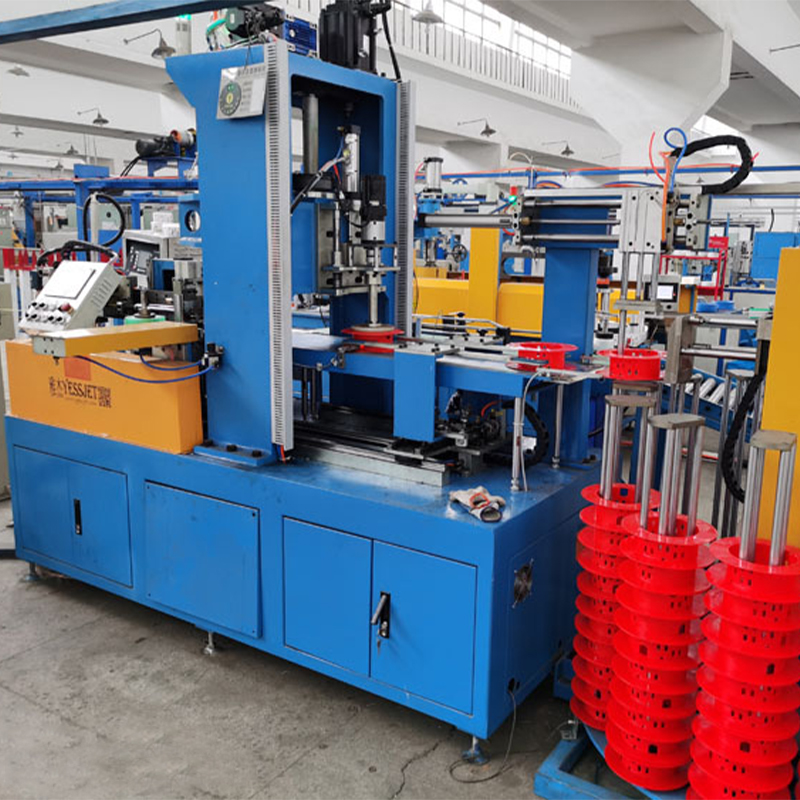
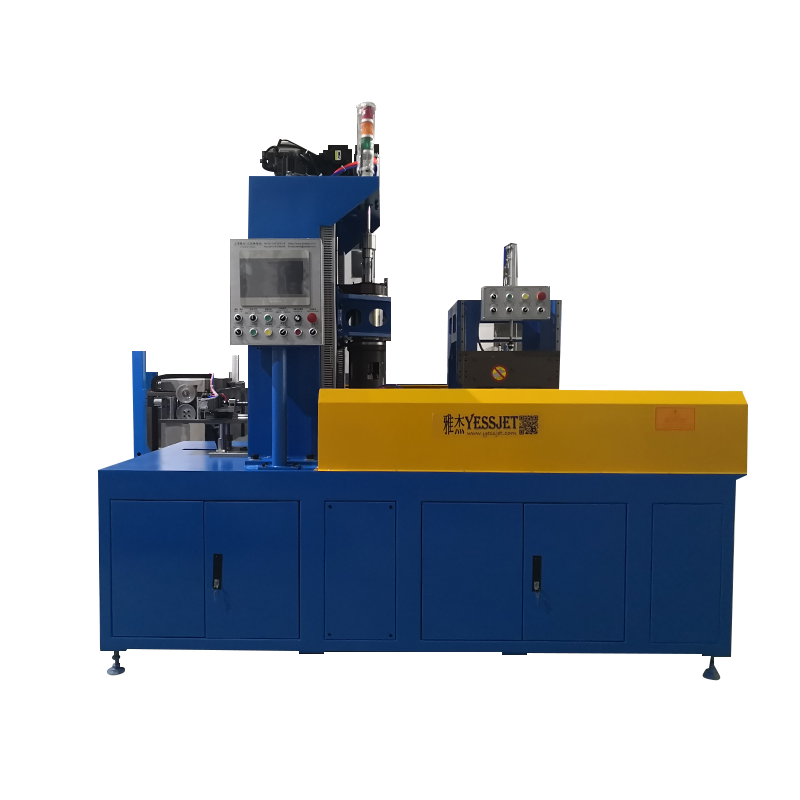
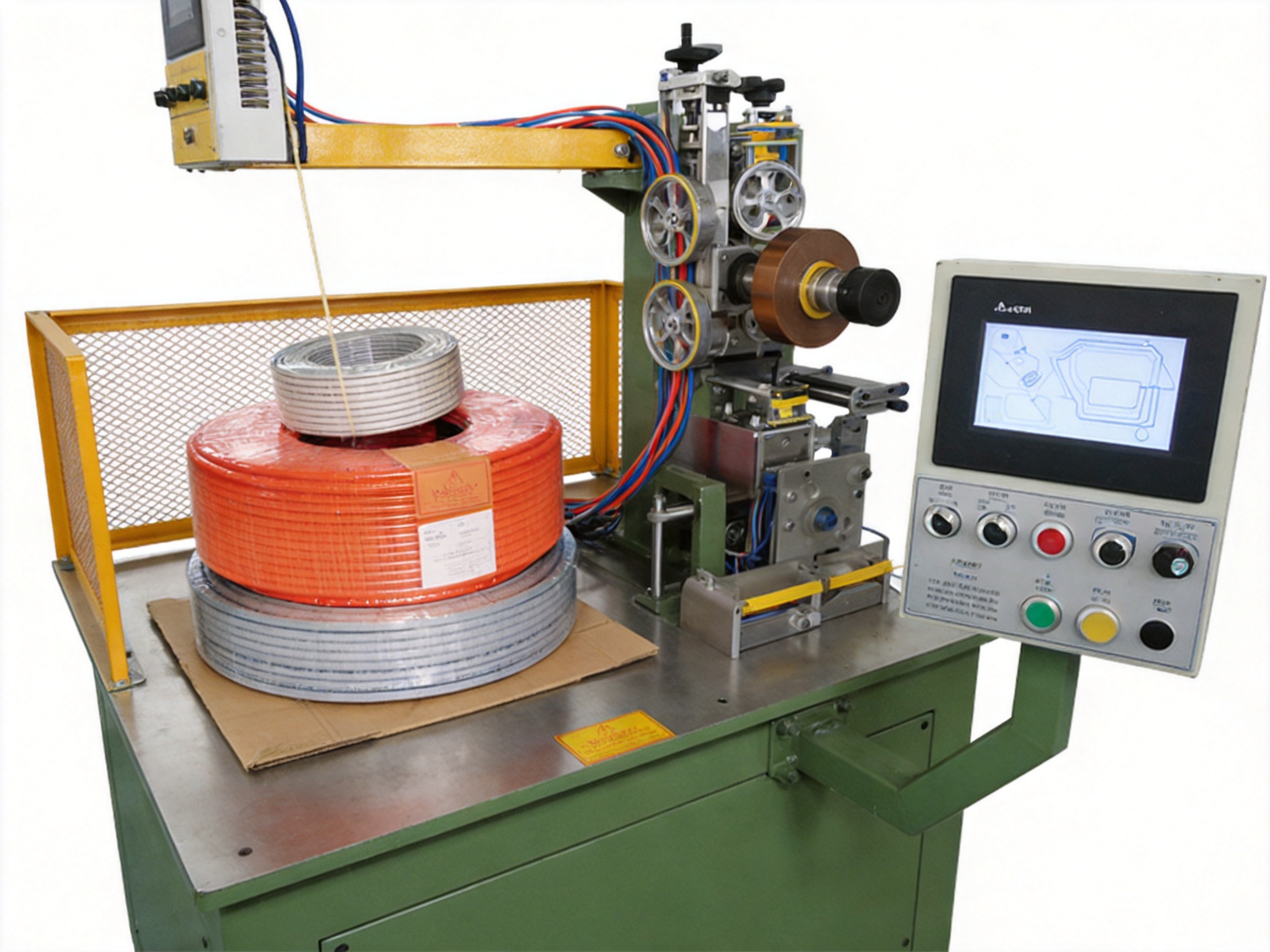
Automatic coiling is an essential finishing process in modern wire and cable manufacturing. After extrusion, cooling, testing, and measurement, the finished cable must be formed into a stable coil, organized neatly, identified correctly, and prepared for storage or shipment. When these operations depend heavily on manual labor, production speed can be limited, coil quality may vary, and operating costs can increase. An automatic coiling machine provides a more consistent and efficient alternative by integrating cable winding, coil forming, cable arrangement, labeling, fault detection, and packaging into one coordinated production system.
The automatic coiling machine described in this article is designed for continuous wire and cable production. It can receive cable directly from an extrusion line or from a motorized pay-off machine, form the cable into a controlled circular coil, and support wrapping with PP tape, paper tape, woven tape, or other suitable packaging materials. Its servo motor traversing system, touch-screen operation, automatic adjustment functions, and programmable coil data storage make it suitable for a broad range of cable sizes and production requirements.
Shanghai Yessjet Precise Machinery Co., Ltd. develops wire and cable machinery for cable production lines, packaging systems, coiling equipment, take-up systems, pay-off equipment, and related accessories. With a product range covering individual machines and complete wire and cable production solutions, the company supports manufacturers that require reliable automation, efficient material handling, and stable finished-product quality.
The Role of Automatic Coiling in Wire and Cable Production
Coiling is more than simply winding cable into a circular shape. A properly formed coil must have a consistent outer diameter, a suitable inner diameter, a stable height, an even surface, and orderly cable layers. The cable should not cross excessively, loosen during handling, or become damaged by excessive tension. The final package must also be convenient for transportation, retail presentation, installation, and later unwinding.
In a traditional manual process, operators may need to guide the cable, adjust the winding path, control the coil dimensions, stop the machine, apply a label, and wrap the completed coil. Each additional manual step creates a possibility of inconsistency. Differences in operator experience can lead to variations in coil appearance and package quality. Manual handling can also increase labor requirements, particularly when production volumes are high or when multiple shifts are needed.
An automatic coiling machine coordinates these operations through mechanical systems, sensors, servo drives, programmable controls, and an operator interface. The cable enters the machine at a controlled speed. The winding mechanism forms the coil while the traversing system distributes the cable across the required width. Once the programmed quantity or size is reached, the machine can complete the coil, apply or prepare labeling, and continue with the next production cycle.
This integrated approach is valuable for cable manufacturers producing building wires, flexible wires, electronic wires, control cables, and other products supplied in coil form. It is particularly useful when the producer needs repeatable dimensions, fast changeovers, reduced manual adjustment, and continuous operation connected to an extrusion line.
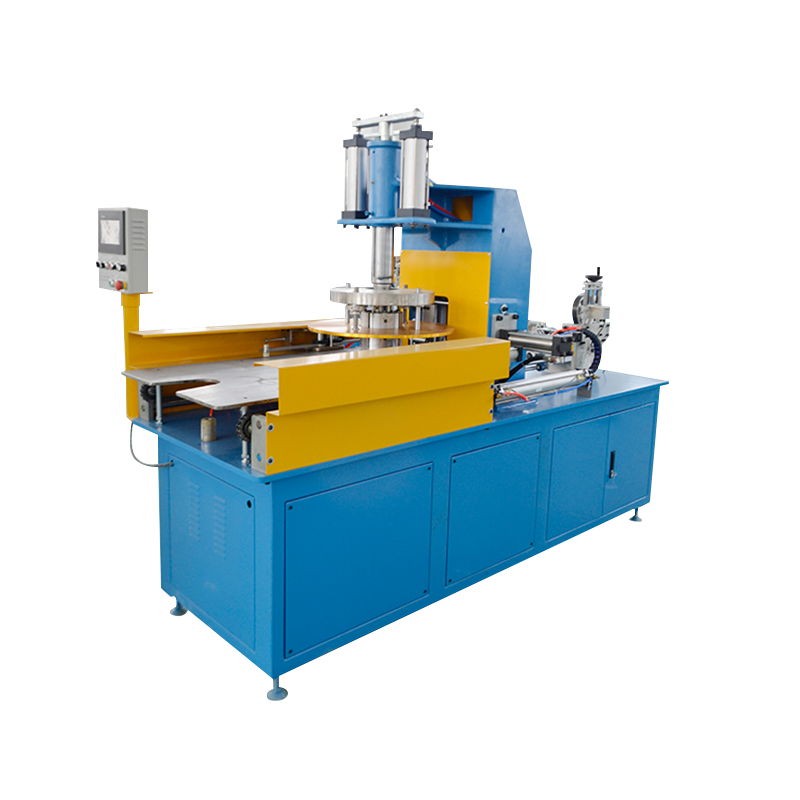
Automatic Coiling Machine
Main Functions of the Automatic Coiling Machine
Automatic Cable Coiling
The core function of the machine is automatic cable winding. It can receive wire or cable from an extrusion line or from a separate pay-off unit and wind the material into a controlled circular coil. The winding process is performed at a regulated speed that corresponds with the cable supply and the selected production settings.
Automatic winding helps reduce the need for operators to manually guide the cable around a forming area. This improves process stability and reduces the risk of uneven coils caused by inconsistent manual movement. The system can be configured for different coil heights, outer diameters, inner diameters, and wire diameters according to the machine model and the cable specification.
Servo Motor Cable Arrangement System
The servo motor cable arrangement system is one of the most important features affecting finished-coil appearance. During winding, the cable must move across the coil width in a controlled pattern. If the traversing movement is too fast, too slow, or poorly synchronized, the finished coil may have irregular edges, gaps, or overlapping sections.
A servo-driven traversing system provides accurate and responsive cable positioning. It can coordinate cable movement with the winding speed, helping produce a smooth and orderly coil surface. Servo control also supports flexible adjustment when the cable diameter or coil dimensions change. Compared with a basic mechanical arrangement system, servo control can provide more precise movement and easier electronic parameter adjustment.
The resulting coil is visually cleaner and more stable for packaging. A smooth surface is also beneficial when the coil is wrapped with tape or another packaging material, because the package is less likely to contain protrusions or loose sections. For manufacturers selling cables in retail or professional installation markets, consistent coil appearance can contribute to a stronger product presentation.
Automatic Thread Holding Arm
The automatic adjustable thread holding arm is designed to secure and guide the cable during the coiling process. Because the arm adjusts automatically, the operator does not need to make repeated manual adjustments when changing from one coil size to another within the applicable operating range.
This feature can reduce setup time and make operation more convenient. It also helps maintain a stable cable position during winding, which supports uniform coil formation. Fewer manual interventions can improve workplace safety and allow one operator to supervise more than one production function.
Automatic Label Feeding
Product identification is an important part of cable packaging. Labels may contain information such as cable type, size, length, production batch, voltage rating, customer information, or internal tracking data. The automatic label feeder reduces the need for operators to apply labels manually after each coil.
Automatic label feeding can improve consistency in label placement and reduce the possibility of missing or incorrectly positioned labels. It also allows labeling to be incorporated into the production cycle instead of being handled as a separate manual operation. For high-volume production, this can save time and simplify final inspection.
Automatic Fault Detection and Alarm Functions
The machine is equipped with automatic error detection. When the system identifies a fault or abnormal operating condition, it can issue an alarm to notify the operator. Depending on the specific configuration, abnormal conditions may involve material supply, machine movement, control signals, or other monitored operating parameters.
Early notification helps reduce the time required to identify problems. It can also prevent a small operating issue from producing a large quantity of defective coils. The alarm function supports preventive maintenance by giving operators a clear indication that attention is required before restarting or continuing production.
Automatic fault detection is especially valuable in continuous manufacturing environments. When the machine is integrated with an extrusion line, an unrecognized problem in the coiling section could interrupt the entire line or affect a long length of finished cable. Timely alarms help protect product quality and improve coordination between upstream and downstream equipment.
Touch-Screen Graphic Operation Terminal
The screen touch graphic operation terminal provides a clear interface for machine control. Operators can view production settings, select coil specifications, monitor the current operating status, and respond to alarms through the control panel.
A graphic interface is generally easier to understand than a collection of individual switches and mechanical adjustment points. It can reduce the learning curve for new operators and make routine production changes more straightforward. The interface also allows important process information to be organized in a logical format, supporting faster troubleshooting and more consistent operation.
Storage of Multiple Coil Programs
The programmable logic controller can store up to 99 types of coil data. This allows manufacturers to create dedicated settings for different cable products and retrieve them when needed. Stored data may include relevant coil dimensions, winding parameters, traversing settings, and other production values determined during commissioning.
Program storage is useful for factories producing many cable specifications. Instead of manually entering all settings for every order, the operator can select the appropriate product program and verify the displayed parameters before production begins. This can reduce setup errors and improve repeatability between production batches.
The ability to save multiple coil programs also supports flexible scheduling. A production department can move between common products without making extensive mechanical changes. This is particularly beneficial for manufacturers serving customers with different packaging requirements or shorter production runs.
Technical Specifications and Model Selection
The automatic coiling machine is available in several models. Each model covers a different range of coil height, outer diameter, inner diameter, wire diameter, and rotational speed. Selecting the correct model requires consideration of the cable construction, finished-coil dimensions, production speed, and packaging method.
Model |
Coil Height (mm) |
Outer Diameter (mm) |
Inner Diameter (mm) |
Wire Diameter (mm) |
Maximum Speed (RPM) |
C1246 |
50–120 |
180–460 |
120–220 |
1–12 |
900 |
C1860 |
60–180 |
220–600 |
180–250 |
5–15 |
300 |
C2060 |
60–200 |
220–600 |
180–250 |
5–15 |
300 |
C2480 |
80–240 |
250–800 |
250–320 |
10–25 |
150 |
The C1246 model is suitable for relatively small and medium wire diameters and offers the highest listed rotational speed. It may be appropriate for applications that require high-speed coiling of smaller cables and compact finished coils.
The C1860 and C2060 models cover similar outer diameter, inner diameter, and wire diameter ranges, while providing different coil-height ranges. Their selection can depend on the required package height, production layout, cable characteristics, and specific line configuration.
The C2480 model is designed for larger coil dimensions and larger cable diameters. Its lower rotational speed corresponds with the greater cable size and larger finished coil. This model can be considered for heavier flexible cables and applications requiring a larger package format.
Actual production performance depends on cable material, insulation properties, flexibility, surface friction, line speed, coil dimensions, packaging material, and the selected operating parameters. A technical evaluation should be completed before purchase so that the machine model and configuration match the intended production range.
Advantages Over Conventional Coiling Equipment
Higher Production Efficiency
One of the main advantages of automatic coiling is the ability to combine several operations into one continuous process. Cable winding, arrangement, label feeding, and preparation for wrapping can be coordinated without requiring the operator to stop the machine after every coil.
Non-stop production improves the number of coils that can be completed during a shift. It also reduces time lost to manual repositioning, repeated adjustment, and separate labeling operations. For factories with high cable output, the cumulative effect can be significant.
Reduced Labor Requirements
Manual coiling and packaging require workers to remain close to the product and perform repetitive movements. Automatic operation reduces the amount of direct handling required. An operator can supervise the control panel, monitor cable supply, respond to alarms, and perform quality checks rather than manually forming every coil.
Lower labor intensity can help manufacturers manage rising labor costs and improve working conditions. It also makes production less dependent on individual operator skill. The machine does not eliminate the need for trained personnel, but it changes the operator’s role from repetitive manual handling to process supervision and quality management.
Consistent Coil Quality
Consistency is a major difference between an automated servo-controlled system and manual coiling. The traversing system follows programmed movement, while the winding mechanism operates at controlled speed. This supports repeatable coil dimensions and a more uniform surface.
Consistent coils are easier to package, stack, store, and transport. They also provide a more professional appearance to customers. When the cable is later removed from the package, an orderly coil can be easier to handle and less likely to become tangled.
Faster Product Changeover
Traditional equipment may require mechanical adjustment when the operator changes coil size. The automatic coiling machine is designed so that the operator does not need to adjust every device manually when changing from one coil size to another within the applicable range. Coil data can be stored in the PLC, allowing a production program to be selected through the interface.
Faster changeover is especially important for manufacturers producing many product types in smaller batches. Reduced setup time increases the proportion of each shift spent on productive manufacturing rather than preparation.
Better Use of Factory Space
Combining coiling and packaging functions in one machine can reduce the floor area required for separate equipment. A compact production arrangement can improve material flow and leave more space for extrusion equipment, inspection stations, finished-product storage, or future expansion.
Space savings should be evaluated together with access requirements, operator clearance, maintenance space, cable routing, and safety provisions. Even so, a unified automatic system can simplify the overall plant layout compared with several independent machines connected by manual handling.
Improved Process Traceability
Stored coil programs and automatic label feeding support better product identification. When the correct data is linked to a product type, the risk of mixing cable specifications or applying the wrong label can be reduced.
Improved identification is valuable for quality control, warehouse management, customer service, and production traceability. It can help staff determine what each coil contains without opening the package or relying on handwritten notes.
Packaging Materials and Finished-Coil Protection
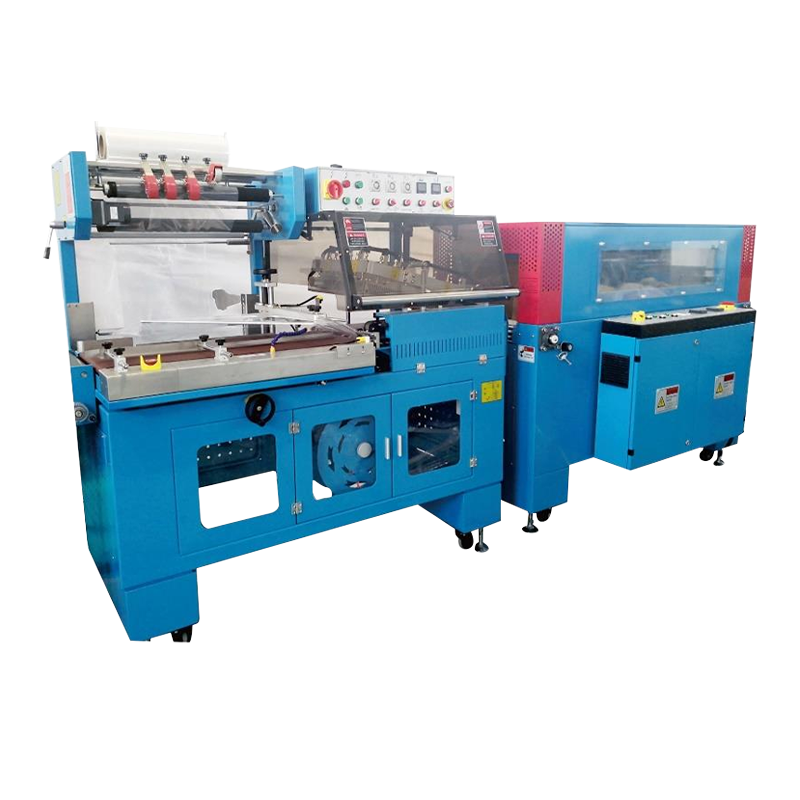
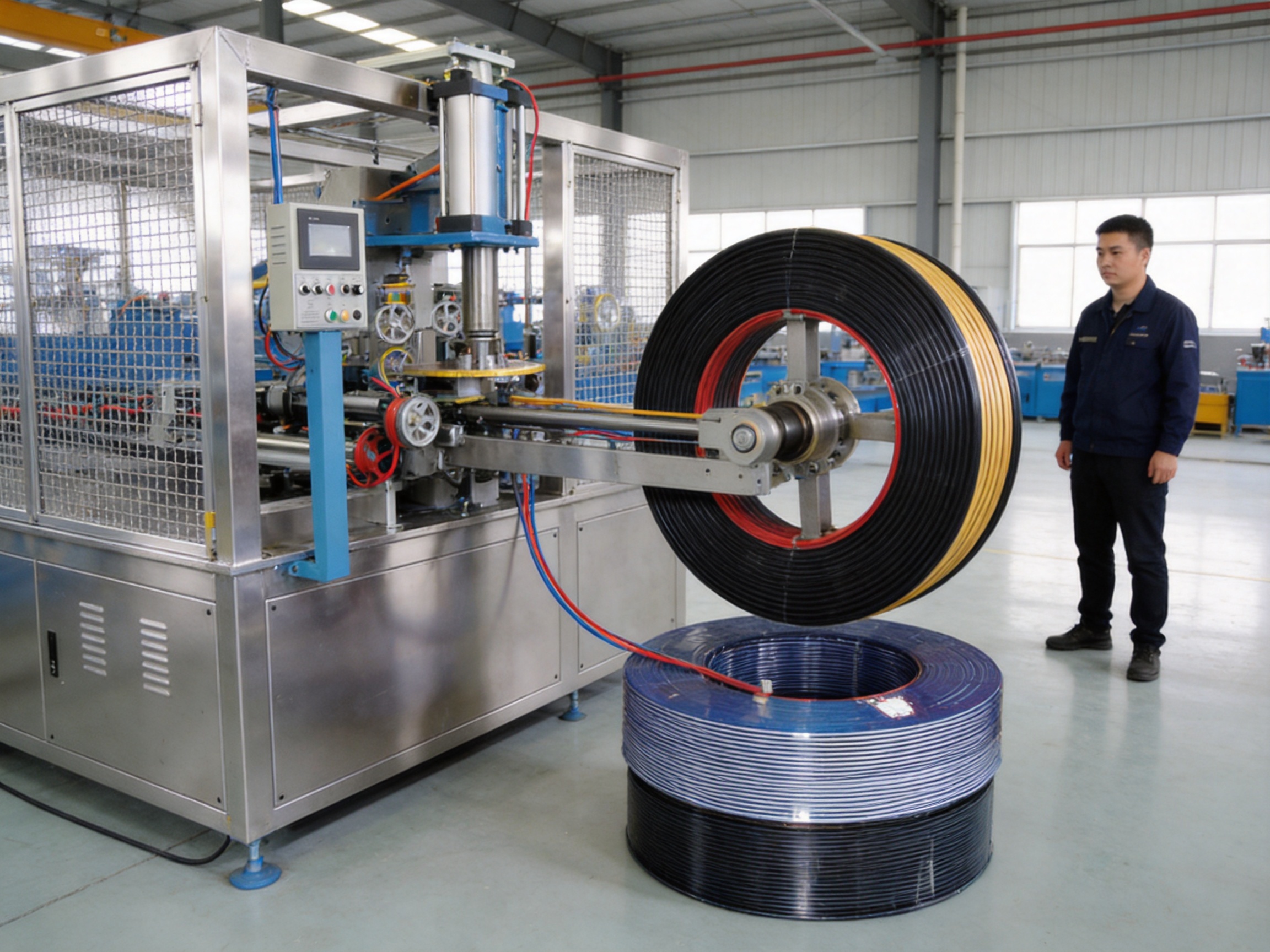
The machine can be used with packaging materials such as PP tape, paper tape, woven tape, and other materials selected according to the cable type and customer requirements. The packaging material must provide sufficient restraint to keep the coil stable while avoiding excessive pressure that could deform the cable or damage its insulation.
PP tape is commonly considered when a strong, lightweight, and practical wrapping material is required. Paper tape may be selected when a paper-based packaging solution is preferred. Woven tape can provide additional strength for certain applications. The appropriate material depends on coil weight, transportation conditions, storage duration, environmental requirements, and customer preferences.
Packaging is not only a visual finishing step. It protects the cable from movement, contamination, and accidental disturbance during handling. A properly wrapped coil is easier to lift, stack, count, and dispatch. It also helps maintain the cable’s organized form until the customer is ready to install or process it.
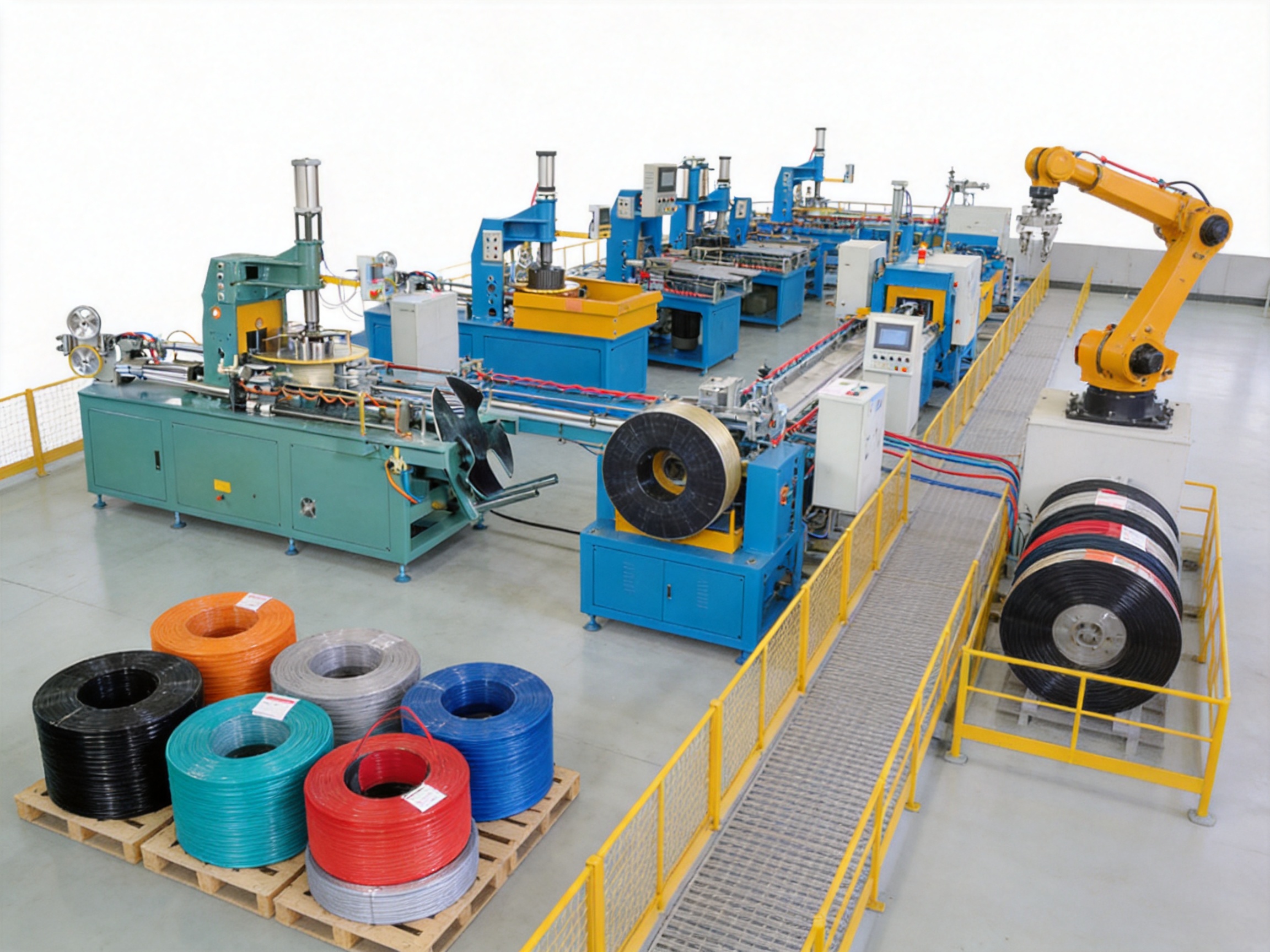
The automatic coiling machine supports the transition between winding and wrapping. The complete line arrangement may include a coiling unit, wrapping unit, label feeder, control system, and downstream collection or stacking equipment. The final configuration can be adapted to the customer’s cable products and factory workflow.
Application Areas
Building Wire
Building wires such as BV and BVR are commonly supplied in coil form for electrical installation work. These products require clean, compact, and easily identifiable packaging. Automatic coiling can help maintain consistent coil dimensions and improve the efficiency of packaging for different conductor sizes.
Flexible Sheathed Cable
RVV and similar flexible cables may be supplied in larger or heavier coils. Their flexibility and surface properties require controlled winding tension and orderly cable arrangement. The servo traversing system can help create a smooth package surface while reducing loose sections.
Electronic Wire
UL electronic wires and other small-diameter products often require high-speed production and accurate handling. The C1246 model, with its higher listed rotational speed and smaller wire diameter range, may be suitable for certain small-wire applications, subject to actual cable testing and line requirements.
Flower Wire and Special Wire Products
Flower wires and other specialized wire types may be manufactured in various diameters and supplied in compact packages. Automatic coiling helps standardize the presentation of these products while reducing the repetitive work involved in forming individual coils.
Extrusion-Line Integration
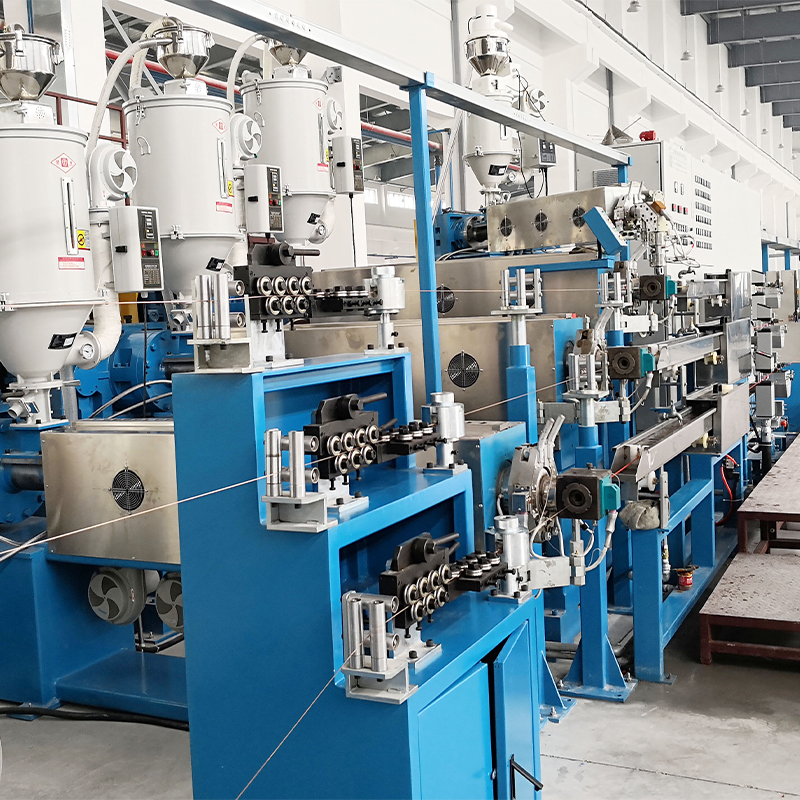
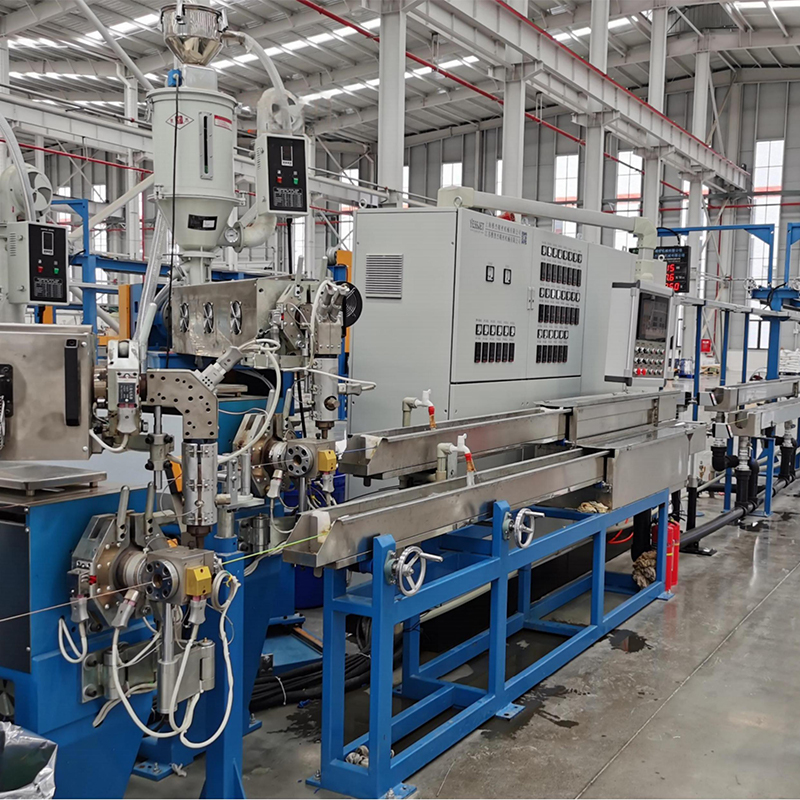
The machine can be installed downstream of an extrusion line, allowing cable to move directly from the production process into coiling and packaging. This reduces intermediate handling and can support a continuous material flow from extrusion to finished product.
Integration requires coordination of line speed, cable tension, cooling conditions, length measurement, control signals, and emergency-stop functions. A properly designed line ensures that the coiler does not pull excessively on the cable or create a backup when the packaging section requires attention.
Pay-Off and Take-Up System Integration
For production lines that do not feed cable directly from an extruder, the automatic coiling machine can work with motorized pay-off or take-up equipment. Pay-off equipment supplies cable at a controlled rate, while take-up equipment can manage other production stages or larger cable packages.
Using coordinated equipment helps manufacturers build a complete and balanced line. The coiler is not treated as an isolated machine; it becomes part of a material-handling system that includes feeding, winding, measuring, packaging, and collection.
Manufacturing Strengths and Engineering Approach
Experience in Wire and Cable Machinery
Shanghai Yessjet Precise Machinery Co., Ltd. focuses on wire and cable machinery, including cable extrusion machines, pay-off equipment, take-up equipment, coiling machines, packaging equipment, intelligent robot stackers, and accessories. This specialization gives the company a broader understanding of the production environment in which an automatic coiler operates.
A supplier that understands extrusion, winding, pay-off, take-up, and packaging can better evaluate the interaction between machines. This is important because coiling performance is affected by upstream line speed and downstream packaging requirements. Equipment selection should consider the complete production process rather than one machine in isolation.
Integrated Mechanical and Electrical Design
An automatic coiling machine combines mechanical structures with servo motion control, sensors, programmable logic control, and operator-interface software. Reliable performance depends on the coordination of all these elements.
The mechanical system must guide the cable smoothly and withstand continuous operation. The servo system must position the cable accurately. The control system must execute the selected program and respond correctly to machine signals. The interface must allow operators to manage production without unnecessary complexity.
An integrated design approach helps reduce conflicts between mechanical and electronic functions. It also simplifies commissioning because the winding, traversing, holding-arm, labeling, and alarm functions can be configured as one coordinated process.
Programmable Production Management
The ability to store up to 99 coil data sets reflects an emphasis on repeatable production management. Rather than treating each production run as a new manual setup, the machine can retain established operating information for frequently manufactured products.
Stored data should still be verified before production, especially after maintenance, cable-material changes, or changes to packaging material. However, program management provides a strong foundation for standardized operation and reduces dependence on handwritten settings.
Customization Capability
Wire and cable manufacturers often have different requirements for coil dimensions, cable speed, labeling, wrapping materials, layout, and line integration. A standard machine platform may therefore require adjustments or additional equipment to suit the customer’s production process.
As a custom wire and cable machinery manufacturer, Yessjet can evaluate application requirements and provide equipment solutions based on the cable type and production objective. Customization may involve machine configuration, auxiliary equipment, packaging arrangements, control interfaces, or the connection of the coiler with extrusion and material-handling systems.
Customization should begin with accurate technical information. The supplier may need cable diameter, insulation material, conductor construction, minimum bending radius, line speed, coil dimensions, finished-coil weight, packaging material, label format, power supply, factory layout, and expected production volume.
Turnkey Production Solutions
A complete wire and cable production line may include conductor pay-off, preheating, extrusion, cooling, diameter measurement, spark testing, capstan pulling, take-up, coiling, wrapping, labeling, and stacking. Coordinating these stages is more complex than purchasing unrelated machines from different sources.
A supplier offering turnkey solutions can help establish a more consistent production concept. The customer can discuss product requirements, line capacity, automation level, and future expansion with one technical partner. This may simplify project communication, installation planning, operator training, and after-sales support.
How the Machine Supports Quality Control
Quality control begins with stable process conditions. An automatic coiling machine helps maintain consistent winding speed, cable arrangement, and coil dimensions. Stable winding reduces the probability of deformation, loose sections, uneven edges, and packaging problems.
Operators can use the touch-screen terminal to check the selected coil program and monitor the machine during production. Automatic alarms help identify faults that may affect output. Labels provide product information for inspection and traceability.
Finished coils can be checked for outer diameter, inner diameter, height, surface smoothness, winding tightness, label position, package integrity, and cable condition. These checks should be included in the customer’s quality-control procedure and adjusted according to the cable product and relevant industry requirements.
The machine does not replace incoming-material inspection, extrusion-process control, electrical testing, or final product testing. Instead, it strengthens the finishing stage by improving the consistency and repeatability of coil formation and packaging.
Installation and Commissioning Considerations
Factory Layout
The installation location should provide sufficient space for the machine, cable entry, package removal, operator access, maintenance, and safe movement of materials. The layout should allow the cable to travel in a smooth path without unnecessary bends or obstructions.
When the coiler is connected to an extrusion line, the distance between upstream equipment and the coiler should be considered carefully. Excessive distance may create unnecessary cable accumulation, while insufficient space may make maintenance difficult.
Electrical and Utility Requirements
Before installation, the customer should confirm power supply, grounding, control connections, compressed air requirements if applicable, and communication signals with associated equipment. Electrical specifications should be matched to the local factory supply.
All connections should be completed by qualified technical personnel. Proper grounding and safety wiring are important for protecting operators and maintaining stable machine operation.
Cable Testing Before Full Production
Commissioning should begin with a controlled test using the actual cable or a representative sample. The test should verify cable feeding, winding behavior, coil dimensions, traversing movement, label operation, wrapping performance, and alarm functions.
Different cable materials may behave differently during winding. A soft flexible cable, a small electronic wire, and a heavier sheathed cable may require different speeds, tension settings, and coil programs. Test results should be recorded and used to establish standard production parameters.
Operator Training
Operators should receive training in machine start-up, product-program selection, parameter verification, cable threading, label loading, packaging-material replacement, alarm response, cleaning, and routine inspection.
Training should also cover emergency-stop procedures and safe access to moving parts. Operators must understand that automatic equipment still requires supervision. A well-trained operator can identify abnormal sounds, material behavior, or coil appearance before a larger problem develops.
Maintenance and Long-Term Operating Value
Regular maintenance helps preserve coiling accuracy and machine reliability. Maintenance tasks may include cleaning cable-contact surfaces, checking fasteners, inspecting guides, reviewing servo movement, checking sensors, examining label-feeding components, and confirming the condition of packaging-material paths.
Dust, insulation fragments, and packaging debris should not be allowed to accumulate around moving or sensing components. Clean operating conditions support reliable detection and reduce the possibility of material interference.
Operators should record alarms and recurring faults. A maintenance record can reveal patterns such as repeated label-feeding interruptions, abnormal cable tension, or inconsistent traversing movement. Early corrective action is generally more effective than waiting for a major failure.
Wear parts and consumable components should be inspected according to operating hours and production conditions. Replacement intervals depend on cable material, operating speed, shift pattern, environmental conditions, and machine usage. The supplier’s maintenance recommendations should be incorporated into the factory’s preventive-maintenance schedule.
Long-term operating value is measured not only by initial machine price but also by production efficiency, labor savings, changeover time, package consistency, downtime, maintenance requirements, and the ability to support future products. A machine with flexible programs and integration capability can remain useful as a manufacturer expands its product range.
Why Choose an Automatic Coiling Machine for Modern Production?
Modern wire and cable factories must balance output, quality, labor, space, and delivery time. An automatic coiling machine addresses these priorities through coordinated automation. It can form coils continuously, arrange cable with a servo traversing system, feed labels automatically, detect faults, store product programs, and reduce the need for manual adjustment.
Compared with a basic winding device, it provides a more complete finishing solution. Compared with manual coiling, it offers greater consistency and a lower repetitive labor burden. Compared with a collection of independent machines, an integrated system can simplify production flow and reduce space requirements.
The strongest advantage is flexibility. The machine can serve different cable types and coil dimensions within the selected model range. Product programs allow manufacturers to change specifications efficiently, while the available model options support both smaller high-speed wires and larger cable packages.
For companies seeking a complete wire and cable production solution, the coiler can be combined with extrusion lines, motorized pay-off equipment, motorized take-up equipment, wrapping systems, labeling devices, and intelligent robotic stacking equipment. This creates a path toward a more automated factory with improved material flow from raw cable production to finished-package handling.
Purchasing Checklist for Cable Manufacturers
Before ordering an automatic coiling machine, the buyer should define the full range of products to be processed. Important information includes minimum and maximum cable diameter, conductor and insulation materials, cable flexibility, coil height, outer diameter, inner diameter, desired line speed, finished-coil weight, and packaging method.
The buyer should also confirm whether the machine will operate independently or be connected directly to an extrusion line. If direct connection is required, upstream and downstream equipment must be reviewed for speed synchronization, communication, emergency stopping, and material accumulation.
Label requirements should be discussed in detail. The label size, material, printing method, placement, data source, and application timing can affect the label-feeding configuration. Packaging requirements should likewise include tape type, wrapping pattern, number of wraps, tension, and finished-package appearance.
Factory conditions should be considered, including available floor space, power supply, operator position, maintenance access, environmental conditions, and delivery route. A layout drawing can help identify potential installation problems before the machine is manufactured.
Finally, the buyer should request a clear scope of supply. The quotation should identify the main machine, control cabinet, touch-screen terminal, servo system, label feeder, safety devices, necessary accessories, commissioning support, documentation, and training. Clear technical communication helps ensure that the final machine meets the intended production goal.
Frequently Asked Questions
What types of wire and cable can the machine process?
The machine is suitable for various wires and cables, including BV, BVR, RVV, UL electronic wires, flower wires, and other products that can be supplied in coil form. The correct model depends on cable diameter, flexibility, coil dimensions, production speed, and finished-package requirements.
Can the machine work directly with an extrusion line?
Yes. The machine can receive cable from an extrusion line or from a motorized pay-off machine. Direct integration requires coordinated line speed, cable tension, control signals, and safety functions. A technical review should be completed before installation.
Does the operator need to adjust the machine manually for every coil size?
The machine is designed to reduce manual adjustment when changing coil sizes within the applicable operating range. Coil data can be stored in the PLC, and up to 99 coil types can be retained. The exact changeover procedure depends on the selected model and product configuration.
What is the purpose of the servo motor traversing system?
The servo motor traversing system moves the cable accurately across the coil width during winding. It helps create a smooth surface, orderly cable arrangement, consistent coil edges, and repeatable finished-coil quality.
What packaging materials can be used?
PP tape, paper tape, woven tape, and other suitable packaging materials can be used, depending on the machine configuration and cable application. The material should be selected according to coil weight, transportation conditions, protection requirements, and customer specifications.
How does automatic fault detection help production?
The system monitors operating conditions and provides an alarm when it detects a fault or abnormal condition. This alerts the operator quickly, reduces troubleshooting time, and helps prevent continued production of defective coils.
How many product settings can be saved?
The PLC can store up to 99 types of coil data. This allows the operator to select saved programs for different cable specifications and reduce repeated manual data entry.
Which model is suitable for small-diameter wire?
The C1246 model covers a wire diameter range of approximately 1 to 12 millimeters and has a listed speed of up to 900 RPM. Suitability must still be confirmed through cable testing and review of the required coil dimensions.
Which model is suitable for larger cable coils?
The C2480 model covers a listed wire diameter range of approximately 10 to 25 millimeters and supports outer diameters from approximately 250 to 800 millimeters. It is intended for larger coil formats, subject to actual material and production conditions.
Can the equipment be customized?
Customization may be available for machine configuration, auxiliary equipment, packaging arrangements, line integration, and control requirements. Customers should provide detailed product and production information so that the proposed solution can be evaluated accurately.
What information should be provided when requesting a quotation?
The customer should provide cable diameter, cable type, insulation material, production speed, target coil dimensions, coil weight, packaging material, label requirements, power supply, factory layout, and whether the machine will connect to an extrusion line or pay-off system.
Does automatic coiling eliminate the need for operators?
No. Automation reduces repetitive manual work, but trained operators are still needed for setup, material loading, program selection, quality checks, alarm response, cleaning, and maintenance coordination.
Conclusion
The automatic coiling machine is a practical solution for manufacturers that need faster, cleaner, and more consistent wire and cable packaging. By combining automatic winding, servo-controlled cable arrangement, adjustable cable holding, label feeding, fault detection, touch-screen operation, and programmable coil data, it provides a more complete alternative to manual coiling or basic winding equipment.
Its model range supports different cable diameters and finished-coil dimensions, while its ability to connect with extrusion lines, pay-off equipment, take-up systems, wrapping machines, and stacking equipment supports broader production-line automation. The result is a more efficient flow from cable extrusion to finished, labeled, and packaged product.
Shanghai Yessjet Precise Machinery Co., Ltd. brings together wire and cable machinery expertise, integrated equipment design, customized production solutions, and turnkey line planning. For cable manufacturers evaluating automation, the most suitable approach is to review the complete product range, define coil and packaging requirements, test representative cable, and select a machine configuration that supports both current output and future production development.
References
1. Wire and Cable Manufacturing Process Principles, technical reference material for extrusion, winding, take-up, and packaging operations.
2. Industrial Automation and Motion Control Fundamentals, reference material covering servo motors, programmable logic controllers, sensors, and operator interfaces.
3. Cable Packaging and Material Handling Practices, technical guidance on coil formation, labeling, wrapping, storage, and transportation.
4. General Principles of Preventive Maintenance for Industrial Machinery, reference material concerning inspection, cleaning, lubrication, fault records, and maintenance planning.
5. Product specifications and application information supplied for the automatic coiling machine product range, including the C1246, C1860, C2060, and C2480 models.
6. Technical information concerning wire and cable production machinery, coiling equipment, packaging equipment, pay-off systems, take-up systems, and integrated production-line solutions.
7. Industrial Safety and Operator Training Principles, reference material for emergency procedures, machine guarding, safe access, commissioning, and production supervision.