LANGUAGE
 中文简体
中文简体 русский
 Français
 Español
 Português
 عربى
عربى
Content
- 1 Why the Coiling Head Matters in Cable Production
- 2 Product Overview
- 3 Customization for Different Cable Specifications
- 4 Advantages Compared with Fixed, Non-Replaceable Designs
- 5 Positioning and Non-Positioning: How to Select the Right Type
- 6 Integration with Cable Coiling and Packaging Equipment
- 7 Manufacturing Strengths and Engineering Approach
- 8 Quality Considerations for Cable Coiling Heads
- 9 Operational Benefits for Cable Processing Enterprises
- 10 Installation and Replacement Principles
- 11 How to Specify a Replacement or Customized Head
- 12 Applications Across Different Cable Products
- 13 Advantages for Export-Oriented and International Customers
- 14 Why Choose a Specialized Cable Machinery Supplier
- 15 Continuous Improvement in Cable Coiling Equipment
- 16 Purchasing Checklist
- 17 Q&A
- 17.1 What is a cable coiling head?
- 17.2 What machines can use this product?
- 17.3 Can the cable coiling head be customized?
- 17.4 What is the difference between positioning and non-positioning types?
- 17.5 Which type is better for standard production?
- 17.6 When should a non-positioning type be selected?
- 17.7 Why use a replaceable coiling head instead of replacing the whole machine?
- 17.8 Does the coiling head improve cable quality by itself?
- 17.9 What information should be provided when requesting a quote?
- 17.10 Can the product be used in an automated production line?
- 17.11 How can a customer reduce replacement time?
- 17.12 Why work with a cable machinery manufacturer for this accessory?
- 18 Conclusion
- 19 References
- 20 Product: Cable Coiling Head
In modern wire and cable manufacturing, the coiling head is a small component with a significant influence on production performance. It determines how cable is guided, arranged, wrapped, and formed into a finished coil. When the coiling head is not properly matched to the cable, machine, or production objective, even a well-designed coiling line may experience uneven winding, unstable coil dimensions, cable tangling, surface damage, inconsistent packaging, and unnecessary downtime.
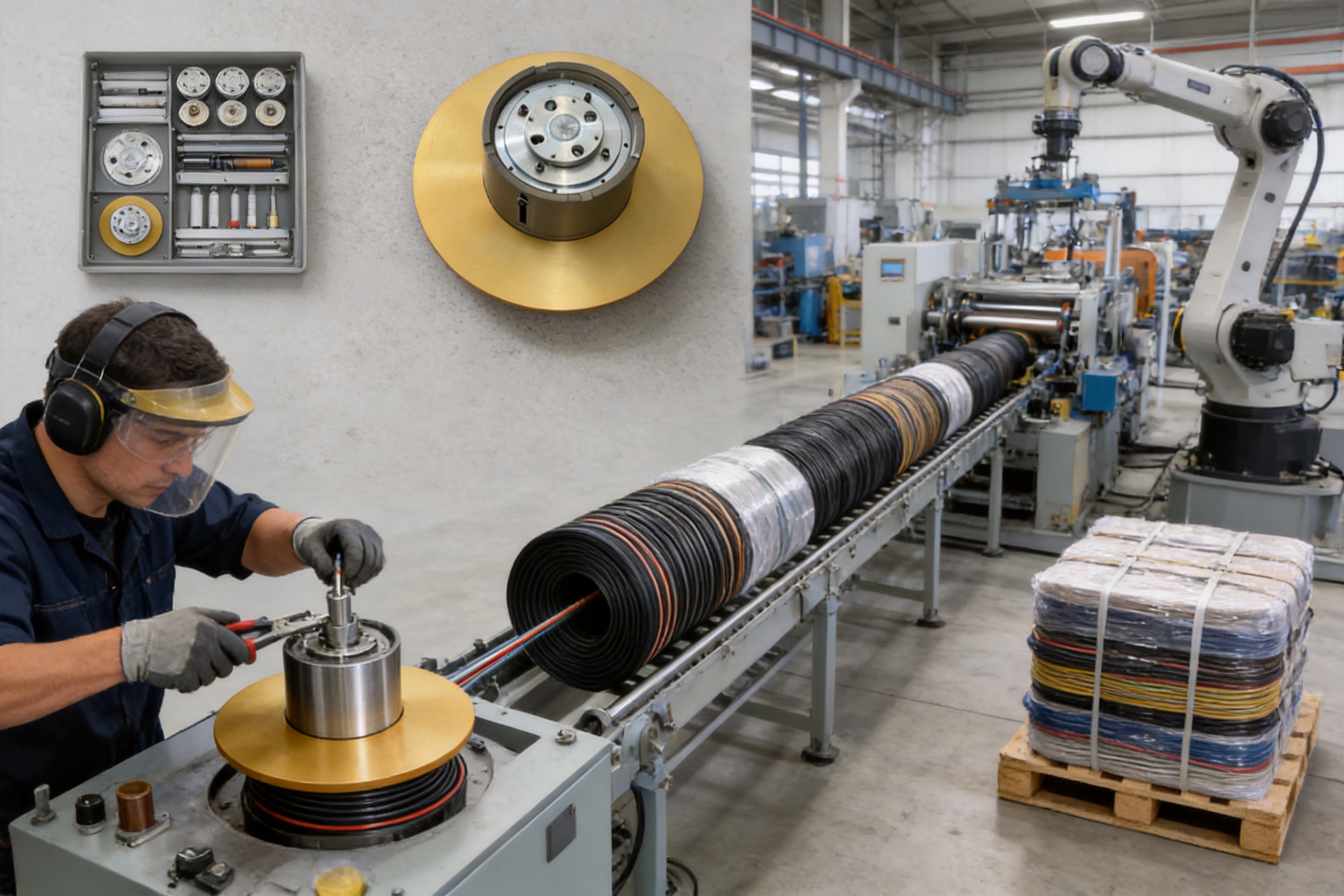
A cable coiling head is a replaceable accessory designed for cable coiling machines, cable coiling and wrapping machines, and cable coiling and binding machines. It serves as the working interface between the machine and the cable during the coiling process. Depending on the application, the head may use a positioning function for accurate cable arrangement or a non-positioning configuration for greater flexibility in irregular or variable coiling operations.
For manufacturers processing different cable types, a replaceable and customizable coiling head offers an important advantage. Instead of replacing an entire machine when production requirements change, the operator can select or customize a suitable coiling head. This approach reduces equipment investment, simplifies changeovers, and allows the same production platform to support a broader range of cable specifications.
Shanghai Yessjet Precise Machinery Co., Ltd. supplies cable production equipment and accessory components for wire and cable manufacturers. Its cable coiling head is developed as a practical, adaptable component for cable processing enterprises that require dependable coiling performance, flexible configuration, and convenient maintenance.
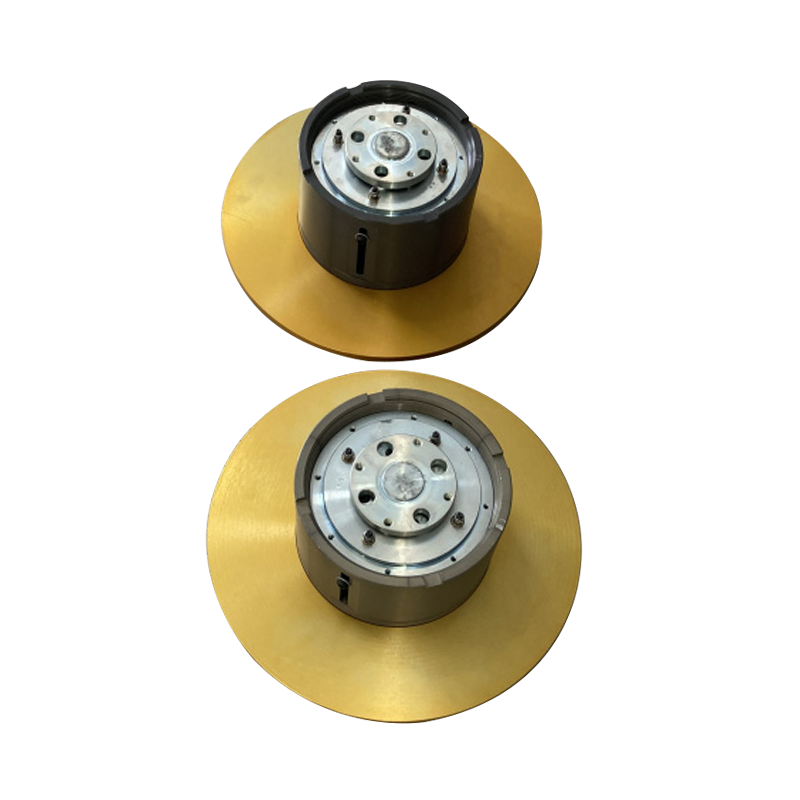
Cable Coiling Head
Why the Coiling Head Matters in Cable Production
Cable coiling is often viewed as the final stage of a production process, but it is more than a simple winding operation. The finished coil must usually meet dimensional, handling, transportation, and presentation requirements. It may need to fit a specified inner diameter, outer diameter, width, weight, or package format. The cable must also remain orderly so that it can be unwound smoothly by the customer or used efficiently in a later assembly process.
The coiling head directly affects these results. It guides the cable along a controlled path and helps establish the relationship between the cable, the rotating coil former, and the machine’s winding mechanism. If the guiding geometry is unsuitable, the cable may overlap unpredictably, move toward one side, or form a coil with an inconsistent edge. If the component is difficult to remove, routine maintenance can interrupt production for too long.
A suitable coiling head supports several important production objectives:
• Stable cable guidance during winding.
• Consistent coil formation and improved appearance.
• Better compatibility with different cable diameters and constructions.
• Easier replacement when a component requires maintenance.
• Faster changeover between product specifications.
• Improved adaptability for coiling, wrapping, and binding applications.
• Reduced dependence on one fixed production format.
These benefits are especially important in factories that process power cable, control cable, communication cable, automotive wire, building wire, flexible cable, and other products with different dimensions and mechanical properties.
Product Overview
The cable coiling head is a core replaceable accessory for cable coiling equipment. It can be customized in size according to the cable specification, coiling requirement, and machine model. The component is intended to work as part of a complete cable production or packaging system rather than as an isolated product.
Its main applications include cable coiling machines, cable coiling and wrapping machines, and cable coiling and binding machines. In each application, the coiling head contributes to the controlled formation of the cable package. The final design may vary according to the cable diameter, material, flexibility, coil dimensions, winding speed, binding method, and desired level of positioning.
Two primary functional options are available:
Positioning Coiling Head
The positioning type is designed for applications where the cable must be guided and arranged with a high degree of regularity. It helps maintain a consistent winding path and supports repeatable coil formation. This configuration is especially useful when the production line requires uniform coil edges, controlled cable distribution, or consistent finished dimensions.
A positioning coiling head is suitable for standard products manufactured in larger quantities. Once the machine parameters and coiling head have been matched to the product, the production process can achieve a stable and repeatable operating pattern. This can simplify inspection and improve the consistency of finished packages.
Non-Positioning Coiling Head
The non-positioning type is intended for applications that require a more flexible coiling behavior. It can be suitable for irregular coiling scenarios, variable product formats, or production conditions where strict cable positioning is not essential. This configuration gives operators more freedom when processing cables with different handling characteristics or when the final coil does not require precisely aligned layers.
The non-positioning option can be valuable for manufacturers serving multiple customer requirements in smaller batches. It allows the coiling process to remain practical without imposing a rigid arrangement pattern on every product.
Customization for Different Cable Specifications
One of the most important advantages of this product is its ability to be customized in size. Cable products vary considerably in diameter, construction, insulation material, flexibility, surface finish, and minimum bending radius. A coiling head designed for one product may not provide the best performance for another. Custom sizing helps ensure that the component is matched to the actual production requirement.
Customization may involve the dimensional relationship between the head and the cable path, the connection arrangement with the machine, the available working space, or the desired coil configuration. The exact design should be determined through communication between the equipment supplier and the end user. Relevant information may include the cable diameter range, line speed, coil dimensions, cable material, winding direction, machine type, and whether the application requires positioning, wrapping, or binding.
This made-to-requirement approach is more practical than relying only on a universal component. A standard part can be convenient when the application is simple, but cable factories often handle product variations that cannot be served efficiently by one fixed design. A customized coiling head provides a better path toward reliable integration.
Customization also supports future expansion. A manufacturer may begin with one cable specification and later add products with different diameters or packaging formats. By working with a supplier that can provide accessory variations, the factory may extend the useful range of its existing coiling equipment rather than purchasing a completely new machine for every product change.
Advantages Compared with Fixed, Non-Replaceable Designs
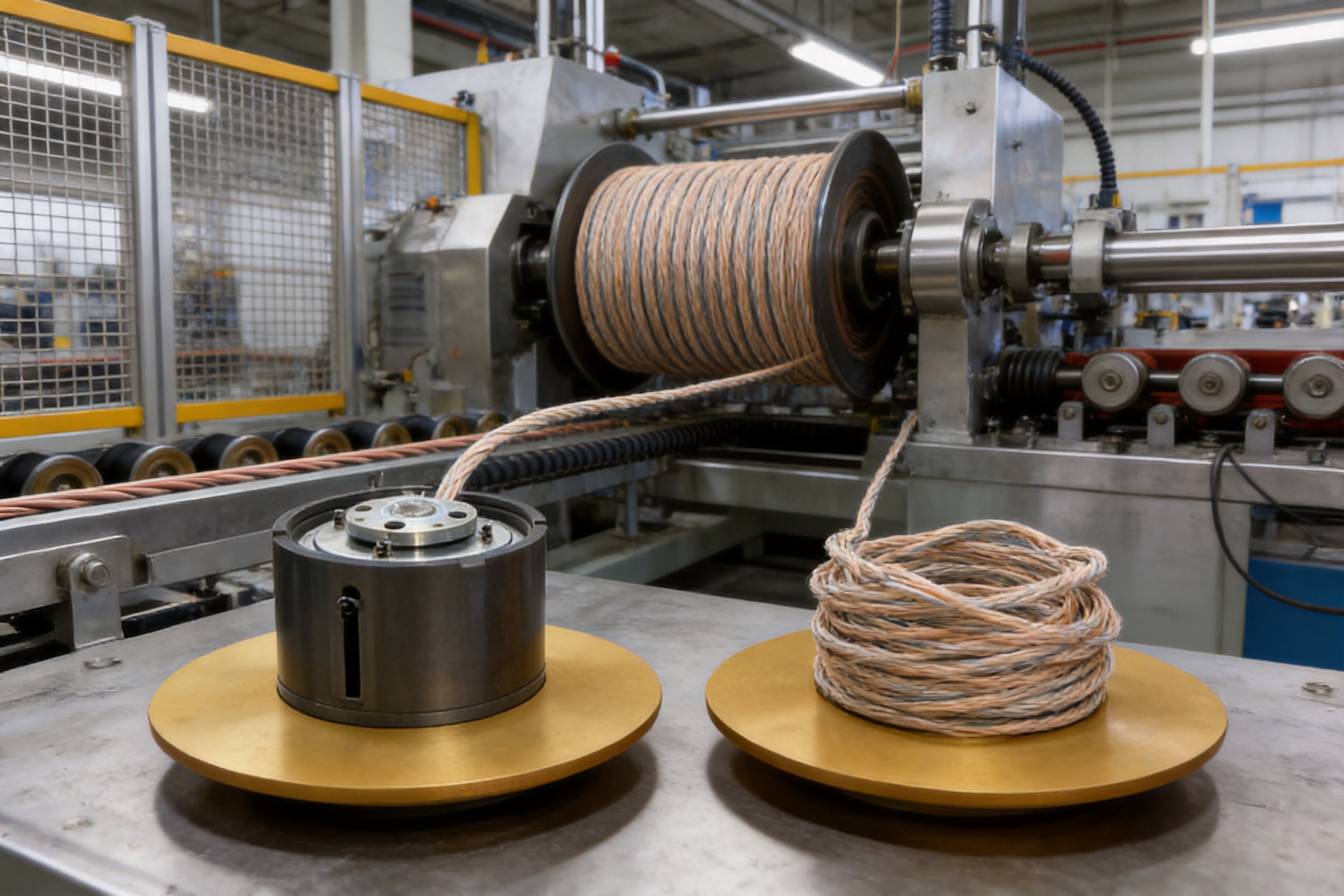
Many production problems originate not from the main machine structure but from a mismatch between the machine’s working accessory and the cable being processed. A fixed, non-replaceable coiling arrangement may be adequate for one narrow production condition, but it can become restrictive when the factory introduces new cables, new package sizes, or new customer requirements.
A replaceable cable coiling head provides several competitive advantages over such fixed designs.
1. Greater Production Flexibility
The same machine can be adapted to different cable products by selecting an appropriate coiling head. This is particularly useful for contract manufacturers and factories with multiple production orders. Instead of designing each machine around a single cable type, the operator can configure the equipment according to the current production plan.
2. Lower Long-Term Equipment Cost
When a component can be replaced independently, the manufacturer does not necessarily need to replace the complete coiling machine when a working format changes. The cost of a spare or customized coiling head is generally more manageable than the cost of a complete new line. This can improve asset utilization and make production upgrades more financially practical.
3. Faster Maintenance
A replaceable accessory simplifies maintenance planning. If the head is worn, damaged, or no longer suitable for a particular product, it can be removed and replaced as a separate part. The factory can keep a spare available and reduce the time required to restore the machine to operation.
4. Improved Changeover Capability
Product changeovers are a normal part of cable manufacturing. A production line may need to switch between different cable diameters, coil sizes, or packaging formats. A modular coiling head enables the operator to organize changeovers around a defined accessory replacement procedure rather than making extensive modifications to the main machine.
5. Better Application Matching
The positioning and non-positioning options recognize that not every cable should be coiled in exactly the same way. Providing two functional configurations gives the user a more suitable choice than a single universal head. The positioning type supports regularity, while the non-positioning type supports flexibility.
6. More Practical Equipment Ownership
Equipment value depends not only on initial performance but also on how easily the machine can be maintained and adapted over time. A coiling head that can be replaced and customized contributes to a more sustainable ownership model. It helps the production line remain useful as product requirements evolve.
Positioning and Non-Positioning: How to Select the Right Type
The choice between positioning and non-positioning should be based on the characteristics of the cable and the required finished coil. There is no single option that is best for every production condition.
| Selection Factor | Positioning Type | Non-Positioning Type |
|---|---|---|
| Coil arrangement | Supports orderly and controlled cable placement | Allows more flexible or irregular placement |
| Finished appearance | Suitable when uniform edges and consistent formation are important | Suitable when a less structured arrangement is acceptable |
| Product variation | Best for defined and repeatable product formats | Useful for variable or mixed production conditions |
| Operating objective | Emphasizes precision and repeatability | Emphasizes adaptability and flexibility |
| Typical application | Standardized cable coils and regular packaging | Irregular coiling, flexible production, and varied requirements |
| Changeover approach | Works well with established settings for recurring products | Can simplify flexible handling across less standardized jobs |
The positioning type may be preferred when the finished coil will be displayed, packed in a defined carton, placed on an automatic palletizing system, or used in a downstream process that requires consistent geometry. The non-positioning type may be preferred when the cable is highly flexible, when the coil format is less strict, or when the production line must accommodate different coiling behaviors.
In practice, the decision should also consider the machine’s existing control system, take-up arrangement, cable tension, production speed, and operator experience. A supplier with knowledge of complete cable machinery can evaluate the coiling head as part of the overall line rather than treating it as an independent component.
Integration with Cable Coiling and Packaging Equipment
A coiling head does not operate alone. Its performance depends on the relationship among the extrusion line, cooling and conveying sections, pay-off and take-up equipment, coiling machine, wrapping equipment, binding mechanism, and finished-product handling system.
In a typical cable production workflow, the cable leaves the extrusion or processing section and moves toward the take-up or coiling area. The cable must travel with suitable tension and speed. The coiling head then helps guide the cable into the selected coil arrangement. If wrapping or binding is required, the coil may proceed to a packaging station or be handled by an automatic system.
Proper integration provides several benefits. It reduces unnecessary cable loops, improves the transition from continuous production to finished packaging, and helps operators maintain consistent settings. It also supports the development of more complete production solutions, including automatic coiling, wrapping, binding, stacking, and material handling.
Because the supplier also works with wire and cable production machinery, the coiling head can be considered within a wider equipment context. This is useful when the customer needs more than a replacement accessory. The customer may require assistance selecting a compatible coiling arrangement, configuring a production line, or coordinating cable handling equipment with packaging and stacking operations.
The best results are normally achieved when the coiling head is specified at the same time as the machine or replacement project. Important interface information should be confirmed before manufacture, including mounting dimensions, operating direction, cable path, clearance, and expected coil format.
Manufacturing Strengths and Engineering Approach
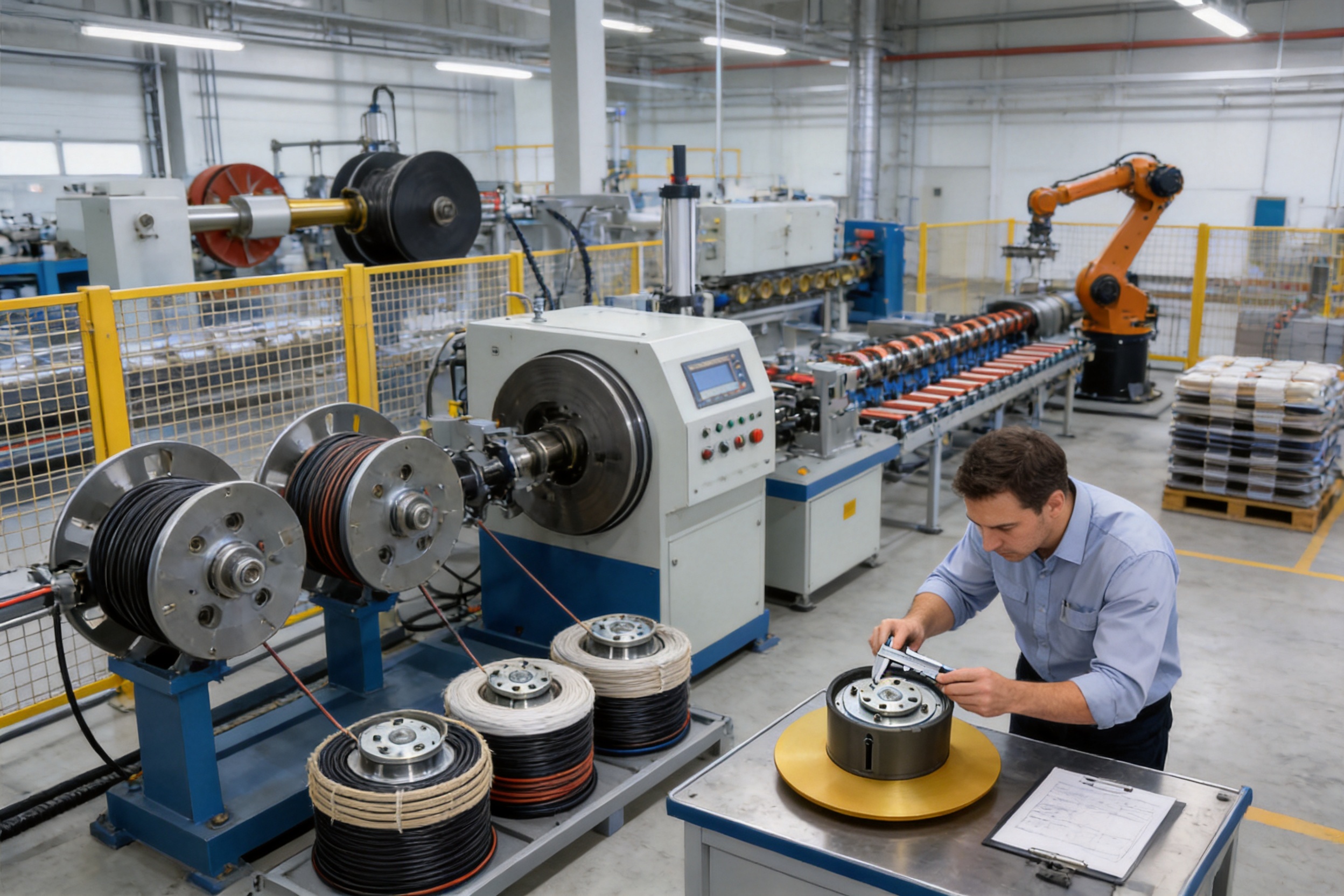
Producing a reliable cable coiling head requires more than forming a component to approximate dimensions. The part must be designed around the motion of the cable, the machine’s operating conditions, and the user’s production objectives. Manufacturing strength is therefore reflected in the supplier’s ability to understand the complete application, convert requirements into a suitable design, and deliver a component that can be integrated into practical factory operations.
Shanghai Yessjet Precise Machinery Co., Ltd. focuses on wire and cable machinery, cable production lines, coiling equipment, take-up systems, pay-off systems, robot stacking equipment, and accessory components. This equipment background provides an important foundation for developing and supplying coiling heads.
Application-Based Engineering
A component supplier with experience in complete machinery can evaluate a coiling head according to its actual working environment. The engineering process can take into account cable size, coiling speed, machine structure, package dimensions, and production objectives. This is more effective than treating the head as a generic item that must fit every machine.
Application-based engineering also helps identify possible conflicts before production begins. For example, the supplier can clarify whether the customer needs precise cable positioning, a flexible coiling path, a particular replacement interface, or a custom size. Early clarification reduces the risk of receiving a component that is technically manufactured but unsuitable for the intended line.
Customized Manufacturing
The ability to manufacture customized sizes is a significant strength for cable processing customers. Different machine models may require different mounting arrangements, working dimensions, or cable guidance paths. A manufacturer capable of producing customized accessories can respond to these differences more effectively than a supplier offering only a limited catalog.
Customization should be controlled through clear technical information and careful confirmation. A professional manufacturing process normally begins with specification review, continues through design and production planning, and concludes with inspection and application verification. This structured approach helps maintain consistency even when the product is made according to individual requirements.
Precision-Oriented Production
The word “precise” in a machinery supplier’s operating philosophy reflects the importance of dimensional accuracy and functional consistency in cable equipment. For a coiling head, precision is relevant to the cable path, the relationship between mating parts, the installation interface, and the stability of the component during operation.
Precision-oriented manufacturing helps reduce unnecessary vibration, uneven guidance, installation difficulty, and variation between replacement parts. It also supports smoother machine adjustment when a customer changes from one coiling head to another.
Accessory and Complete-Line Perspective
Some suppliers focus only on individual components, while others understand how accessories interact with complete production systems. A complete-line perspective is valuable because cable coiling performance is influenced by upstream and downstream equipment. The coiling head must work with the machine’s tension, speed, material flow, and package handling requirements.
The company’s product range includes wire and cable extrusion lines, cable extrusion machines, motorized pay-off equipment, motorized take-up equipment, coiling machines, fully automatic coiling and packaging equipment, intelligent robot stackers, and accessory equipment. This broad portfolio supports a more coordinated approach to cable production projects.
Practical Replacement Support
A replaceable coiling head is most useful when the customer can identify the correct replacement and install it without unnecessary uncertainty. Clear communication about model, size, function, and machine application is therefore an important part of the supply process. Customers should provide drawings, photographs, sample parts, or machine information whenever possible.
Practical replacement support can also include confirmation of whether the customer requires the positioning or non-positioning type. This small distinction may have a large effect on the final coiling result. A supplier that pays attention to this requirement can help the customer avoid an unsuitable purchase.
Quality Considerations for Cable Coiling Heads
Quality should be assessed through both material and performance. The coiling head must be sufficiently durable for repeated cable contact and machine operation. Its working surfaces should support smooth cable movement and avoid creating unnecessary abrasion or interference. Its installation features should be consistent with the equipment for which it is intended.
Several quality factors deserve attention:
• Dimensional consistency between the manufactured component and the approved design.
• Correct mounting and connection dimensions.
• Smooth and suitable cable-contact surfaces.
• Stable operation at the intended production speed.
• Compatibility with the cable’s diameter and construction.
• Correct selection of positioning or non-positioning function.
• Ease of removal and replacement during maintenance.
• Consistency between the supplied component and any previous approved part.
Quality control should begin before machining or assembly. The manufacturer should review the technical request and identify the critical dimensions and functional surfaces. During production, these elements should receive appropriate inspection. Before shipment, the part should be checked against the confirmed customer requirements.
For customized components, documentation is particularly important. A record of the size, machine model, application type, and customer approval can make future replacement easier. It also helps the customer maintain a more organized spare-parts program.
Operational Benefits for Cable Processing Enterprises
The value of a cable coiling head can be measured through its contribution to everyday production. A component that is easy to install, properly matched, and stable during operation can help improve the efficiency of the entire coiling process.
Improved Coil Consistency
When cable guidance is properly controlled, the finished coil can achieve a more repeatable shape. Consistency improves handling, storage, counting, packaging, and visual inspection. It may also reduce the risk that cable ends become buried or difficult to locate.
Reduced Production Interruptions
Because the head is replaceable, maintenance can be planned more efficiently. A spare part can be prepared for rapid replacement, reducing the time required to repair or reconfigure the machine. This is especially valuable in high-utilization factories where even short stoppages affect delivery schedules.
Better Adaptation to Customer Orders
Many cable manufacturers produce according to customer-specific requirements. One order may call for compact coils, while another may require a larger package or a different binding method. A customizable coiling head gives the factory additional options for responding to these variations.
More Efficient Use of Existing Machinery
Extending the application range of an existing machine can improve the return on investment. Instead of dedicating each machine to only one product, the manufacturer may use interchangeable or customized heads to support several production conditions.
Support for Automation
Regular coil formation is useful when the production line includes automatic wrapping, binding, conveying, or robot stacking. A stable coil can be easier for automated handling equipment to identify, transfer, and place. Although the coiling head is only one part of the system, its performance can influence downstream automation.
Installation and Replacement Principles
Before replacing a cable coiling head, the machine should be stopped according to the manufacturer’s safety procedure. Power, motion, and cable tension should be controlled before the operator removes the existing component. The replacement part should be compared with the approved specification to confirm its function and dimensions.
Installation should begin with a clean and accessible machine interface. Dirt, damaged fasteners, or misalignment at the mounting point can affect the performance of the new part. The head should be installed without forcing it into position. If the component does not fit naturally, the operator should stop and verify the model, dimensions, and mounting arrangement.
After installation, the cable path should be checked manually or at low operating speed. The operator should confirm that the cable moves smoothly, does not rub against unsuitable surfaces, and enters the coiling area in the correct direction. Initial production should be monitored to confirm coil shape, cable arrangement, and machine stability.
Where the positioning type is used, the operator should verify that the cable is being arranged consistently across the coil. Where the non-positioning type is used, the operator should confirm that the flexible coiling behavior matches the intended package result.
Routine inspection should include checking for wear, looseness, surface damage, abnormal noise, and changes in cable guidance. Early detection allows the factory to replace the component before it causes more serious production problems.
How to Specify a Replacement or Customized Head
Customers can improve communication and reduce lead-time risk by preparing complete technical information before requesting a cable coiling head. The following details are helpful:
• Name and model of the coiling machine.
• Cable type and construction.
• Minimum, maximum, or normal cable diameter.
• Required inner diameter, outer diameter, width, or weight of the coil.
• Target coiling speed.
• Required winding direction.
• Whether the cable must be precisely positioned.
• Whether wrapping or binding is part of the operation.
• Existing head dimensions or machine drawings.
• Photographs showing the installation interface.
• Quantity required and expected spare-parts demand.
The more complete the information, the easier it is for the supplier to recommend the correct type and confirm whether customization is necessary. If the customer is replacing an existing component, a sample or detailed drawing can be especially useful.
Customers should also explain the production problem they are trying to solve. For example, the issue may be irregular coil edges, poor compatibility with a new cable diameter, excessive replacement time, or difficulty maintaining a stable package shape. Understanding the problem helps the supplier focus on the appropriate functional solution rather than simply copying an old part.
Applications Across Different Cable Products
The cable coiling head can be applied to various wire and cable production environments. The correct configuration depends on the product and the expected finished package.
Building Wire
Building wire is often produced in standardized sizes and may require orderly coils for retail packaging, transport, or installation use. A positioning coiling head can support a consistent appearance and repeatable coil dimensions.
Control and Instrumentation Cable
Control and instrumentation cables may include multiple conductors, shielding, insulation layers, or protective jackets. Their flexibility and surface characteristics can differ from simple single-core wire. A properly matched coiling head can help guide the finished cable without creating unnecessary deformation.
Communication Cable
Communication cable may require careful handling because its electrical performance can be affected by excessive bending or mechanical stress. The coiling configuration should be selected with the cable’s bending requirements and finished package objectives in mind.
Flexible Industrial Cable
Flexible industrial cables may be heavier, more resilient, or more difficult to arrange than smaller wires. Custom sizing and appropriate coiling behavior can support stable handling during winding.
Automotive and Special-Purpose Wire
Automotive wire and special-purpose cable may be produced in many sizes and in relatively short order lengths. A replaceable accessory helps manufacturers respond to varied product specifications without redesigning the entire coiling machine.
These examples demonstrate why flexibility is important. The coiling head should be considered according to the actual cable and package, not selected only by appearance or nominal machine size.
Advantages for Export-Oriented and International Customers
International cable manufacturers often operate multiple production lines and serve customers in different markets. Their equipment may include machines from different suppliers, and replacement accessories must be matched carefully to existing interfaces. A company experienced in cable production machinery can provide useful support by communicating in terms of machine application, cable specification, and production objective.
Customization is also important for overseas customers because local production requirements may differ. Packaging standards, coil dimensions, labeling methods, transport conditions, and downstream handling systems can vary from one market to another. A flexible accessory supply model allows the customer to request a product that fits the actual operation rather than accepting an unsuitable standard component.
For international procurement, customers should confirm technical drawings, installation details, packaging protection, quantity, and delivery requirements in advance. A clear approval process helps avoid misunderstandings and supports consistent repeat orders.
Shanghai Yessjet Precise Machinery Co., Ltd. is based in China and provides wire and cable machinery solutions for customers seeking equipment, accessories, and production-line support. Its product range allows customers to discuss a coiling head as part of a broader cable manufacturing project when required.
Why Choose a Specialized Cable Machinery Supplier
A general industrial component supplier may be able to manufacture a metal or mechanical part, but a specialized cable machinery supplier understands why that part is used and how it affects the production line. This distinction is important for coiling heads because the correct result depends on the relationship between component geometry, cable movement, machine control, and final packaging.
A specialized supplier can provide value in several ways:
• Understanding of cable extrusion and downstream handling.
• Experience with coiling, wrapping, binding, pay-off, and take-up operations.
• Ability to distinguish between positioning and non-positioning requirements.
• Capability to customize accessory dimensions.
• Awareness of machine integration and replacement needs.
• Broader support for complete wire and cable production lines.
• More direct communication about technical application requirements.
This combination of product knowledge and manufacturing capability helps customers make a more informed decision. The goal is not simply to purchase a component that can be installed, but to obtain a coiling head that contributes to stable production and practical equipment ownership.
Continuous Improvement in Cable Coiling Equipment
Wire and cable manufacturers increasingly expect equipment to be flexible, efficient, and suitable for automation. Production lines must often accommodate more product variations while maintaining consistent quality and controlling labor requirements. Replaceable accessories such as cable coiling heads support this direction by making equipment more adaptable.
Future-oriented cable production may combine precision coiling with automatic wrapping, binding, conveying, and robot stacking. In such systems, each stage must provide a stable output to the next stage. A well-formed coil can improve the reliability of automatic package handling, while a suitable coiling head can help the machine maintain repeatable cable movement.
Equipment improvement does not always require a complete machine replacement. In many cases, upgrading or customizing a key accessory can address a specific production limitation. This approach allows manufacturers to make targeted improvements while preserving useful machine structures and established operating procedures.
The practical design of the cable coiling head reflects this philosophy. It is a replaceable accessory, available in different functional forms, and customizable in size. These characteristics give cable manufacturers a way to improve application matching without unnecessarily increasing system complexity.
Purchasing Checklist
Before placing an order, the buyer should review the following questions:
1. Is the part intended for a cable coiling machine, wrapping machine, binding machine, or a combined system?
2. Does the application require precise cable positioning?
3. Would a non-positioning arrangement better suit irregular or flexible coiling?
4. What cable diameters and materials will be processed?
5. What coil dimensions must be achieved?
6. Is the part a direct replacement or a new customized design?
7. Are drawings, photographs, or samples available for interface confirmation?
8. Will the coiling head be used with automatic packaging or robot stacking equipment?
9. Is a spare part required for maintenance planning?
10. Does the supplier understand the complete production-line application?
Answering these questions can improve technical accuracy and reduce the possibility of selecting the wrong configuration. It also helps the supplier estimate the appropriate manufacturing and inspection requirements.
Q&A
What is a cable coiling head?
A cable coiling head is a replaceable accessory used to guide and arrange cable during the coiling process. It is installed on cable coiling machines and related coiling, wrapping, or binding equipment.
What machines can use this product?
The product is designed for cable coiling machines, cable coiling and wrapping machines, and cable coiling and binding machines. Compatibility should be confirmed according to the machine model and installation interface.
Can the cable coiling head be customized?
Yes. The coiling head can be customized in size to match different cable specifications and equipment models. Customers should provide cable dimensions, machine information, drawings, or photographs for accurate confirmation.
What is the difference between positioning and non-positioning types?
The positioning type is intended to support precise cable arrangement and consistent coil formation. The non-positioning type provides greater flexibility for irregular coiling scenarios or applications where exact cable alignment is not essential.
Which type is better for standard production?
For standardized products that require repeatable coil dimensions and orderly cable arrangement, the positioning type may be more suitable. The final choice should consider cable characteristics, machine settings, and packaging requirements.
When should a non-positioning type be selected?
The non-positioning type may be appropriate for irregular coiling, varied production formats, highly flexible cable, or applications where a less structured coil is acceptable.
Why use a replaceable coiling head instead of replacing the whole machine?
A replaceable head allows the customer to adapt the machine to different cable or packaging requirements with a smaller equipment investment. It can also simplify maintenance and reduce downtime when the accessory requires replacement.
Does the coiling head improve cable quality by itself?
The coiling head is one part of the complete process. It can support stable guidance and consistent coil formation, but final results also depend on cable tension, line speed, machine condition, operator settings, and the characteristics of the cable.
What information should be provided when requesting a quote?
The customer should provide the machine model, cable diameter, cable type, desired coil dimensions, required function, mounting details, and any available drawings or photographs. Information about wrapping, binding, or automatic stacking is also helpful.
Can the product be used in an automated production line?
Yes, it can be integrated into cable coiling and packaging systems when the dimensions and operating characteristics are properly matched. A stable coil can also support downstream wrapping, binding, conveying, and robot stacking operations.
How can a customer reduce replacement time?
The customer can keep an approved spare coiling head in inventory, maintain accurate part records, and confirm the positioning or non-positioning function before ordering. Clear documentation of the machine interface also helps accelerate future replacement.
Why work with a cable machinery manufacturer for this accessory?
A specialized cable machinery manufacturer understands the connection between the coiling head and the wider production system. This can make it easier to select a suitable configuration, customize the size, and coordinate the accessory with coiling, take-up, packaging, and stacking equipment.
Conclusion
The cable coiling head is a compact but important component in wire and cable production. Its role in guiding, arranging, and forming cable directly influences finished coil consistency, machine adaptability, maintenance efficiency, and packaging performance.
The availability of positioning and non-positioning configurations gives manufacturers a practical choice between precise arrangement and flexible coiling. Customizable sizing allows the component to match different cable specifications, machine models, and production conditions. Its replaceable design helps reduce downtime, extend equipment usefulness, and avoid replacing an entire machine when only the coiling arrangement needs to change.
Compared with fixed and non-adaptable designs, a customized cable coiling head offers stronger flexibility, more practical maintenance, and better compatibility with changing production requirements. When supplied by a company experienced in wire and cable machinery, the accessory can be evaluated as part of the complete production line rather than as an isolated mechanical part.
Shanghai Yessjet Precise Machinery Co., Ltd. combines cable machinery knowledge with a product range covering extrusion, pay-off, take-up, coiling, packaging, binding, and intelligent stacking equipment. This broader manufacturing perspective supports customers looking for practical accessory solutions as well as complete cable production turnkey solutions.
For cable processing enterprises seeking dependable coiling performance and adaptable equipment, selecting the correct cable coiling head is a meaningful step toward more stable, efficient, and future-ready production.
References
1. General principles of wire and cable manufacturing, extrusion, take-up, coiling, and packaging operations.
2. Industrial equipment maintenance practices for replaceable mechanical accessories.
3. Cable handling considerations related to bending, tension, winding, and finished-coil formation.
4. Manufacturing engineering principles for customized machine components and production-line integration.
5. Supplier product information for cable coiling heads, cable coiling machines, cable wrapping and binding equipment, and wire and cable production lines.