LANGUAGE
 中文简体
 русский
 Français
 Español
 Português
 عربى

Content
- 1 Introduction
- 2 Why LAN Cable Coiling Requires Specialized Equipment
- 3 Product Overview
- 4 Core Operating Principle
- 5 Compatibility with Common LAN Cable Types
- 6 Net-Type Coiling and Its Practical Benefits
- 7 Adjustable Central Hole Design
- 8 Technical Specifications
- 9 Comparison with Manual Coiling
- 10 Advantages over Less Flexible Winding Equipment
- 11 Manufacturing Strengths and Engineering Approach
- 12 Integration into a Cable Production Line
- 13 Control and Operator Convenience
- 14 Quality and Packaging Benefits
- 15 Model Selection Guide
- 16 Installation and Commissioning Considerations
- 17 Maintenance and Long-Term Reliability
- 18 Business Value for Cable Manufacturers
- 19 Recommended Production Workflow
- 20 Frequently Asked Questions
- 20.1 What cable types can the Cross Winder for LAN Cable process?
- 20.2 Can the machine produce a coil without a central hole?
- 20.3 Can the central-hole size be changed?
- 20.4 What is the difference between DCW-2540 and DCW-2540P?
- 20.5 Is the machine suitable for high-volume LAN cable production?
- 20.6 Does the machine eliminate manual labor completely?
- 20.7 Can the machine be integrated with other cable equipment?
- 20.8 What information should be supplied for a technical quotation?
- 20.9 How can manufacturers maintain consistent coil quality?
- 20.10 Why is a net-type coil useful?
- 21 Conclusion
- 22 References
- 23 Product: Cross Winder For LAN Cable
Introduction
LAN cable manufacturing does not end when the conductor, insulation, shielding, and outer jacket have been produced. The final winding and packaging stage is equally important because it determines how easily the cable can be handled, stored, transported, and installed. A poorly formed coil may become tangled, deformed, difficult to place inside a box, or vulnerable to surface damage. For this reason, an efficient cable manufacturer needs a winding system that provides repeatable coil geometry, stable production speed, flexible size adjustment, and dependable operation.
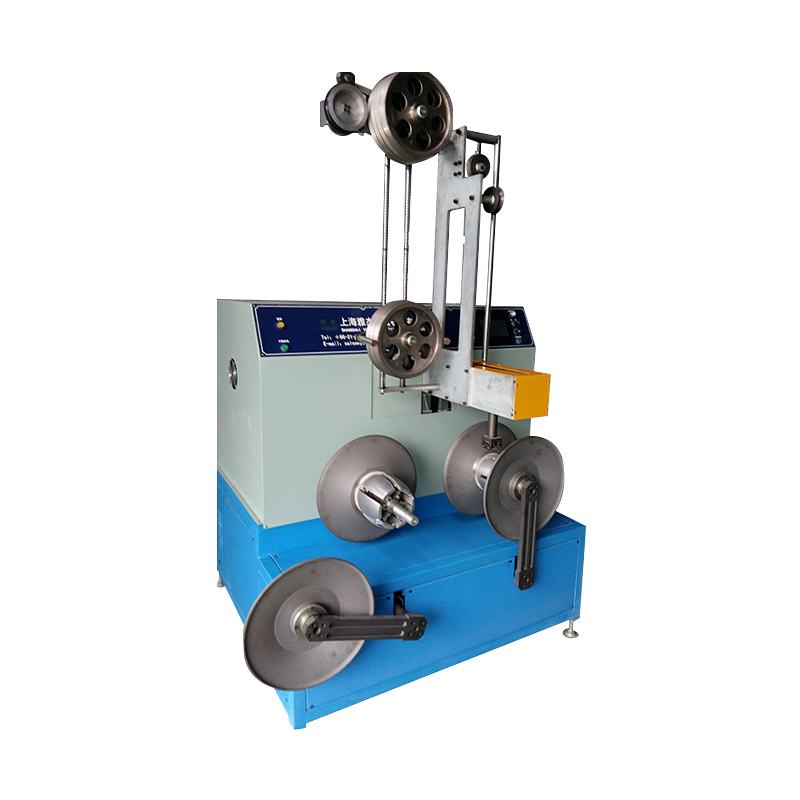
The Cross Winder for LAN Cable is designed to meet these requirements. It automatically coils LAN cables into a neat net-type formation and is suitable for commonly produced communication cables, including Cat5, Cat5e, and Cat6. It can also be used with suitable coaxial cable applications, giving manufacturers greater production flexibility. The machine supports coil winding with or without a central hole, while the hole size can be adjusted through a touch-screen control interface.
This flexibility makes the equipment suitable for different packaging concepts. A manufacturer may produce a compact coil for a carton, a coil with a large central opening for easier dispensing, or a solid coil without a hole when the packaging design calls for maximum cable density. Instead of relying on manual adjustment and repeated trial-and-error, operators can configure the required winding pattern directly through the control system.
Manufactured and supplied by Shanghai Yessjet Precise Machinery Co., Ltd., the equipment forms part of a broader range of wire and cable machinery that includes extrusion lines, pay-off equipment, take-up equipment, coiling machines, accessory equipment, and automated packaging and stacking solutions. This product-focused article explains the operating concept, technical specifications, production benefits, application scope, and selection considerations associated with the Cross Winder for LAN Cable.
Cross Winder For LAN Cable
Why LAN Cable Coiling Requires Specialized Equipment
LAN cable is produced in many different constructions and sizes. Although the finished cable may appear simple from the outside, its internal pairs, insulation layers, separator elements, shielding, and jacket can influence how it bends and how it behaves during winding. Excessive tension, poor guiding, or inconsistent coil formation may negatively affect both appearance and handling performance.
Manual coiling often creates variations from one package to another. One operator may produce a tight coil, while another may leave loose sections or uneven edges. These variations can increase labor requirements and make downstream boxing less efficient. Manual production also makes it difficult to maintain consistent winding speed when order quantities are large.
A dedicated cross-winding machine addresses these problems by controlling the movement of the cable as it is wound. The cable is distributed across the coil in a cross-pattern, creating a stable net-type shape rather than a loose bundle. This arrangement helps the finished cable maintain a more orderly form and reduces the possibility of random loops becoming caught during storage or transport.
The cross-winding principle is especially useful for cables that must be placed into cartons or other compact packaging. A regular coil can be positioned more predictably, allowing packaging personnel or automated packing equipment to work with consistent dimensions. The ability to configure a central hole further improves compatibility with different boxes, reels, dispensing systems, and customer requirements.
For manufacturers serving structured cabling, data communication, security, networking, and electronic equipment markets, the final package is part of the product experience. A cable that is easy to remove from its box and unlikely to tangle can reduce installation time for distributors, contractors, and end users. The winding machine therefore contributes not only to factory productivity but also to customer satisfaction.
Product Overview
The Cross Winder for LAN Cable is an automatic coiling solution intended for efficient and repeatable winding of communication cables. It is compatible with Cat5, Cat5e, and Cat6 cable types within the applicable diameter range. It can also accommodate coaxial cable when the construction and production conditions are suitable for the selected model.
The equipment creates a net-type coil in which the cable is arranged in an orderly cross-wound structure. The operator can select whether the finished coil should include a central hole. When a hole is required, its size can be adjusted using the touch screen. This feature allows the machine to be adapted to packaging boxes with different internal dimensions or dispensing requirements.
Two listed model configurations are available. The DCW-2540 is designed for cable diameters from 0.8 to 6 millimeters and does not require a pneumatic system. The DCW-2540P covers cable diameters from 1 to 12 millimeters and includes pneumatic functionality. Both models provide a listed maximum speed of 250 revolutions per minute, with a 250-millimeter height and a 400-millimeter outside diameter. The listed inside diameter is 180 millimeters.
These specifications give manufacturers a practical starting point for equipment selection. The appropriate model depends on the cable diameter, cable construction, desired package dimensions, production speed, and whether pneumatic operation is required. Before ordering, users should confirm the complete cable specification and conduct a production trial for special cable constructions or unusual packaging formats.
Core Operating Principle
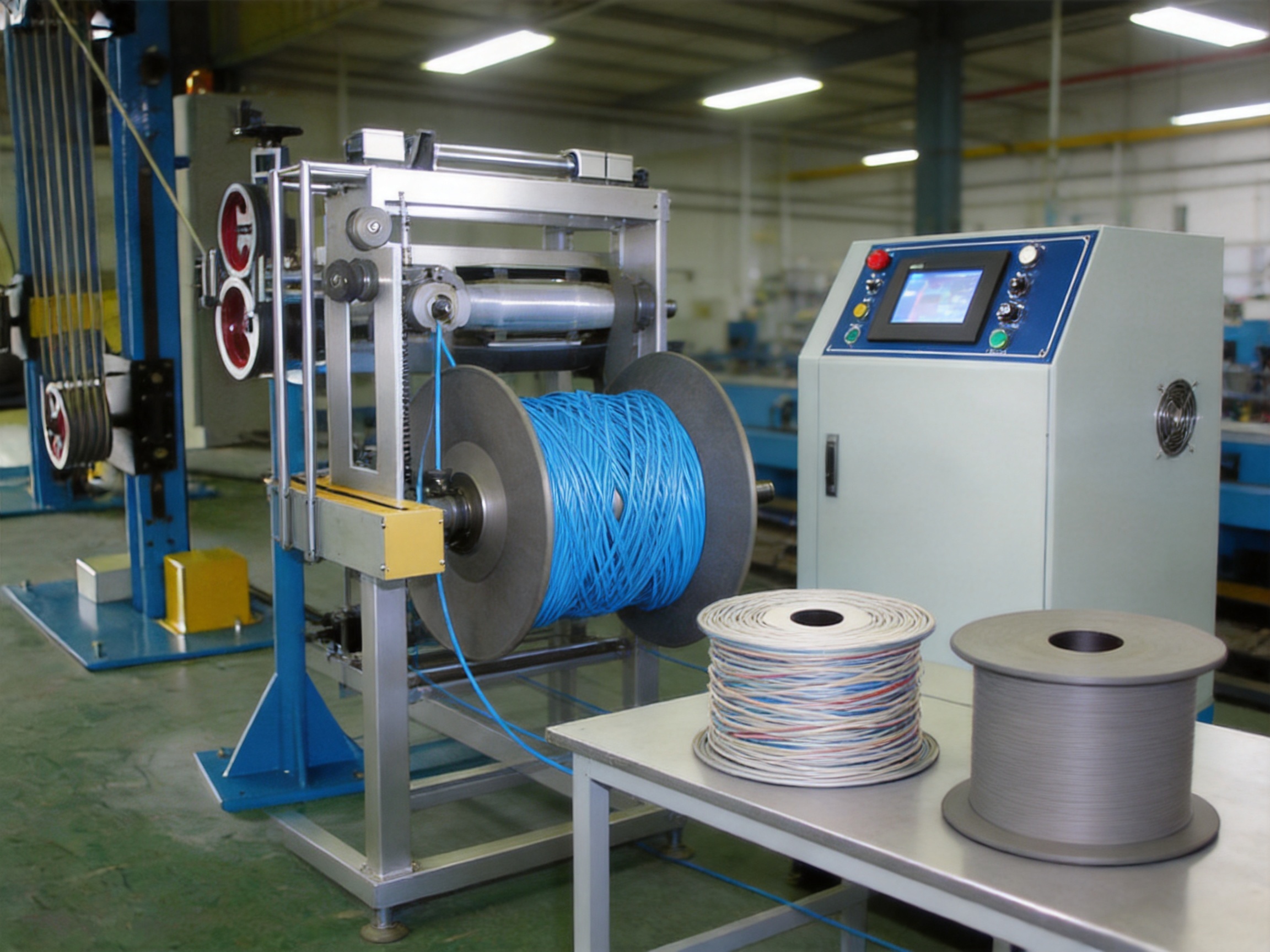
During operation, cable is supplied to the winding section through an upstream pay-off or cable-feeding arrangement. The machine receives the cable at a controlled rate and guides it into the coiling area. The winding mechanism rotates while the cable distribution system moves in a controlled pattern, placing the cable across the coil width.
The cross movement is essential to forming a stable net-type package. Rather than depositing the cable in one fixed circular path, the machine distributes successive turns across the working area. This creates a balanced structure and helps prevent localized accumulation. When configured correctly, the cable forms a compact coil with a consistent external appearance.
The operator can select the required winding mode through the touch-screen interface. For a solid coil, the system can wind without a central opening. For a dispensing package, it can create a hole with a selected diameter. The actual setting should correspond to the box design, cable size, and required removal method.
At the end of the programmed winding cycle, the finished coil can be removed and transferred to packaging. Depending on the production line design, the coiler may operate alongside manual packaging, a box-forming station, a labeling station, or further automatic packaging equipment. This makes the machine suitable for both standalone use and integration into a broader cable production workflow.
Because the machine is designed for automatic operation, it reduces the need for continuous manual manipulation of the cable. Operators can focus on material supply, parameter confirmation, quality inspection, and package handling rather than manually shaping every coil. This can improve production consistency while reducing repetitive physical work.
Compatibility with Common LAN Cable Types
Cat5 Cable
Cat5 cable remains relevant in certain legacy installations and cost-sensitive applications. Its winding behavior depends on conductor size, insulation, jacket material, and overall diameter. The DCW-2540 model supports cable diameters beginning at 0.8 millimeters, making it suitable for many smaller communication cable constructions within the specified range.
Cat5e Cable
Cat5e is widely used in residential, commercial, and general network installations. It is frequently produced in high volumes, which makes automatic winding valuable. Consistent coiling helps manufacturers prepare regular packages for distributors, installers, and retail channels. The machine can provide a repeatable coil shape for Cat5e products when the cable diameter remains within the selected model’s working range.
Cat6 Cable
Cat6 cable can have a larger or more complex construction than lower-category LAN cables. Internal separators, thicker insulation, and larger jackets may affect the cable’s flexibility. The pneumatic DCW-2540P model supports cable diameters from 1 to 12 millimeters, giving it a broader nominal diameter range for larger cable products.
Coaxial Cable
The machine is also applicable to coaxial cable. Coaxial products may be used for video, radio-frequency, signal transmission, instrumentation, or communication purposes. Since coaxial cables vary considerably in construction and stiffness, the actual suitability should be confirmed through a sample winding test. Correct tension, guide adjustment, and winding parameters are important for protecting the cable and producing a stable final coil.
Net-Type Coiling and Its Practical Benefits
The net-type structure is one of the most important characteristics of this machine. In a net-type coil, cable turns are distributed across the winding area in a controlled crosswise arrangement. This gives the package a more organized appearance and helps individual sections remain in position.
Compared with an irregular hand-wound bundle, a net-type coil can be easier to place inside a box. Its outer shape is more predictable, and its central area can be designed according to the packaging requirement. A regular package also simplifies visual inspection because damaged, displaced, or incorrectly wound cable sections are easier to identify.
Orderly coiling may reduce the chance of tangling during storage and transportation. While no winding method can eliminate all handling risks for every cable construction, a controlled coil generally provides a more stable package than an inconsistent loose bundle. This is particularly useful when cartons are stacked, moved through distribution centers, or opened at an installation site.
The net-type design can also improve material presentation. Manufacturers may use consistent coils to support product differentiation, packaging quality, and professional appearance. In competitive cable markets, the physical condition of the package influences how buyers evaluate manufacturing reliability.
Adjustable Central Hole Design
A major advantage of the Cross Winder for LAN Cable is its ability to create coils with or without a central hole. Different markets and packaging designs require different winding formats. Some customers prefer a solid coil that maximizes the use of the box volume. Others need a central opening so that the cable can be pulled from the inside or placed over a dispensing structure.
The hole diameter can be adjusted through the touch screen. This makes the machine more flexible than equipment limited to one fixed core or one permanent winding geometry. When a manufacturer changes from one box size to another, the operator can adjust the program rather than replacing the entire machine or using a different dedicated coiler.
Adjustability is particularly valuable for manufacturers producing private-label cable, export products, or multiple package sizes. The same machine can support different customer specifications, provided that the requested coil dimensions remain within the working capabilities of the equipment.
The hole setting should be selected carefully. A hole that is too small may make cable removal difficult, while a hole that is too large can reduce package density and affect coil stability. The best value depends on the cable’s flexibility, the box dimensions, the intended dispensing direction, and the customer’s installation method.
Technical Specifications
The following table summarizes the principal listed specifications for the two available configurations.
| Model | Height | Outside Diameter | Inside Diameter | Applicable Cable Diameter | Listed Speed | Pneumatic System |
|---|---|---|---|---|---|---|
| DCW-2540 | 250 mm | 400 mm | 180 mm | 0.8–6 mm | 250 RPM | No |
| DCW-2540P | 250 mm | 400 mm | 180 mm | 1–12 mm | 250 RPM | Yes |
The table should be used as a preliminary selection guide rather than a substitute for a complete technical evaluation. Cable diameter alone does not determine final performance. Jacket material, bending stiffness, conductor construction, shielding, surface friction, cable temperature, line tension, and required coil length may all influence the result.
Manufacturers should provide representative cable samples when requesting confirmation. A trial can establish whether the cable feeds smoothly, whether the coil edges remain stable, whether the selected hole size is appropriate, and whether the desired package can be produced at the required rate.
Comparison with Manual Coiling
Manual coiling may appear inexpensive at low production volumes, but it creates several hidden costs. Operators must repeatedly handle the cable, maintain the coil shape, monitor the package size, and correct tangles or uneven sections. The labor requirement increases as order volume rises, and the final quality may vary between shifts.
Automatic cross winding reduces these variations by using a defined winding method. Once the operating parameters are set, the machine can repeat the same basic motion for successive coils. This supports more consistent package dimensions and makes production planning easier.
Manual winding also places greater dependence on operator skill. Experienced personnel may produce excellent coils, but training new employees takes time. Automatic operation allows a wider range of personnel to perform routine production tasks after receiving appropriate instruction in loading, parameter setting, inspection, and safety procedures.
Another advantage is reduced repetitive strain. Cable coiling can involve repeated bending, pulling, lifting, and wrist movement. Automating the repetitive part of the process can improve the working environment and allow employees to concentrate on quality control and material handling.
The machine may also improve the use of floor space. A standardized coiling station provides a defined production footprint and can be arranged close to extrusion, testing, marking, or packaging equipment. Better organization can reduce unnecessary movement between process steps.
Advantages over Less Flexible Winding Equipment
Some conventional winding systems are designed around one cable diameter, one core size, or one package format. These machines may perform well for a narrow production range but can become restrictive when product variety increases. The Cross Winder for LAN Cable offers a broader operating concept by supporting several LAN cable categories, coaxial cable applications, and different central-hole configurations.
The pneumatic DCW-2540P model provides an expanded nominal cable diameter range up to 12 millimeters. This makes it more suitable for manufacturers that handle larger communication cables or products with heavier jackets. The non-pneumatic DCW-2540 model is a practical option for smaller cable diameters and operations that prefer a simpler configuration.
Another differentiating feature is touch-screen hole adjustment. A fixed mechanical core may require time-consuming changes when the packaging format changes. Digital adjustment can shorten changeover activity and help operators store or repeat settings more conveniently, depending on the control configuration supplied with the machine.
The machine’s automatic cross-winding function also offers a more orderly package than a simple rotary winding arrangement that places every turn on the same path. The resulting net-type structure is designed for improved stability and better presentation.
These advantages are most valuable for cable manufacturers with multiple product specifications, frequent packaging changes, or a requirement for consistent export-ready presentation. The equipment does not eliminate the need for correct setup, but it gives the production team more control over the final package.
Manufacturing Strengths and Engineering Approach
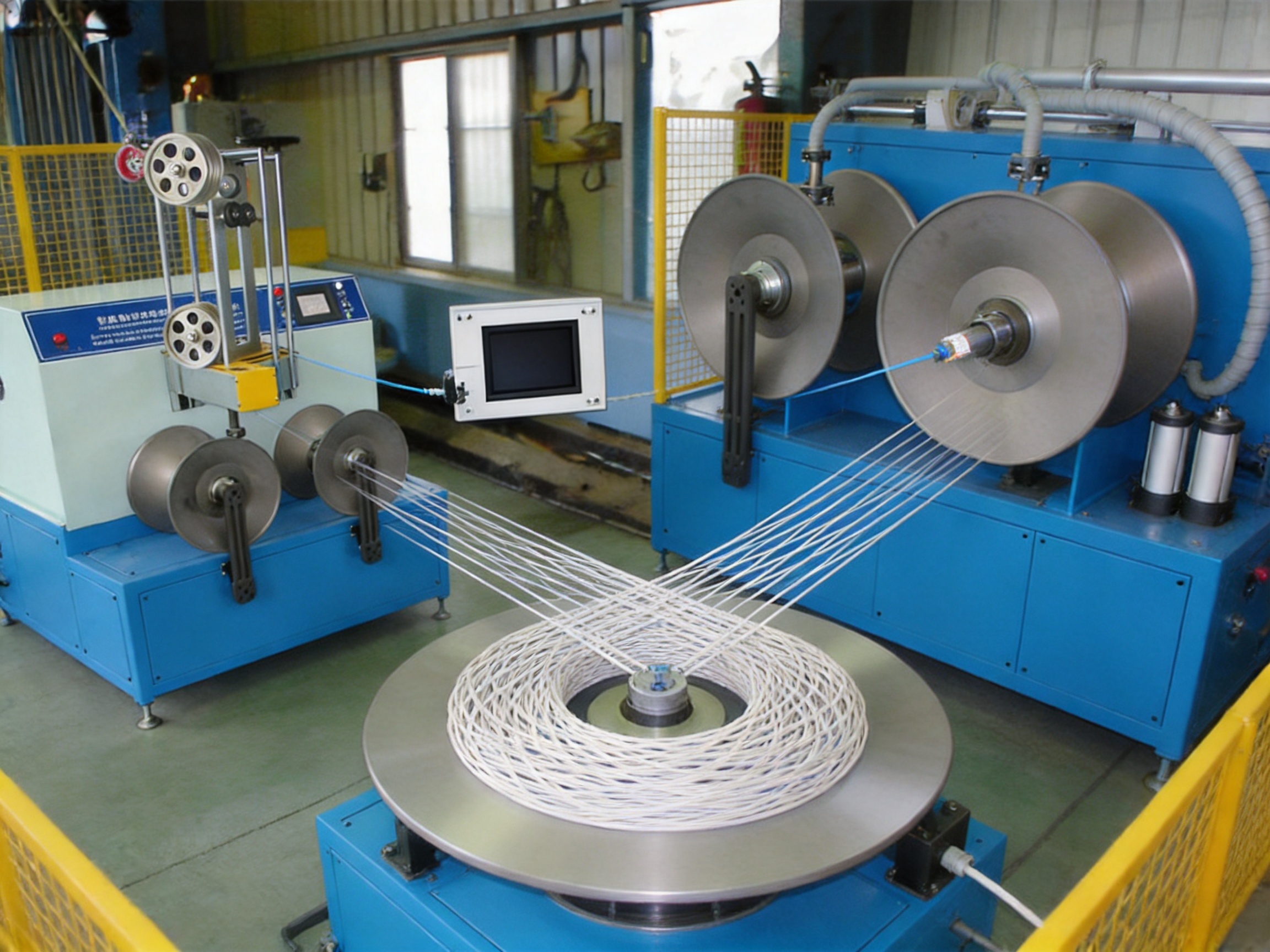
Shanghai Yessjet Precise Machinery Co., Ltd. operates in the wire and cable machinery sector and provides equipment for cable extrusion, pay-off, take-up, coiling, packaging, and material handling. The company’s product range indicates an engineering approach that considers the cable manufacturing process as a complete production chain rather than as a collection of isolated machines.
For a coiling machine, this broader understanding is important. The final coil depends on the condition of the cable arriving from upstream equipment. Stable line speed, suitable tension, accurate guiding, and consistent cable dimensions all influence winding quality. Experience with extrusion lines, pay-off equipment, and take-up equipment can help a machinery supplier understand how the coiler must interact with the rest of the line.
The company’s focus on precise machinery is reflected in the need for controlled movement, repeatable dimensions, and practical operator adjustment. A modern winding machine must combine mechanical stability, reliable transmission, suitable cable guiding, and an accessible control interface. Each element contributes to consistent production.
An advanced manufacturing process for this type of equipment normally includes design review, component selection, mechanical fabrication, assembly, electrical integration, software or control configuration, trial operation, and final inspection. The value of the finished machine depends on how well these stages are coordinated.
Mechanical parts must be aligned so that the winding motion remains smooth. Rotating elements require appropriate balance and support. Cable-contact surfaces should be designed to minimize unnecessary abrasion. The frame must provide sufficient rigidity for the selected operating speed. Electrical and control components must be installed in a way that supports safe operation and convenient maintenance.
Before shipment, equipment should be checked for operating movement, control response, winding consistency, and basic safety functions. When customer samples are available, sample testing can provide additional confirmation that the selected configuration matches the cable and packaging requirement.
Integration into a Cable Production Line
The Cross Winder for LAN Cable can be used as an independent production machine or connected to upstream and downstream equipment. In a cable extrusion plant, the coiler may receive finished cable after cooling, diameter control, marking, testing, and length measurement. The cable is then wound into its final package for boxing and shipment.
A typical process may include a motorized pay-off for supplying cable or raw material, an extrusion line for insulation or jacketing, cooling and sizing equipment, a testing and measurement section, a motorized take-up or accumulation system, and the cross-winding station. The exact line configuration depends on the cable type and production method.
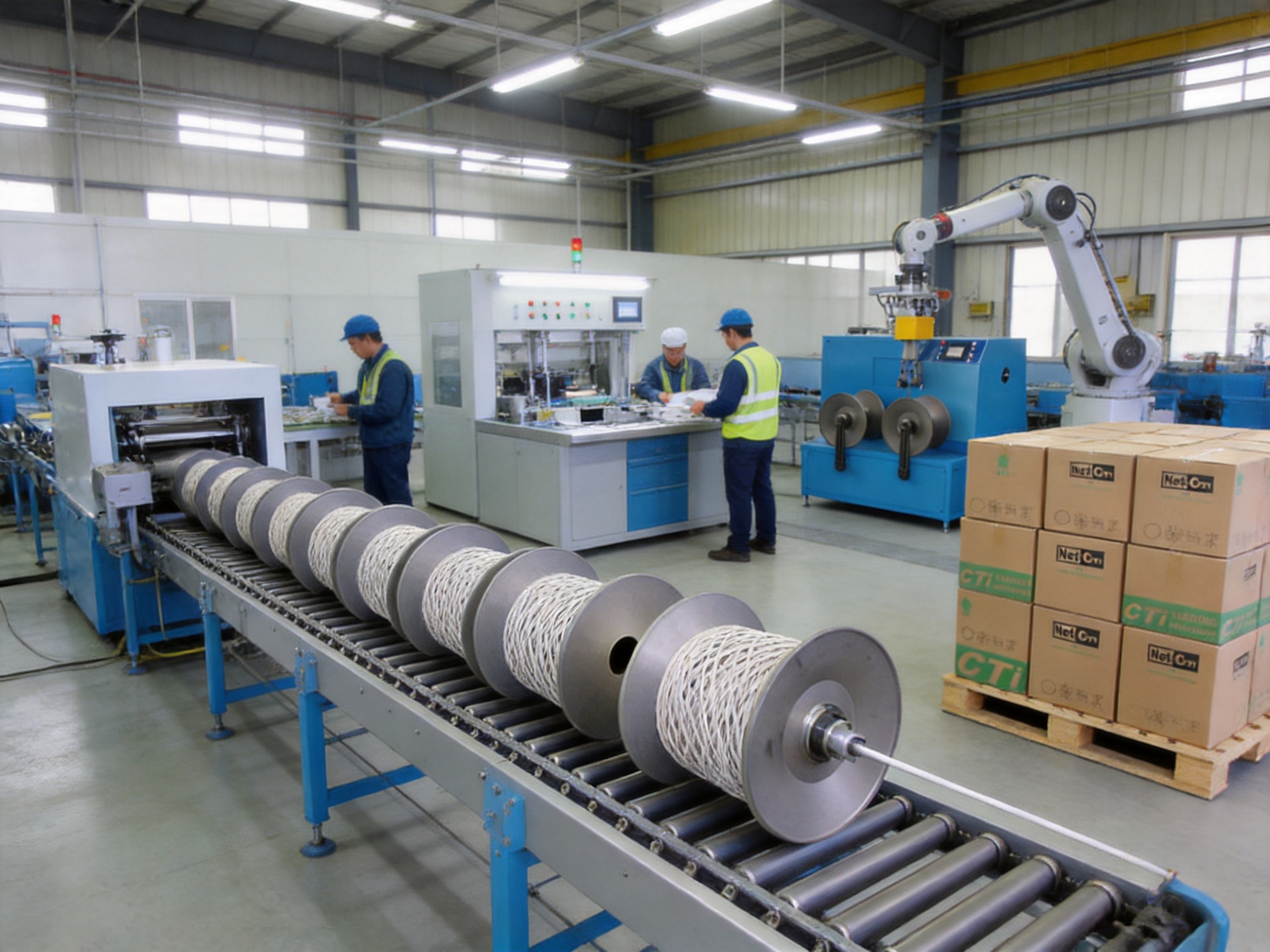
For high-volume operations, the coiler can be positioned near automatic packaging equipment. After a coil is completed, it may be transferred to a box, labeled, sealed, and sent to a stacking area. The supplier’s broader product range includes fully automatic coiling packaging equipment and intelligent robot stacker solutions, which can support manufacturers seeking a higher level of automation.
Integration should be planned around cable continuity and tension control. If the cable enters the coiler too quickly, excessive loops or tension may develop. If the supply is unstable, the finished coil may become uneven. Communication between upstream and downstream devices can help coordinate start, stop, speed change, and package-complete signals.
Manufacturers should also consider access for operators, cable threading, inspection, cleaning, and maintenance. A technically advanced machine must remain practical to use during everyday production. Clear work instructions and accessible adjustment points can reduce downtime and improve operator confidence.
Control and Operator Convenience
The touch-screen interface is intended to simplify parameter adjustment. Operators can use it to select winding with or without a hole and to set the required hole size. A suitable interface should make the relationship between each parameter and the final package clear.
Digital control also supports repeatability. Once a satisfactory setting has been established for a particular cable and box, the production team can document the setting and use it as a reference for future orders. This reduces dependence on memory and makes changeover procedures more structured.
Operator training should cover cable loading, threading, winding direction, speed selection, hole adjustment, emergency stopping, completed-coil removal, and routine inspection. Training is especially important when the machine is connected to other automated equipment, since a problem upstream or downstream may affect the coiling section.
Controls should be used together with physical inspection. Operators should verify that the cable is not rubbing against sharp edges, that the coil is forming evenly, that the package is stable, and that the finished dimensions match the order requirements. Automation improves consistency, but quality assurance remains an essential part of production.
Quality and Packaging Benefits
A consistent coil makes it easier to maintain packaging dimensions from one unit to the next. This can improve carton utilization and reduce the risk of packages that are too loose or too tight. Stable dimensions also help when products are labeled, weighed, palletized, or prepared for shipment.
The neat appearance of a cross-wound coil can strengthen product presentation. Customers often associate orderly packaging with careful manufacturing. For distributors and installers, a well-formed coil is easier to handle and may reduce the time required to prepare cable for use.
Packaging protection is another consideration. A stable coil is less likely to shift excessively inside its box. Reduced movement can help protect the jacket from abrasion caused by repeated friction during transport. Packaging materials and box design remain important, but the winding structure provides the foundation for a secure package.
Manufacturers should define acceptance criteria for finished coils. These criteria may include outside diameter, height, central-hole diameter, total cable length, coil stability, surface condition, winding direction, and labeling accuracy. Clear criteria make it easier to evaluate production results and maintain consistent quality across different operators and shifts.
Model Selection Guide
When to Choose DCW-2540
The DCW-2540 is suitable for cable diameters from 0.8 to 6 millimeters. It is a practical choice for manufacturers primarily producing smaller LAN cables and related communication products. Its non-pneumatic configuration may appeal to factories that prefer a simpler utility arrangement or do not require pneumatic operation for their standard products.
Typical candidates include many Cat5, Cat5e, and smaller Cat6 cable constructions, subject to actual cable flexibility and production testing. The model can be considered when product specifications remain within the stated diameter range and a straightforward automatic coiling process is desired.
When to Choose DCW-2540P
The DCW-2540P supports a broader nominal cable diameter range from 1 to 12 millimeters and includes pneumatic functionality. It may be more appropriate for manufacturers producing larger LAN cables, heavier-jacket products, or a mixture of communication cable sizes.
The pneumatic configuration can provide additional flexibility for specific operating or holding functions. Its suitability should be confirmed according to the exact cable construction, required winding tension, production speed, and factory utility conditions.
Questions to Ask Before Ordering
Before selecting a model, the buyer should identify the smallest and largest cable diameters, the cable jacket material, the target coil outside diameter, the desired coil height, the preferred hole size, the cable length per package, the required output per hour, and the available electrical and pneumatic utilities.
The buyer should also clarify whether the machine will operate as a standalone unit or as part of a complete automatic packaging line. Sample testing is recommended for cables with unusual stiffness, special shielding, soft jackets, flat constructions, or tight bending requirements.
Installation and Commissioning Considerations
Installation should begin with a suitable foundation and adequate working space. The machine must be positioned so that cable can be fed smoothly without sharp bends or unnecessary changes in direction. Sufficient access should be provided for threading, coil removal, cleaning, electrical inspection, and maintenance.
Electrical installation should be completed by qualified personnel according to the supplied technical documentation and applicable local requirements. If the selected model uses pneumatic functions, the plant should provide clean and stable compressed air at the required pressure and flow rate.
Commissioning should include an unloaded movement check, a low-speed cable trial, and a gradual increase to the intended operating condition. The production team should inspect the cable path, winding pattern, hole size, coil stability, and package dimensions at each stage.
Initial settings should be recorded. These records may include cable type, diameter, winding speed, hole setting, guide position, tension setting, and packaging format. A documented setup makes future production more efficient and reduces the time required for repeat orders.
Maintenance and Long-Term Reliability
Routine maintenance is essential for preserving winding accuracy. Operators should keep cable-contact surfaces clean and inspect them for wear, residue, or damage. Any surface that contacts the cable should remain smooth and free of sharp edges that could mark or cut the jacket.
Rotating and moving components should be inspected according to the supplier’s maintenance recommendations. Lubrication, fastening checks, belt or transmission inspection, sensor cleaning, and electrical cabinet checks may be required depending on the final machine configuration.
Pneumatic models require additional attention to air quality, filters, tubing, fittings, and cylinders. Moisture or contamination in the air system can affect pneumatic response and shorten component life. A preventive maintenance schedule can help identify developing problems before they cause an unplanned stoppage.
Maintenance personnel should also review the touch-screen settings and control functions. Backups of important production parameters can help restore normal operation after a control issue or accidental change. Operators should never bypass safety functions or continue operating a machine when abnormal noise, vibration, overheating, or cable damage is observed.
Business Value for Cable Manufacturers
The economic value of an automatic cross winder comes from more than its rotational speed. It can reduce manual labor, improve production consistency, support multiple product formats, and make final packaging more predictable. These benefits can contribute to lower handling costs and improved utilization of factory personnel.
Greater flexibility is particularly valuable when manufacturers serve several customer groups. A single machine that supports different LAN cable categories, coaxial cable applications, and adjustable hole sizes can reduce the need for separate dedicated winding stations.
Consistent packaging may also reduce rework. If coils fit correctly into boxes on the first attempt, fewer packages need to be opened and rearranged. Reduced rework saves material, time, and labor while helping the production schedule remain stable.
For exporters, a neat and secure package can support better logistics performance. Standardized coil dimensions make cartons easier to stack and calculate for shipment. Although transportation results depend on the entire packaging system, the coiling stage plays an important role in creating a stable unit load.
The machine can also support future automation. A manufacturer may begin with a standalone coiler and later add automatic boxing, labeling, conveying, or robotic stacking. Equipment that fits within a wider wire and cable machinery portfolio can make phased modernization more practical.
Recommended Production Workflow
A reliable workflow begins with verifying the cable specification and selecting the appropriate model. The cable should be checked for diameter, flexibility, surface condition, and any special construction features. Packaging dimensions should be confirmed before the hole and coil settings are finalized.
Next, the operator should thread the cable through the designated guide path and confirm that it moves without obstruction. The winding program should be selected through the touch screen, including the presence or absence of a central hole and the required hole dimension.
A short trial coil should be produced at a controlled speed. The operator should inspect the cross-winding pattern, coil edges, cable surface, central opening, and overall stability. If necessary, the guide position, winding speed, or other available settings should be adjusted.
Once the result is approved, the machine can proceed to normal production. Periodic checks should be performed throughout the shift to ensure that the cable supply, winding pattern, package dimensions, and coil quality remain consistent.
At the end of each production order, the operator should record completed quantities, rejected packages, parameter changes, and any observed issues. This information supports continuous improvement and provides useful feedback for future orders.
Frequently Asked Questions
What cable types can the Cross Winder for LAN Cable process?
The machine is designed for mainstream LAN cable types, including Cat5, Cat5e, and Cat6. It is also applicable to coaxial cable when the cable construction and diameter are suitable for the selected model. A sample test is recommended for products with unusual mechanical characteristics.
Can the machine produce a coil without a central hole?
Yes. The machine allows the operator to select winding with or without a hole. The appropriate mode depends on the customer’s packaging design and dispensing requirements.
Can the central-hole size be changed?
Yes. The hole size is adjustable through the touch-screen control interface. This allows the machine to accommodate different box dimensions and product presentation requirements within its operating range.
What is the difference between DCW-2540 and DCW-2540P?
The DCW-2540 is listed for cable diameters from 0.8 to 6 millimeters and does not use a pneumatic system. The DCW-2540P is listed for cable diameters from 1 to 12 millimeters and includes pneumatic functionality. Both models have a listed speed of 250 RPM, a height of 250 millimeters, an outside diameter of 400 millimeters, and an inside diameter of 180 millimeters.
Is the machine suitable for high-volume LAN cable production?
Its automatic operation and repeatable cross-winding process make it suitable for production environments where consistent cable packages are required. Actual output depends on cable length, winding settings, loading and unloading time, upstream supply, downstream packaging, and the required quality inspection process.
Does the machine eliminate manual labor completely?
The machine reduces manual coiling work but does not remove the need for operators. Personnel are still required for cable loading, setup, parameter confirmation, quality checks, coil removal, packaging coordination, and routine maintenance.
Can the machine be integrated with other cable equipment?
Yes. It can be used with pay-off equipment, take-up equipment, extrusion lines, testing systems, packaging machines, conveyors, and stacking solutions, subject to the interface and control requirements of the complete line.
What information should be supplied for a technical quotation?
Manufacturers should provide the cable type, cable diameter, cable construction, required coil dimensions, central-hole requirement, cable length per package, target production speed, packaging box dimensions, electrical supply, and pneumatic availability if applicable. Representative cable samples are useful for confirming performance.
How can manufacturers maintain consistent coil quality?
They should use stable upstream cable tension, correct model selection, documented operating parameters, regular guide and machine inspection, suitable packaging dimensions, and periodic finished-coil checks. Operators should also be trained to identify tangling, uneven edges, cable surface damage, and incorrect hole dimensions.
Why is a net-type coil useful?
A net-type coil provides an orderly cross-wound arrangement that can improve package stability, reduce random tangling, support easier storage and transport, and create a more consistent appearance than irregular manual bundling.
Conclusion
The Cross Winder for LAN Cable provides a practical automatic solution for manufacturers that need clean, repeatable, and flexible cable packages. Its compatibility with Cat5, Cat5e, Cat6, and suitable coaxial cable applications gives it broad relevance across communication cable production. Its net-type winding structure supports orderly storage and handling, while the selectable central-hole design allows manufacturers to match different packaging concepts.
The DCW-2540 and DCW-2540P configurations provide options for different cable diameter ranges and operating requirements. The touch-screen interface supports convenient adjustment, and the automatic process reduces dependence on manual coiling. Compared with fixed-format or labor-intensive winding methods, the machine offers greater flexibility for changing product specifications and packaging requirements.
The equipment also benefits from the supplier’s wider experience in wire and cable machinery, including extrusion, pay-off, take-up, packaging, and robotic stacking solutions. This broader production knowledge can support manufacturers that are planning a standalone upgrade or a complete cable production line.
For the best result, buyers should evaluate the machine together with their actual cable samples, package dimensions, production targets, and factory utilities. With correct model selection, commissioning, operator training, and preventive maintenance, the Cross Winder for LAN Cable can become an important part of a modern cable manufacturing and packaging process.
References
1. Product technical information for the Cross Winder for LAN Cable, including model specifications and applicable cable diameter ranges.
2. General principles of wire and cable manufacturing, cable handling, winding, and packaging operations.
3. Industrial automation practices for cable production lines, material feeding, take-up systems, coiling, and packaging integration.
4. Equipment maintenance principles for rotating machinery, cable-contact surfaces, electrical control systems, and pneumatic components.
5. Packaging and logistics considerations for coiled communication cables and structured cabling products.