LANGUAGE
 中文简体
 русский
 Français
 Español
 Português
 عربى

Content
- 1 Why Material Transfer Matters in Cable Manufacturing
- 2 Product Overview
- 3 Core Advantages of the Dual-Mode Transmission Design
- 4 Advantages Over Conventional Manual Handling
- 5 Energy and Labor Cost Considerations
- 6 Integration with Wire and Cable Production Equipment
- 7 Manufacturing Strengths and Engineering-Oriented Development
- 8 Design Features That Support Practical Factory Operation
- 9 How the System Can Improve Workplace Organization
- 10 Applications in Different Production Scenarios
- 11 Installation and Workflow Planning Considerations
- 12 Maintenance and Long-Term Performance
- 13 Comparison with Alternative Material Handling Methods
- 14 Why Choose an Integrated Wire and Cable Machinery Supplier
- 15 Value for Manufacturers Seeking Turnkey Solutions
- 16 Recommended Evaluation Checklist
- 17 Q&A About Cable Conveyor Belt Systems
- 17.1 What are Cable Conveyor Belt Systems used for?
- 17.2 What is the difference between automatic track transmission and manual roller transmission?
- 17.3 Can both transmission methods be used in one production line?
- 17.4 Are these systems suitable for small-batch production?
- 17.5 How can a conveyor reduce labor intensity?
- 17.6 Can the system be connected to coiling and packaging equipment?
- 17.7 Can it support future automation?
- 17.8 What information is needed for equipment planning?
- 17.9 Does the conveyor eliminate the need for manual operators?
- 17.10 Why work with a wire and cable machinery manufacturer?
- 18 Conclusion
- 19 References
- 20 Product: Cable Conveyor Belt Systems
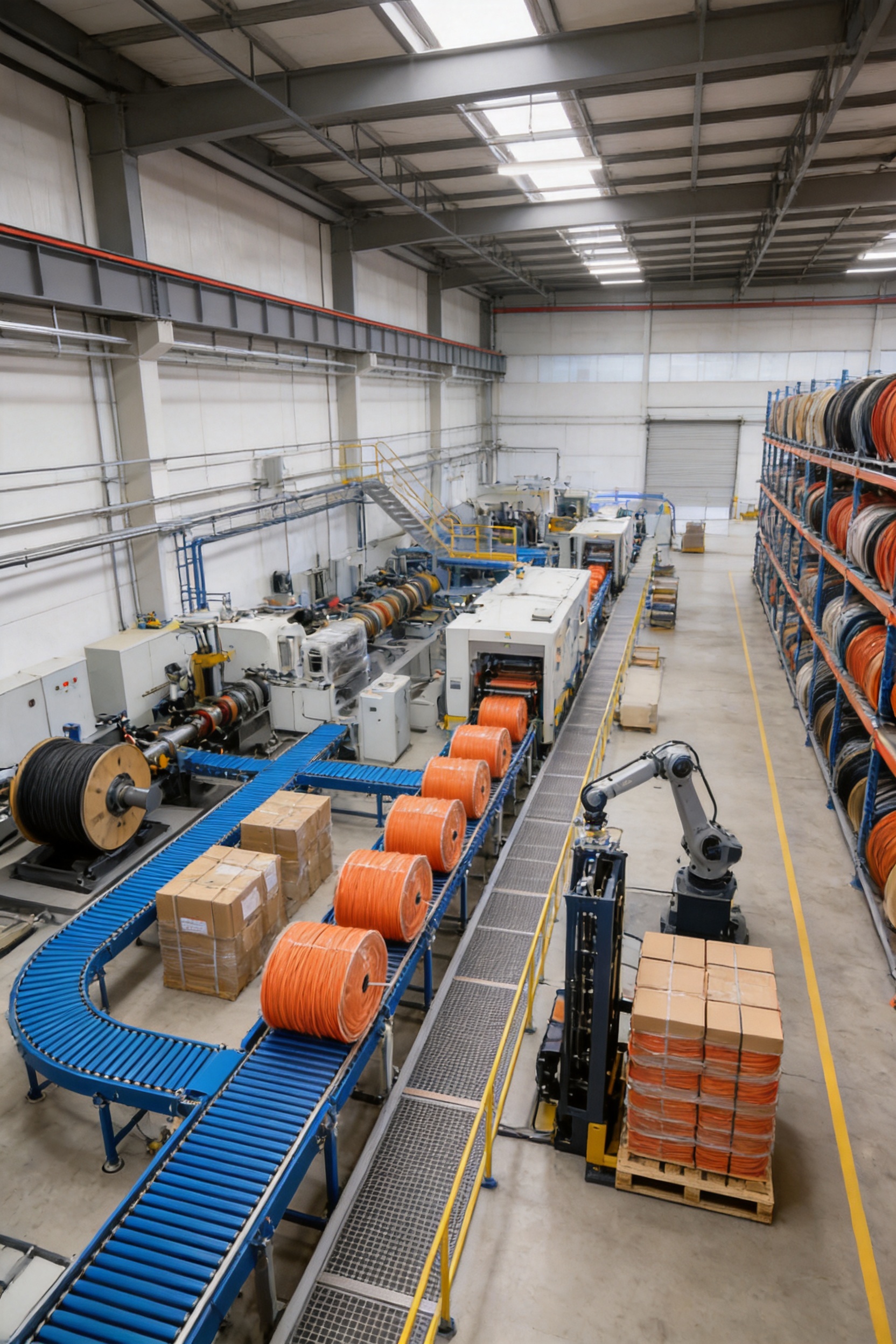
In modern wire and cable manufacturing, production efficiency depends on more than extrusion speed alone. Every meter of cable that leaves an extrusion line must be cooled, guided, collected, transported, inspected, packaged, and transferred to the next operating point. If packaged goods are moved manually over long distances, production teams may experience unnecessary labor requirements, material flow interruptions, product handling risks, and higher operating costs. Cable Conveyor Belt Systems provide a practical way to connect production areas with designated handling stations while creating a more organized and efficient material flow.
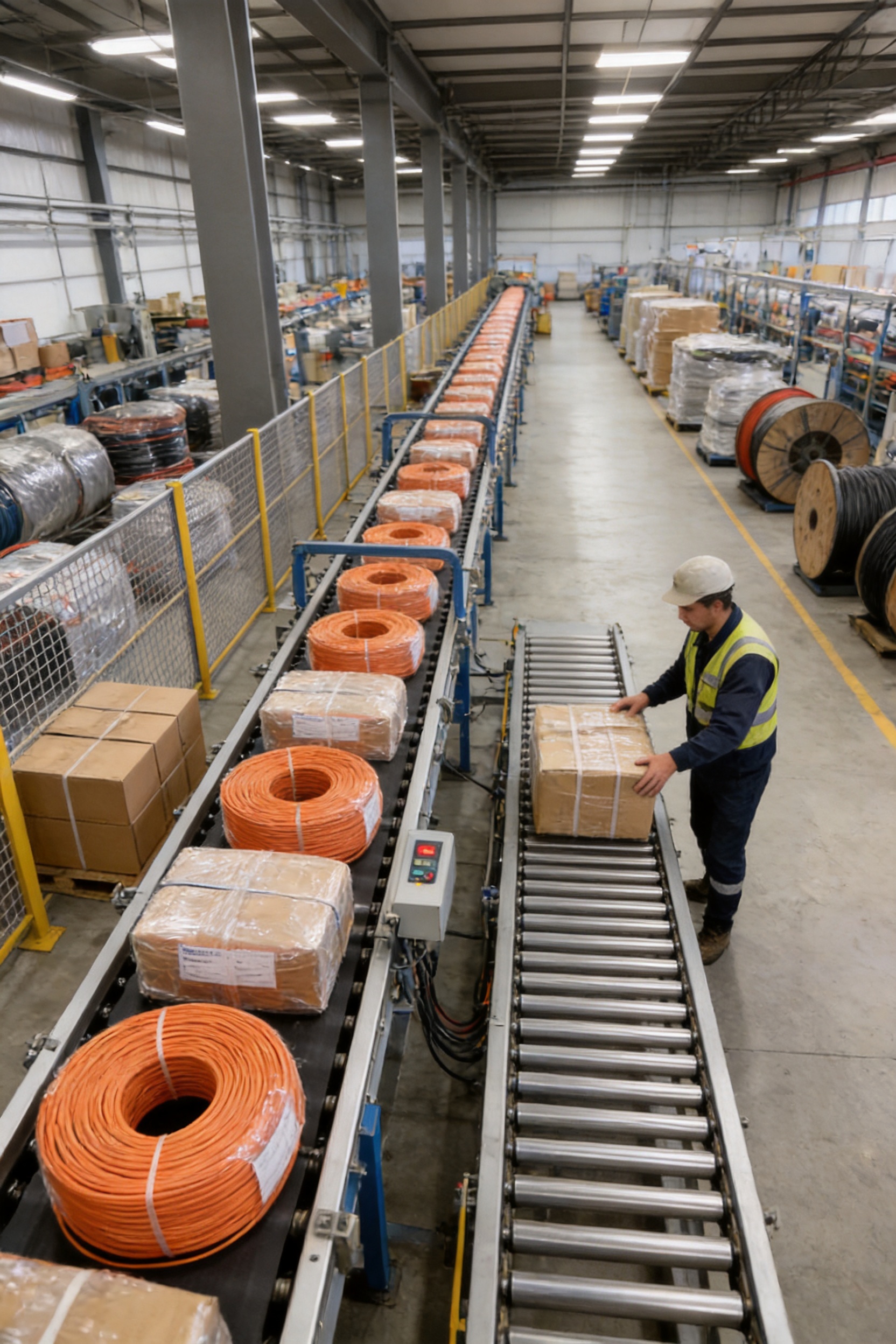
The Cable Conveyor Belt Systems described in this article are designed for packaged goods transfer in wire and cable production environments. The system combines two flexible transmission methods: automatic track transmission and manual roller transmission. Automatic track transmission supports continuous, consistent movement for repetitive production tasks, while manual roller transmission provides a simple and adaptable option for small-batch operations, temporary transfer points, or locations where operators need direct control over product movement.
By transferring packaged goods from the production location to an assigned manual handling area, the system reduces redundant carrying procedures and improves the use of factory space. It can help lower labor intensity, reduce unnecessary energy consumption, and support a smoother connection between manufacturing, packaging, inspection, storage, and dispatch operations.
Why Material Transfer Matters in Cable Manufacturing
Wire and cable production is usually organized as a sequence of connected operations. Depending on the product, the process may include conductor pay-off, drawing, stranding, insulation extrusion, cooling, printing, take-up, coiling, packaging, inspection, and final storage. Each operation must be coordinated with the next. Even when the main machinery performs reliably, inefficient movement between stations can weaken the performance of the entire production system.
Packaged cable products are often heavy, flexible, and difficult to carry safely by hand. Coils, drums, cartons, bundles, and wrapped products may need to move from a coiling or packaging machine to a manual inspection station, palletizing area, warehouse entrance, or loading zone. When these products are carried manually, workers may spend a substantial portion of their time on transportation rather than inspection, packaging control, or other value-adding tasks.
A conveyor system creates a defined route. Instead of repeatedly lifting, dragging, or carrying packaged products, operators can place them on the transmission platform and allow the system to move them toward the designated destination. This makes material handling more predictable and helps reduce unnecessary contact with the packaged product.
Efficient transfer also supports production planning. When material moves through a clear route, supervisors can more easily identify where products are located, where work is delayed, and whether packaging capacity is balanced with extrusion or coiling output. A well-arranged conveyor is therefore not only a transport device. It is part of the factory’s production organization.
Product Overview
The Cable Conveyor Belt Systems are accessory equipment intended for packaged goods transfer. Their central function is to move packaged products out of the production location and deliver them to a designated position for manual handling. The system is particularly useful in wire and cable manufacturing plants where production machinery and manual workstations are separated by a practical distance.
The transmission platform is divided into two operating forms:
Automatic track transmission is designed for consistent and efficient conveyance. It can support repetitive material movement along a planned route and reduce the need for continuous manual carrying. This operating method is suitable when packaged products must be transferred at regular intervals and when the production workflow benefits from steady movement.
Manual roller transmission is intended for flexible operation. Operators can move goods manually across the roller surface, making this option practical for small-batch production, variable product sizes, temporary work areas, or applications where the operator needs to stop, position, or redirect goods directly.
Combining both transmission methods gives the system broader usability than a single-mode conveyor. Automatic operation can be used where repetitive movement is the priority, while manual roller handling can be used where flexibility and direct operator control are more important.
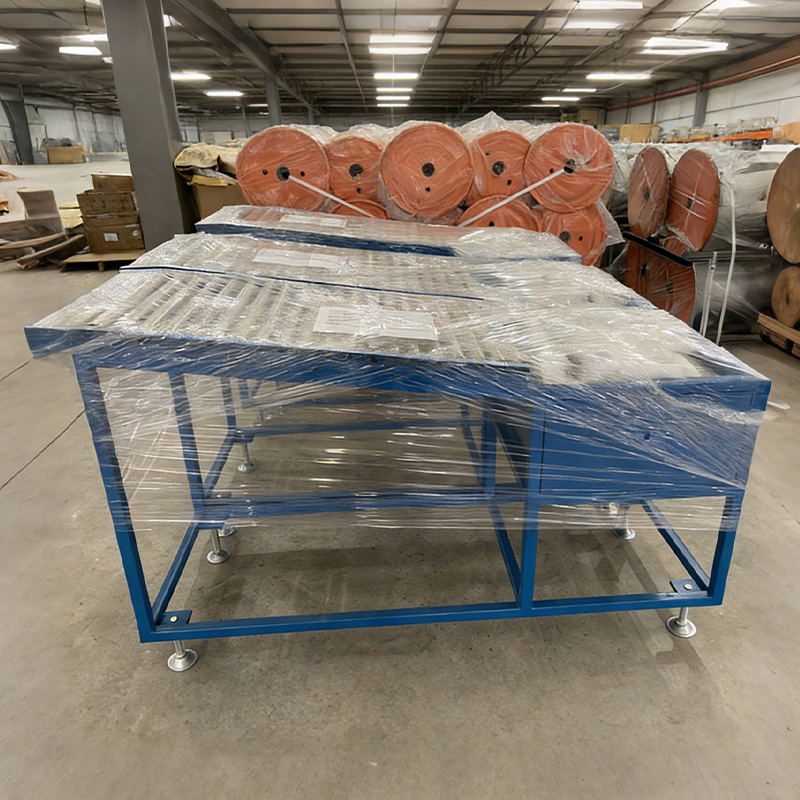
Cable Conveyor Belt Systems
Core Advantages of the Dual-Mode Transmission Design
Automatic Track Transmission for Consistent Conveyance
Automatic track transmission supports a stable movement pattern for packaged goods. In a production environment, consistency is valuable because materials should arrive at the next operating area at a predictable rate. A defined track can help reduce interruptions caused by manual carrying and can make the transfer process easier to coordinate with upstream packaging or coiling equipment.
Compared with completely manual transport, an automatic track reduces dependence on repeated physical movement by operators. This can help create a more orderly working area and can lower the risk of congestion around packaging machines. When several products are processed in succession, the track can support a continuous transfer rhythm instead of requiring a worker to carry each product individually.
Automatic transmission is also beneficial when the transfer distance is long or when the packaged product is too heavy or cumbersome for comfortable manual handling. By integrating the transfer route into the production layout, the manufacturer can use labor more efficiently and focus personnel on inspection, packaging quality, labeling, and process supervision.
Manual Roller Transmission for Flexible Handling
Manual roller transmission provides a different kind of value. Not every production order has the same packaging format, weight, dimensions, or transfer frequency. Small-batch production may not justify a fully automatic transfer sequence for every product. Operators may also need to reposition a package, inspect its surface, align it with a pallet, or temporarily hold it before the next process.
A manual roller platform allows products to be moved with relatively little effort while preserving direct operator control. It can be used as a standalone transfer section or as a complementary part of a larger conveyor arrangement. This flexibility is useful for plants that manufacture many cable specifications or frequently change production schedules.
Manual roller transmission can also support practical layout adjustments. If a workstation is temporarily relocated or if a production route changes, the roller section can provide a convenient connection without requiring the entire factory to be redesigned. This makes it a useful option for growing manufacturers and plants that need adaptable material handling.
One System for Different Production Conditions
The combination of automatic and manual transmission makes the equipment suitable for different operating conditions. A large, repetitive order may use automatic track transmission for the majority of the transfer route, while the final section near the inspection or packing area may use manual rollers. A small-batch order may rely mainly on manual roller movement. The same general system concept can therefore support both standardized production and flexible manufacturing.
This dual-mode approach can provide a better balance between automation investment and operational practicality. Instead of forcing every transfer activity into a fully automated structure, the plant can apply automation where it creates the greatest benefit and retain manual control where product variation makes it more useful.
Advantages Over Conventional Manual Handling
Traditional manual handling may appear simple because it does not require dedicated transfer equipment. However, it can create hidden costs. Workers may need to walk repeatedly between production equipment and handling stations. Heavy products can increase physical strain. Delays may occur when the assigned worker is busy with another task. Packages can also be placed temporarily in unsuitable locations, creating congestion or obstructing walkways.
A Cable Conveyor Belt System addresses these challenges by establishing a regular route and a designated transfer method. The benefits may include improved workplace organization, reduced unnecessary walking, better use of labor, and more predictable product movement.
Another advantage is that the system can help reduce repeated handling. Every additional lifting or dragging action increases the possibility of package damage, surface contamination, label displacement, or accidental impact. A conveyor-supported route minimizes the number of times operators need to physically move the packaged product.
Conveyors can also support more consistent production records. When the transfer path is connected to packaging or coiling equipment, it is easier to observe product flow and identify whether a bottleneck occurs before or after packaging. This visibility is valuable for production managers who want to improve throughput without immediately replacing major manufacturing equipment.
Energy and Labor Cost Considerations
One of the stated purposes of the transmission platform is to save energy and labor costs. The system supports this objective by shortening unnecessary material movement and reducing repetitive manual transport. The exact savings depend on the product weight, transfer distance, operating schedule, layout, and selected transmission mode, but the principle is straightforward: a defined transfer route can reduce wasted movement throughout the working day.
Labor savings do not necessarily mean eliminating personnel. In many factories, the more practical objective is to redirect workers toward tasks that require judgment and attention. Operators can spend more time checking packaging integrity, confirming product specifications, recording production data, preparing dispatch documents, or monitoring equipment conditions instead of carrying goods from one area to another.
Energy efficiency also depends on selecting the appropriate operating mode. Automatic track transmission can be used for regular and continuous movement, while manual roller transmission can be used when automatic operation would be unnecessary. This flexible approach helps the plant avoid operating a powered transfer system when only a few packages must be moved.
When evaluating cost performance, manufacturers should consider the total workflow rather than only the purchase price of the conveyor. Relevant factors include labor requirements, product handling frequency, floor-space utilization, transfer time, maintenance needs, and the potential reduction in handling-related disruptions. An appropriately configured system may provide value throughout the service life of the production line.
Integration with Wire and Cable Production Equipment
The conveyor system is designed as accessory equipment and can support a broader wire and cable production environment. It may be positioned after coiling equipment, packaging equipment, take-up equipment, or other machinery that produces packaged cable goods. It can also form a connection between the packaging area and an inspection, warehousing, or manual handling station.
In a typical workflow, cable is manufactured through one or more production stages. After extrusion, cooling, printing, and take-up, the finished cable may be coiled or gathered into a defined package. Packaging equipment then protects the product and prepares it for transfer. At this point, the conveyor system can move the package away from the production location and toward the next assigned station.
This arrangement helps separate production machinery from manual handling activities. The packaging machine can continue operating without requiring a worker to stand beside it solely for product removal. At the receiving end, an operator can complete inspection, labeling, pallet preparation, or other manual tasks in a more suitable working position.
The conveyor can also complement intelligent robot stackers and fully automatic coiling packaging equipment. In a more automated line, the system may act as a transfer link between packaging and robotic stacking. In a semi-automatic line, it may deliver products to a worker for visual inspection or manual palletizing. This adaptability enables manufacturers to improve automation gradually rather than changing every part of the line at once.
| Production Area | Possible Conveyor Function | Primary Operational Benefit |
|---|---|---|
| Coiling station | Move completed coils toward packaging or inspection | Reduces repeated manual carrying |
| Packaging station | Transfer wrapped cable packages to a handling point | Creates a defined material flow route |
| Inspection area | Present packaged goods for manual checking | Supports organized quality-control work |
| Warehouse entrance | Move finished packages toward storage or dispatch | Improves connection between production and logistics |
| Robot stacking area | Deliver packages for automatic stacking | Supports expansion toward higher automation |
| Small-batch workstation | Provide manually controlled roller movement | Maintains flexibility for variable orders |
Manufacturing Strengths and Engineering-Oriented Development
Shanghai Yessjet Precise Machinery Co., Ltd. operates in the wire and cable machinery sector and provides equipment related to wire and cable production lines, coiling, pay-off, take-up, packaging, accessory systems, and cable extrusion. This product range gives the company an engineering-oriented understanding of the relationship between primary production machinery and auxiliary handling equipment.
A conveyor used in a cable factory must be considered in relation to the products and machines around it. The dimensions of a cable coil, the type of packaging, the position of the take-up machine, the height of the receiving station, and the desired transfer direction all influence the practical performance of the system. A manufacturer that works across several categories of cable machinery is better positioned to consider these connections during equipment planning.
The company’s manufacturing strength is also reflected in its ability to provide equipment for complete or partial production solutions. Wire and cable manufacturers often need more than an isolated machine. They may require a coordinated arrangement that includes pay-off equipment, extrusion equipment, take-up equipment, coiling machines, packaging equipment, conveyor systems, and stacking equipment. A supplier with a broad product portfolio can help customers create a more coherent workflow.
An engineering-oriented production process generally begins with understanding the customer’s material flow. The manufacturer can assess where packaged products are generated, how far they must travel, how operators receive them, and whether automatic or manual transmission is more appropriate. This application-based approach is more useful than selecting a conveyor solely by length or appearance.
Application Analysis Before Equipment Production
Before manufacturing or configuring a conveyor system, several operating conditions should be considered. These include product type, package dimensions, package weight, transfer distance, required height, movement frequency, receiving method, available floor space, and the relationship with existing production machines.
For example, a plant producing a small number of heavy cable drums may need a different transfer arrangement from a plant producing many lightweight coils every hour. A facility with a fixed, linear layout may prefer automatic track transmission, while a facility with changing product routes may benefit from manual roller sections. Understanding these conditions helps prevent the installation of equipment that is technically functional but poorly matched to the production process.
Coordinated Manufacturing and Assembly
Manufacturing quality depends on coordination between component preparation, fabrication, assembly, adjustment, and inspection. A conveyor is not merely a frame and a moving surface. Its structure must be assembled accurately so that products can move smoothly and the operating path remains stable. The transmission components, support structure, guides, and connection points must work together as a complete system.
For an equipment manufacturer, disciplined assembly practices help improve repeatability. Components should be checked before assembly, mechanical connections should be secured properly, and the completed unit should be reviewed for alignment and operating consistency. These steps are especially important when the conveyor is integrated with packaging equipment or another machine whose output height and position are fixed.
Process-Based Quality Control
Quality control is most effective when it is built into the manufacturing process rather than performed only at the end. For Cable Conveyor Belt Systems, process-based quality control can include checking structural dimensions, transmission alignment, roller or track movement, operating stability, connection quality, and the interface between the conveyor and adjacent equipment.
Final inspection should confirm that the system performs its intended transfer function. The equipment should be reviewed under representative operating conditions, including the movement of packaged products across the transmission platform. This approach helps identify issues that may not be visible during an inspection of individual components alone.
Although specific configurations may differ according to customer requirements, a systematic manufacturing process provides a foundation for stable equipment performance. It also supports clearer communication between engineering, production, assembly, and customer service teams.
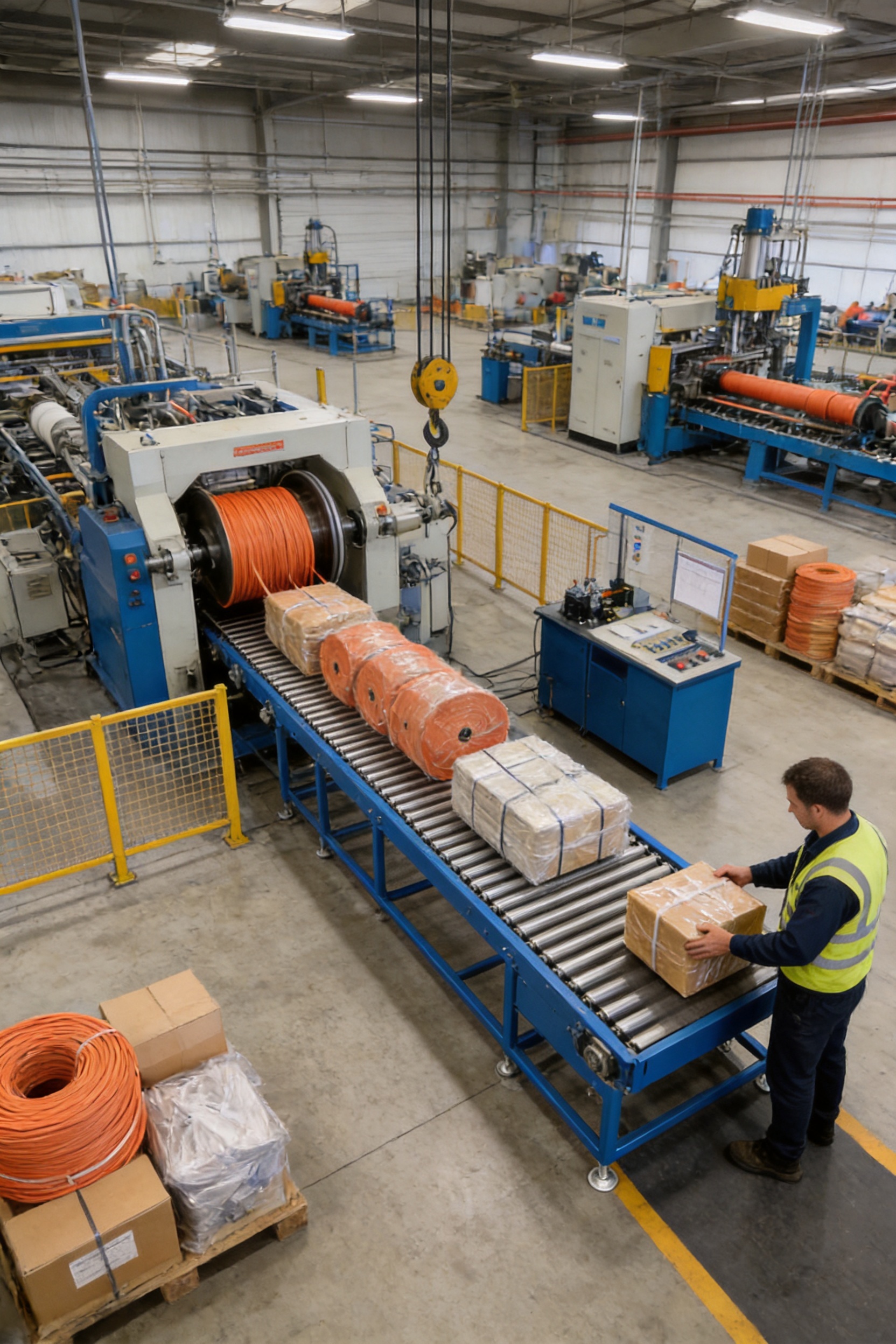
Design Features That Support Practical Factory Operation
Defined Product Flow
The conveyor establishes a clear route between the production area and the designated manual handling location. A defined route can improve visual organization and reduce the chance that finished goods will be left in aisles or placed in random temporary positions.
Flexible Operating Method
The availability of automatic track transmission and manual roller transmission allows the plant to select the operating method according to production needs. This is especially useful for manufacturers handling multiple cable types or order quantities.
Reduced Handling Frequency
Moving products through a conveyor-supported path can reduce the number of times packages must be lifted, dragged, or carried. Fewer handling actions may help protect product packaging and improve operator comfort.
Support for Manual Workstations
The system does not remove the need for skilled manual work. Instead, it delivers products to a planned location where operators can perform inspection, sorting, labeling, pallet preparation, or other tasks efficiently.
Compatibility with Production Expansion
Because the conveyor functions as accessory equipment, it can be included in a new production line or added to an existing workflow. This makes it suitable for plants that are improving automation step by step.
How the System Can Improve Workplace Organization
Factory organization has a direct effect on productivity and safety. When finished goods are carried manually, they may be temporarily placed near machines, doorways, aisles, or emergency access points. These temporary locations can create obstacles and make it harder for workers to identify which products are ready for inspection or dispatch.
A conveyor provides a visible and dedicated movement route. Products can enter the route at the production side and leave it at the receiving side. The defined path can help separate moving goods from walking areas and can make the status of finished products easier to understand.
Better organization may also simplify cleaning and routine maintenance. When packages are not scattered throughout the production floor, workers can access the area around machines more easily. The production team can identify spills, obstructions, or abnormal material accumulation sooner.
In addition, a clear transfer route supports communication between departments. Production personnel know where the packaged goods are sent, inspection personnel know where to receive them, and warehouse personnel can plan the next movement more effectively. These improvements are simple but valuable in daily factory operation.
Applications in Different Production Scenarios
High-Frequency Packaged Cable Production
In a high-frequency production environment, automatic track transmission can help maintain a consistent flow from packaging equipment to the next station. This arrangement may reduce waiting time between packages and decrease the need for a worker to repeatedly travel between stations.
Small-Batch and Customized Orders
Small-batch production often involves different package sizes, cable specifications, and delivery destinations. Manual roller transmission provides the operator with direct control and makes it easier to adjust the transfer process for each order.
Inspection and Rework Areas
Some packaged goods require visual inspection, measurement, labeling verification, or rework before entering storage. A conveyor can bring products to a designated manual station where these tasks are performed in an orderly sequence.
Connection to Warehousing and Dispatch
Finished cable packages can be moved toward a warehouse entrance or dispatch preparation area. The conveyor does not replace warehouse equipment, but it can provide a practical link between production output and logistics handling.
Progressive Automation Projects
Manufacturers may begin with manual handling, add roller transmission, and later introduce automatic track transmission or robotic stacking. This progressive approach allows investment to follow production growth and operational priorities.
Installation and Workflow Planning Considerations
Correct planning is important for achieving the benefits of a conveyor system. The equipment should be positioned so that the entry point matches the output of the upstream production or packaging machine. The receiving end should be aligned with the manual handling station, pallet area, inspection bench, warehouse route, or robotic equipment that follows.
The layout should allow workers to approach the conveyor safely without blocking the moving path. Adequate space should be provided around loading and receiving points so that operators can perform their tasks comfortably. The route should also be considered in relation to doors, columns, other equipment, maintenance access, and emergency pathways.
Product characteristics must be reviewed before final configuration. Cable packages may differ in diameter, width, weight, wrapping method, and base shape. The selected transmission surface and support arrangement should be suitable for the products that will actually move through the system.
Operating procedures should be established after installation. Personnel should understand how to place products on the transmission platform, how to use the automatic and manual modes, how to stop the system when necessary, and how to report abnormal movement. Clear procedures help protect both the equipment and the packaged products.
Maintenance and Long-Term Performance
Routine maintenance is essential for any material handling system. Operators should regularly observe whether the transmission path is moving smoothly, whether packages remain stable, and whether unusual noise, vibration, or resistance occurs. Early attention to abnormal conditions can help prevent larger interruptions.
The transmission surface should be kept free of packaging debris, loose materials, and other obstructions. The surrounding area should also remain clean so that products can enter and exit the system without interference. Periodic checks should include structural connections, supports, rollers or track components, and interfaces with adjacent machinery.
Maintenance requirements may vary according to the selected configuration and operating frequency. A system used continuously in a high-output factory may require more frequent inspection than a manual roller section used occasionally for small batches. A practical maintenance schedule should therefore be based on actual usage conditions.
Good maintenance also helps preserve the advantages of the system. Stable transmission supports consistent workflow, reduces unexpected manual handling, and helps the factory maintain a predictable transfer rhythm.
Comparison with Alternative Material Handling Methods
Manual carrying provides maximum simplicity but usually requires more labor and creates greater dependence on operator availability. It may be acceptable for very low production volumes, short distances, or exceptionally light packages, but it becomes less efficient as production output increases.
Forklift transport can handle heavier loads and longer distances, but it requires trained operators, maneuvering space, traffic control, and suitable floor conditions. Forklifts may also be less practical for frequent short-distance movement directly from a packaging machine to a nearby workstation.
Standalone carts provide flexibility and can be useful for varied products. However, carts still require workers to push or pull them, and they may occupy aisles or need to be returned after each transfer. A fixed conveyor route offers more consistent movement for repetitive transfers.
A fully automated conveyor may provide high throughput, but it can be more complex and less flexible for variable production conditions. The dual-mode design described here offers a compromise: automatic operation where consistent movement is needed and manual roller handling where flexibility is more valuable.
| Handling Method | Strength | Limitation | Suitable Use |
|---|---|---|---|
| Manual carrying | Simple and immediately available | Labor-intensive and physically demanding | Very low volume or short-distance movement |
| Forklift | Suitable for heavy loads | Requires space, traffic control, and trained operation | Warehouse and long-distance transport |
| Transfer cart | Flexible route selection | Requires repeated pushing and return movement | Variable destinations and intermittent handling |
| Automatic track transmission | Consistent and efficient conveyance | Best suited to planned routes | Repetitive production transfer |
| Manual roller transmission | Flexible and easy to control | Still requires operator movement | Small batches and variable products |
| Dual-mode conveyor system | Balances automation and flexibility | Requires suitable layout planning | Mixed production environments |
Why Choose an Integrated Wire and Cable Machinery Supplier
Selecting accessory equipment from a supplier familiar with wire and cable production can simplify the planning process. A conveyor must work alongside the machines that produce, collect, coil, package, and stack the cable. A supplier with experience across these equipment categories can better understand the operational relationship between them.
Shanghai Yessjet Precise Machinery Co., Ltd. presents itself as a wire and cable machinery manufacturer providing cable production turnkey solutions and custom wire cable production line support. Its product categories include wire and cable extrusion lines, fully automatic coiling packaging equipment, intelligent robot stackers, coiling machines, motorized pay-off equipment, motorized take-up equipment, accessory equipment, and cable extrusion machines.
This broad scope is important because material handling improvements are often most effective when they are considered as part of the complete line. A conveyor positioned after a coiling machine may need to coordinate with package output. A conveyor leading to a robot stacker may need to support a repeatable presentation position. A manual roller section near a packaging station may need to accommodate frequent product changes.
An integrated supplier can evaluate these relationships and help the customer select a practical combination of machines. The goal is not simply to add more automation, but to create a workflow in which each machine supports the next operation.
Value for Manufacturers Seeking Turnkey Solutions
Turnkey production solutions can reduce the difficulty of coordinating equipment from multiple sources. When a production line includes extrusion, pay-off, take-up, coiling, packaging, conveying, and stacking, each interface must be considered. Differences in dimensions, operating logic, transfer height, and product presentation can create delays if they are not addressed during the planning stage.
A machinery supplier that provides several related categories can support a more coordinated project. The conveyor system can be treated as part of the material flow rather than as an unrelated accessory. This perspective helps the manufacturer consider production speed, package handling, operator positions, inspection points, and warehouse transfer together.
For customers with existing equipment, a conveyor may provide a relatively practical improvement without replacing the main production machines. Adding a transfer route after packaging can reduce manual work and improve organization while preserving the customer’s existing extrusion or coiling investment.
Recommended Evaluation Checklist
Before selecting a Cable Conveyor Belt System, the manufacturer should define the products that will move through it. Important information includes package type, dimensions, weight, surface condition, quantity per hour, and whether the package is rigid, flexible, wrapped, boxed, or coiled.
The transfer route should also be described. The customer should identify the starting point, destination, distance, required direction, elevation difference, available floor area, and any obstacles around the route. Photos, layout drawings, and equipment dimensions can support accurate planning.
The operating method should be selected according to production conditions. Automatic track transmission is generally appropriate for repeated and predictable movement. Manual roller transmission is useful when product variety, low volume, or direct operator control is important. A combined arrangement may be the most practical option for a mixed production line.
The receiving operation must be considered as carefully as the starting operation. The product should arrive at a location where workers or downstream equipment can receive it safely and efficiently. If the destination is a robot stacker, the presentation position must be consistent. If the destination is a manual station, the operator should have enough room to inspect and handle the goods.
Finally, the customer should discuss maintenance access, operating procedures, safety expectations, future production growth, and possible expansion toward additional automation. These considerations help ensure that the system remains useful as the factory develops.
Q&A About Cable Conveyor Belt Systems
What are Cable Conveyor Belt Systems used for?
They are used to transfer packaged wire and cable goods from a production location to a designated manual handling station or another downstream area. Typical destinations include inspection stations, packaging areas, warehouse entrances, dispatch zones, and robotic stacking equipment.
What is the difference between automatic track transmission and manual roller transmission?
Automatic track transmission moves packaged products through a defined route with consistent, efficient conveyance. Manual roller transmission allows operators to move products manually across rollers, providing greater flexibility for small batches, variable products, and situations requiring direct control.
Can both transmission methods be used in one production line?
Yes. A production line can use automatic track transmission for repetitive movement and manual roller transmission at a receiving or adjustment area. Combining both methods allows the factory to balance efficiency with flexibility.
Are these systems suitable for small-batch production?
Yes. The manual roller transmission option is particularly suitable for small-batch manufacturing and production environments where product sizes, package formats, or destinations change frequently.
How can a conveyor reduce labor intensity?
It reduces the need for workers to repeatedly carry, lift, or drag packaged products between production equipment and handling stations. Workers can focus more on inspection, packaging control, labeling, and other tasks that require attention.
Can the system be connected to coiling and packaging equipment?
Yes. The system can be planned as an accessory to coiling machines, packaging equipment, take-up equipment, and other wire and cable machinery. The connection should be designed according to product dimensions, output position, transfer height, and downstream handling requirements.
Can it support future automation?
Yes. A conveyor can serve as a link to intelligent robot stackers or other automated handling equipment. It can also be added as part of a gradual automation program in which the factory improves material flow step by step.
What information is needed for equipment planning?
Useful information includes package dimensions, product weight, package type, transfer distance, desired height, production volume, operating frequency, starting and receiving equipment, factory layout, and the preferred balance between automatic and manual transmission.
Does the conveyor eliminate the need for manual operators?
Not necessarily. It is designed to reduce unnecessary carrying and improve the location of manual work. Operators may still be needed for inspection, packaging verification, labeling, pallet preparation, product sorting, and other tasks.
Why work with a wire and cable machinery manufacturer?
A supplier familiar with extrusion lines, pay-off equipment, take-up equipment, coiling machines, packaging systems, and robot stackers can better understand how the conveyor should interact with the complete production workflow. This can simplify project coordination and improve equipment compatibility.
Conclusion
Cable Conveyor Belt Systems provide a practical material handling solution for wire and cable manufacturers that want to improve the movement of packaged goods. Their combination of automatic track transmission and manual roller transmission allows the system to support both repetitive high-efficiency conveyance and flexible small-batch operation.
The system can reduce redundant carrying, lower labor intensity, improve the organization of factory space, and create a clearer connection between production equipment and manual handling stations. It can also support broader automation projects by linking coiling, packaging, inspection, warehousing, and robotic stacking operations.
The main advantage of this design is its balance. Automatic transmission is available where consistent movement is required, while manual roller transmission remains available where product variation and operator control are important. This makes the equipment suitable for diverse production environments rather than only one narrowly defined application.
As a wire and cable machinery manufacturer, Shanghai Yessjet Precise Machinery Co., Ltd. offers a product range that covers primary production machinery and accessory equipment. This broader engineering background supports the development of coordinated wire and cable production solutions, including extrusion, coiling, packaging, conveying, pay-off, take-up, and stacking functions.
For manufacturers seeking to reduce handling costs and improve production flow, a properly planned conveyor system can be a valuable upgrade. By treating material transfer as an essential part of the production line, enterprises can create a more efficient, organized, and scalable manufacturing environment.
References
1. Wire and Cable Manufacturing Process Principles, industrial production reference material.
2. Material Handling Equipment Selection and Factory Workflow Planning, manufacturing engineering reference material.
3. Conveyor Systems: Design, Operation, and Maintenance Practices, mechanical handling reference material.
4. Industrial Ergonomics and Manual Material Handling Guidelines, workplace efficiency reference material.
5. Cable Extrusion and Finishing Line Engineering, wire and cable production reference material.
6. Production Automation and Integrated Packaging Systems, industrial automation reference material.