LANGUAGE
 中文简体
 русский
 Français
 Español
 Português
 عربى

Content
- 1 Why Circular Coil Packaging Matters
- 2 Product Overview
- 3 Main Technical Specifications
- 4 Key Advantages Over Manual and Basic Wrapping Methods
- 5 Application in Wire and Cable Production
- 6 How the Four-Arm Carrier Supports Better Wrapping
- 7 Manufacturing Strengths and Engineering Approach
- 8 Operational Workflow
- 9 Choosing the Correct Model
- 10 Installation and Factory Layout Considerations
- 11 Maintenance and Long-Term Performance
- 12 Safety and Operator Training
- 13 Advantages for Different Types of Manufacturers
- 14 Comparison with Competing Packaging Approaches
- 15 Economic and Environmental Considerations
- 16 Integration with a Complete Cable Production Solution
- 17 Frequently Asked Questions
- 17.1 Is this a fully automatic wrapping machine?
- 17.2 What products can be wrapped?
- 17.3 Which wrapping materials are supported?
- 17.4 How many wrapping programs can be stored?
- 17.5 What is the largest listed coil capacity?
- 17.6 What is the smallest listed model?
- 17.7 Does the machine detect faults automatically?
- 17.8 Is a touch screen included?
- 17.9 Why is smooth carrier rotation important?
- 17.10 How should a customer select a model?
- 17.11 Can the wrapping machine be connected with other cable machinery?
- 17.12 What makes this machine suitable for wire and cable factories?
- 18 Conclusion
- 19 References
- 20 Product: Auto-Wrapping Machine For Circular Object
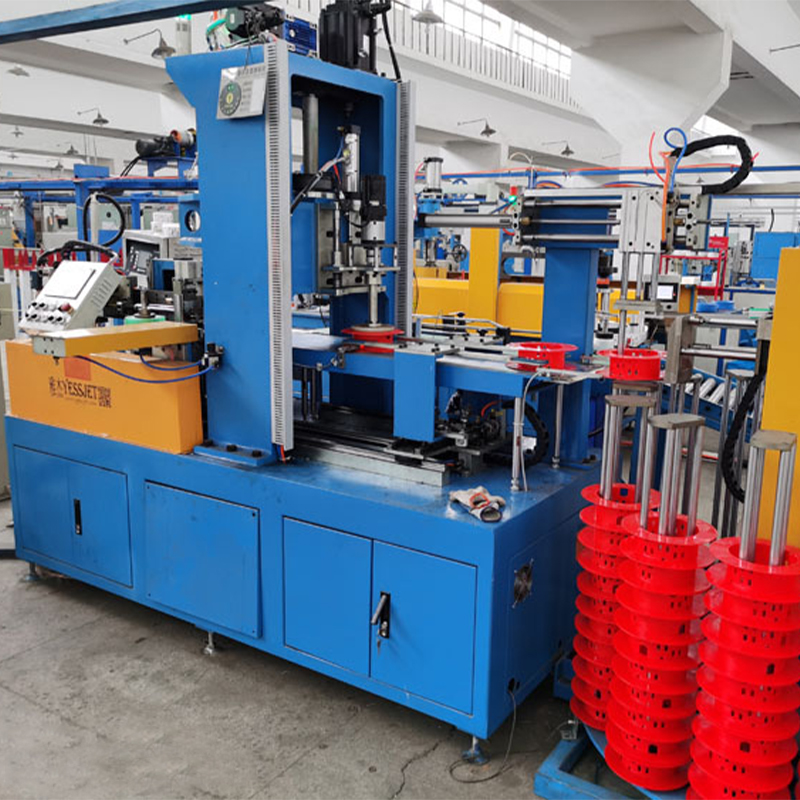
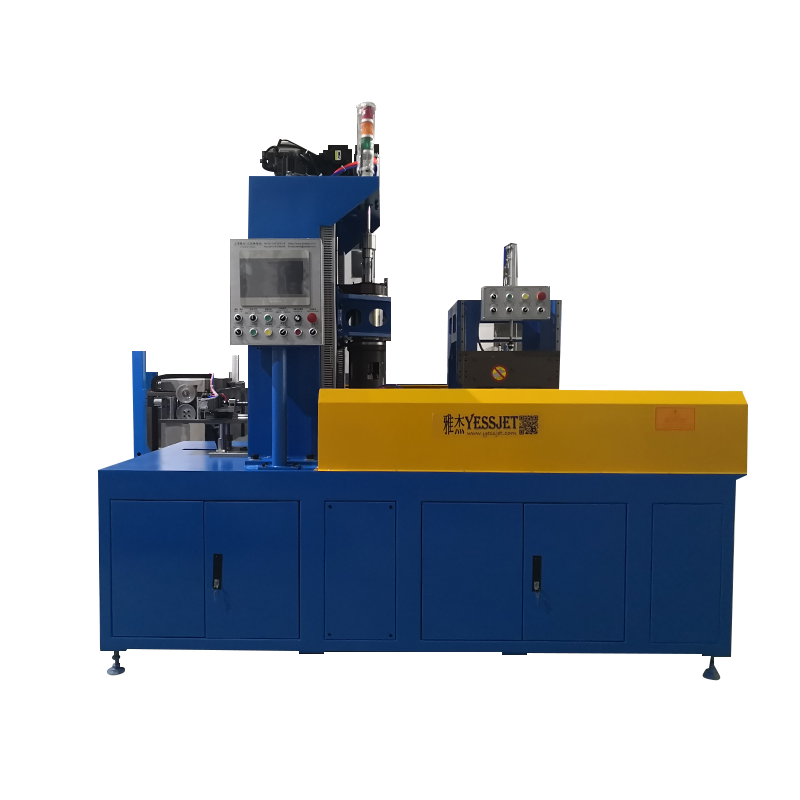
Efficient packaging is an essential stage in modern wire and cable production. After extrusion, cooling, testing, measuring, and coiling, the finished product must be protected from dust, moisture, abrasion, and handling damage. It must also be presented in a compact, stable, and professional form for storage, transportation, and delivery. The automatic wrapping machine for circular objects is designed to meet these requirements by applying PVC film, PE film, PP woven band, paper, or other suitable packaging materials around circular products such as wire coils and cable coils.
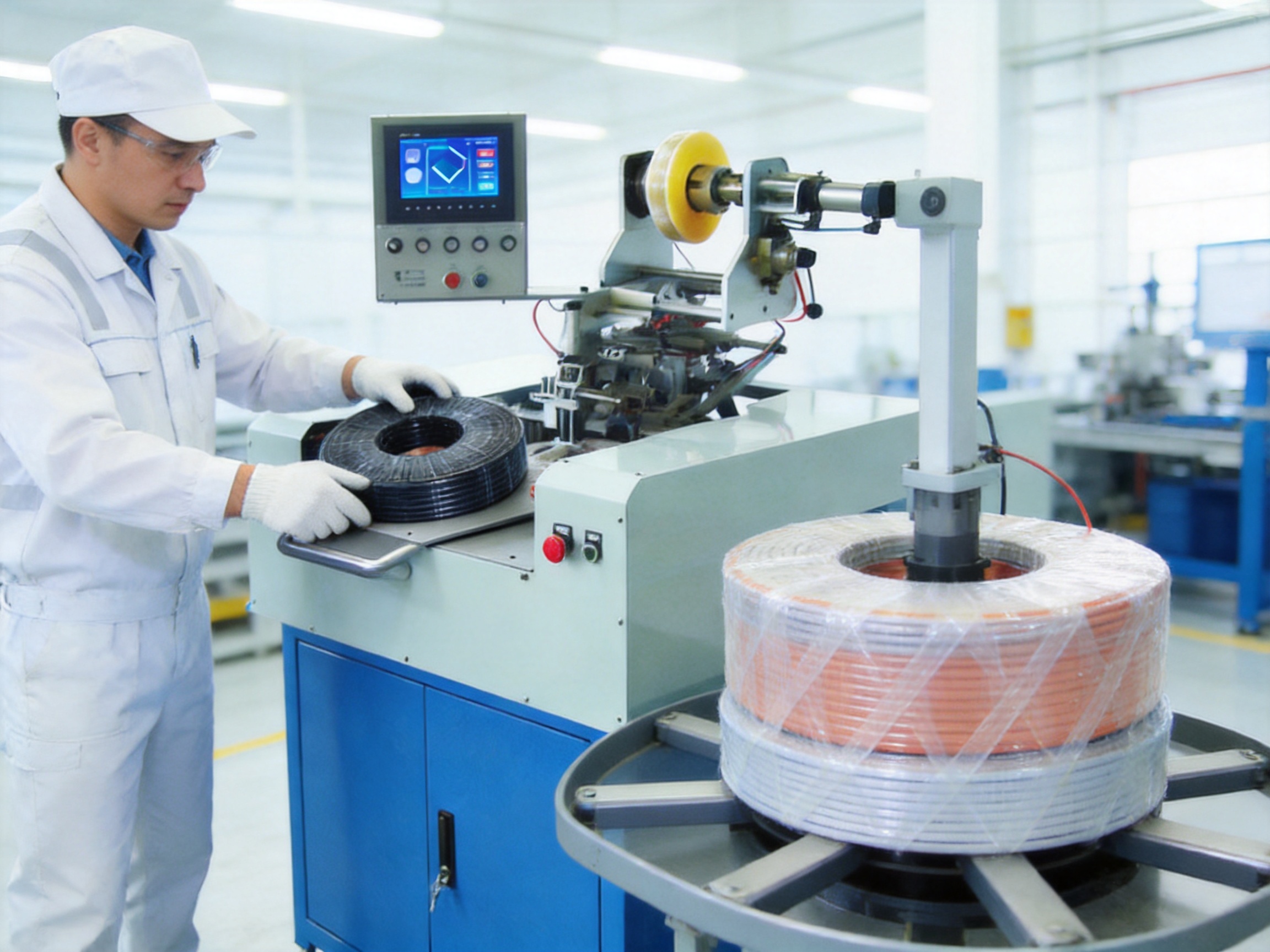
This equipment combines a powered four-arm carrier, programmable control, touch-screen operation, automatic fault detection, and flexible wrapping parameters. It is particularly suitable for circular wire products, including BV, BVR, RVV, UL electronic wires, flower wires, and similar cable coils. Although the machine is described as semi-automatic because an operator places the coil onto the handle plate manually, the wrapping cycle itself is highly automated. Once the product is positioned and the correct program is selected, the machine can perform the main wrapping operation consistently and efficiently.
For wire and cable manufacturers, this combination of simple loading and automatic wrapping offers a practical balance between investment, productivity, and operating convenience. It reduces repetitive manual packaging work while preserving flexibility for different coil sizes. Compared with basic manual wrapping or less adaptable packaging machines, it provides better control over packaging quality, faster cycle preparation, and more reliable production continuity.
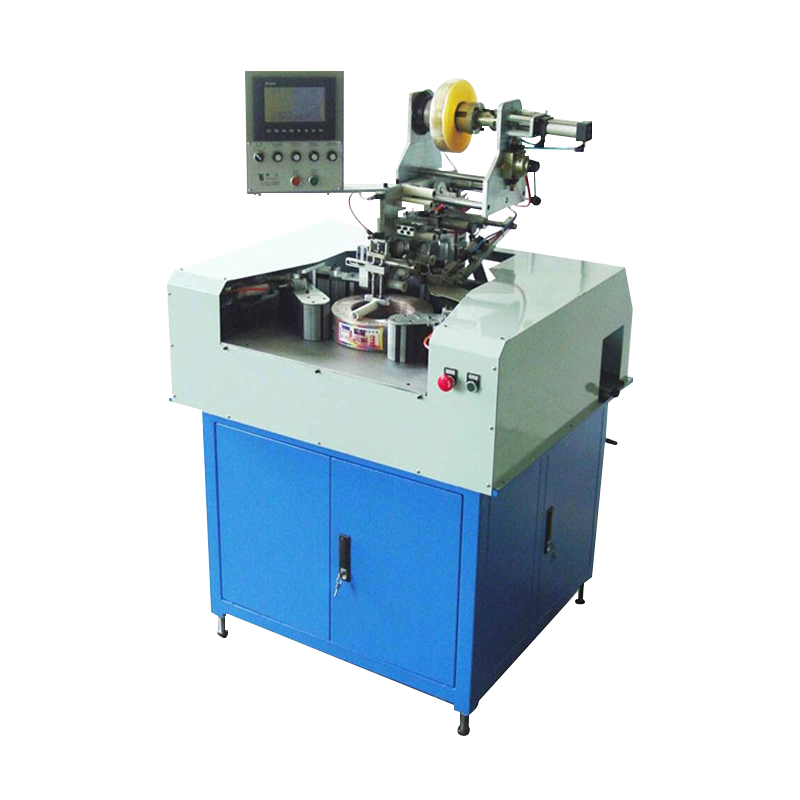
Auto-Wrapping Machine For Circular Object
Why Circular Coil Packaging Matters
Wire and cable coils are often produced in high volumes and in many different specifications. A single production line may manufacture several conductor sizes, insulation types, colors, and packaging formats in one working day. The packaging equipment must therefore accommodate changes without requiring excessive adjustment or long changeover periods.
Unprotected wire coils can become tangled, scratched, contaminated, or deformed during movement. Exposed cable surfaces may also be affected by moisture, dust, and friction. A suitable wrapping process helps hold the coil together, protects the outer surface, and provides a neat appearance that improves warehouse organization and customer satisfaction.
Packaging consistency is especially important when coils are sold through distributors or shipped over long distances. A coil with loose film, uneven overlap, or insufficient protection can be damaged before it reaches the customer. Manual wrapping may also lead to differences between operators. One coil may receive too much material while another may be wrapped too loosely. Such variation increases material consumption and makes quality inspection more difficult.
The automatic wrapping machine addresses these issues with controlled movement and repeatable settings. The rotating four-arm carrier turns the coil smoothly, allowing the packaging material to be applied around the circular surface. The operator can save up to 99 types of coil wrapping data in the PLC memory. Each stored setting can represent a particular product size, wrapping material, material width, thickness, overlap requirement, or operating condition.
Product Overview
The machine is intended for circular objects, with wire and cable coils being its primary application. The operator manually places the finished coil on the machine’s handle plate. After the coil is correctly positioned, the selected wrapping program controls the wrapping movement. The carrier, driven by a motor, rotates the product smoothly while the packaging material is applied.
The machine supports PVC and PE film as standard wrapping materials. Depending on the production requirement, it can also be used with PP woven band or paper. The available packaging material width varies according to the model, while the supported material thickness is generally 0.04 to 0.07 millimeters for the listed configurations.
The equipment is built around several operating principles:
1. The coil is positioned manually on the handle plate.
2. The operator selects an existing wrapping program or enters suitable parameters through the touch-screen terminal.
3. The motorized four-arm carrier rotates the coil smoothly.
4. The wrapping material is applied at a controlled speed and arrangement.
5. The wrapping cycle is completed according to the stored settings.
6. If an abnormal condition occurs, the automatic error-detection function identifies the problem and sends an alarm to the operator.
This process is straightforward for operators and suitable for production environments where product dimensions change regularly. The machine does not require the complex loading and unloading automation associated with a fully integrated robotic packaging cell, making it a practical choice for manufacturers that want automated wrapping without unnecessary system complexity.
Main Technical Specifications
| Model | Coil Height (mm) | Outer Diameter (mm) | Inner Diameter (mm) | Maximum Coil Weight | Wrapping Material | Material Width (mm) | Material Thickness (mm) |
|---|---|---|---|---|---|---|---|
| P100 | 50–100 | 180–460 | 120 | 35 kg | PVC or PE film | 40 | 0.04–0.07 |
| P120 | 70–120 | 220–600 | 140 | 40 kg | PVC or PE film | 45 | 0.04–0.07 |
| P140 | 70–140 | 300–600 | 180 | 60 kg | PVC or PE film | 50 | 0.04–0.07 |
| P180 | 90–180 | 320–600 | 180 | 80 kg | PVC or PE film | 60 | 0.04–0.07 |
| P210 | 100–210 | 400–800 | 250 | 100 kg | PVC or PE film | 80 | 0.04–0.07 |
The five available models cover a broad range of coil dimensions. The P100 is suitable for smaller circular products with coil weights up to 35 kilograms, while the P210 supports larger coils with outer diameters up to 800 millimeters and weights up to 100 kilograms. This model range allows manufacturers to select a machine that matches their product portfolio instead of using an oversized machine for small coils or a machine with insufficient capacity for larger products.
The inner diameter also varies by model, from 120 millimeters on the P100 to 250 millimeters on the P210. This is important because the central opening of a cable coil affects how the product sits on the handle plate and how the wrapping motion is controlled. Proper model selection helps maintain smooth rotation and stable wrapping quality.
Key Advantages Over Manual and Basic Wrapping Methods
Consistent Wrapping Quality
The main advantage of the machine is repeatability. Manual wrapping depends heavily on operator experience, physical strength, and attention. The amount of material, wrapping tightness, overlap, and finished appearance may vary from one coil to another. A motorized carrier and stored PLC programs help create a more consistent wrapping pattern.
Consistent wrapping is not limited to appearance. It also helps control material consumption. If the film is applied unevenly, some sections may use unnecessary material while other sections remain insufficiently protected. A programmed cycle allows the manufacturer to establish a repeatable packaging standard for each product type.
Improved Production Efficiency
High-speed coil wrapping can significantly reduce the time required for final packaging. Operators do not need to manually rotate heavy coils or repeatedly reposition the product. The motor-driven four-arm carrier performs the main rotational movement, allowing the operator to focus on loading, unloading, inspection, and material preparation.
In a busy wire and cable factory, even a small reduction in packaging time can have a substantial effect on daily output. The benefit becomes greater when several extrusion lines feed coils into one packaging area. Faster wrapping helps prevent finished products from accumulating between production and shipping.
Reduced Physical Labor
Manual wrapping can require repeated bending, pulling, turning, and lifting. These actions are tiring and may increase the risk of workplace strain, especially when large or heavy coils are involved. The machine reduces the need for manual rotation and allows the operator to use a more controlled loading method.
Because the machine is semi-automatic, manual loading is still required. However, the most repetitive part of the work—the continuous rotation and application of packaging material—is transferred to the equipment. This creates a useful compromise between labor reduction and operational simplicity.
Flexible Product Changeover
Wire and cable manufacturers often need to switch between products with different coil heights, outer diameters, inner diameters, and weights. The five model options and programmable control system make the machine suitable for a variety of production conditions.
Up to 99 types of coil wrapping data can be stored in the PLC memory. This allows operators to recall established settings instead of entering parameters from the beginning each time a product changes. The result is a shorter changeover process and reduced risk of setting errors.
Touch-Screen Operation
The screen touch graphic operation terminal is designed to make machine operation easier. Operators can view settings, select programs, monitor the cycle, and respond to alarms through a graphical interface. Compared with a control panel based only on switches and indicator lights, a touch-screen terminal provides clearer information and makes it easier to organize product programs.
A graphical interface is especially valuable in factories with multiple shifts. New operators can learn the basic operating sequence more quickly, while experienced operators can access saved programs without relying on handwritten notes or memory.
Automatic Fault Detection
Automatic error detection improves operational safety and maintenance response. When the equipment detects an abnormal condition, it can issue an alarm to remind the operator. This helps prevent prolonged operation under unsuitable conditions and makes troubleshooting more direct.
Early notification can reduce downtime because the operator can respond before a minor issue develops into a larger mechanical or packaging problem. Alarm functions also support more systematic maintenance records by showing when faults occur and which operating conditions may require attention.
Application in Wire and Cable Production
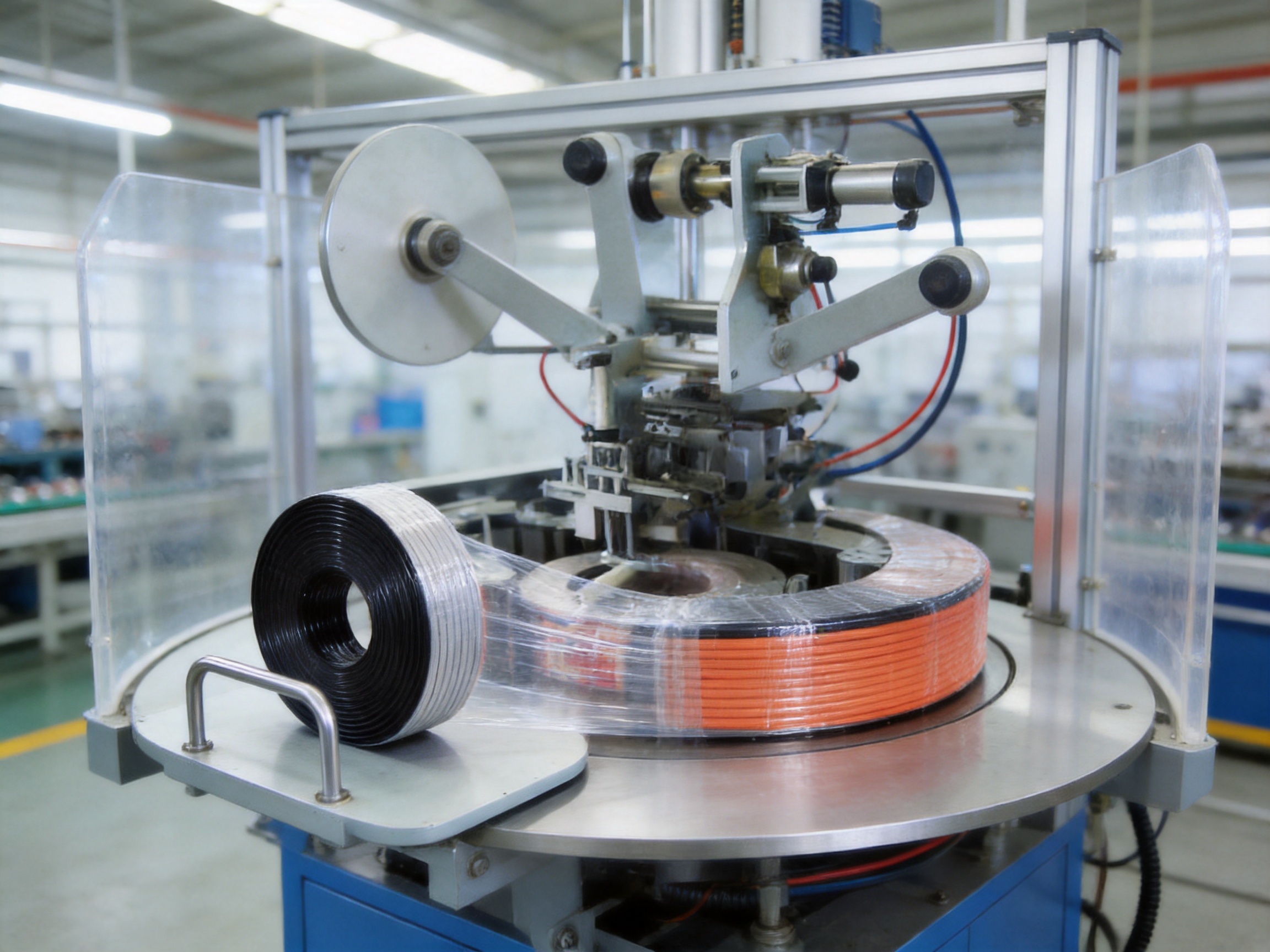
The machine is suitable for circular coils produced by a wide range of wire and cable processes. Applications include BV wire, BVR wire, RVV cable, UL electronic wire, flower wire, and other similar products. These products may vary considerably in insulation structure, flexibility, diameter, and finished coil size, but they share the need for stable and protective packaging.
For building wire, wrapping can help keep coils compact and orderly after extrusion and testing. For flexible electronic cable, packaging can protect the surface from contamination and maintain a clean presentation. For flower wire and other smaller circular products, a suitable film can hold the coil together and reduce the possibility of unwinding during transportation.
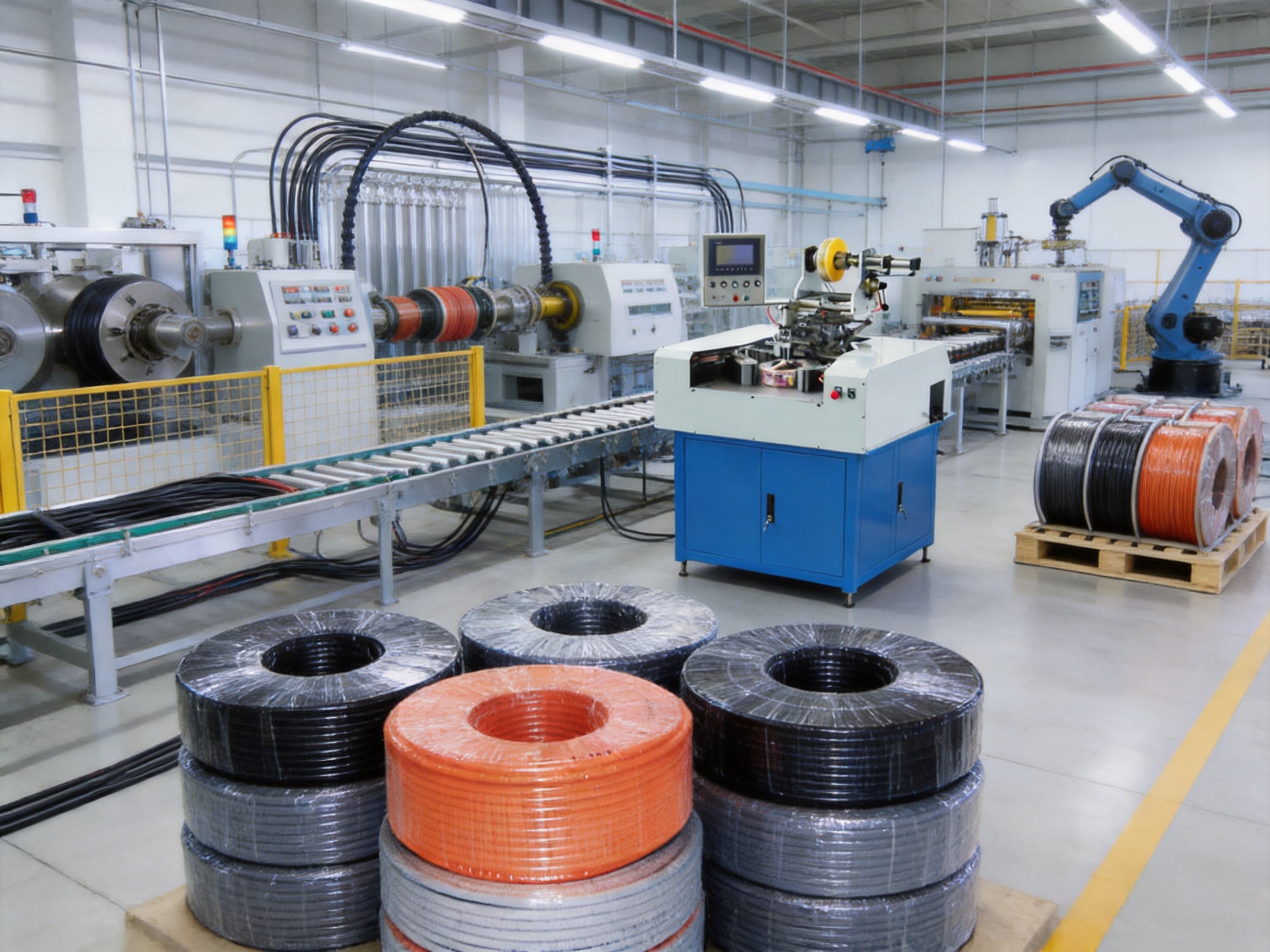
The machine can be positioned after the final coiling operation and before labeling, boxing, palletizing, or shipping. In a larger production system, it may work together with motorized take-up equipment, coiling machines, inspection systems, conveyors, and robotic stackers. This makes it possible to create a coordinated packaging section without requiring every process to be fully automated at the same time.
Its compatibility with different packaging materials also gives manufacturers more control over product presentation. PVC film may be selected for certain protection and appearance requirements, while PE film can be used for general wrapping applications. Paper or PP woven band may be considered where a different packaging style, strength characteristic, or environmental preference is required.
How the Four-Arm Carrier Supports Better Wrapping
The four-arm carrier is one of the central mechanical features of the equipment. Driven by a motor, it rotates the coil smoothly during wrapping. Smooth movement is important because abrupt acceleration or uneven rotation can affect film tension and cause wrinkles, loose sections, or irregular overlap.
A stable carrier also helps reduce unnecessary movement of the cable coil. If the product shifts during rotation, the wrapping material may not follow the intended path. The resulting package may have exposed areas or an uneven outer shape. Controlled rotation supports a more uniform finish and helps maintain the position of the coil throughout the cycle.
For heavier coils, smooth rotation is even more important. The P180 and P210 models are designed for coils up to 80 and 100 kilograms respectively. At these weights, manual turning is inefficient and may create safety concerns. A powered carrier gives the wrapping process a more controlled mechanical foundation.
The carrier also contributes to reduced operator effort. Instead of physically turning the product, the operator monitors the cycle and ensures that the material supply remains suitable. This changes the operator’s role from manual wrapping labor to controlled equipment operation.
Manufacturing Strengths and Engineering Approach
The equipment is supplied by Shanghai Yessjet Precise Machinery Co., Ltd., a manufacturer focused on wire and cable machinery, extrusion line equipment, coiling and packaging systems, pay-off and take-up machines, accessory equipment, and intelligent stacking solutions. This product range is important because packaging equipment performs best when it is developed with an understanding of the complete cable production process.
A manufacturer with experience across extrusion, coiling, take-up, and packaging can better understand how upstream equipment affects the final coil. Coil diameter, winding tension, product flexibility, surface condition, and take-up speed all influence packaging performance. This broader process knowledge supports more practical equipment design than treating the wrapping machine as an isolated product.
The manufacturing approach can be understood through several strengths: mechanical integration, programmable control, model selection, application knowledge, and service-oriented customization.
Mechanical Integration
The machine integrates a motorized carrier, wrapping-material handling components, a support structure, control elements, and operator interface into one coordinated unit. Mechanical integration reduces the need for the customer to combine unrelated components from different suppliers.
When a packaging machine is designed as a complete system, the carrier movement and wrapping action can be considered together. This supports more stable operation and simplifies the installation process. It also gives the manufacturer a clearer responsibility for the performance of the finished equipment.
Programmable Control
The PLC-based system allows wrapping information to be stored and recalled. This is a significant advantage for manufacturers with many product specifications. Programmability also creates a foundation for future integration with production management systems, barcode identification, conveyor controls, or automatic product tracking, depending on the customer’s requirements.
The stored data function contributes to process standardization. Instead of allowing each operator to develop an individual wrapping method, the production department can define approved settings for each coil type. This supports quality management and makes training easier.
Application-Based Model Selection
The availability of P100, P120, P140, P180, and P210 models demonstrates an application-based approach. Different factories have different coil sizes and production volumes. A compact machine may be more appropriate for small electronic wire coils, while a larger model may be necessary for heavy power or building cable coils.
Matching the machine to the product avoids two common problems. The first is under-capacity, where the equipment cannot safely handle the coil size or weight. The second is over-capacity, where the customer pays for a machine much larger than necessary and loses floor space. A structured model range helps balance capability and investment.
Quality-Oriented Assembly
Reliable packaging equipment depends on the quality of its mechanical assembly and electrical integration. Carrier alignment, motor performance, film guidance, sensor positioning, control-panel wiring, and safety-related functions must work together. A careful manufacturing and assembly process helps reduce vibration, inconsistent rotation, and unnecessary adjustment during operation.
For industrial machinery, quality is not limited to the appearance of individual parts. It also includes how the components interact after installation. The machine should operate predictably through repeated cycles, maintain stable movement, and provide understandable responses when an error occurs.
Production Testing and Commissioning
Before delivery, equipment of this type should be checked through functional testing, control verification, and trial operation. Typical checks include carrier rotation, program selection, touch-screen response, alarm behavior, material feeding, and compatibility with representative coil sizes.
Testing with realistic products is particularly valuable. A machine may perform correctly with an empty carrier but behave differently when handling a heavy coil. Trial operation helps confirm that the mechanical structure, motorized movement, and wrapping process are appropriate for the intended application.
Support for Turnkey Cable Production
The company’s broader product portfolio includes wire and cable extrusion lines, motorized pay-off machines, motorized take-up machines, coiling machines, accessory equipment, and intelligent robot stackers. This allows customers to discuss individual packaging requirements within a wider cable production context.
A complete production solution can be designed around the customer’s product specifications, available floor space, target output, packaging style, and labor arrangement. Even when a customer purchases only the wrapping machine, access to broader process knowledge can help improve the equipment selection and layout.
Operational Workflow
The typical workflow begins when a finished circular coil is transferred to the wrapping area. The operator checks that the coil is within the selected model’s supported dimensions and weight. The coil is then placed on the handle plate, with attention given to stable positioning and correct alignment.
After loading, the operator selects the appropriate stored program through the touch-screen graphic terminal. If the product is new, the operator or technician can enter the required settings and save them in the PLC memory for future use. The wrapping material is checked to ensure that it matches the planned material type, width, and thickness.
The wrapping cycle is then started. The four-arm carrier rotates the coil, and the material is applied according to the programmed process. The operator observes the initial part of the cycle to confirm that the coil is stable and that the film or band is feeding correctly.
When the cycle is complete, the wrapped coil is removed manually or transferred to the next packaging stage. Depending on the factory layout, the next stage may include labeling, weighing, carton packing, palletizing, or robotic stacking.
If an abnormal condition occurs, the automatic error-detection system sends an alarm. The operator should stop and inspect the indicated condition rather than continuing to run the machine without investigation. Regular cleaning, inspection, and replacement of consumable packaging material help maintain stable performance.
Choosing the Correct Model
Model selection should begin with the actual dimensions and weight of the finished coil. The relevant measurements include coil height, outer diameter, inner diameter, and total coil weight. It is advisable to select a model that accommodates the largest regular product while avoiding unnecessary excess capacity.
For coils with heights between 50 and 100 millimeters, outer diameters from 180 to 460 millimeters, inner diameters of 120 millimeters, and weights up to 35 kilograms, the P100 may be suitable. The P120 covers a height range of 70 to 120 millimeters and outer diameters from 220 to 600 millimeters, with a maximum weight of 40 kilograms.
The P140 and P180 provide higher capacity for larger or heavier products. The P140 supports coils up to 60 kilograms, while the P180 supports up to 80 kilograms. The P210 is the largest listed model, supporting outer diameters from 400 to 800 millimeters and coil weights up to 100 kilograms.
Packaging material requirements should also be considered. The listed models use PVC or PE film and support material thickness from 0.04 to 0.07 millimeters. Material width ranges from 40 millimeters on the P100 to 80 millimeters on the P210. If a customer intends to use a different material or a special width, this should be confirmed during the technical evaluation.
Installation and Factory Layout Considerations
The wrapping machine should be installed in a location that provides adequate space for loading, unloading, operator movement, material replacement, and maintenance. The operator needs enough room to place the coil safely and to inspect the wrapping process without standing in an unsafe position.
The machine may be placed near the coiling machine or take-up equipment to minimize product handling. However, the layout should also allow time for inspection before wrapping. If the coil has an obvious dimensional or surface problem, it may be more efficient to identify it before the product enters the packaging cycle.
For higher-output facilities, conveyors can be used to connect the wrapping station with upstream and downstream equipment. A conveyor arrangement can reduce manual carrying and improve product flow. When combined with a robot stacker, the wrapping machine can become part of a more automated finished-product handling system.
Floor strength, electrical supply, environmental conditions, and access for maintenance should be reviewed before installation. The area should be kept clean and free of loose film, cable scraps, and other objects that could interfere with moving parts.
Maintenance and Long-Term Performance
Routine maintenance helps protect the investment and preserve packaging consistency. Operators should keep the machine clean, particularly around the material path, carrier area, sensors, and rotating components. Accumulated film fragments or dust may affect material feeding and sensor performance.
Mechanical inspection should include the carrier, motor-driven movement, fasteners, support points, and areas subject to repeated motion. Any unusual noise, vibration, or change in rotation should be investigated promptly. Early attention can help prevent more serious damage.
The packaging material should be stored properly and protected from contamination or deformation. Film rolls with damaged edges may feed poorly and create irregular wrapping. Operators should also verify that the material width and thickness correspond to the selected program.
Electrical and control-system maintenance should be performed by qualified personnel. The touch-screen terminal, PLC, sensors, alarms, and wiring should be checked if the machine behaves unexpectedly. Stored programs should be documented and protected from accidental changes so that approved wrapping standards remain available.
Preventive maintenance is especially important in multi-shift production. A clear maintenance schedule can assign daily cleaning, weekly inspection, and periodic technical checks. This organized approach is generally more effective than waiting for a machine failure to interrupt production.
Safety and Operator Training
Operator training should cover loading, program selection, material installation, cycle start, alarm response, unloading, and emergency procedures. The operator must understand the permitted coil dimensions and weight for the selected model.
Hands, clothing, tools, and loose materials should be kept away from moving components during operation. The machine should not be adjusted while the carrier is rotating unless the equipment has been safely stopped and the relevant energy sources have been controlled.
Training should also explain the difference between a normal alarm and a serious mechanical or electrical problem. An alarm is an instruction to inspect the machine, not a signal to repeatedly restart it without identifying the cause.
Because the machine is semi-automatic, loading and unloading require particular attention. The coil should be stable before the wrapping cycle begins, and the operator should use suitable handling equipment or procedures for heavier models. Safe handling protects both the operator and the cable product.
Advantages for Different Types of Manufacturers
Small and Medium-Sized Cable Producers
Small and medium-sized manufacturers may need automation but may not be ready for a fully robotic packaging line. This machine offers a moderate level of automation. Manual loading keeps the system relatively straightforward, while motorized wrapping and programmable control improve productivity and consistency.
The model range also allows smaller companies to select a machine according to current production needs. As production expands, the saved programs and repeatable process can support additional product types without requiring a complete change in packaging method.
High-Volume Wire Producers
High-volume factories benefit from cycle consistency and reduced manual work. The machine can be positioned as a dedicated wrapping station for a specific family of products or used as part of a broader automated line.
For manufacturers operating several extrusion lines, multiple machines may be configured according to product size. Alternatively, a larger model may handle a wider range of coils if the production mix permits. The best arrangement depends on throughput, floor space, labor availability, and desired automation level.
Contract and Customized Cable Manufacturers
Contract manufacturers often produce many product specifications in relatively small batches. The 99-program memory is particularly useful in this environment because different wrapping settings can be stored and recalled. This reduces setup time and helps maintain consistent packaging across short production runs.
The touch-screen interface also supports better communication between shifts. Operators can use approved programs instead of creating new settings for each batch. This improves repeatability even when different people operate the machine.
Comparison with Competing Packaging Approaches
Compared with fully manual wrapping, the machine offers better consistency, lower physical labor, and improved cycle efficiency. Manual methods may have a lower initial cost, but they often require more labor and produce greater variation in material usage and appearance.
Compared with simple motorized turntables, the four-arm carrier provides a more structured approach to holding and rotating the circular product. A basic turntable may require more manual control, while the programmable machine coordinates rotation and wrapping operation more systematically.
Compared with a fully automatic loading and unloading cell, this machine is simpler and generally easier to introduce into an existing factory. The operator still places the object manually, but the core wrapping action is automated. This can reduce system complexity, installation requirements, and training demands.
Compared with a machine designed for only one coil dimension, the five-model range and PLC memory provide greater flexibility. A manufacturer can select suitable capacity and maintain multiple saved wrapping programs. This flexibility is valuable when cable product sizes change frequently.
The most important competitive advantage is therefore not one isolated feature. It is the combination of high-speed wrapping, programmable control, smooth motorized rotation, error detection, multiple model sizes, and application experience in wire and cable machinery.
Economic and Environmental Considerations
Packaging equipment affects more than labor cost. It also influences material consumption, product damage, rework, storage efficiency, and shipping presentation. A consistent wrapping process can help reduce unnecessary use of film and lower the number of coils requiring repackaging.
Better protection may reduce damage caused by dust, abrasion, or loose coils during transport. When finished products arrive in good condition, manufacturers may experience fewer customer complaints and less replacement activity.
Material selection should be based on the protection required by the product and the customer’s packaging expectations. PVC film, PE film, PP woven band, and paper each have different characteristics. Manufacturers should evaluate the required strength, appearance, storage conditions, recycling arrangements, and end-user preferences before choosing a material.
Efficient operation also supports responsible resource use. The machine’s programmable settings make it easier to establish standard material application practices. By avoiding excessive overlap or inconsistent wrapping, the factory can use packaging material more deliberately.
Integration with a Complete Cable Production Solution
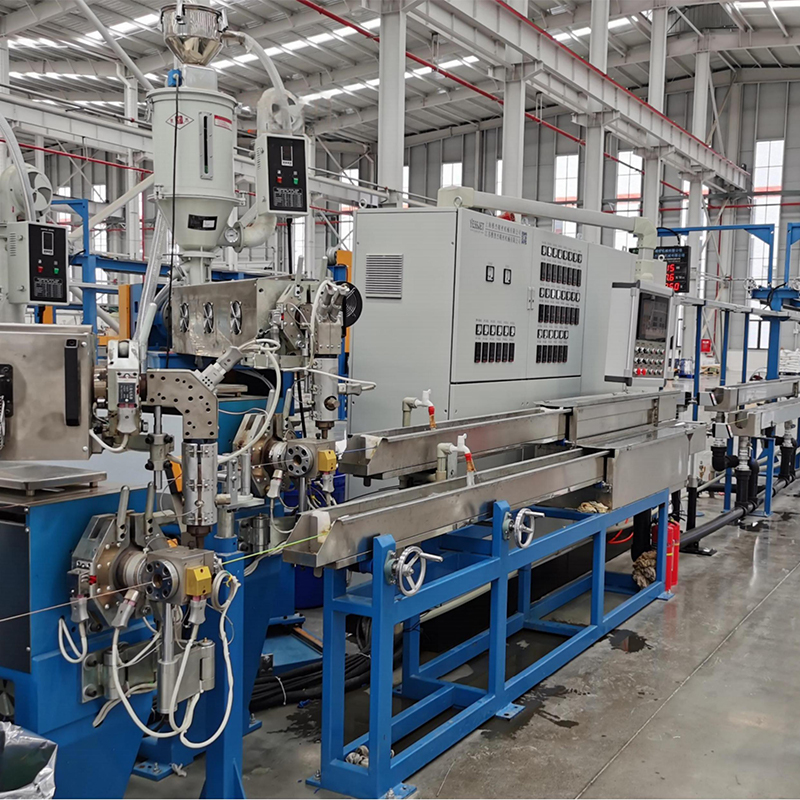
A wire and cable factory is a connected production environment. Pay-off equipment supplies conductor or material to the extrusion line. The extrusion process applies insulation or sheathing. Cooling, testing, measuring, take-up, and coiling prepare the product for final handling. Packaging then protects and organizes the finished coil.
The automatic wrapping machine can serve as the link between coiling and finished-product logistics. When combined with motorized take-up equipment and coiling machines, it helps create a more organized downstream process. When combined with an intelligent robot stacker, it can support automated placement of wrapped coils onto pallets or into storage areas.
The benefit of working with a supplier that understands multiple stages is that equipment decisions can be made with the complete process in mind. Coil size, output speed, product handling, operator position, and future automation can all be considered together.
For customers planning a new production line, the wrapping machine can be included during the initial layout and capacity calculation. For existing factories, it can be introduced as a stand-alone improvement to replace manual packaging or increase the capacity of an overloaded wrapping station.
Frequently Asked Questions
Is this a fully automatic wrapping machine?
It is a semi-automatic machine. The operator manually places the circular object or wire coil on the handle plate. After loading, the wrapping operation is automated through the motorized carrier and programmed control system.
What products can be wrapped?
The machine is suitable for circular objects, especially wire and cable coils. Typical applications include BV, BVR, RVV, UL electronic wires, flower wires, and other similar circular products.
Which wrapping materials are supported?
The listed specifications identify PVC film and PE film as standard materials. The product description also indicates that PP woven band and paper may be used for suitable applications. Material compatibility should be confirmed according to the selected model and customer requirements.
How many wrapping programs can be stored?
Up to 99 types of coil wrapping data can be stored in the PLC memory. This enables operators to recall established settings for different coil products.
What is the largest listed coil capacity?
The P210 model supports coils with heights from 100 to 210 millimeters, outer diameters from 400 to 800 millimeters, an inner diameter of 250 millimeters, and a maximum coil weight of 100 kilograms.
What is the smallest listed model?
The P100 is the smallest listed model. It supports coil heights from 50 to 100 millimeters, outer diameters from 180 to 460 millimeters, an inner diameter of 120 millimeters, and coil weights up to 35 kilograms.
Does the machine detect faults automatically?
Yes. The machine includes automatic error detection. When an abnormal condition is identified, the equipment sends an alarm to remind the operator and support timely troubleshooting.
Is a touch screen included?
Yes. The machine uses a screen touch graphic operation terminal. The interface is intended to simplify program selection, parameter management, and operation monitoring.
Why is smooth carrier rotation important?
Smooth rotation helps maintain stable film application, consistent overlap, and better coil positioning. It also reduces the need for manual turning and supports safer handling of heavier coils.
How should a customer select a model?
The customer should compare the coil height, outer diameter, inner diameter, weight, packaging material width, and production requirements with the specifications of each model. The selected machine should accommodate the largest regular product within a suitable operating range.
Can the wrapping machine be connected with other cable machinery?
Yes. It can be used near coiling machines, motorized take-up equipment, conveyors, labeling equipment, and intelligent robot stackers. The exact integration method depends on the factory layout and automation requirements.
What makes this machine suitable for wire and cable factories?
Its suitability comes from the combination of circular-coil application, programmable wrapping data, smooth motorized rotation, multiple capacity models, touch-screen control, automatic error detection, and the supplier’s broader experience with wire and cable production equipment.
Conclusion
The automatic wrapping machine for circular objects provides an efficient and practical solution for packaging wire and cable coils. It combines semi-automatic loading with automated wrapping, allowing manufacturers to reduce repetitive labor while maintaining control over product handling.
Its main advantages include high-speed coil wrapping, motor-driven four-arm rotation, touch-screen operation, PLC memory for up to 99 wrapping programs, automatic error detection, and support for PVC or PE film. The five model options cover coil weights from 35 to 100 kilograms and outer diameters up to 800 millimeters, giving manufacturers flexibility when selecting equipment for different products.
Compared with manual packaging and basic wrapping methods, the machine provides better repeatability, more organized operation, reduced physical effort, and improved adaptability to changing product specifications. Its semi-automatic structure also makes it easier to introduce into an existing factory than a fully robotic cell.
Supported by a manufacturer whose equipment portfolio includes extrusion lines, pay-off machines, take-up machines, coiling machines, accessory equipment, and robot stackers, the machine can be applied as a stand-alone packaging improvement or as part of a complete wire and cable production solution.
For manufacturers seeking a reliable way to protect, organize, and present circular wire and cable products, this wrapping machine offers a balanced combination of automation, flexibility, and production value.
References
1. Product technical information for automatic wrapping equipment for circular objects.
2. Product specifications for P100, P120, P140, P180, and P210 wrapping machine models.
3. General principles of wire and cable extrusion, coiling, take-up, and finished-product packaging.
4. Industrial packaging equipment operation, preventive maintenance, and operator safety practices.
5. Manufacturing and process-integration considerations for wire and cable production machinery.