LANGUAGE
 中文简体
 русский
 Français
 Español
 Português
 عربى
Content
- 1 Why Cable Coil Palletizing Requires Specialized Automation
- 2 Main Functions of the Intelligent Robot Stacker
- 3 Advantages Compared with Conventional Stacking Systems
- 4 End-of-Arm Tooling for Cable Coil Handling
- 5 Intelligent Pallet Pattern Programming
- 6 Conveyor and Pallet Management
- 7 Control System and Human-Machine Interface
- 8 Cycle Time and Productivity Considerations
- 9 Vision System Integration and Calibration
- 10 Safety Architecture for Robotic Stacking Cells
- 11 Manufacturing Strengths and Engineering Capabilities
- 12 Applications Beyond Cable Packaging
- 13 Installation, Operation, and Maintenance
- 14 How to Select the Right Intelligent Robot Stacker
- 15 Frequently Asked Questions
- 15.1 What products can the Intelligent Robot Stacker handle?
- 15.2 Can the system handle different cable coil diameters?
- 15.3 How many coils can be placed on one pallet?
- 15.4 Is vision guidance always necessary?
- 15.5 How does the system prevent unstable pallets?
- 15.6 Can the pallet exchange process be automated?
- 15.7 What happens if a coil is not picked correctly?
- 15.8 Can the robot stack products in different patterns on alternate layers?
- 15.9 What information is needed for a quotation?
- 15.10 What is the main advantage of choosing an experienced cable machinery manufacturer?
- 16 Conclusion
- 17 References
- 18 Product: Intelligent Robot Stacker
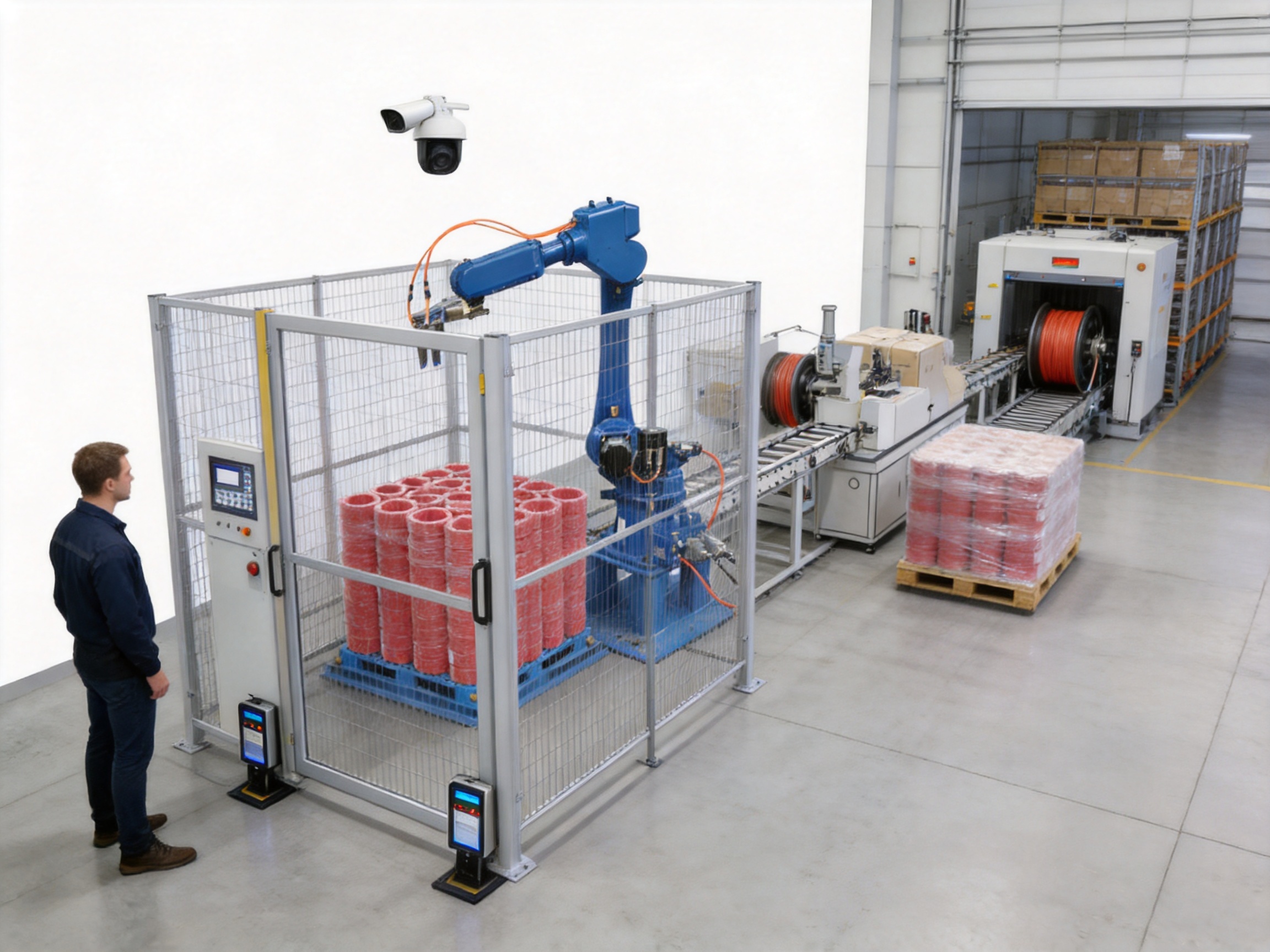
Modern wire and cable manufacturers are under constant pressure to increase production efficiency, reduce manual handling, improve workplace safety, and maintain consistent packaging quality. Coiled cable is particularly challenging to handle because it is round, flexible, variable in diameter, and frequently supplied in different weights and packaging configurations. Traditional manual stacking methods can lead to unstable pallet loads, product damage, inconsistent layer arrangements, and higher labor costs. A conventional palletizing machine designed for cartons or rigid products may also struggle to position cable coils accurately.
The Intelligent Robot Stacker is developed to address these challenges through coordinated robotic handling, programmable stacking logic, conveyor integration, and intelligent production monitoring. It can automatically pick, transfer, arrange, and stack cable coils according to preset production parameters. The system can also be adapted for metal products, photovoltaic materials, warehousing operations, food and beverage packaging, and other industries requiring repeatable material handling.
Shanghai Yessjet Precise Machinery Co., Ltd. combines experience in wire and cable machinery with robotic automation engineering to develop customized intelligent stacking solutions. Its equipment is designed around the actual characteristics of the customer’s product, including coil diameter, coil weight, jacket material, strap arrangement, pallet dimensions, stacking height, and required production speed.
Compared with basic palletizing systems, the Intelligent Robot Stacker provides broader product adaptability, more flexible recipe management, improved placement accuracy, integrated safety functions, and a production architecture that can be expanded with conveyors, sensors, vision systems, pallet dispensers, and automatic inspection equipment.
Why Cable Coil Palletizing Requires Specialized Automation
Cable coils are not simple rectangular loads. Their round profile creates gaps between adjacent products, while their flexible construction may allow the coil to deform slightly when lifted or clamped. Outer diameter can vary significantly between product families, and the coil may be secured with plastic or metal straps that affect its handling characteristics. Different jacket materials also produce different surface friction levels, which influence how the coil behaves during acceleration, deceleration, and release.
In a manual operation, workers must repeatedly lift or reposition coils, judge the correct pallet position, and compensate for changing product dimensions. As production volume increases, fatigue can cause placement deviations and workplace risks. A poorly arranged pallet may lean during transport, create excessive gaps, or allow coils to move when wrapped or strapped.
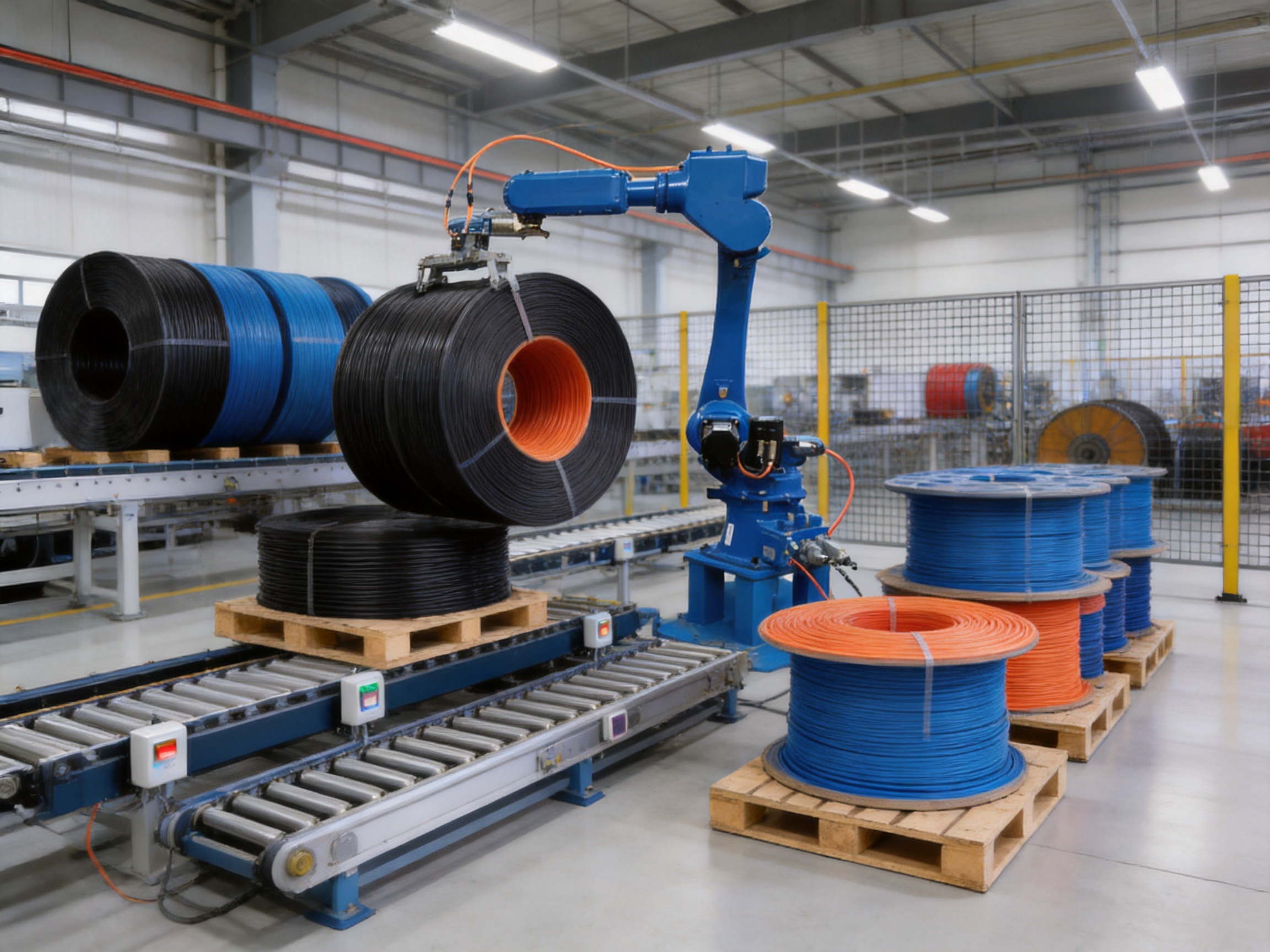
A standard industrial robot can perform the required movements, but the overall system must be engineered around the product. The end-of-arm tooling, conveyor height, pallet position, robot trajectory, safety system, control software, and stacking pattern must work together. The Intelligent Robot Stacker is therefore more than a robot arm. It is an integrated handling cell that coordinates material feeding, coil identification, robotic transfer, pallet management, stacking logic, and production feedback.
The system can be configured for cable coils presented individually, in batches, or through a continuous production line. It can also be connected to a coiling machine, automatic packaging machine, strapping station, wrapping machine, conveyor, or finished-product storage system. This makes it suitable for both standalone automation upgrades and complete wire and cable production turnkey solutions.
Main Functions of the Intelligent Robot Stacker
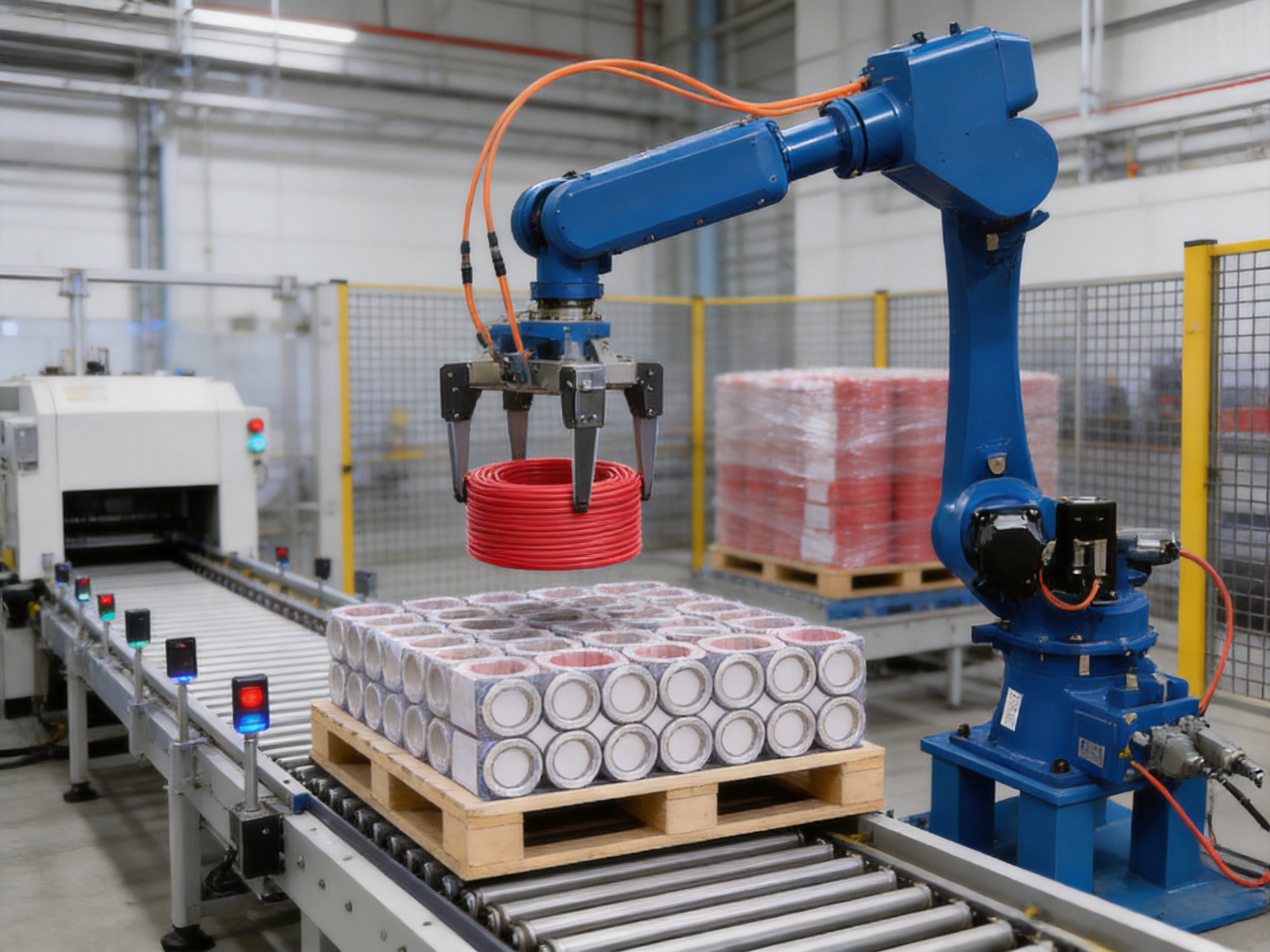
The Intelligent Robot Stacker receives cable coils from an upstream conveyor or packaging system and places them on a pallet according to a programmed arrangement. Operators can use the human-machine interface to select a product recipe, set the number of coils per layer, define the number of layers, adjust pallet dimensions, and monitor equipment status.
The principal functions include automatic coil picking, product positioning, pallet layer management, empty pallet handling, full pallet detection, conveyor coordination, alarm monitoring, and operator notification. Depending on the production requirements, the system can also include vision-guided positioning, barcode or product identification, pallet dispensers, pallet conveyors, automatic wrapping, and downstream transfer equipment.
The stacking system can divide the pallet area into an empty pallet zone, an active working zone, and a full-load zone. This arrangement allows the equipment to manage the complete pallet flow instead of focusing only on the robotic pick-and-place movement. When stacking is completed, the system can automatically detect the full pallet and send a message to the operator or a higher-level factory management system.
Such coordination reduces dependence on manual supervision. Operators do not need to remain beside the robot throughout the production cycle. Instead, they can monitor system status through the interface, respond to alarms, replace consumables, and manage other production tasks.
Advantages Compared with Conventional Stacking Systems
Flexible Handling of Multiple Product Sizes
Many conventional stacking machines are designed for a narrow product range. If the cable diameter, coil diameter, or coil weight changes, the machine may require mechanical adjustment or a new set of dedicated tooling. This reduces production flexibility and increases changeover time.
The Intelligent Robot Stacker uses programmable control parameters and configurable tooling to accommodate a broader range of cable coils. Product recipes can record different coil dimensions, weights, pallet sizes, stacking patterns, approach heights, release positions, and movement speeds. Operators can select the corresponding recipe instead of rebuilding the machine for each product.
For facilities producing several cable families, this flexibility is a significant advantage. It allows the same robotic cell to handle small and large coils, different jacket materials, and varied packaging formats while maintaining controlled and repeatable operation.
Improved Placement Accuracy
Manual stacking depends on operator judgment and physical endurance. Even experienced workers may gradually lose placement accuracy during a long shift. A robotic system uses programmed coordinates, controlled acceleration, and repeatable trajectories to place every coil in a defined position.
For applications requiring additional compensation, a vision system or position sensor can determine the actual coil location on the infeed conveyor. The robot then adjusts its approach path before picking the product. This is especially useful when cable coils are not perfectly centered or when upstream equipment produces minor position variations.
Consistent placement supports more stable pallets, better use of available pallet space, and improved appearance after wrapping. It also reduces the risk that a coil will interfere with a neighboring coil or extend beyond the pallet edge.
Higher Labor Efficiency
Manual palletizing requires workers to repeatedly lift, turn, carry, and arrange cable coils. Depending on product weight and production volume, this can require several operators per shift. The Intelligent Robot Stacker transfers these repetitive operations to an automated cell while allowing personnel to focus on quality control, machine supervision, material preparation, and maintenance.
Reducing manual lifting can also help lower ergonomic risks. The system is particularly valuable in high-volume operations where the same movement is repeated hundreds or thousands of times per production period. Labor efficiency improves without requiring a proportional increase in staffing as output rises.
Consistent Pallet Quality
A stable pallet depends on correct spacing, layer alignment, and height control. The robot can use different patterns for different layers, including offset or interlocking arrangements. Alternate layers can be rotated or shifted to reduce the risk of lateral movement during transport.
Because the system records the stacking parameters, the same pallet structure can be reproduced from one production batch to the next. This repeatability is difficult to maintain when stacking is performed entirely by hand.
Better Production Traceability
The control system can record product recipes, production counts, completed pallet numbers, alarm events, and operating status. When connected to a factory management system, the palletizing cell may also exchange production information with upstream and downstream equipment.
This supports better production planning and makes it easier to identify the time and conditions under which a problem occurred. For cable manufacturers serving demanding industrial customers, repeatable production records can contribute to quality assurance and process improvement.
End-of-Arm Tooling for Cable Coil Handling
The end-of-arm tool is one of the most important components in a robotic stacking cell. The robot arm provides movement, but the tooling determines whether the coil can be picked securely, transferred smoothly, and released accurately. Selecting an unsuitable gripper can lead to slipping, deformation, strap interference, failed picks, and unstable placement.
Shanghai Yessjet Precise Machinery Co., Ltd. develops tooling specifications from a product payload matrix. This matrix may include coil outside diameter, coil inside diameter, total weight, cable jacket material, surface friction, strap type, strap position, packaging condition, and acceptable deformation. The information is used to determine the appropriate gripping method and the required robot movement profile.
Clamp-Type Grippers
Clamp grippers hold the coil by applying controlled lateral pressure to its outer surface or structural packaging. They can be effective when coil diameter is consistent and the cable jacket or packaging can withstand the required clamping force.
The principal benefit of a clamp gripper is that it can pick a coil without requiring clearance beneath the product. This may be useful when the coil rests directly on a conveyor or when the line layout provides limited space for fork insertion.
However, clamping force must be carefully controlled. Excessive pressure may deform soft cable jackets, damage packaging, or distort the coil. Insufficient pressure may allow the load to move during acceleration. For this reason, the gripper design should be matched to the product weight, surface material, and coil rigidity.
Fork-Style Lifting Tools
Fork-style tooling lifts the coil from below using two or more tines. This approach can be more tolerant of outside-diameter variation because the load is supported from its base rather than squeezed from the sides.
Fork-style tooling requires a suitable gap beneath the coil and a consistent presentation height. Conveyor design, product orientation, and coil support must therefore be considered during system planning. The tines must also be shaped and positioned to avoid contact with the cable, straps, packaging, or conveyor components.
Hybrid Tooling
For mixed-product facilities, a hybrid tool can combine adjustable side support with a retractable bottom support. This arrangement provides greater compatibility across different coil sizes and weights. The tooling can stabilize the product from the side while also supporting it from below during transfer.
Hybrid tooling may involve greater mechanical complexity and longer setup time, but it can reduce the need for separate palletizing cells. For manufacturers running cable diameters from small communication wires to larger power cables, the broader operating range can justify the additional investment.
The tooling design must also account for loose strap tails. A strap tail that is not properly secured may catch on a neighboring coil or interfere with the release sequence. The upstream strapping process, the gripper geometry, and the robot release movement should therefore be evaluated as one integrated process.
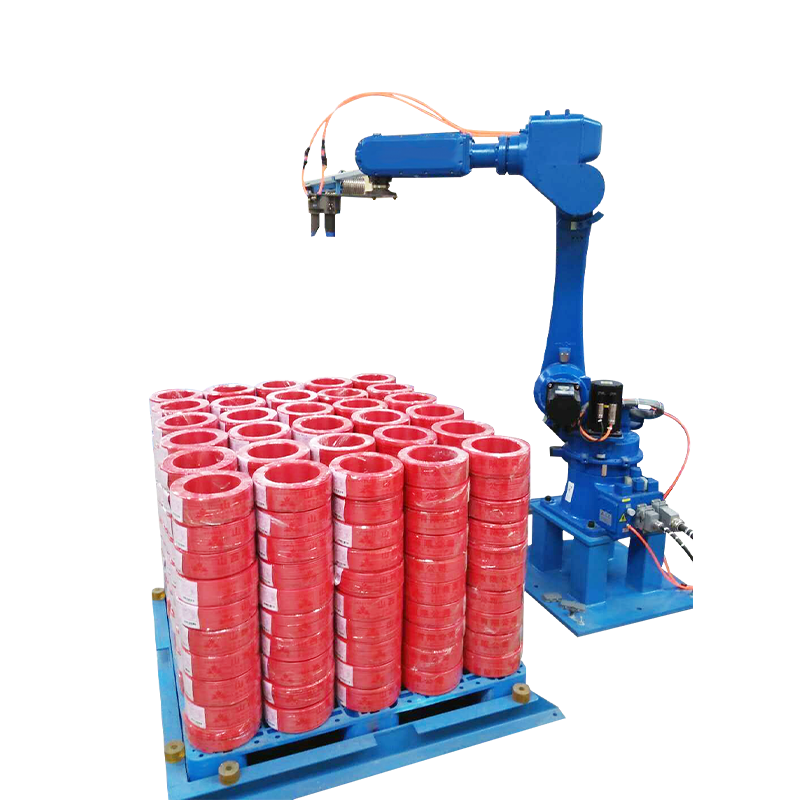
Intelligent Robot Stacker
Intelligent Pallet Pattern Programming
Round cable coils do not fill a pallet in the same way as rectangular cartons. The spaces between coils influence pallet density, stability, wrapping efficiency, and transport safety. The Intelligent Robot Stacker can use static patterns, parameter-based patterns, or adaptive patterns according to the production requirements.
Static Pattern Programming
A static pattern uses predetermined coordinates for each coil position. It is suitable for a dedicated line producing one product or a limited number of products with consistent dimensions. Static patterns are simple to validate and can provide very fast cycle performance.
The disadvantage is that each significant product change may require a new program. If the coil diameter changes, the original pattern may create excessive gaps or cause interference between adjacent coils. Over time, a high-mix factory may accumulate a large and difficult-to-maintain pattern library.
Parameter-Based Pattern Programming
A parameter-based system calculates positions from entered values such as coil diameter, pallet length, pallet width, number of rows, and number of columns. Operators can select a recipe or enter a limited group of product parameters through the human-machine interface.
This method provides a balance between flexibility and simplicity. It reduces the number of dedicated programs while retaining predictable operation. It is particularly suitable for manufacturers with several standard coil families and regular product changeovers.
Adaptive and Vision-Guided Patterns
An adaptive system can use measured product dimensions or vision data to calculate the placement grid. The controller may determine how many coils fit on a layer, center the arrangement within the pallet boundaries, and adjust the robot waypoints automatically.
Vision guidance is also useful when the coil arrives at a variable position or orientation. The camera identifies the product location, and the robot corrects its path before picking. With suitable calibration, the system can reduce the effect of infeed variation without requiring frequent manual adjustment.
Adaptive pattern programming is especially valuable in high-mix production environments. It allows manufacturers to introduce new cable products without creating a completely new palletizing program for every variation.
Layer Interlocking
Layer interlocking improves stability by changing the orientation or offset of alternate layers. For example, the second layer may be shifted relative to the first, while the third layer follows the first-layer arrangement. This reduces the chance that the coils will slide in the same direction during transportation.
The stacking controller can track the current layer and apply the appropriate pattern automatically. The system can also control the placement height to compensate for accumulated coil thickness. This is important because the robot’s vertical movement changes as the pallet grows.
| Pattern Approach | Best Application | Main Benefit | Primary Limitation |
| Static pre-programmed pattern | Dedicated high-volume production | Simple operation and predictable cycle performance | Less flexible when product dimensions change |
| Parameter-based pattern | Several standard cable product families | Fast recipe change and reduced programming work | Requires accurate product parameters |
| OD-adaptive pattern | Mixed coil diameters and frequent changeovers | Automatically adjusts spacing to product size | Requires reliable diameter input or measurement |
| Vision-guided pattern | High-mix production with variable presentation position | Corrects product location and orientation automatically | Higher system cost and calibration requirements |
Conveyor and Pallet Management
Reliable palletizing depends on more than robot motion. The conveyor system must present each coil at a repeatable position and transfer finished pallets without interrupting production unnecessarily. Yessjet can customize conveyor length, width, height, and layout according to the customer’s workshop and production flow.
The infeed conveyor may include positioning stops, sensors, side guides, accumulation zones, and product detection devices. These components ensure that the coil is available to the robot at the expected pick location. If the system includes vision guidance, the conveyor should provide a stable imaging area with controlled vibration and appropriate lighting.
The pallet side can be arranged with empty pallet storage, an active stacking position, and a full pallet discharge position. An automatic pallet dispenser can provide an empty pallet when the current pallet is full. This reduces the time required for pallet exchange and helps prevent the upstream coiling or packaging equipment from stopping.
Manual pallet exchange may require a forklift and can create a significant production interruption. Automatic pallet handling can reduce the exchange interval and make the stacking cell less dependent on shared material-handling resources. In a factory with multiple production lines, this can improve overall equipment availability.
The pallet conveyor can also be connected to automatic stretch wrapping, strapping, labeling, weighing, or warehouse transfer equipment. Such integration converts the robotic stacker into a complete finished-product handling station rather than an isolated machine.
Control System and Human-Machine Interface
The human-machine interface provides the operator with access to production recipes, manual controls, alarm information, maintenance functions, and real-time operating status. The interface should be designed so that routine operations are clear and protected settings cannot be changed accidentally.
Typical recipe parameters include cable or coil identification, coil dimensions, weight range, gripping mode, number of coils per layer, number of layers, pallet dimensions, layer offset, approach speed, release speed, and safety limits. Authorized personnel can adjust these parameters during commissioning or when new products are introduced.
The controller coordinates the robot, conveyors, sensors, pallet dispenser, safety PLC, and optional vision equipment. Interlocking logic ensures that the robot does not enter a work area unless the relevant conveyor and pallet conditions are confirmed. Similarly, the conveyor should not move a pallet while the robot is in a position that could create a collision risk.
Alarm messages can identify issues such as missing product, failed pick, pallet absence, pallet full condition, gripper fault, sensor malfunction, safety gate activation, communication failure, or vision calibration error. Clear alarm information shortens troubleshooting time and helps operators restore production more efficiently.
For larger factories, the system can provide production data to a supervisory control platform or manufacturing execution system. This can support production counts, batch records, equipment utilization analysis, and preventive maintenance planning.
Cycle Time and Productivity Considerations
Cycle time depends on product weight, pick distance, pallet height, coil presentation accuracy, robot payload, tooling design, stacking pattern, and pallet exchange method. A meaningful cycle-time evaluation should represent actual production conditions rather than an ideal laboratory demonstration.
During production, several factors can add time to each pick. Infeed position variation may require the robot to correct its approach. As the pallet becomes taller, the robot must travel farther vertically. A coil that is not correctly seated may need to be lifted and repositioned. Loose strap tails may require a controlled release or short dwell before the robot moves away.
Infeed positioning variation of approximately 30 millimeters can create additional travel and correction time for a vision-guided system. Although the increase per pick may appear small, it can become significant over hundreds of picks. Correct conveyor design, product stops, and suitable sensor placement can reduce this lost time.
Pallet exchange is often one of the largest sources of avoidable downtime. A manual exchange may interrupt the upstream line for one or two minutes, while a coordinated automatic pallet dispenser can reduce the exchange period considerably. The exact result depends on the pallet size, robot layout, conveyor arrangement, and upstream buffer capacity.
Placement confirmation sensors can also improve efficiency. If the system verifies that a coil has been correctly seated, it can immediately identify an abnormal placement and perform a controlled correction. Without confirmation, a misplaced coil may remain unnoticed until it affects the next layer.
Productivity Improvements Through Process Integration
The highest productivity does not come from increasing robot speed alone. Excessive acceleration can cause coil movement, strap interference, or unstable release. A better approach is to balance speed with load control, use an optimized trajectory, reduce unnecessary travel, and coordinate robot movement with the conveyor and pallet systems.
Yessjet’s experience in wire and cable machinery enables the robotic stacker to be evaluated together with the coiling, packaging, and conveying processes. This process-level approach helps identify the real bottleneck. In some installations, improving coil presentation or reducing pallet exchange time creates more benefit than increasing the robot’s nominal speed.
Vision System Integration and Calibration
Vision guidance can increase flexibility by detecting coil location, orientation, outer diameter, or product identification. However, vision equipment must be designed for the actual factory environment. Cable production areas may include vibration from adjacent machines, variable lighting, reflective straps, dark cable jackets, and moving equipment that creates shadows.
Fixed structured lighting helps maintain stable image quality. A ring light or linear light mounted near the camera can reduce dependence on changing factory illumination. Camera brackets should be rigid and protected from accidental impact. The imaging area should also be kept free of unnecessary reflections and obstructions.
Calibration establishes the relationship between the camera coordinate system and the robot coordinate system. The calibration process should be performed during commissioning and checked periodically. A reference target at a known location can be used to verify whether the reported position remains within the permitted tolerance.
Thermal changes can cause small shifts in the camera bracket, robot base, or surrounding structure. Over a long shift, these changes may affect placement accuracy. Practical countermeasures include rigid mounting, stable lighting, temperature compensation, periodic verification, and a pallet pattern that includes a suitable tolerance margin.
A vision system should be selected only when it provides measurable value. For a dedicated line with consistent coil presentation, mechanical positioning devices may be more economical and easier to maintain. For high-mix production or variable coil presentation, vision guidance can reduce manual setup and improve overall flexibility.
Safety Architecture for Robotic Stacking Cells
Safety must be considered from the initial layout stage. The Intelligent Robot Stacker may include a robot arm, conveyors, pallet movement, grippers, sensors, and automated wrapping or strapping equipment. Each component creates potential hazards if access is not properly controlled.
Traditional safety architecture uses a perimeter fence with interlocked access gates. When a gate is opened, the robot and associated machinery enter a safe stop condition. This approach is effective and easy to understand, but frequent access can reduce production availability if every intervention requires a complete restart sequence.
Modern installations may combine physical guarding with area scanners, safety-rated monitored stops, safety-rated speed control, and force-limited operation where appropriate. The correct solution depends on the robot payload, product weight, layout, access frequency, local regulations, and risk assessment.
Safety-Rated Monitored Stop
A safety-rated monitored stop brings the robot to a controlled stop when a person enters a defined zone. Once the person leaves and the relevant conditions are confirmed, production may resume according to the validated restart procedure. This can reduce unnecessary downtime during authorized inspections or minor interventions.
Speed and Separation Monitoring
Area scanners can establish multiple safety zones. When a person approaches the work area, the robot may reduce speed. If the person enters a closer exclusion zone, the system initiates a protective stop. This approach allows the layout to respond to the operator’s distance from the robot while maintaining controlled access protection.
Safety PLC Integration
Emergency stops, gate interlocks, scanner inputs, robot safety signals, and conveyor safety functions should be managed through an appropriate safety control architecture. A dedicated safety PLC helps keep safety logic separate from ordinary production recipes and operating parameters.
Shanghai Yessjet Precise Machinery Co., Ltd. designs robotic palletizing safety systems with reference to applicable industrial robot and machinery safety requirements. Risk assessment, safety-zone configuration, access analysis, factory acceptance testing, and on-site commissioning are important parts of a complete project.
Safety functions must always be validated for the actual installation. The final safety design should reflect the customer’s operator workflow, maintenance requirements, pallet movement, and emergency access conditions rather than relying only on a standard layout.
Manufacturing Strengths and Engineering Capabilities
The quality of an intelligent robotic stacker depends on the engineering process behind it. A reliable system requires accurate mechanical fabrication, stable electrical assembly, disciplined software development, careful integration, and complete testing before shipment.
Shanghai Yessjet Precise Machinery Co., Ltd. was founded in Shanghai in 2002 and expanded its manufacturing presence through Jiangsu Yessjet Precise Machinery Co., Ltd. in Yixing in 2017. The company’s experience covers wire and cable machinery, coiling equipment, packaging systems, pay-off and take-up machines, conveyors, accessory equipment, and robotic automation.
This broad product background is an important advantage over suppliers that provide only a general-purpose robot without deep knowledge of cable production. Understanding upstream coiling and packaging conditions allows Yessjet engineers to design the stacking cell around the complete production process.
Application-Based System Design
Each project can begin with an application review covering product specifications, expected output, pallet dimensions, workshop conditions, operator workflow, and future expansion plans. This information guides the choice of robot payload, tooling type, conveyor arrangement, sensor package, and control architecture.
Application-based design reduces the risk of selecting a standard machine that performs well only under one set of conditions. It also enables the system to be configured for future cable products and additional automation modules.
Mechanical Engineering and Fabrication
The frame, conveyor, gripper, pallet guide, safety guarding, and support structures must maintain rigidity under repeated operation. Mechanical components should be manufactured and assembled with appropriate dimensional control so that the robot’s programmed positions remain consistent during long-term use.
Special attention is required for the end-of-arm tool because it experiences repeated acceleration, deceleration, gripping, and release cycles. The tooling must be light enough to preserve robot payload capacity while remaining strong enough for the intended load range.
Electrical and Control Integration
The electrical system coordinates the robot controller, PLC, sensors, safety devices, drive units, vision components, and operator interface. Proper cable routing, cabinet organization, labeling, grounding, and protection improve maintainability and reduce troubleshooting time.
Control programs should include clear operating modes for automatic production, manual setup, maintenance, testing, and emergency recovery. Access to critical parameters can be protected through user permissions so that only authorized personnel can change safety-related or motion-related settings.
Factory Testing and Commissioning
Before shipment, the equipment can be tested with representative cable coils, pallets, tooling, and production recipes. Factory testing verifies pick reliability, placement accuracy, pallet pattern performance, conveyor synchronization, alarm functions, safety circuits, and communication between system components.
On-site commissioning then confirms performance under the customer’s actual conditions. This may include local power supply, ambient temperature, floor conditions, upstream machine behavior, pallet quality, and operator procedures. The commissioning process helps ensure that the installed system performs as intended in real production rather than only in a controlled factory test.
Applications Beyond Cable Packaging
Although the Intelligent Robot Stacker is highly suitable for cable coils, its capabilities are not limited to the wire and cable industry. With suitable tooling and programming, the same robotic platform can support material handling, assembly, grinding, polishing, deburring, warehousing, photovoltaic production, metal products, food and beverage packaging, and other industrial applications.
For metal products, the tooling can be adapted to handle shaped or irregular components. In photovoltaic logistics, the system may be configured for module-related packaging or material transfer, subject to payload and safety requirements. In warehousing, the robot can manage standardized containers or cartons through an integrated conveyor and pallet system.
The multi-industry capability gives customers greater long-term value. If production requirements change, the robotic cell may be retooled or reprogrammed rather than replaced completely. The practical reusability of the robot, controller, frame, and conveyor platform can support future automation projects.
Installation, Operation, and Maintenance
Before installation, the customer should prepare a suitable floor area, power supply, compressed air if required, pallet specifications, upstream and downstream interfaces, and safety clearance. The layout should provide adequate space for operators to access the control cabinet, robot tooling, conveyors, and maintenance points.
Operators should be trained in recipe selection, start-up and shutdown procedures, alarm response, manual recovery, tooling inspection, and basic safety rules. Maintenance personnel should also understand lubrication points, sensor cleaning, gripper inspection, cable routing, and backup procedures for robot programs and PLC data.
Routine maintenance may include checking gripper pads, tightening mechanical fasteners, inspecting conveyor belts or rollers, cleaning sensors, verifying safety devices, checking pneumatic components, and confirming camera calibration where vision is installed.
Preventive maintenance is especially important in a high-cycle application. Small wear in a gripper pad, guide rail, sensor bracket, or conveyor stop can gradually affect placement accuracy. Early inspection prevents minor deviations from developing into repeated pick failures or unstable pallets.
Production recipes and control programs should be backed up regularly. If the system is connected to a factory network, appropriate access control and data protection should be applied. Documentation should include electrical drawings, pneumatic diagrams, spare-parts information, operating instructions, and safety validation records.
How to Select the Right Intelligent Robot Stacker
Customers should evaluate more than the robot brand or nominal payload when comparing suppliers. The complete system must be judged according to the cable product, production target, pallet format, factory layout, safety requirements, and expected future product range.
Key Product Questions
The supplier should understand the minimum and maximum coil outside diameter, coil width, coil weight, cable jacket material, strap type, packaging condition, and acceptable deformation. Product samples should be tested with the proposed end-of-arm tool before final approval.
Key Production Questions
The required picks per minute, operating hours per shift, number of product changes, pallet capacity, pallet exchange method, and upstream buffer capacity all influence the system design. A cycle-time proposal should reflect realistic product variation and pallet exchange conditions.
Key Integration Questions
The customer should determine whether the stacker will connect to a coiling machine, packaging machine, wrapping system, labeling equipment, warehouse conveyor, or manufacturing execution system. Early definition of these interfaces reduces later modification work.
Key Service Questions
Important supplier capabilities include application engineering, tooling design, factory testing, commissioning, operator training, spare-parts support, software backup, and after-sales service. A lower initial purchase price may not represent better value if the system requires extensive modification after installation.
Frequently Asked Questions
What products can the Intelligent Robot Stacker handle?
The equipment is primarily designed for cable coils and wire products, but it can also handle suitable metal products, photovoltaic materials, cartons, containers, and other loads. The tooling and control program must be matched to the product’s size, weight, surface, and packaging characteristics.
Can the system handle different cable coil diameters?
Yes. Different product recipes can store different coil dimensions, gripping parameters, pallet patterns, and stacking heights. For a wider product range, adjustable tooling, parameter-based patterns, or vision-guided measurement may be included.
How many coils can be placed on one pallet?
The number depends on coil diameter, coil width, product weight, pallet dimensions, stacking height, and the required stability margin. Yessjet engineers can calculate a suitable pattern based on the customer’s product data and pallet requirements.
Is vision guidance always necessary?
No. A mechanically controlled conveyor may be sufficient when coils arrive at a stable and repeatable position. Vision guidance is more valuable when product presentation varies, several coil sizes are handled, or automatic dimension and position detection is required.
How does the system prevent unstable pallets?
The system uses controlled placement coordinates, layer management, optional interlocking patterns, height compensation, and suitable tooling. Pallet stability also depends on correct coil packaging, strap quality, product friction, and the final wrapping or securing process.
Can the pallet exchange process be automated?
Yes. The system can include empty pallet storage, pallet dispensers, full-pallet conveyors, and automatic transfer to wrapping or warehouse equipment. Automatic exchange reduces forklift dependence and can shorten production interruptions.
What happens if a coil is not picked correctly?
Sensors, gripper feedback, or vision verification can detect a failed or incomplete pick. The controller can stop the cycle, issue an alarm, or perform a programmed recovery sequence depending on the application and safety validation.
Can the robot stack products in different patterns on alternate layers?
Yes. The system can use layer offsets, rotations, or interlocking arrangements. The controller tracks the current layer and applies the corresponding pattern to improve pallet stability and product density.
What information is needed for a quotation?
Useful information includes product drawings or samples, coil diameter and weight range, pallet dimensions, target production capacity, number of product types, available floor space, upstream equipment details, desired automation level, and local electrical and safety requirements.
What is the main advantage of choosing an experienced cable machinery manufacturer?
An experienced cable machinery manufacturer understands the relationship between coiling, packaging, conveying, and palletizing. This helps the supplier design the robot cell around actual production conditions instead of treating the robot as an isolated component.
Conclusion
The Intelligent Robot Stacker provides a practical automation solution for cable manufacturers seeking safer handling, consistent pallet quality, lower manual labor requirements, and greater production flexibility. Its value comes from the coordinated design of robot motion, end-of-arm tooling, conveyor management, pallet pattern logic, safety systems, and production control software.
Compared with basic palletizing equipment, the system can offer broader product adaptability, programmable recipes, adaptive stacking patterns, optional vision guidance, automatic pallet management, production monitoring, and integration with complete cable packaging lines. These features help manufacturers handle changing product specifications without sacrificing operational consistency.
Shanghai Yessjet Precise Machinery Co., Ltd. strengthens this solution with experience in wire and cable production equipment, customized mechanical design, robotic integration, control engineering, safety planning, factory testing, and commissioning. Its ability to supply related coiling, packaging, pay-off, take-up, conveyor, and accessory equipment allows customers to develop a more coordinated production line from one engineering source.
For manufacturers planning a new cable production line or upgrading an existing packaging operation, the Intelligent Robot Stacker can serve as a foundation for improved automation and future expansion. Proper evaluation of the product, tooling, pallet pattern, cycle time, safety architecture, and factory layout will ensure that the selected system delivers reliable performance throughout its operating life.
References
1. ISO 10218-1, Robots and Robotic Devices—Safety Requirements for Industrial Robots.
2. ISO 10218-2, Robots and Robotic Devices—Safety Requirements for Industrial Robot Applications and Robot Cells.
3. ISO/TS 15066, Robots and Robotic Devices—Collaborative Robot Operation.
4. GB 11291.2, Industrial Robots—Safety Requirements for Robot Systems and Integration.
5. International Federation of Robotics, World Robotics: Industrial Robots.
6. Modern Materials Handling, Principles of Robotic Palletizing and Automated Material Flow.
7. Packaging Machinery Manufacturers Institute, Guidelines for Packaging Automation and Palletizing Systems.
8. Manufacturing Automation and Industrial Robotics Engineering, Technical Principles of End-of-Arm Tooling and Robotic Cell Integration.